admin
admin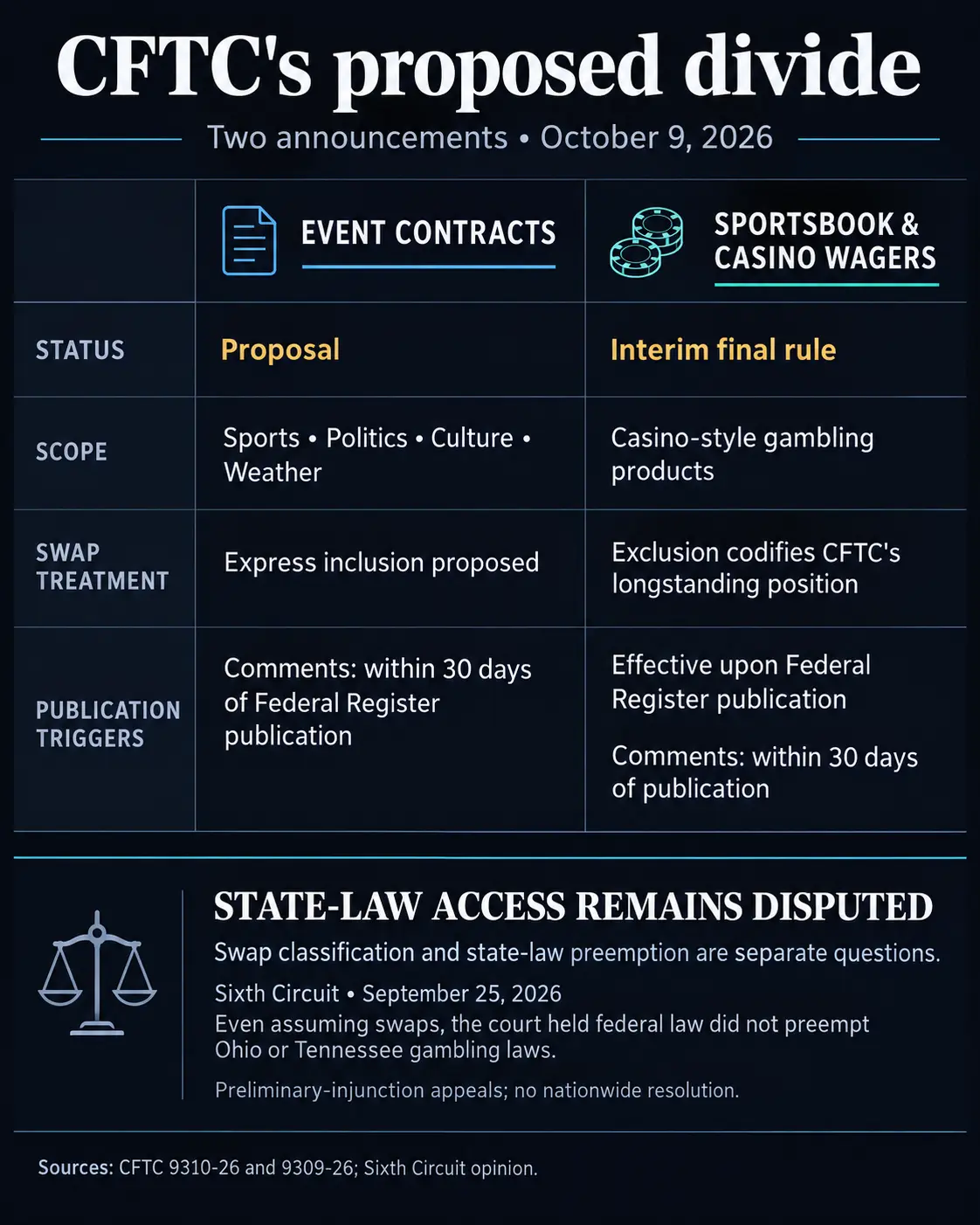
The Commodity Futures Trading Commission (CFTC) has taken a significant step to delineate the regulatory boundaries between prediction market contracts and traditional gambling activities. On October 9, the agency unveiled two distinct actions: a proposed rule that would expressly include sports and other event contracts within the definition of a swap, a type of financial derivative, and an interim final rule formalizing the exclusion of sportsbook and casino wagers from this classification. This bifurcated approach aims to clarify federal jurisdiction but leaves unresolved the contentious issue of state-level access and regulation for these evolving markets.
The proposed rule concerning event contracts, which covers outcomes related to sports, politics, cultural events, and even weather patterns, aims to bring these under the CFTC’s exclusive purview as defined by the Commodity Exchange Act. CFTC Chairman Michael S. Selig emphasized that these products, by their nature, fall within the agency’s mandate. Event contracts typically allow traders to acquire "yes" or "no" positions on future events, with a predetermined fixed payout, often set at $1. The value of these contracts fluctuates based on the likelihood of the event occurring, providing avenues for both risk hedging and speculative investment. This mechanism distinguishes them from the odds-based wagering commonly found in sportsbooks.
The distinction between these two types of financial instruments has been a point of contention. While prediction markets operate on the principle of aggregating collective wisdom to forecast outcomes, sportsbooks and casinos offer direct wagers on the probability of specific results. CryptoSlate’s reviews of platforms like Cloudbet Sportsbook, which focuses on odds-based betting, and Polymarket, a prominent prediction market, highlight this functional divergence.
The CFTC’s proposal for event contracts is currently open for public comment. Interested parties are invited to submit written feedback through Regulations.gov within 30 days of its official publication in the Federal Register. This period is crucial for stakeholders to voice their opinions on the proposed reclassification and its potential ramifications.
Concurrently, the CFTC announced a separate interim final rule specifically addressing casino-style gambling products. This rule formally codifies the agency’s long-standing position that wagers placed on sportsbooks and casino games do not qualify as swaps and therefore fall outside the CFTC’s regulatory scope. This exclusion is effective immediately upon publication in the Federal Register, though a 30-day comment period will also be provided for this rule. The exact dates of Federal Register publication for both announcements have not yet been specified, meaning the October 9 date does not establish the effective dates or comment deadlines for either action.
A History of Regulatory Ambiguity
The classification of event contracts has been a subject of debate and legal challenge for years. Prior to these recent actions, the regulatory landscape was somewhat fluid, leading to uncertainty for operators and investors alike. Platforms offering prediction markets often sought to differentiate their services from traditional gambling to avoid stringent state-level regulations.
The CFTC’s mandate under the Commodity Exchange Act grants it authority over "swaps" and "commodity futures." The definition of a swap is broad and includes agreements to exchange cash flows or liabilities based on the value of an underlying asset or index. For years, the question has been whether event contracts, which derive their value from the occurrence or non-occurrence of a specific event, fit this definition.

In 2018, the CFTC’s approach to prediction markets was tested when the National Futures Association (NFA) issued guidance on the matter. While the NFA did not explicitly ban prediction markets, its guidance emphasized that such contracts could be considered commodities if the underlying event was sufficiently speculative and if the contracts were traded on a registered exchange. This led some operators to register with the CFTC or pursue other regulatory pathways.
However, the distinction between a speculative financial contract and a wager remained blurry, especially when events with a high degree of predictability, such as sporting events, were involved. This ambiguity created a fertile ground for legal disputes, as seen in recent court cases.
The Sixth Circuit Ruling and its Implications
A pivotal moment in this regulatory saga came with a September 25 ruling by the Sixth Circuit Court of Appeals concerning preliminary injunction appeals related to Kalshi, a prediction market operator. The court determined that Kalshi’s sports-event contracts did not meet the statutory definition of a swap. Crucially, in an alternative holding, the court also ruled that even if the contracts were considered swaps, the Commodity Exchange Act did not preempt Ohio’s or Tennessee’s state gambling laws.
This dual finding is highly significant. It implies that even if an operator successfully argues that their event contracts fall under federal jurisdiction as swaps, it does not automatically grant them immunity from state gambling regulations. This presents a substantial hurdle for platforms aiming for nationwide operation. The court’s reasoning suggests that state laws governing gambling may continue to apply, creating a complex patchwork of regulations that operators must navigate.
The Sixth Circuit’s decision highlights a fundamental tension: the federal government’s authority over financial derivatives versus the states’ traditional role in regulating gambling. The court’s reluctance to find federal preemption in this instance underscores the principle that states retain significant power in areas traditionally within their domain, unless Congress has explicitly intended to override them.
Reactions and Criticisms
The CFTC’s recent actions have drawn attention and commentary from various stakeholders. While the agency aims to provide clarity, some critics argue that the proposed divide is artificial and fails to address the underlying nature of many event contracts.
Better Markets, an advocacy group focused on financial markets, expressed its concerns in an October 9 statement. Benjamin Schiffrin, the organization’s securities-policy director, argued that sports event contracts are fundamentally akin to sports betting and should therefore remain subject to state gambling laws. This viewpoint suggests that the CFTC’s classification of these contracts as financial derivatives might be a mischaracterization, potentially allowing them to operate in a regulatory gray area that circumvents established gambling oversight.
Schiffrin’s critique implies that the CFTC’s actions could inadvertently facilitate the expansion of gambling under the guise of financial trading. This perspective emphasizes the potential for consumer harm and the erosion of state-level consumer protection measures if these markets are not adequately regulated as gambling.

Broader Impact and Future Outlook
The CFTC’s dual-pronged approach has several significant implications for the financial markets and the broader gambling industry.
Firstly, it provides a clearer, albeit debated, framework for financial institutions and platforms considering involvement in prediction markets. By proposing to classify event contracts as swaps, the CFTC signals its intention to regulate these products under existing derivatives rules, which typically involve registration, reporting, and risk management requirements. This could lead to increased institutional interest and a more mature market for event-based financial instruments.
Secondly, the explicit exclusion of sportsbooks and casino wagers from the swap definition reinforces the existing regulatory landscape for traditional gambling. This means that these activities will continue to be governed primarily by state laws and licensing requirements, maintaining the status quo in that sector.
Thirdly, and perhaps most critically, the unresolved issue of state-law preemption remains a major point of contention. The Sixth Circuit’s ruling suggests that federal classification alone may not be sufficient to overcome state regulatory authority over gambling. This means that operators of prediction markets, even if classified as swaps by the CFTC, may still face legal challenges and restrictions in states with strict anti-gambling laws.
The future of prediction markets, especially those tied to sporting events, will likely depend on the interplay between federal regulatory pronouncements and ongoing state-level legal battles. The CFTC’s actions are a significant step toward defining its own role, but they do not definitively settle the question of how these markets will be accessed and regulated across the United States.
Further developments may include additional legal challenges, potential legislative action by Congress to clarify federal authority, or evolving interpretations of existing laws by state courts and regulatory bodies. The distinction the CFTC seeks to draw between financial derivatives and gambling products is complex, and its long-term implications will continue to unfold as the markets and their regulators adapt. The 30-day comment periods for both the proposed and interim final rules represent a critical window for shaping the regulatory future of these dynamic markets.