
 James Watt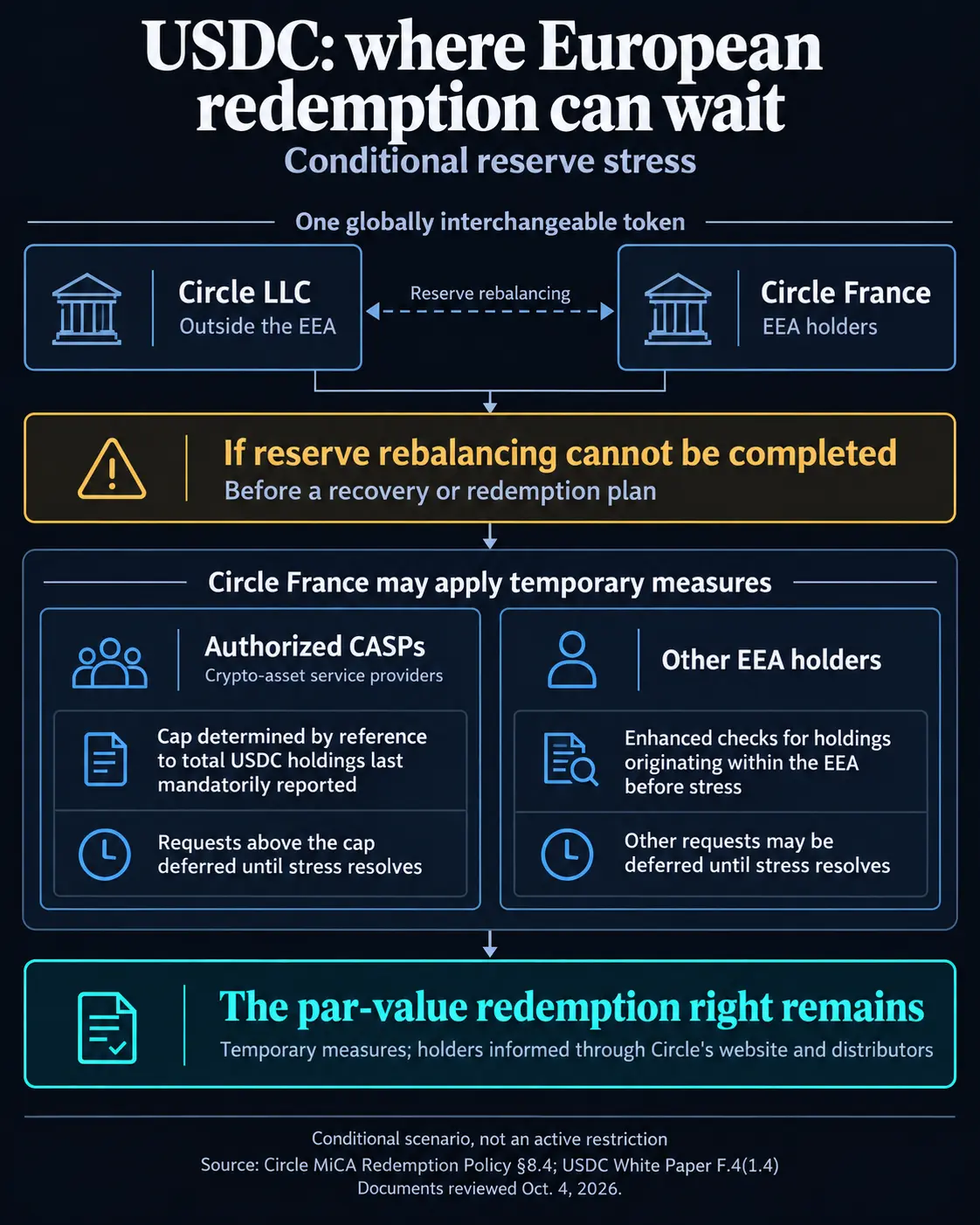
The promise of stablecoins rests on the seamless, near-instantaneous conversion of digital tokens into sovereign currency, yet the regulatory architecture governing these assets is beginning to reveal the physical and legal boundaries of global liquidity. For holders of USDC within the European Economic Area (EEA), the ability to exit into U.S. dollars is increasingly contingent on the operational "plumbing" between Circle’s French and American entities. While Circle maintains that its stablecoin is a worldwide, interchangeable asset, its current European redemption policy acknowledges a scenario where a "cash-access boundary" could manifest, potentially leaving European users in a queue during periods of financial or operational stress.
This structural nuance has become a focal point as Circle lobbies European regulators to maintain a "multi-issuer" model. In an October 1 response to the European Commission’s review of the Markets in Crypto-Assets (MiCA) regulation, Circle argued that allowing reserves to be co-issued and dynamically rebalanced across borders is essential for keeping global liquidity within Europe’s regulatory reach. However, the fine print of Circle’s current terms of service provides a blueprint for what occurs when those cross-border reserve transfers—the very mechanism Circle seeks to preserve—encounter friction.
The Mechanics of Multi-Issuer Contingencies
Under the MiCA framework, Circle operates in Europe through Circle Internet Financial Europe SAS, a French-licensed electronic money institution. This entity, referred to as Circle France, is the primary point of contact for USDC holders established within the EEA. Conversely, holders located outside of Europe continue to interact with Circle Internet Financial, LLC, the U.S.-based parent company. While the tokens are technologically identical on the blockchain, the legal claims to the underlying reserves are segmented by geography.
The core of the current policy concerns the "rebalancing" of reserves. To ensure that Circle France can meet redemption demands at par value, as mandated by Article 49 of MiCA, it must maintain a reserve of assets equivalent to the value of the USDC held by EEA users. Because USDC is a global pool of liquidity, tokens frequently move across the Atlantic. When a significant volume of USDC migrates from the U.S. market into the European market, Circle must move a corresponding amount of dollar-denominated reserves from its U.S. accounts to its French accounts to satisfy MiCA’s strict reserve requirements.
The "Stress Event" provision, detailed in Section 8.4 of Circle’s redemption policy, identifies the risk that this rebalancing might fail. A Stress Event is defined as a period where reserves cannot be moved between Circle France and Circle LLC, yet a formal Recovery or Redemption Plan has not yet been triggered. During such a window, Circle reserves the right to "adjust the processing and order of redemption requests," which explicitly includes the power to defer the execution of payments beyond standard operating timelines.
Differential Treatment: Providers vs. Retail Holders
The contingency measures outlined in the USDC white paper (specifically Section F.4) distinguish between different types of market participants, creating a tiered system for liquidity access during a reserve-transfer failure.
Authorized Crypto-Asset Service Providers (CASPs) and other professional intermediaries may face a redemption cap. This limit is based on their previously reported holdings, a move designed to prevent a "run" on the local French reserves by large-scale actors who may have recently acquired tokens from outside the EEA. By capping these providers, Circle aims to preserve its limited local liquidity for a broader base of users.
For other EEA holders, the restrictions take the form of "provenance checks." During a Stress Event, Circle may require holders to establish that their USDC was held within the EEA before the onset of the stress period. This suggests that tokens acquired on the secondary market during a crisis—perhaps at a discount from panicked sellers outside the region—might not be immediately redeemable for cash through the official issuer channel until the reserve rebalancing issues are resolved.
It is important to note that as of early October 2024, these documents represent precautionary legal disclosures rather than active restrictions. There is no evidence of an ongoing reserve-transfer failure. However, the existence of these terms qualifies the assumptions users can make about the speed of "on-demand" liquidity in a fragmented regulatory environment.
The Regulatory Tug-of-War: Circle vs. the ESRB
The friction between global liquidity and local oversight is not merely a corporate policy issue; it is a fundamental debate within European governance. Circle’s advocacy for dynamic rebalancing is a direct response to a more restrictive vision proposed by the European Systemic Risk Board (ESRB).
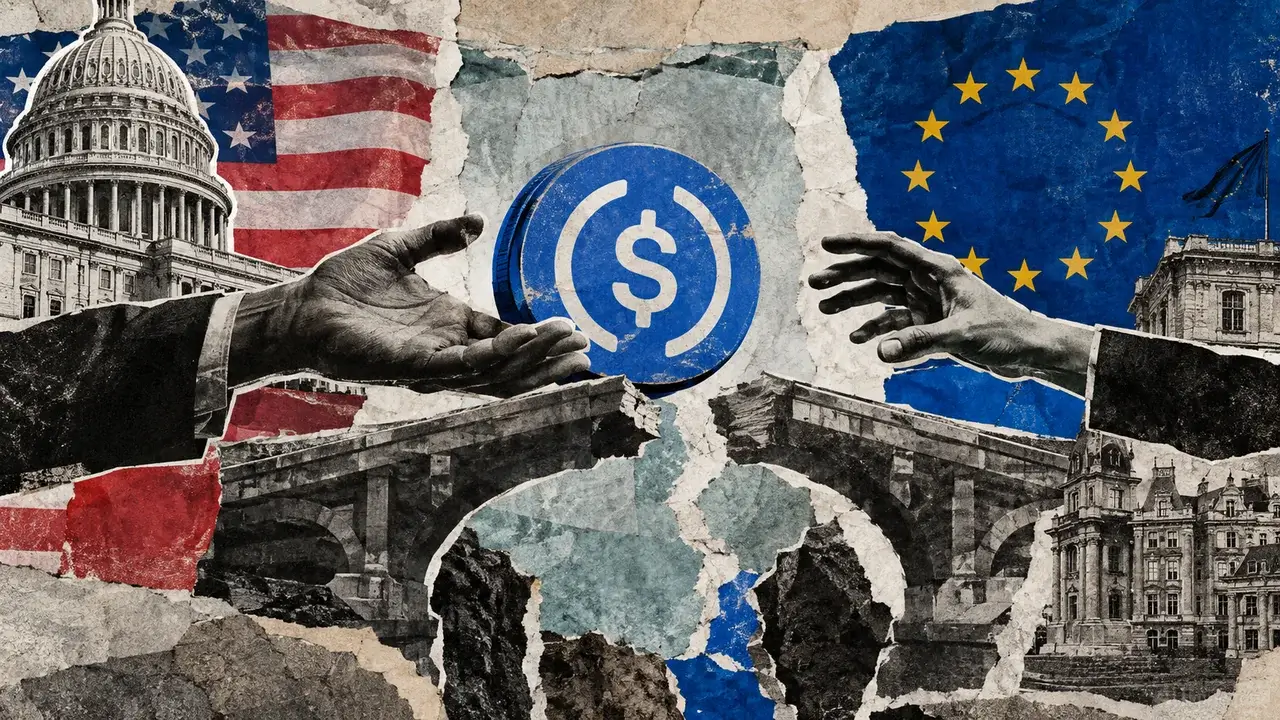
In a September 2025 recommendation regarding third-country multi-issuer stablecoins, the ESRB expressed skepticism toward the very structure Circle utilizes. The ESRB’s primary concern is "contagion." If a U.S.-based issuer faces a liquidity crisis or a regulatory freeze, the ESRB fears that a European subsidiary relying on that U.S. entity for reserve rebalancing would be pulled down with it. The board has urged the European Commission to interpret MiCA in a way that discourages or prohibits these multi-issuer schemes, favoring instead a model where European stablecoins are backed by reserves held entirely within the EU’s direct jurisdiction.
The ESRB’s recommendation called for a rigorous assessment of "barriers to reserve mobility." This includes examining whether supporting financial institutions can promptly sell assets, transfer funds across borders, and maintain access to payment systems like TARGET2 or the Federal Reserve’s Fedwire during a systemic crisis. Circle’s October 1 rebuttal argues that such a "fortress Europe" approach would backfire. By making it difficult for global stablecoins to operate legally within the EU, Circle contends that regulators would simply drive European users toward unregulated, offshore providers that offer no MiCA-level protections at all.
Secondary Markets and the Illusion of Instant Liquidity
For the average user, the delay in official issuer redemption might not be immediately apparent if secondary markets—such as centralized exchanges (CEXs) and decentralized protocols (DEXs)—continue to function. A holder seeking an immediate exit could sell their USDC for another asset or a different fiat currency on an exchange.
However, the Circle disclosures highlight a critical "conditional cash-flow" reality: in a Stress Event, the burden of liquidity shifts from the issuer to the intermediary. If an exchange allows a user to cash out instantly while Circle’s redemption window is deferred, that exchange is essentially using its own balance sheet to "bridge" the gap. The exchange takes on the timing risk, holding the USDC until Circle France is able to process the redemption.
If market stress is widespread, intermediaries may become unwilling or unable to provide this bridge. Without a guaranteed, immediate "put" to the issuer, the secondary market price of USDC within the EEA could deviate from its $1.00 peg, reflecting a "liquidity discount" for the time-value of the wait. Circle’s policy ensures that the claim remains at par value, but it does not guarantee the timing of the cash delivery, which is the essential component of a stablecoin’s utility in a crisis.
Timeline of Key Regulatory and Policy Milestones
To understand the current landscape, it is necessary to trace the evolution of USDC’s entry into the European regulatory fold:
- June 2023: The Markets in Crypto-Assets (MiCA) regulation officially enters into force, setting a countdown for stablecoin issuers to obtain licenses.
- July 2024: Circle becomes the first global stablecoin issuer to secure an Electronic Money Institution (EMI) license in France, positioning USDC as the leading compliant stablecoin in the EEA.
- September 2025: The European Systemic Risk Board (ESRB) issues its recommendation to the European Commission, questioning the safety of multi-issuer structures and cross-border reserve mobility.
- October 1, 2024 (and subsequent reviews): Circle submits formal responses to the European Commission, defending its co-issuance model as a pillar of European financial competitiveness.
- September 15, 2026: The date marked on Circle’s current MiCA redemption policy and USDC white paper amendments, indicating a long-term roadmap for these contingency provisions.
Broader Implications for the Stablecoin Ecosystem
The situation with USDC in Europe serves as a case study for the "trilemma" of stablecoin regulation: achieving safety, liquidity, and decentralization (or global reach) simultaneously. By complying with MiCA, Circle has opted for safety and legal clarity, but the cost of that compliance is the introduction of potential procedural delays that do not exist in the unregulated "Wild West" of the crypto market.
For institutional investors, these disclosures necessitate a more sophisticated approach to liquidity management. The assumption that USDC is a "cash equivalent" must now be tempered with an understanding of the specific legal entity holding the reserves. If an institution holds USDC through an EEA-based service provider, its risk profile is now explicitly linked to the operational success of the Circle France-Circle LLC rebalancing bridge.
Furthermore, this highlights a growing divergence in the stablecoin market. On one side are "regulated" tokens like USDC and Société Générale’s EUR CoinVertible, which offer legal recourse but are subject to the frictions of the banking system. On the other side are "offshore" tokens like Tether (USDT), which may offer higher immediate liquidity in certain contexts due to their lack of strict jurisdictional segmentation, but carry significantly higher opaque reserve and regulatory seizure risks.
Circle’s policy case ultimately rests on the idea that global liquidity is a net benefit to Europe. By keeping the "pipes" open to the U.S. dollar market, Circle believes it provides European businesses with better access to global trade and finance. However, as the ESRB’s stance suggests, European regulators remain wary of any system where the "off switch" or the "delay button" resides outside their borders. As MiCA continues to be refined, the resolution of this reserve-transfer debate will determine whether stablecoins can truly function as a seamless global currency or if they will remain tethered to the physical realities of the traditional financial system.









