
 James Watt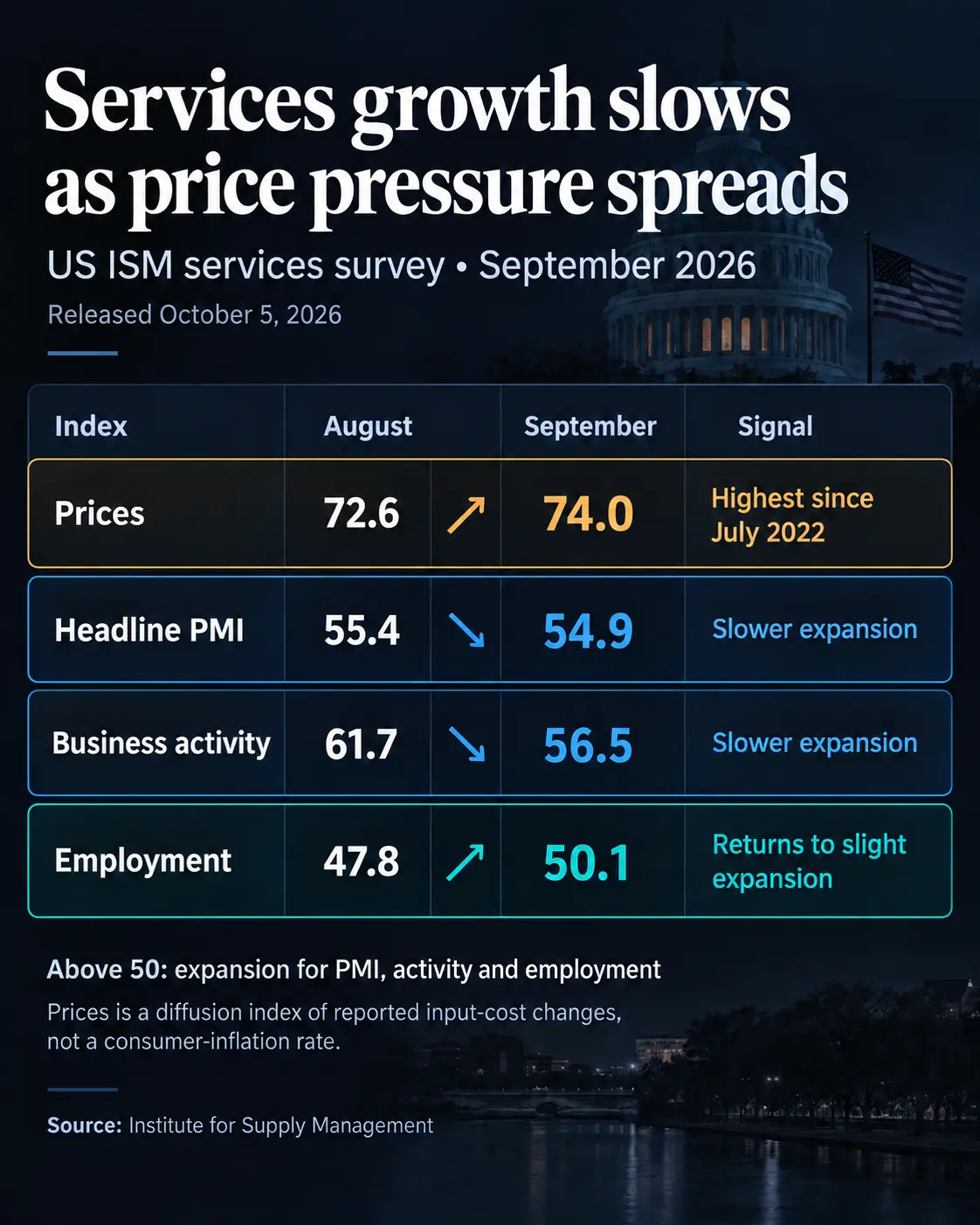
The United States services sector experienced a significant surge in input costs during September, with a key price index reaching its highest level in over four years. This development, occurring alongside a noticeable deceleration in overall sector growth, has introduced fresh complications for the Federal Reserve’s monetary policy trajectory and, by extension, the outlook for high-risk assets like Bitcoin. The Institute for Supply Management (ISM) released its monthly Services PMI report on October 5, revealing a complex economic landscape where inflationary pressures in the services industry remain stubbornly persistent despite a cooling in business activity.
For the digital asset market, particularly for investors maintaining leveraged Bitcoin positions, the data suggests that the "pivot" toward lower interest rates may be further off than previously anticipated. The persistent strength of service-side inflation provides the Federal Reserve with a compelling reason to maintain restrictive interest rates, keeping financing costs high for traders who rely on borrowed capital to amplify their market exposure.
Analysis of the ISM Services Report Data
The September ISM Services report is a critical barometer for the U.S. economy, as the services sector accounts for more than two-thirds of the nation’s Gross Domestic Product (GDP). The headline Services PMI (Purchasing Managers’ Index) registered a reading of 54.9 in September. While any reading above 50 indicates expansion, this figure represented a decline from August’s 55.4, signaling that while the sector is still growing, the pace of that growth is losing momentum.
The most striking component of the report was the Prices Index, which climbed to 74.0 from 72.6 in August. This marks the highest reading for the index since July 2022, when it reached 74.5 during the height of the post-pandemic inflationary surge. The Prices Index is a "diffusion index," meaning it measures the proportion of businesses reporting higher prices for inputs versus those reporting lower prices. A reading of 74.0 indicates that a vast majority of service providers—ranging from healthcare and finance to hospitality and logistics—are facing rising costs for the materials and labor required to operate.
Other key metrics within the report showed a divergence in economic health. The Business Activity Index dropped significantly to 56.5 from 61.7 in August, suggesting a sharp cooling in the volume of services being rendered. Conversely, the Employment Index moved back into expansion territory, rising to 50.1 from 47.8. This return to growth in hiring, while modest, suggests that the labor market remains tight enough to potentially fuel wage-based inflation, further complicating the Federal Reserve’s task.
Chronology of Economic Indicators and Policy Shifts
The current economic tension follows a series of aggressive policy maneuvers by the Federal Reserve aimed at taming inflation that peaked in mid-2022. To understand the significance of the September 74.0 price reading, it is necessary to look at the timeline of the last several years.
In early 2022, as inflation soared, the ISM Services Prices Index frequently hovered in the high 70s and low 80s. As the Fed began raising the federal funds rate from near-zero levels, these price pressures slowly abated throughout 2023 and 2024. By mid-2025, many analysts believed that inflation was firmly under control, leading to market expectations of a steady decline in interest rates throughout 2026.
However, the recent data suggests a reversal of that cooling trend. On October 1, just days before the ISM release, Federal Reserve Vice Chair Philip Jefferson signaled that the central bank remains on high alert. In a public address, Jefferson noted that inflation risks are still tilted to the upside. He confirmed that the Fed had recently implemented a quarter-point increase in the federal funds target range, bringing it to a restrictive 3.75%–4.00%. Jefferson emphasized that future adjustments would be strictly data-dependent, a stance that now looks increasingly hawkish in light of the 74.0 services price reading.
The Impact on Bitcoin and Crypto Market Liquidity
Bitcoin has historically been sensitive to changes in U.S. monetary policy. As a non-yielding asset, its "opportunity cost" increases when interest rates are high. Furthermore, Bitcoin is often viewed as a "liquidity barometer." When the Federal Reserve tightens the money supply or signals that rates will remain high, the surplus liquidity that often flows into the crypto markets tends to dry up.
Following the release of the ISM data, Bitcoin was trading near $85,580, reflecting a minor 24-hour decline of 0.04%. While the immediate price reaction was muted, the long-term implications for market structure are more profound. The primary concern for the cryptocurrency sector lies in "leveraged exposure." Many professional traders and hedge funds use margin and perpetual futures to take positions in Bitcoin. These instruments are directly or indirectly influenced by the broader interest rate environment.
When the Federal Reserve maintains a high policy rate, the cost of borrowing dollars—often used to fund "long" positions—remains elevated. If the ISM data prevents the Fed from cutting rates, these financing costs will continue to eat into the profit margins of crypto traders. In a scenario where price volatility increases, highly leveraged traders may find themselves unable to meet margin calls, leading to forced liquidations that can exacerbate downward price spirals.
The Commodity Futures Trading Commission (CFTC) has frequently warned about the risks inherent in margined virtual currency futures. The agency notes that because of the high leverage available in these markets, even a small movement against a trader’s position can result in the total loss of collateral. The persistence of high input costs in the services sector suggests that the "macro tailwind" of cheap money is unlikely to return in the immediate future.
Divergent Perspectives: Macro Data vs. Crypto Independence
Despite the clear link between interest rates and market liquidity, some analysts argue that Bitcoin is becoming increasingly decoupled from traditional macroeconomic indicators. A landmark study published by the Federal Reserve Bank of New York in February 2023 used intraday data to analyze Bitcoin’s reaction to various news events. The study concluded that, during the sample period, Bitcoin was largely disconnected from most monetary and macroeconomic news, behaving more as an independent speculative asset than a traditional currency or inflation hedge.
This perspective suggests that while the ISM Services report is a critical piece of the puzzle for the U.S. economy, its direct impact on Bitcoin’s price may be secondary to "crypto-native" factors. These factors include spot Bitcoin ETF inflows, the supply dynamics following the most recent halving events, and the growth of decentralized finance (DeFi) ecosystems.
However, the "funding risk" remains a tangible bridge between the two worlds. Coinbase’s documentation on perpetual futures highlights that funding rates—the periodic payments made between long and short traders—are designed to keep the price of the perpetual contract in line with the spot price. While these rates are determined by market demand within the crypto ecosystem, they are influenced by the broader availability of credit. If institutional investors face higher borrowing costs in the traditional banking system due to Fed policy, their willingness to provide liquidity to the crypto markets may diminish.

Broader Implications for the Global Economy
The rise in the services price gauge is not just a concern for Bitcoin traders; it signals a potential "stagflationary" environment for the broader U.S. economy. Stagflation occurs when economic growth slows down (as evidenced by the drop in Business Activity to 56.5) while inflation remains high (as evidenced by the 74.0 price index).
For the Federal Reserve, this is the "nightmare scenario." If the Fed cuts rates to stimulate the slowing business activity, it risks letting inflation spiral out of control. If it raises rates to combat the rising service costs, it risks pushing the economy into a recession. This uncertainty is precisely what the markets dislike. Uncertainty leads to higher volatility and a "risk-off" sentiment, where investors move away from volatile assets like Bitcoin and into "safe havens" like U.S. Treasury bonds or gold.
Industry reactions to the ISM report have been cautious. Supply chain managers in the services sector have reported that while some commodity prices have stabilized, labor costs and the cost of specialized services continue to climb. "We are seeing a persistent ‘stickiness’ in service pricing," noted one industry analyst. "Unlike manufactured goods, which can see rapid price drops when supply chains normalize, services are heavily dependent on wages and rent—two areas where prices are notoriously difficult to bring down."
Conclusion and Future Outlook
The 74.0 reading in the ISM Services Prices Index serves as a stark reminder that the battle against inflation in the United States is far from over. For Bitcoin, which has enjoyed a period of relative strength and price appreciation, the data introduces a layer of "macro-risk" that cannot be ignored.
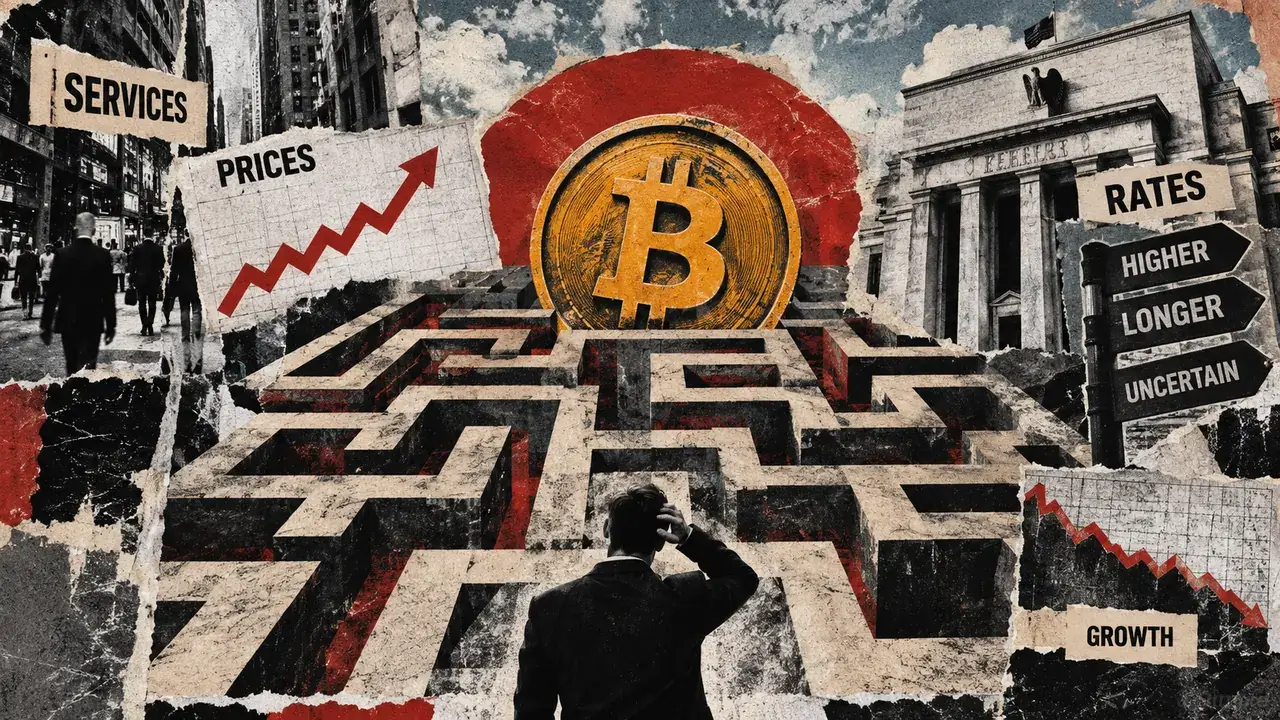
The path forward for Bitcoin will likely depend on whether it can maintain its narrative as a "digital gold" and a hedge against currency debasement, even in a high-interest-rate environment. If institutional adoption through ETFs continues to grow, it may provide a cushion against the liquidity drains caused by restrictive Fed policy. However, for the retail and speculative segments of the market that rely on leverage, the "maze" of rising prices and uncertain rate relief remains a formidable obstacle.
Investors will now look toward the next consumer price index (CPI) release and the subsequent Federal Open Market Committee (FOMC) meeting for further clarity. Until then, the high input costs in the services sector will continue to cast a shadow over the prospects for a more accommodative monetary environment, keeping the pressure on leveraged positions across the financial spectrum.









