
 James Watt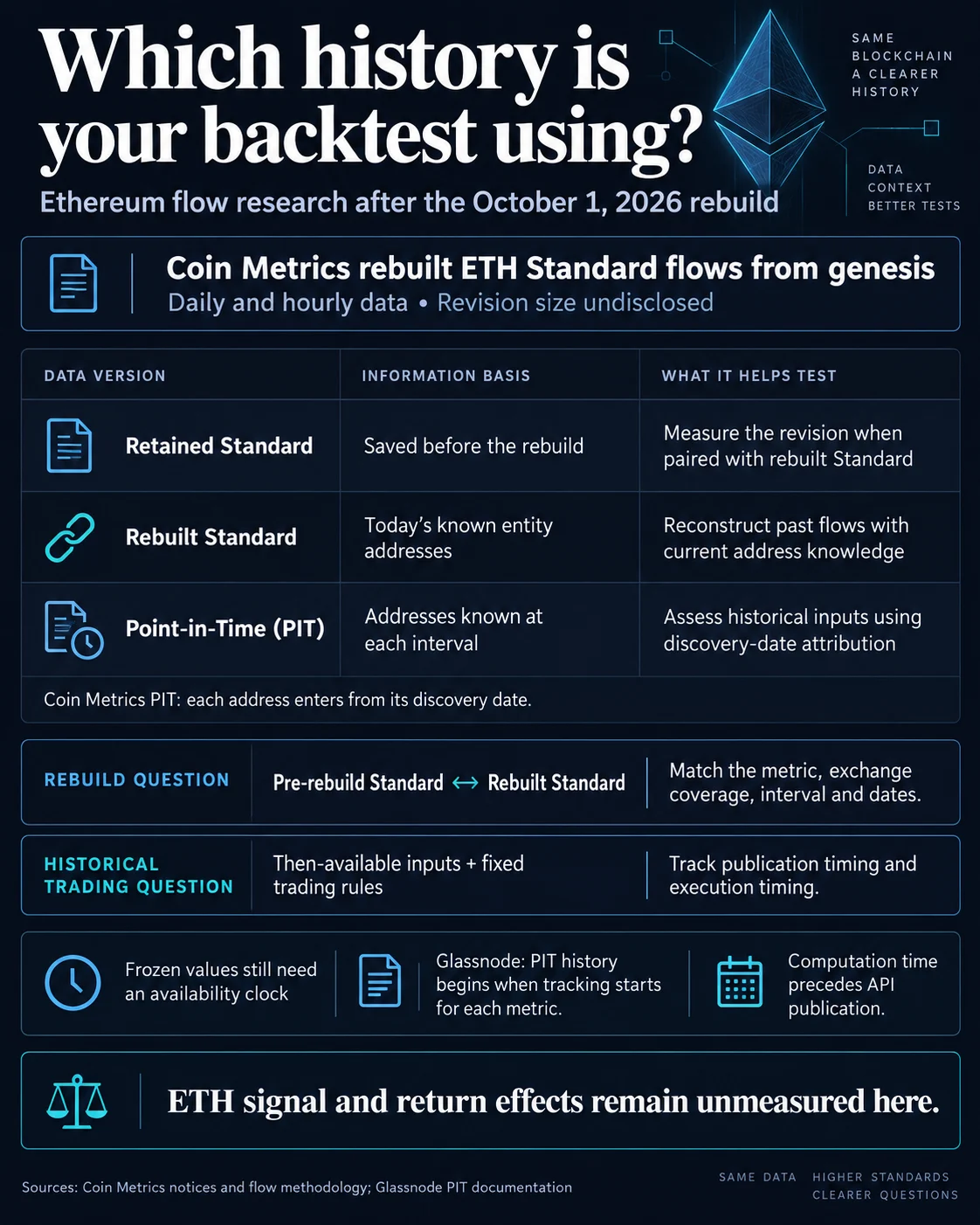
The digital asset data landscape underwent a significant structural shift on October 1, 2026, as Coin Metrics announced the successful completion of a comprehensive rebuild of its Ethereum Standard Flow Metrics. This retrospective recomputation, which spans from the network’s genesis block to the present day, introduces a fundamental challenge for quantitative researchers and institutional traders who rely on exchange outflow data as a primary trading signal. By updating historical records with contemporary knowledge of exchange-controlled addresses, the provider has highlighted a persistent risk in financial modeling: the discrepancy between data that is "true" in hindsight and data that was actually "available" at the moment a trade was executed.
The initiative was part of the provider’s broader Ethereum Point-in-Time (PIT) release, aimed at improving the precision of on-chain attribution. According to the official notice, the recomputation affected all ETH flow metrics at both daily and hourly frequencies. While the update provides a more accurate historical map of how Ether has moved between entities over the last decade, it simultaneously renders many existing backtests obsolete. For investment researchers, the distinction is not merely academic; it represents the difference between a strategy that appears profitable on a chart and one that could have actually been executed in a live market environment.
The Technical Mechanics of Historical Restatement
To understand why a rebuild of historical data is necessary, one must first examine the methodology of on-chain entity identification. Coin Metrics, like many of its peers, employs sophisticated clustering algorithms to identify which blockchain addresses belong to specific entities, such as Binance, Coinbase, or Kraken. These clusters are not static; as exchanges create new deposit addresses or move funds into new cold storage wallets, the map of the exchange’s "footprint" expands.
Under the "Standard Flow Metrics" framework, when a new address is identified as belonging to an exchange today, its entire transaction history is retroactively added to that exchange’s balance sheet. For a researcher looking at a chart of 2022 flows in 2026, this provides a "fuller" picture of reality. However, a trader sitting in 2022 would not have known that specific address belonged to an exchange. Consequently, a backtest using "Standard" metrics inadvertently incorporates "future" knowledge—a phenomenon known in quantitative finance as look-ahead bias.
The rebuild announced on October 1 ensures that the Standard metrics reflect the most up-to-date address library available. While this is beneficial for forensic analysis and long-term supply-side research, it creates a "data vintage" problem. Any backtest conducted using the previous version of the Standard metrics may now yield different results when run against the corrected history, even if the dates and the trading rules remain identical.
Chronology of the Ethereum Data Recomputation
The process of updating the Ethereum network’s historical flows was a multi-day technical operation that required significant coordination. On September 28, 2026, Coin Metrics first outlined the recomputation plan to its institutional clients. The goal was to maintain a clear distinction between Standard and Point-in-Time data sets, ensuring that the integration of the new Ethereum PIT metrics did not inadvertently corrupt the existing Standard data streams without proper versioning.
The provider initially targeted September 30 for the completion of the ETH data migration. However, given the massive volume of data associated with the Ethereum network—which includes millions of smart contract interactions and internal transactions—the final completion notice was not issued until October 1 at 17:04 UTC. This timing is critical for analysts: any data fetched via API prior to this timestamp represents a different "vintage" than data fetched afterward.
The immediate consequence for the market is a requirement for rigorous documentation of data provenance. Analysts must now identify which version of the ETH flow history was used in their models. Without this metadata, it becomes impossible to determine if a strategy’s performance is due to a genuine market edge or simply a byproduct of the data provider’s improved hindsight.
Point-in-Time vs. Standard Metrics: A Comparative Analysis
The introduction of Point-in-Time (PIT) metrics serves as the primary solution to the look-ahead bias inherent in Standard metrics. Coin Metrics’ PIT series functions on a "knowledge-at-the-time" basis. An address only contributes to an entity’s flow metrics from the moment it is discovered and verified by the provider. Subsequent discoveries do not result in the rewriting of earlier PIT intervals.
This creates two distinct narratives for the same historical date:

- The Standard Narrative: "Based on what we know in 2026, this is how much ETH moved out of exchanges in 2022."
- The PIT Narrative: "Based on what a trader could have known in 2022, this is how much ETH appeared to move out of exchanges."
The difference between these two can be stark. In many cases, exchange outflows are used as a proxy for "bullish" sentiment, under the assumption that users are moving coins to private storage to hold for the long term. However, if a large "outflow" was actually just an exchange moving funds to a new internal wallet that hadn’t been identified yet, a Standard metric would later "correct" that outflow to zero. A PIT metric, however, would preserve the "outflow" signal because that is what the market saw at the time.
Industry Precedents and the Glassnode Case Study
The challenges posed by data revisions are not unique to Coin Metrics. Other major providers, such as CryptoQuant and Glassnode, have also grappled with the tension between historical accuracy and backtesting integrity. CryptoQuant’s documentation for ETH Exchange Flows, for instance, explicitly warns users that their endpoints do not support PIT accuracy. They note that historical values may change as exchange wallets are discovered and validated through periodic clustering updates, which typically occur every Tuesday at 00:00 UTC.
Glassnode provided a high-profile illustration of this risk in a hypothetical backtest released on March 13, 2026. The study focused on Bitcoin (BTC) balances on Binance, using a simple moving average crossover strategy (a 5-day MA falling below a 14-day MA) to trigger market entries. The test, which ran from early 2024 through March 2026, demonstrated that using "Standard" (revised) data resulted in significantly better performance than using "Point-in-Time" data.
The Glassnode results suggested that the "signal" generated by exchange flows was often an artifact of retrospective address identification. When the "future" knowledge was removed, the trading rule’s returns diminished. This serves as a cautionary tale for Ethereum traders: the "edge" found in historical ETH outflows might vanish once the Coin Metrics rebuild is accounted for or once PIT data is applied.
Implications for Institutional Ethereum Research
The Ethereum network presents unique challenges for flow attribution compared to Bitcoin. Because Ethereum uses an account-based model rather than Bitcoin’s Unspent Transaction Output (UTXO) model, and because it supports complex smart contract logic, the "meaning" of a transfer is often obscured.
For institutional investors, the Coin Metrics rebuild necessitates a three-step verification process:
- Data Vintage Identification: Analysts must confirm whether their models are using the "pre-rebuild" or "post-rebuild" Standard data.
- Signal Sensitivity Testing: Researchers should run their trading rules against both the Standard and PIT datasets. If a strategy only works on Standard data, it is likely relying on look-ahead bias.
- Publication Delay Accounting: Even PIT data has a "computed_at" timestamp. A value might be "known" at 12:00 PM but not published to an API until 12:05 PM. A high-frequency backtest that "trades" at 12:01 PM using that data is still technically using information from the future.
Furthermore, the interpretation of an "outflow" itself requires more restraint. The crypto industry has long treated exchange outflows as a de facto "buy" signal, but as the Coin Metrics update proves, an outflow is simply a measurement of movement relative to known wallets. A claim that such movements represent profitable trading opportunities requires reproducible evidence that accounts for transaction costs, slippage, and, most importantly, data availability.
Conclusion: The Path Forward for On-Chain Alpha
The recomputation of Ethereum’s historical flows by Coin Metrics is a milestone in the maturation of crypto-asset data. It reflects a move toward the rigorous standards found in traditional equities and fixed-income markets, where "point-in-time" databases are the gold standard for quantitative research.
However, the immediate impact is a period of uncertainty for those who have built strategies on the shifting sands of mutable blockchain data. The decisive follow-up for any serious analyst will be the creation of a paired ETH dataset—one that separates "what happened" from "what was known."
As the industry moves forward, the focus will likely shift away from simple "exchange balance" charts and toward more nuanced metrics that incorporate the computed_at metadata. Only by acknowledging the "timing problem" can the crypto-research community move toward a truly scientific understanding of how on-chain movements influence market prices. For now, the message from the Oct. 1 rebuild is clear: in the world of crypto-data, the past is never quite as settled as it seems.









