James Watt
The CLARITY Act, designed to establish a permanent federal rulebook for cryptocurrency exchanges, brokers, dealers, and custodians, represents a departure from the "regulation-by-enforcement" model that has defined the U.S. crypto sector for years. By granting the Commodity Futures Trading Commission (CFTC) formal authority over the digital asset spot market, the bill seeks to provide the legal durability that market participants have long demanded.
The Stablecoin Yield Conflict and the Systemic Risk Argument
At the heart of the legislative deadlock was a fierce debate over whether crypto firms should be permitted to offer yield or rewards on stablecoin balances. Traditional banking institutions viewed this prospect as a direct threat to their deposit bases. The concern was not merely competitive but systemic; if digital asset platforms could offer higher yields on dollar-pegged assets than traditional savings accounts, the potential for a massive migration of capital was significant.
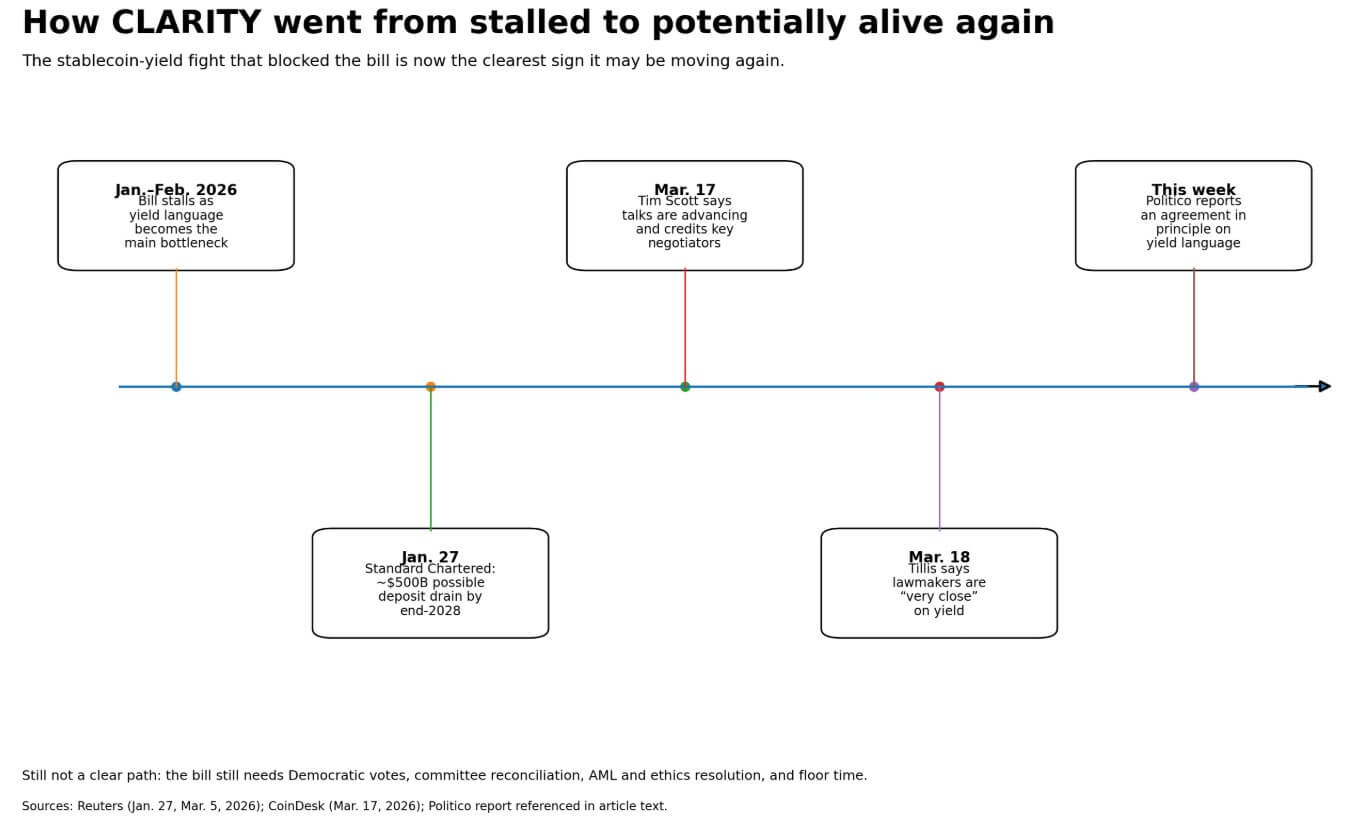
Analysis from Standard Chartered underscored these fears, estimating that yield-bearing stablecoins could drain approximately $500 billion from U.S. bank deposits by the end of 2028. This projection gave Senate opponents a credible argument centered on systemic financial stability. Critics argued that such a drain could weaken the lending capacity of regional and national banks, leading to a broader economic contraction.
The reported agreement in principle suggests a compromise that balances the innovation of the crypto sector with the stability of the traditional financial system. While the specific details of the yield language remain under wraps, the consensus among Senators Angela Alsobrooks and Thom Tillis, alongside White House adviser Patrick Witt, indicates that a middle ground has been found to mitigate the "poison pill" nature of the original rewards clause.

A Chronology of the CLARITY Act’s Stagnation
The journey of the CLARITY Act through the 119th Congress has been marked by periods of intense optimism followed by months of legislative inertia. Understanding the timeline is essential to grasping the weight of the current breakthrough:
- January 2026: The CLARITY Act gains initial momentum as bipartisan support builds for a market structure framework. Early optimism is reflected in significant Bitcoin ETP inflows, totaling $1.66 billion between January 12 and 14 alone.
- February 2026: Negotiations begin to sour as the banking lobby intensifies its opposition to the stablecoin-yield provisions. Standard Chartered releases its $500 billion deposit-drain warning, causing a shift in the Senate Banking Committee’s priorities.
- March 2026 (Early): Institutional analysts begin to adjust their forecasts. Citigroup lowers its 12-month Bitcoin target from $143,000 to $112,000, explicitly citing the narrowed window for regulatory catalysts due to stalled legislation.
- March 17, 2026: SEC Chair Paul Atkins emphasizes in public statements that agency guidance is merely a "bridge" and that only statutory law can provide the future-proof rulebook the industry requires. Senate Banking Chairman Tim Scott confirms that negotiations are advancing but remain delicate.
- March 18–20, 2026: Senator Thom Tillis signals that lawmakers are "very close" to a deal. Reports emerge that an agreement in principle has been reached with the White House, effectively unfreezing the bill.
Institutional Sentiment and the "Sizing Decision"
The impact of the CLARITY Act extends far beyond the technicalities of stablecoin interest. For major financial institutions, regulatory clarity is a prerequisite for "sizing decisions"—the process of determining how much capital to allocate to a specific asset class.
A comprehensive survey conducted by Coinbase and EY-Parthenon in March 2026, involving 351 institutional investors, highlighted the direct correlation between policy and participation. Among firms planning to increase their digital asset holdings within the year, 65% cited improved regulatory clarity as the primary driver. Conversely, 66% identified regulatory uncertainty as their chief concern, and 78% stated that market structure guardrails were the area most in need of legislative intervention.
The survey data suggests that the passage of the CLARITY Act could catalyze a significant shift in asset allocation. The share of institutional firms allocating more than 5% of their Assets Under Management (AUM) to digital assets is projected to rise from 18% to 29% by the end of the year, provided the legislative environment stabilizes. This transition from "cautious interest" to "active allocation" is what analysts believe will drive the next wave of Bitcoin demand.
Banking Perspectives: JPMorgan and Citigroup’s Forecasts
Wall Street’s largest banks have been tracking the progress of the CLARITY Act with high granularity, as the bill’s success or failure is now a primary variable in their valuation models.

JPMorgan analysts have framed the legislation as a second-half catalyst for 2026. Their research notes suggest that the passage of market structure rules would effectively end the era of regulation-by-enforcement, thereby promoting the tokenization of real-world assets and bringing greater institutional participation within reach. JPMorgan’s outlook posits that the market could see a "meaningful lift" in the latter half of the year if the bill clears the Senate by midyear.
Citigroup, while more conservative in its recent target revision, maintains a wide spread in its scenarios based on legislative outcomes. Their "bull case" for Bitcoin sits at $165,000, a figure predicated on a successful regulatory rollout. Their "recessionary bear case" of $58,000 reflects a scenario where legislative progress fails, leaving the market to grapple with macro headwinds and continued legal ambiguity. The $107,000 gap between these two figures is, in large part, the "regulation premium" the market is currently pricing.
The Role of the CFTC and SEC
One of the most consequential aspects of the CLARITY Act is the formalization of the CFTC’s role. For years, the digital asset industry has operated in a gray zone between the SEC’s focus on securities and the CFTC’s oversight of commodities. By handing the CFTC formal spot-market authority, the CLARITY Act provides a clearer path for Bitcoin, which is widely classified as a commodity.
SEC Chair Paul Atkins has been vocal about the limitations of his own agency. Atkins has noted that no amount of Commission-level guidance can replace the permanence of a federal statute. This admission has reinforced the market’s view that while the SEC can offer temporary bridges, the CLARITY Act is the ultimate destination for legal certainty.
Remaining Hurdles: Midterms and Ethics Disputes
Despite the breakthrough on stablecoin yields, the CLARITY Act still faces a gauntlet of political obstacles. To pass the Senate, the bill requires the support of at least seven Democrats, a task complicated by unresolved disputes over anti-money laundering (AML) demands. Furthermore, ethics concerns regarding elected officials profiting from crypto-related ventures continue to be a point of contention in committee markups.

The legislative calendar itself is a significant risk factor. As the U.S. moves closer to the midterm elections, the window for floor time in the Senate shrinks. Legislative priorities often shift toward populist issues or campaign-focused rhetoric, which could push the CLARITY Act into a "lame duck" session or indefinitely delay it.
Market Implications for Retail and Institutional Investors
For the average retail investor, the impact of the CLARITY Act may not be immediately visible in daily price candles. Unlike a sudden "halving" event or a spot ETF approval, the mechanism of legislative impact is structural and gradual.
The primary benefit of the bill is the reduction of friction. Greater institutional comfort leads to greater platform willingness to offer crypto products, which in turn leads to deeper liquidity and tighter spreads. As BlackRock has noted, Bitcoin’s trajectory in 2026 is increasingly tied to liquidity conditions and wealth-advisory adoption. The CLARITY Act provides the legal plumbing necessary for these conditions to flourish.
In the bull case, where the compromise holds and the bill moves through the Senate Banking Committee, the market is likely to assign higher odds to eventual passage. This "probability pricing" would support Bitcoin by validating the long-term institutional thesis. In the bear case, where ethics or AML disputes cause the deal to fray, the market would likely revert to trading based on macroeconomic indicators, such as interest rates and inflation data, rather than policy optimism.
Conclusion: The Strategic Shift in Washington
The reported agreement on the CLARITY Act’s yield language represents more than just a legislative tweak; it is a signal of a strategic shift in Washington. By addressing the systemic risk concerns of the banking sector while preserving the growth potential of digital assets, lawmakers are attempting to integrate crypto into the broader financial fabric of the United States.
Treasury Secretary Scott Bessent encapsulated this sentiment recently, stating that the CLARITY Act would provide "great comfort to the market." For an industry that has spent the better part of a decade in a defensive posture against regulatory uncertainty, that comfort could be the catalyst that transforms Bitcoin from a speculative asset into a foundational component of the modern institutional portfolio. As the bill moves toward a potential vote, the eyes of the global financial community remain fixed on the Senate floor, waiting to see if the deadlock has truly been broken.