Nila Kartika Wati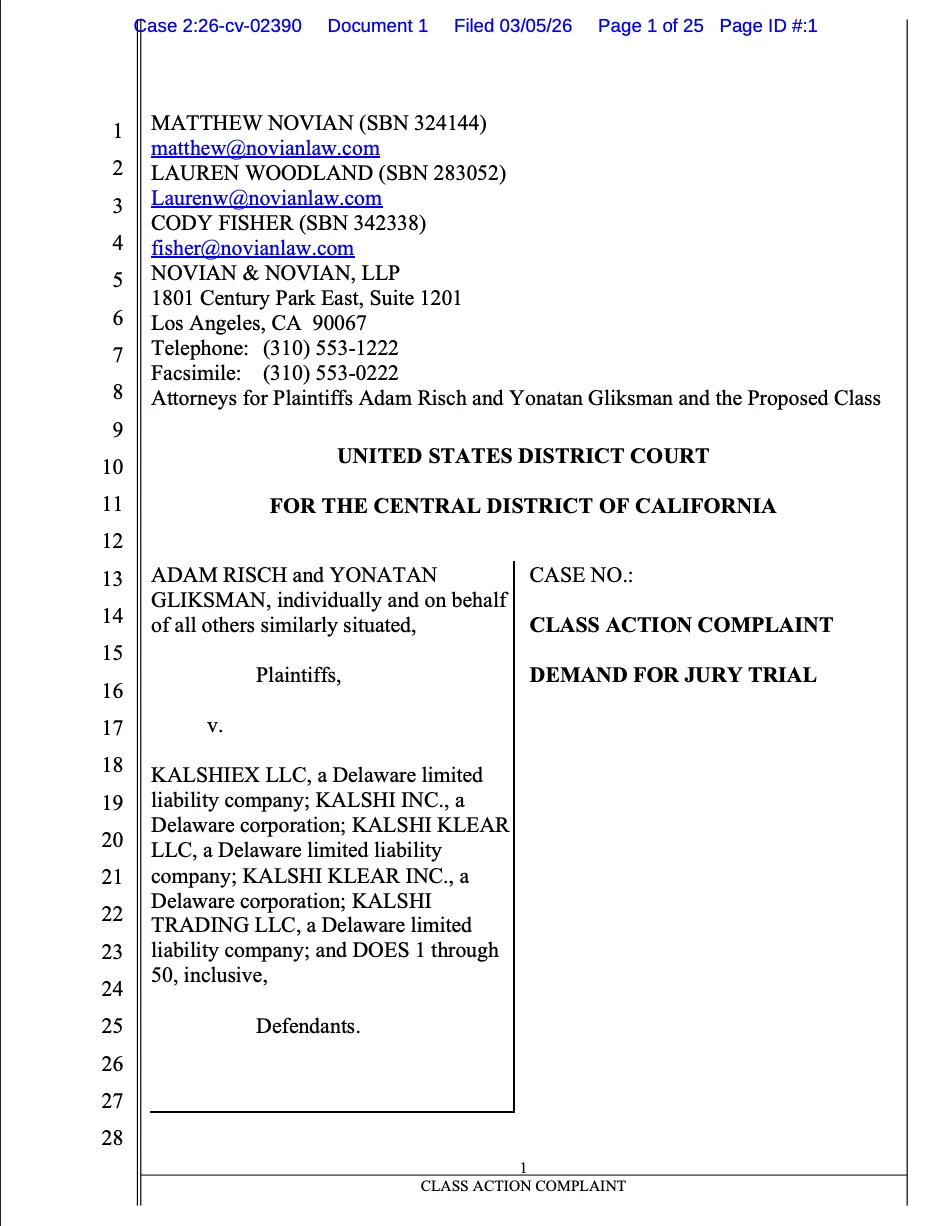
A significant class action lawsuit has been filed against Kalshi, a U.S.-regulated prediction market, asserting that the platform engaged in deceptive practices regarding a "death carveout" clause within its "Ali Khamenei out as Supreme Leader" market. The plaintiffs claim that this crucial policy was inadequately disclosed to users, leading to the wrongful voiding of winning trades and subsequent failure to pay out participants following the confirmed death of the former Iranian Supreme Leader. This legal challenge casts a spotlight on the intricacies of user agreements in novel financial instruments and the ethical considerations surrounding event-based trading.
The lawsuit, filed by plaintiffs Risch et al. against Kalshiex LLC, centers on the assertion that the "death carveout" was not integrated into the market’s user-facing rules summary in a manner that would inform a "reasonable consumer" of its existence or implications. According to the court filing, Kalshi itself later admitted that its prior disclosures were "grammatically ambiguous," a concession that the plaintiffs highlight as evidence of the alleged obfuscation. The core of the dispute lies in the nature of the "Ali Khamenei out as Supreme Leader" market. Participants in this market were essentially wagering on whether Ali Khamenei would cease to be Supreme Leader of Iran by a certain date. Given his advanced age and the volatile geopolitical climate surrounding Iran, plaintiffs argue that death was not merely a foreseeable outcome, but in many cases, the most probable mechanism for his departure from office.
The Allegations Unpacked: Deception and Unfair Practices
The legal challenge describes Kalshi’s carveout policy as "predatory" and an "unfair" business practice specifically for this particular market. The plaintiffs contend that Kalshi intentionally leveraged the ambiguity of its terms and conditions to avoid payouts. The lawsuit filing eloquently articulated this perspective: "With an American naval armada amassed on Iran’s doorstep and military conflict not merely foreseeable but widely anticipated, consumers understood that the most likely, and in many cases the only realistic, mechanism by which an 85-year-old autocratic leader would ‘leave office’ was through his death. Defendants understood this as well." This argument suggests that the market’s very design implicitly acknowledged the high probability of death as an outcome for the condition to be met, making the subsequent application of a death carveout disingenuous.
The plaintiffs’ case hinges on the principle of clear and unambiguous disclosure. In financial markets, especially those dealing with speculative instruments like prediction markets, transparency in rules and conditions is paramount for investor protection. The lawsuit alleges that Kalshi failed to meet this standard, thereby misleading users into participating in a market where a highly probable winning scenario was, in fact, nullified by an obscure clause. This perceived lack of clarity extends beyond the initial market rules to the subsequent reimbursement process, which also faced significant user backlash.
Kalshi’s Defense and the "Death Market" Stance
In response to the controversy and the burgeoning legal action, Kalshi co-founder Tarek Mansour has publicly defended the platform’s actions, reiterating that Kalshi maintains a strict policy against facilitating "death markets." Mansour stated, "We don’t list markets directly tied to death. When there are markets where potential outcomes involve death, we design the rules to prevent people from profiting from death." This ethical stance, he claims, is foundational to Kalshi’s operations and was, in his view, clearly communicated in the market rules. He also emphasized that Kalshi did not profit from the incident, stating, "Kalshi made no money here and even reimbursed all losses out of pocket. Not a single user walked away losing money from this market."
Mansour’s defense hinges on the idea that while Khamenei’s death was an event, the market was structured around his ousting as Supreme Leader, a distinction Kalshi believes is critical. The carveout, from Kalshi’s perspective, serves to uphold its ethical commitment. However, the plaintiffs argue that this distinction is semantic at best, particularly when an 85-year-old leader’s departure from power is overwhelmingly likely to be due to natural causes, especially in a context where other forms of ouster might be less probable.
A Chronology of Events and Controversy
The timeline of events leading to the lawsuit highlights the sequence of decisions that ignited user outrage and culminated in legal action.
- Market Creation: Kalshi launched the "Ali Khamenei out as Supreme Leader" prediction market, allowing users to bet on the duration of his tenure. Such markets are common in the prediction market space, reflecting public interest in political stability and leadership changes, particularly in geopolitically significant nations like Iran.
- Trading Activity: Users actively traded positions on this market, with many likely factoring in Khamenei’s age and health as key variables influencing the market’s resolution. The geopolitical tensions, as alluded to in the lawsuit, would have also played a role in traders’ calculations regarding potential "ousting" scenarios.
- Confirmation of Death: Following the widely reported and confirmed death of Ali Khamenei, speculation mounted among users regarding the market’s resolution. Traders who had bet on Khamenei’s departure naturally anticipated a payout.
- Kalshi’s Decision to Void Trades: Instead of resolving to "yes," Kalshi announced that it was voiding all trading positions in the market. This decision was based on its "death carveout" policy, which stipulates that markets will not resolve positively if the condition is met through the death of an individual. This immediately triggered widespread discontent among users who felt their winning trades were unjustly nullified.
- Initial User Pushback: Social media platforms and online forums quickly filled with complaints from users who felt blindsided by the carveout, arguing that it was not adequately disclosed and fundamentally altered the nature of their bets.
- Mansour’s Public Defense and Reimbursement Announcement: Amidst the growing backlash, Tarek Mansour publicly defended Kalshi’s policy, emphasizing its ethical underpinnings. Concurrently, Kalshi announced a reimbursement policy for affected users, calculated using the "last traded price" for the market before Khamenei’s death was confirmed.
- Further Reimbursement Controversy: Even the reimbursement policy, intended to mitigate losses, drew significant pushback. Plaintiffs in the lawsuit specifically argue that the methodology and precise timestamps used to calculate the "last traded price" were neither disclosed nor transparent, leading to further distrust and accusations of opacity. Users claimed that the reimbursement amounts did not reflect the true value of their positions at the point of market closure or what they would have received had the market resolved fairly.
- Class Action Lawsuit Filed: The cumulative dissatisfaction and perceived injustice ultimately led to the filing of the class action lawsuit, seeking damages and clarity on Kalshi’s operational practices.
Broader Context: The Rise of Prediction Markets and Regulatory Scrutiny

This incident occurs against a backdrop of surging trading volumes on prediction markets, which have reportedly hit new record highs in recent years. Platforms like Kalshi, Polymarket, and others have gained considerable popularity as venues for betting on real-world events, ranging from political outcomes and economic indicators to scientific discoveries and pop culture occurrences.
Kalshi distinguishes itself by being regulated by the U.S. Commodity Futures Trading Commission (CFTC) as a designated contract market, granting it a unique position in the often-unregulated prediction market landscape. This regulatory status is typically seen as a mark of legitimacy and consumer protection, implying a higher standard of disclosure and fair practice. The lawsuit, therefore, not only challenges Kalshi’s specific actions but also raises questions about the efficacy of regulatory oversight in these innovative markets.
The ethical dimension of "death markets" is a long-standing debate within the industry. While some argue that all information is fair game for prediction, others contend that betting on human mortality crosses an ethical line, potentially incentivizing malicious behavior or simply being morbid. Kalshi’s stated policy against death markets attempts to navigate this ethical minefield, but the current lawsuit suggests that the implementation of this policy may have inadvertently created its own set of problems, particularly when the event in question (a leader leaving office) is inherently intertwined with the possibility of death.
The Geopolitical Undercurrents of the Khamenei Market
The specific market concerning Ali Khamenei, the Supreme Leader of Iran, also carries significant geopolitical weight. Khamenei, who succeeded Ayatollah Ruhollah Khomeini in 1989, has been a central figure in Iranian politics for decades, overseeing a period marked by profound domestic and international challenges. His health has been a recurring subject of speculation, with rumors occasionally surfacing about his deteriorating condition. Given Iran’s regional influence, its nuclear program, and its complex relationship with Western powers, the question of Khamenei’s succession has long been a sensitive and highly anticipated event.
The plaintiffs’ reference to an "American naval armada amassed on Iran’s doorstep" underscores the high-stakes environment in which this market operated. This context suggests that users might have perceived a higher likelihood of an "ousting" through external pressure or internal political upheaval, but simultaneously, recognized that a natural death for an octogenarian leader was equally, if not more, probable. The lawsuit effectively argues that Kalshi cannot claim ignorance of these widely understood realities when designing and offering such a market.

Legal Ramifications and Industry Impact
The class action lawsuit against Kalshi carries significant potential ramifications, both for the platform itself and for the broader prediction market industry. For Kalshi, a negative outcome could result in substantial financial penalties, including potential payouts to all affected users and legal fees. More importantly, it could severely damage its reputation as a trusted and regulated prediction market, potentially impacting user adoption and future growth. The claim of "deceptive" practices, if proven, could also attract further scrutiny from the CFTC, potentially leading to regulatory sanctions or demands for stricter compliance measures.
For the wider prediction market industry, this case could serve as a critical precedent. It highlights the absolute necessity of crystal-clear terms and conditions, especially for complex or sensitive events. Platforms may be forced to review their user agreements, improve the visibility of crucial carveouts, and ensure that their market designs do not inadvertently mislead participants. The case could also reignite debates about the scope of regulatory oversight for prediction markets and whether existing frameworks are sufficient to protect consumers engaging in these novel forms of financial speculation. It might also encourage other platforms to more explicitly address the ethical considerations of "death markets" and similar sensitive topics in their market rules.
The ongoing legal battle between Kalshi and its users represents a pivotal moment for the prediction market industry. It underscores the challenges of balancing innovation with consumer protection and the critical importance of transparency in an evolving financial landscape. As the legal proceedings unfold, the industry will be watching closely to see how courts interpret the duties of prediction market platforms to their users and what standards of disclosure will ultimately be upheld. The outcome will likely shape how future prediction markets are designed, regulated, and perceived by the public.