admin
admin
CleanSpark, a prominent player in Bitcoin mining and data center development, has inked a significant 20-year triple-net lease for 175 megawatts (MW) of critical IT load at its Sandersville, Georgia, campus. This strategic agreement, formalized on July 10, 2026, and disclosed via a Form 8-K filing on July 14, positions the company to generate substantial long-term revenue. The initial term of the lease is projected to have a contract value of $6.6 billion, with an estimated annual net operating income (NOI) contribution of approximately $330 million. However, this ambitious expansion is shadowed by a formidable financing hurdle: CleanSpark must secure an estimated $1.75 billion to $2.10 billion to fund the construction of the data center itself.
The Magnitude of the Sandersville Deal
The newly announced lease agreement is a cornerstone for CleanSpark’s future growth, particularly in the burgeoning field of AI infrastructure. The Sandersville campus, a key asset for the company, will host 175 MW of capacity under a long-term commitment. This triple-net lease structure typically means the tenant assumes responsibility for operating expenses, taxes, and insurance, providing a stable revenue stream for the landlord, CleanSpark.
The projected contract value of $6.6 billion over the initial 20-year term underscores the long-term financial commitment from the undisclosed tenant. Furthermore, the lease includes two optional five-year extensions, which, if exercised, could potentially escalate the total contract value to an impressive $11.6 billion. This extended revenue visibility is a crucial factor for CleanSpark as it navigates the capital-intensive nature of data center development. The company’s projection of an average annual NOI of $330 million highlights the significant profitability anticipated from this operation, assuming full build-out and occupancy.
The Staggering Construction Cost
While the lease agreement provides a robust revenue framework, the operational reality of building the data center presents a significant financial challenge. CleanSpark’s internal estimates place the landlord’s project costs between $10 million and $12 million per megawatt. For the 175 MW capacity secured by the lease, this translates into a total estimated build cost ranging from $1.75 billion to $2.10 billion.
This colossal figure dwarfs CleanSpark’s current financial resources. As of March 31, 2026, the company reported $260.3 million in cash. Additionally, it holds a "HODL value" of Bitcoin, a metric defined by the company to include current and non-current Bitcoin, as well as Bitcoin held under collateral arrangements, valued at $925.2 million. Even when these two figures are combined, their sum of approximately $1.18 billion falls significantly short of the required construction capital. The stark reality is that the estimated build cost is roughly 1.9 to 2.3 times the company’s reported Bitcoin holdings and approximately 6.7 to 8.1 times its available cash.
Unveiling the Tenant and Financing Ambiguities
A key aspect of the announcement is the identity of the tenant, which has been kept confidential. CleanSpark has described the counterparty as a "high-investment-grade global technology company." This designation is crucial, as it is intended to facilitate access to financing for the substantial project costs. The tenant’s strong credit profile is expected to provide lenders with a degree of confidence in the long-term viability of the lease payments, forming the basis for potential project financing.
However, the initial lease announcement, released on July 10, 2026, is conspicuously silent on several critical details pertaining to the financing. There is no mention of a specific lender, a committed financing amount, the pricing of any debt, the sponsor equity contribution from the tenant, or a clear draw schedule for the construction funds. This lack of transparency surrounding the financing arrangements leaves many questions unanswered regarding the immediate path to securing the necessary capital.
The phased delivery of the data center is anticipated to commence in the fourth quarter of 2027. The exact schedules for full delivery and the commencement of rent payments remain undisclosed. The structure of the eventual financing package will be pivotal. It will dictate whether the project is primarily funded against the lease itself, or if CleanSpark will be compelled to assume more leverage, dilute its existing shareholders through equity issuance, or expose its Bitcoin reserves to further collateral risk.
Understanding the "Triple-Net" Lease Nuance
It is important to clarify the implications of the "triple-net lease" designation in this context. While this lease structure typically shifts financial responsibilities to the tenant, the wording in CleanSpark’s SEC filing indicates that the tenant will bear specific costs, charges, indemnities, and expenses as outlined in the lease. Crucially, this does not automatically absolve CleanSpark of the responsibility for the initial construction and development of the project. The company’s own estimation of landlord project costs directly addresses this: the $10 million to $12 million per MW figure points to CleanSpark’s role in undertaking the substantial build-out.
Financial Snapshot: A Picture of Constraints
A deeper dive into CleanSpark’s financial position as of March 31, 2026, highlights the scale of the funding challenge. The company reported $260.3 million in cash and $925.2 million in HODL value. In addition, its long-term debt stood at $1.788 billion, with total liabilities reaching $1.927 billion.
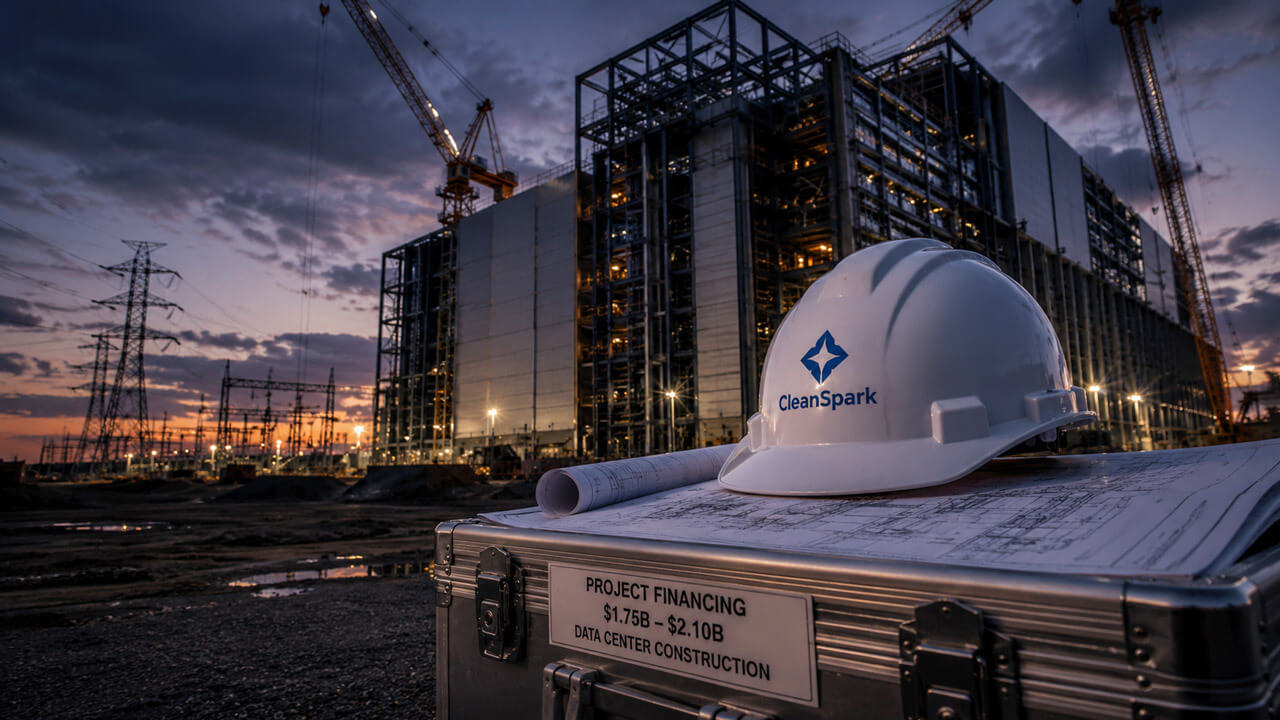
The estimated Sandersville construction cost represents a significant multiple of the company’s readily available cash. It also represents a substantial portion, potentially exceeding 100%, of its long-term debt. This juxtaposition underscores that CleanSpark cannot self-fund this project through its current cash reserves or by significantly increasing its existing debt burden without a fundamental shift in its financial strategy or external capital infusion.
Furthermore, CleanSpark’s reported net loss for the fiscal second quarter ended March 31, 2026, was $378.3 million. This loss was significantly impacted by non-cash accounting charges, including a $224.1 million Bitcoin fair-value loss and a $38.8 million loss on Bitcoin collateral. While these figures reflect market volatility and accounting conventions, they also illustrate the potential for significant fluctuations in the company’s reported financial performance, making its net loss a less reliable indicator of its quarterly cash burn.
Navigating the Funding Pathways and Risk Allocation
The path forward for financing the Sandersville data center involves several potential strategies, each with distinct implications for risk distribution:
-
Project Financing Backed by the Lease: A primary scenario involves securing project-specific financing, leveraging the strong credit profile of the tenant and the long-term nature of the lease. Lenders may underwrite construction loans based on the contractual cash flows guaranteed by the tenant. However, the specifics of such financing—including the extent of sponsor guarantees, corporate recourse obligations, the requirement for Bitcoin collateral, or substantial equity contributions from the tenant—will determine how much residual risk is borne by CleanSpark and its shareholders.
-
Corporate Balance Sheet Funding: Alternatively, CleanSpark could attempt to fund the project through its corporate balance sheet. This approach carries significant risks:
- Increased Leverage: Taking on substantial new corporate debt would further elevate its already high leverage, which stood at nearly $1.8 billion in long-term debt as of March 31.
- Shareholder Dilution: Issuing new common equity or convertible securities to raise capital would dilute the ownership stake of existing shareholders.
- Reduced Bitcoin Exposure: Selling portions of its Bitcoin treasury to fund the project would diminish its exposure to potential upside in cryptocurrency markets and reduce its perceived liquid asset base.
- Bitcoin-Backed Borrowing: While this could preserve nominal Bitcoin ownership, it introduces additional risks associated with collateral requirements, margin calls, and potential liquidation if the value of the collateralized Bitcoin declines.
CleanSpark’s existing financial instruments, such as its $1.769 billion net carrying balance for zero-coupon convertible notes and $400 million in undrawn Bitcoin-backed credit lines, provide context for its current debt structure and potential borrowing capacity. The company’s prior use of convertible notes for financing, as covered in previous reporting, and the model of AI data center landlords like Hut 8, which combine project debt with Bitcoin-backed bridge capital, offer precedents for potential financing structures. However, the precise capital arrangement for Sandersville remains an open question.
Conditional Value and Execution Milestones
The headline contract value of $6.6 billion, while substantial, is not guaranteed. The lease agreement is intrinsically linked to CleanSpark’s ability to execute on several critical fronts. The SEC filing explicitly states that the company must meet specified financing, construction, and delivery milestones, alongside other covenants and conditions. Failure to meet these benchmarks could lead to significant consequences, including rent abatements—reductions in the lease payments—or even outright termination of the agreement. This contractual framework places considerable onus on CleanSpark to deliver the project on time and to the agreed-upon specifications.
The Timeline Factor
The phased delivery of the 175 MW facility is slated to begin in the fourth quarter of 2027. The exact timeline for the full build-out, the commencement dates for rent payments for each phase, and whether the projected average annual NOI of $330 million assumes a fully operational campus from the outset, are all critical, yet undisclosed, details. Assuming this NOI figure is a run-rate from the initial phase commencement in Q4 2027 would likely overstate the immediate revenue generation.
A Broader Strategic Context
The Sandersville deal represents a significant advancement for CleanSpark, moving beyond mere pitches for AI infrastructure to securing contracted execution. This is a crucial step in validating its business model in the increasingly competitive data center market. The company also has a separate letter of intent and exclusivity agreement with the same tenant covering its 718-acre Texas portfolio, potentially encompassing up to 885 MW of secured and planned power capacity. However, this Texas arrangement is not yet a completed lease, unlike the Sandersville agreement.
The ultimate success of the Sandersville project and the financial burden it places on CleanSpark will hinge on the undisclosed financing terms. The path to Q4 2027 and beyond will reveal the true distribution of risk: whether it falls primarily on CleanSpark’s Bitcoin holdings, its corporate balance sheet, or its shareholders. The company’s ability to secure favorable and sustainable financing for this monumental build will be a defining factor in its trajectory within the rapidly evolving AI and data center landscape. The market will be watching closely for further disclosures that illuminate the specific financial instruments and risk-sharing mechanisms that will underpin this ambitious undertaking.