admin
admin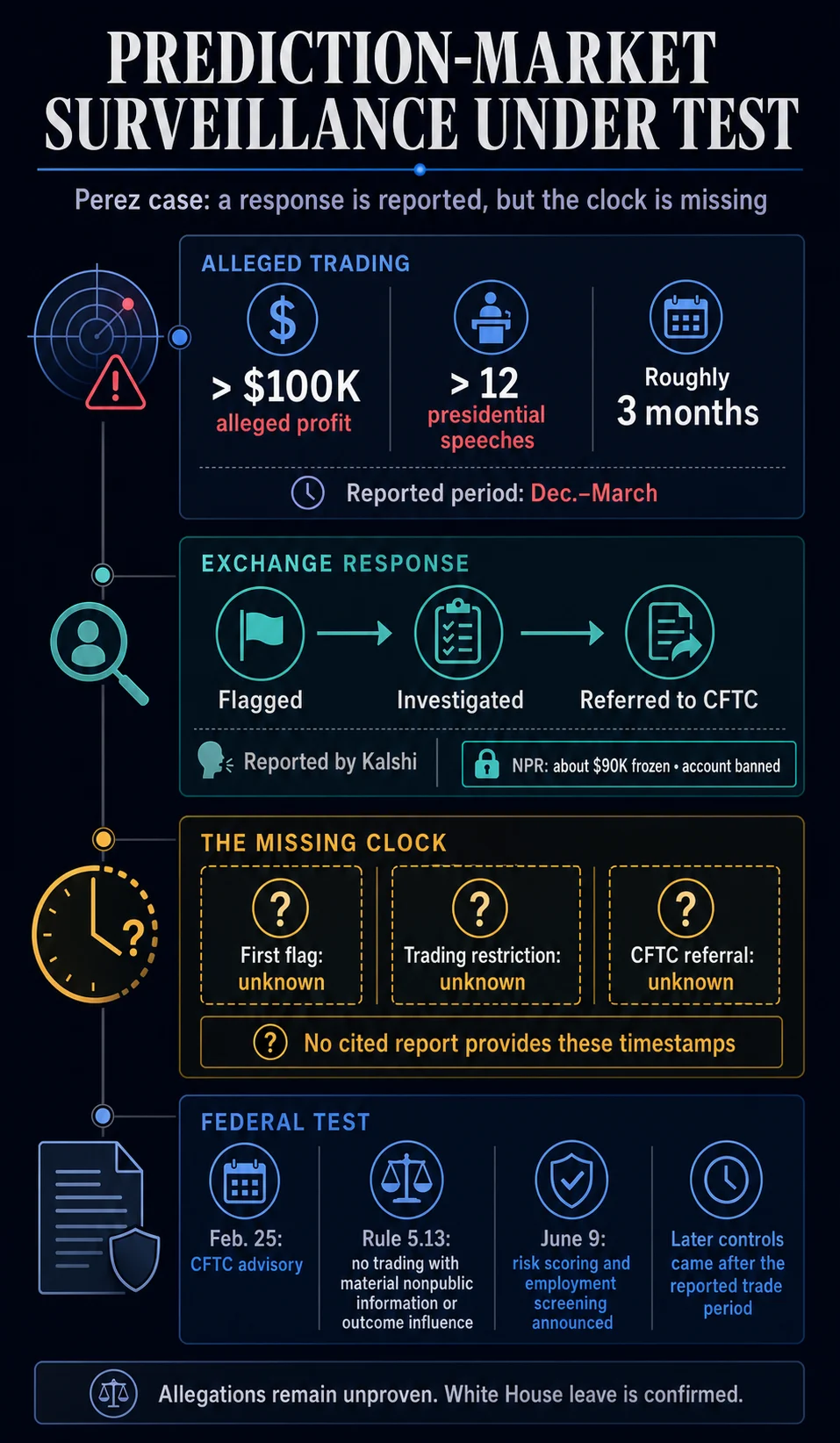
The White House has placed Gabriel Perez, a long-serving teleprompter operator for President Donald Trump, on unpaid administrative leave following ABC News reports alleging he leveraged advance access to the President’s prepared remarks to amass over $100,000 through trading on the Kalshi exchange. The allegations suggest a sophisticated scheme where insider information regarding upcoming presidential speeches was allegedly exploited for financial gain on a platform designed for event-based contracts.
Sources speaking to ABC News indicated that the alleged trading activity spanned more than a dozen speeches over an approximate three-month period. The report further states that Perez is reportedly engaged in discussions with the Commodity Futures Trading Commission (CFTC) regarding a potential settlement. The CFTC, when approached for comment, declined to provide any statement on the matter.
Kalshi, the exchange where the alleged trades took place, issued a statement asserting that its internal surveillance team promptly identified, investigated, and subsequently referred the suspicious trades to the CFTC. Separately, NPR reported, citing unnamed sources, that the exchange had frozen approximately $90,000 of Perez’s funds and implemented a ban on his participation on the platform.
The Timeline of Detection: A Critical Missing Piece
While Kalshi’s internal systems appear to have successfully detected unusual activity, initiated an investigation, and alerted federal regulators, a crucial element remains conspicuously absent from public reporting: the precise timing of these actions. News outlets, including ABC News, The Associated Press, and NPR, have failed to provide specific dates or even approximate timelines for when Kalshi first flagged Perez’s account, when trading restrictions were imposed, or when the referral to the CFTC occurred in relation to the alleged series of over a dozen speeches.
This lack of precise timestamps renders it impossible to definitively ascertain whether Kalshi acted to restrict Perez’s account before any further alleged trading activity took place. The ability to establish this chronology is vital for understanding the efficacy of Kalshi’s surveillance mechanisms and the extent to which they may have mitigated further potential illicit gains. Without this information, the narrative remains incomplete, leaving open questions about the speed and effectiveness of the exchange’s response.
Regulatory Framework and Kalshi’s Obligations
The legal and regulatory framework governing such activities is well-established, although its application to the specific circumstances of the Perez allegations has not yet been publicly detailed. A CFTC advisory issued in February 2026 explicitly stated that the misappropriation of confidential information, in breach of a fiduciary duty, can constitute a violation of Section 6(c)(1) of the Commodity Exchange Act and Regulation 180.1. This regulation broadly prohibits manipulative or deceptive devices and contrivances in connection with the purchase or sale of commodity futures or options.
Furthermore, the advisory emphasized the independent duty of designated contract markets, such as Kalshi, to maintain comprehensive audit trails, conduct robust surveillance of trading activity, and enforce their own established rules. Kalshi’s own rulebook contains provisions that explicitly bar members who possess material nonpublic information or exert influence over an outcome from trading the relevant contract. It also mandates that unusual trading activity be meticulously reviewed and, where deemed appropriate, thoroughly investigated.
Precedent and Escalating Concerns in Prediction Markets
The allegations surrounding Gabriel Perez are not isolated incidents but appear to reflect an escalating pattern of concern within the prediction market landscape. The CFTC has previously issued broader warnings regarding the integrity of these markets, and a separate case involving a Special Forces soldier and the Polymarket exchange, which CryptoSlate covered earlier in 2026, highlighted similar issues of alleged insider trading.
What distinguishes the Perez allegations is the alleged source of the insider information – direct access to White House speeches – and the fact that the trades were executed on a federally regulated exchange’s mention markets. These markets allow for trading on the outcome of specific events, such as political speeches, which can influence market sentiment and asset prices.
The Broader Ecosystem: Information Velocity and Market Access
The timing of these revelations also coincides with a significant development in the broader ecosystem surrounding President Trump’s public communications. Trump Media announced on July 16, 2026, the launch of Truth API, a premium data feed designed to deliver posts from Truth Social’s most influential accounts, including President Trump himself, to institutional clients with millisecond-level latency. Scheduled to commence operations on August 1, 2026, the service is explicitly targeted at high-frequency and algorithmic trading firms for whom even the slightest delay in information can translate into substantial financial implications.
While the Truth API focuses on providing faster access to publicly disseminated information after its release, rather than advance knowledge of nonpublic remarks, both developments underscore a critical trend: the emergence of adjacent markets built around the velocity and access to President Trump’s potentially market-moving statements. The core commodity, in both instances, is receiving information before slower-reacting market participants.

Kalshi had announced new market integrity measures on June 9, 2026, which included the implementation of market risk scores and enhanced employment verification protocols for users seeking access to certain heightened-risk markets. These measures were introduced following the December-to-March period during which Perez allegedly conducted his trades. However, it remains undisclosed whether these newly implemented safeguards were applied to presidential-mention markets after their rollout or if similar checks were already in place prior to the alleged trading activity.
Implications for Market Integrity and Regulatory Oversight
The Gabriel Perez case raises significant questions about the effectiveness of market surveillance and the speed of regulatory intervention in prediction markets. While Kalshi’s reported actions – a referral to the CFTC, a freeze on funds, and a user ban – suggest that its surveillance mechanisms are functional, the absence of precise timestamps for each step leaves the deterrent effect of its response and the overall speed of its intervention unproven.
The allegations suggest that the framework designed to prevent insider trading in prediction markets may face challenges when confronted with individuals holding positions that grant them direct access to highly sensitive, market-moving information. The precise timing of Kalshi’s intervention is crucial in determining whether it acted swiftly enough to prevent the alleged illicit profits or merely reacted after a substantial portion of the alleged activity had already occurred.
The outcome of this case, and any potential settlement or enforcement action by the CFTC, will likely set important precedents for the oversight of prediction markets and the accountability of individuals who occupy positions that grant them privileged access to information. The continued development of sophisticated surveillance technologies by exchanges like Kalshi is essential, but it must be coupled with transparent reporting on the timeliness of their interventions to ensure true market integrity. The incident also highlights the ongoing tension between the rapid dissemination of information in the digital age and the regulatory imperative to maintain fair and orderly markets, especially when that information is derived from the highest levels of government.