
 James Watt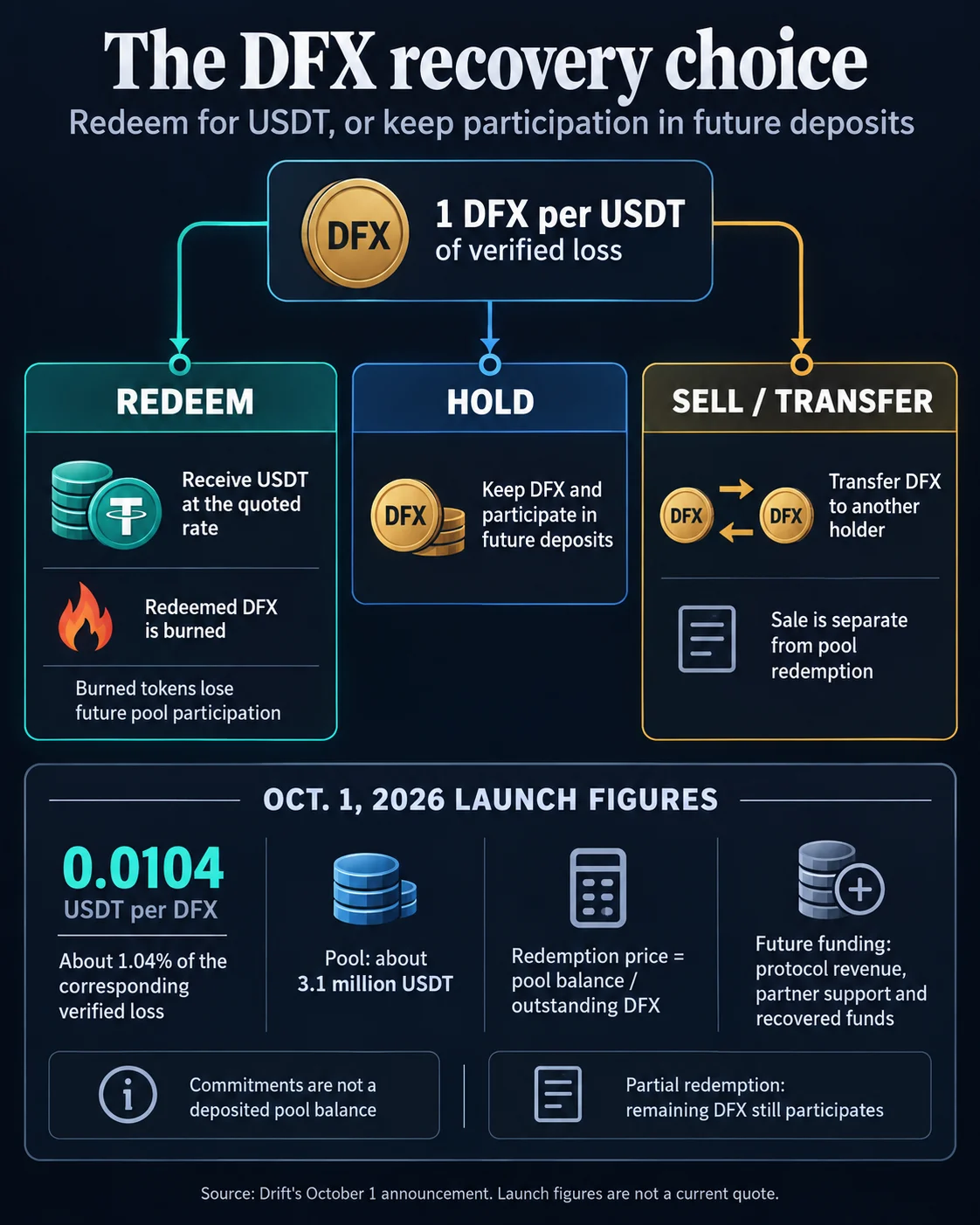
The Drift Protocol, a decentralized finance (DeFi) ecosystem built on the Solana blockchain, officially commenced the claims and redemption process for its DFX recovery token on October 1, 2026. This milestone marks a critical, albeit sobering, chapter for the thousands of users impacted by the protocol’s devastating exploit in April 2026. While the opening of the recovery pool provides a pathway for victims to reclaim a portion of their lost assets, the initial valuation of the DFX token has highlighted the long and arduous road ahead for full restitution. At the time of launch, the redemption rate was quoted at approximately 0.0104 USDT per DFX, effectively offering victims a recovery of just over one cent for every dollar lost in the hack.
This recovery initiative is centered around a dedicated Recovery Pool, which serves as a repository for funds intended to compensate users who suffered verified losses. The DFX token, a transferable asset distinct from Drift’s native governance token (DRIFT), acts as a digital receipt of debt. However, the mechanics of the redemption process present a permanent trade-off for token holders: those who choose to exit now by redeeming their DFX for USDT must agree to the permanent destruction, or "burning," of those tokens, thereby forfeiting any claim to future deposits or revenue-sharing within the recovery ecosystem.
The Financial Framework of the DFX Recovery Token
The scale of the Drift exploit is reflected in the total fixed allocation of the DFX token. Drift has set the supply at exactly 299,500,810.998 DFX, a figure that corresponds directly to the nearly 299.5 million USDT in verified losses incurred by the protocol’s user base during the April breach. Under the recovery design, one DFX was issued for every one USDT of verified loss, creating a transparent, if daunting, 1:1 accounting of the protocol’s debt to its community.
On the launch date of October 1, the Recovery Pool held approximately 3.1 million USDT. By dividing this pool balance by the total outstanding DFX supply, the protocol arrived at the initial redemption price of 0.0104 USDT. For a user who lost 10,000 USDT in the exploit, their 10,000 DFX tokens would currently yield only 104 USDT upon redemption. This 1.04% recovery rate underscores the gap between the immediate liquidity available and the total capital required to make victims whole.
The protocol has clarified that the redemption rate is dynamic. As new funds are deposited into the pool from protocol revenue or recovered assets, the amount of USDT available per remaining DFX token will increase, provided that the rate of new deposits outpaces the rate of token redemptions. Conversely, as tokens are burned through the redemption process, the total supply of DFX decreases, which mathematically supports the value of the remaining tokens in the face of future inflows.
The Mechanics of Redemption: A Permanent Exit
Drift has engineered the redemption process as an atomic transaction on the Solana blockchain. This means that the payment of USDT and the burning of the DFX token occur simultaneously; either both actions succeed, or the entire transaction fails. This ensures that the protocol does not lose liquidity without a corresponding reduction in its outstanding debt obligations.
The protocol has emphasized that completed redemptions are final and irreversible. This finality forces DFX holders into a strategic dilemma. A holder may choose to redeem only a portion of their tokens to secure immediate liquidity while retaining the remainder to participate in future pool growth. However, any token burned today is a token that will not benefit from the "Velocity" trading platform’s revenue or any potential windfall from the recovery of the original stolen funds.
For those seeking an alternative to the official redemption pool, DFX remains a transferable token. It can be traded on secondary markets such as Raydium, a leading automated market maker (AMM) on Solana. Secondary market trading allows holders to transfer their tokens—and the associated rights to future recovery—to other investors without triggering a burn. This creates a speculative market for DFX, where buyers may purchase the tokens at a discount from victims who need immediate cash, betting that the long-term recovery will exceed the current purchase price.
Chronology of the Drift Recovery Effort
The path to the October 1 launch began in the immediate aftermath of the April 2026 exploit. The timeline of events reflects a complex effort to stabilize a protocol that had seen nearly $300 million in total value locked (TVL) evaporate in a matter of hours.
- April 2026: A sophisticated exploit targets Drift Protocol’s smart contracts, resulting in the unauthorized withdrawal of approximately 299.5 million USDT in user assets.
- April 16, 2026: Drift announces a preliminary recovery framework. This plan introduced the concept of a revenue-linked credit facility and an ecosystem grant. Simultaneously, Tether (the issuer of USDT) announced its intent to lead a support package of up to $150 million to stabilize the relaunch of the protocol.
- May – September 2026: Drift focuses on rebuilding its architecture, launching the "Velocity" trading platform, and finalizing the legal and technical requirements for the DFX token issuance.
- October 1, 2026: The DFX claim portal and redemption pool officially open to the public. The initial recovery rate is set at 1.04%.
- January 1, 2028: The deadline for victims to claim their DFX tokens. Any unclaimed tokens after this date will be permanently burned, effectively narrowing the pool of eligible claimants.
Tether’s Role and the Progressive Funding Model
One of the most discussed aspects of the recovery plan has been the involvement of Tether and other strategic partners. While initial headlines in April suggested a $150 million lifeline, the reality of the funding is more nuanced. Tether’s commitment was capped at 127.5 million USDT, with an additional 20 million USDT pledged by strategic partners.
However, these funds were not provided as an upfront lump sum to be distributed to victims. Instead, Tether specified that the capital would be introduced "progressively" and would be strictly aligned with the platform’s performance and the expansion of USDT usage on the Solana network. This performance-linked model means that the full $147.5 million is a ceiling rather than a guarantee.
The recovery framework describes these funds as part of a package that includes a credit facility and market-maker loans. Such structures are designed to provide the liquidity necessary for the protocol to resume operations and generate revenue, rather than serving as a direct payout fund for historical losses. Consequently, the 3.1 million USDT available on October 1 represents the actual liquid cash currently earmarked for victims, a fraction of the total committed support.
The Velocity Platform and Future Inflows
The long-term viability of the DFX token depends heavily on the success of Drift’s new trading engine, "Velocity." According to the protocol’s design, a designated share of net protocol revenue from Velocity is funneled into the Recovery Pool on a daily basis at 00:00 UTC.

This revenue-sharing model effectively turns DFX holders into quasi-stakeholders in the protocol’s future success. If Velocity manages to recapture its former market share and generate significant trading volume, the daily deposits into the Recovery Pool could steadily drive up the redemption price. Furthermore, any funds successfully recovered from the original exploiter—either through law enforcement action or a "white hat" negotiation—will be deposited directly into the pool, providing potential "jump shifts" in the token’s value.
Despite these mechanisms, Drift has been careful to manage expectations. The protocol’s documentation explicitly states that the current commitments and revenue-sharing models are not a promise of 100% recovery. The ultimate value of DFX remains tied to the protocol’s ability to operate profitably in a highly competitive Solana DeFi landscape.
Broader Implications for the DeFi Sector
The Drift recovery process serves as a high-profile case study in "post-exploit" protocol management. Unlike the total collapses seen in previous market cycles, Drift has attempted to maintain a path forward by tokenizing its debt and aligning its recovery with its future growth.
For the broader DeFi industry, the 1% initial recovery rate is a stark reminder of the risks inherent in smart contract interactions. It also highlights the limitations of "insurance funds" and external bailouts. Even with the backing of a giant like Tether, the process of making users whole after a $300 million loss is measured in years, not weeks.
The bearish sentiment surrounding the launch reflects the market’s pragmatic assessment of these timelines. While the technical execution of the DFX claim has been seamless, the financial reality for victims is one of significant capital impairment. As the January 1, 2028, claim deadline approaches, the industry will be watching closely to see if Drift can transform a 1% starting point into a meaningful recovery for those who choose to wait. For now, the protocol remains a cautionary tale of the fragility of liquidity and the immense difficulty of rebuilding trust after a catastrophic breach.









