
 admin
admin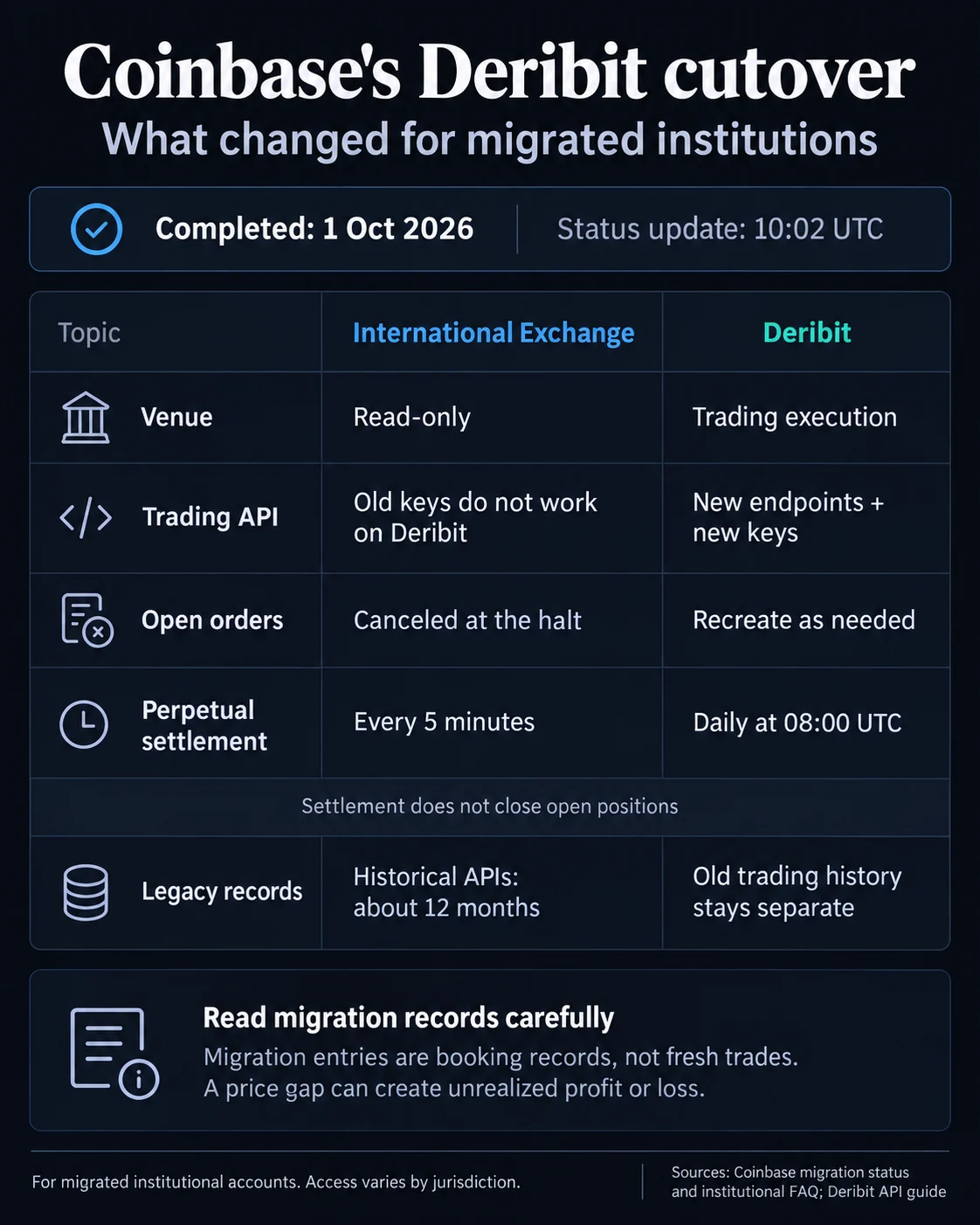
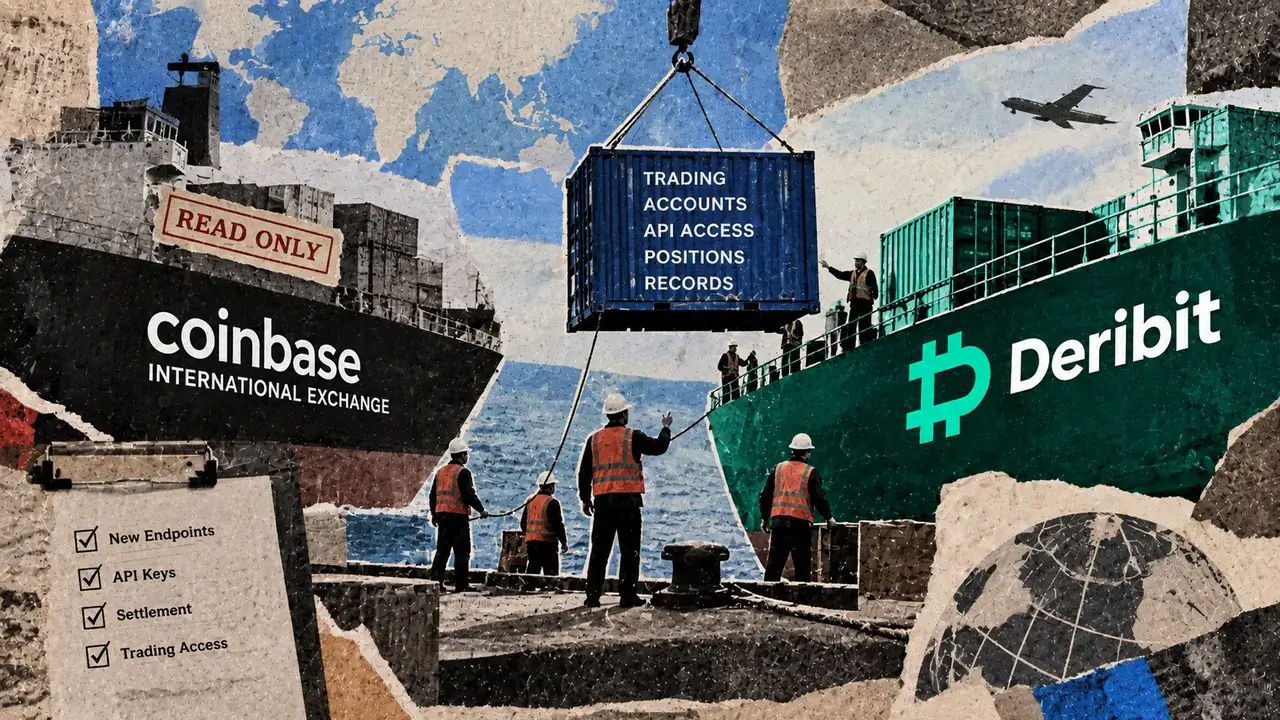
Coinbase has successfully completed the migration of its Coinbase International Exchange (CIE) operations to Deribit, a significant move that officially concluded trading on the former international venue as of October 1, 2026. The legacy platform is now exclusively in a read-only state, with all active trading functionalities and client positions transitioned to Deribit. This operational shift marks a pivotal moment for institutional clients who previously utilized CIE, necessitating immediate adjustments to their trading access, settlement procedures, and historical data management.
The October 1 Cutover: A New Operational Landscape
The completion of the migration, confirmed at 10:02 UTC on October 1, 2026, as per Coinbase’s official status report, fundamentally alters the operational framework for affected institutional entities. These clients, exclusively non-US institutions operating within specific jurisdictions, now face the immediate realities of establishing new trading connections, adapting to a different settlement cycle, and managing a bifurcated historical record of their trading activities. The strategic consolidation aims to streamline liquidity, pooling resources that were previously dispersed across two distinct trading venues. However, the availability of specific products and the breadth of access remain contingent on an institution’s account type and its geographical location.
For institutions relying on API or FIX connections, the transition demands a complete overhaul of their integration protocols. New Deribit endpoints are now mandatory, requiring the generation of entirely new Deribit API keys. Crucially, existing Coinbase International Exchange keys are rendered obsolete, and there will be no overlapping trading window on the decommissioned venue to facilitate a gradual transition. Deribit’s dedicated API migration guide explicitly details these requirements, emphasizing that elements such as API-key IP allowlists will not be automatically transferred. Furthermore, instrument names and order attributes have undergone modifications, and any open orders on the International Exchange at the time of the halt were systematically canceled rather than migrated. Institutions seeking to reinstate these canceled orders must manually recreate them on the Deribit platform.
Operational and Legal Framework Post-Migration
While the execution of trades now takes place on Deribit’s infrastructure, the institutional legal relationship remains anchored under Coinbase’s umbrella. According to Coinbase’s comprehensive institutional guidance, Coinbase Bermuda Limited serves as the primary broker, custodian, and counterparty for these clients. This entity facilitates the routing of client orders to Deribit, maintaining a distinct legal and contractual framework separate from the execution venue.
The settlement cycle for migrated perpetual positions has undergone a significant alteration. Previously operating on a five-minute cycle, these positions now settle once daily at 08:00 UTC. This daily settlement process involves crediting profits or deducting losses directly from cash balances without necessitating the closure of the positions themselves. Funding rates, which accrue continuously, are also cash-settled at this same daily juncture. It is important to note that the quoted eight-hour funding rate is a separate convention and does not reflect the daily settlement mechanism.
The management of trade histories also presents a nuanced challenge. Block-trade entries specifically tagged as "Migration" are designed to recreate positions as they existed on the International Exchange at its settlement price. These entries are essentially booking artifacts intended to reflect historical positions, not new buy or sell transactions. Consequently, any disparity between this International Exchange settlement price and Deribit’s mark price at the time of reopening can result in immediate, albeit unrealized, profit or loss.
A critical operational point for institutions is that legacy International Exchange trading history will not be directly integrated into Deribit. Coinbase has stated that historical trade and order APIs will remain accessible for a period of approximately 12 months following the migration. This measure allows institutions to maintain separate records for their trading activities occurring before and after the transition, necessitating robust internal data management strategies.
User Experience and Product Availability
For users engaging with Coinbase through its standard app and website interfaces, the transition offers a somewhat different user experience. These clients will retain their existing Coinbase accounts and familiar core workflows. While the visual presentation of screens and market data may evolve to reflect the integration, the fundamental user journey is designed to be as seamless as possible. However, customers who utilize the Coinbase Advanced Trade API for derivatives trading will still need to connect through the new Deribit-powered gateway.
The full spectrum of derivatives products may not be universally available immediately post-migration. Coinbase continues to maintain a distinction for its CFTC-regulated Coinbase Derivatives futures, operating them separately. Access to US Prime options, a different product category, is following its own distinct timeline. The company’s retail-focused FAQ indicates plans to introduce in-app options for eligible users in select non-US jurisdictions by late October, subject to regulatory and operational readiness.

Background and Strategic Rationale
This migration is part of a broader strategic initiative by Coinbase to consolidate and enhance its institutional derivatives offerings. The Coinbase International Exchange was launched to cater to a global institutional client base, offering a range of perpetual futures and other derivative products. However, managing multiple international trading venues can lead to fragmented liquidity and increased operational complexity. By integrating these operations onto Deribit’s established and robust platform, Coinbase aims to achieve several key objectives:
- Enhanced Liquidity: Deribit is a leading global cryptocurrency options and futures exchange, known for its deep liquidity pools. Consolidating Coinbase’s institutional derivatives trading onto this platform is expected to attract more participants and create more efficient price discovery.
- Operational Efficiency: Streamlining operations onto a single, advanced platform reduces the technical and administrative overhead associated with managing multiple exchange infrastructures. This can lead to cost savings and improved internal processes.
- Product Specialization: By leveraging Deribit’s expertise in derivatives, Coinbase can focus on its core strengths in spot trading and broader digital asset services, while entrusting derivatives execution to a specialized and reputable partner.
- Regulatory Compliance: Operating within the complex global regulatory landscape for digital assets requires careful consideration. The partnership with Deribit, which has its own established compliance frameworks, can support Coinbase’s efforts to navigate these challenges.
The decision to partner with Deribit, rather than solely rely on internal development for its international derivatives business, underscores the maturity of the derivatives market and the benefits of specialization. Deribit has built a reputation for its technological infrastructure, security protocols, and deep understanding of the institutional trading environment. This partnership allows Coinbase to offer a competitive institutional derivatives product without the extensive capital investment and time required to build and scale such a platform from the ground up independently.
Implications for the Institutional Crypto Market
The successful migration of Coinbase International Exchange to Deribit is a significant development for the institutional cryptocurrency market. It signals a trend towards consolidation and specialization among major players seeking to offer robust and efficient trading solutions. For institutions, this move necessitates a period of adaptation, requiring them to update their trading systems, retrain personnel on new workflows, and carefully manage their historical data.
The integration also highlights the increasing sophistication of the cryptocurrency derivatives market. As institutional adoption grows, the demand for advanced trading products, deep liquidity, and reliable execution infrastructure intensifies. Partnerships like the one between Coinbase and Deribit are becoming crucial for meeting these evolving demands.
Looking ahead, the success of this migration could pave the way for further collaborations and strategic alliances within the digital asset space. As the industry matures, companies are likely to focus on their core competencies and leverage partnerships to enhance their product offerings and operational efficiency. For Coinbase, this move solidifies its position as a comprehensive digital asset platform, offering a broad suite of services from spot trading to sophisticated institutional derivatives, all while navigating the complexities of a global regulatory environment. The ongoing monitoring of Deribit’s performance, client feedback, and the overall impact on market liquidity will be key indicators of the long-term success of this strategic consolidation.








