
 admin
admin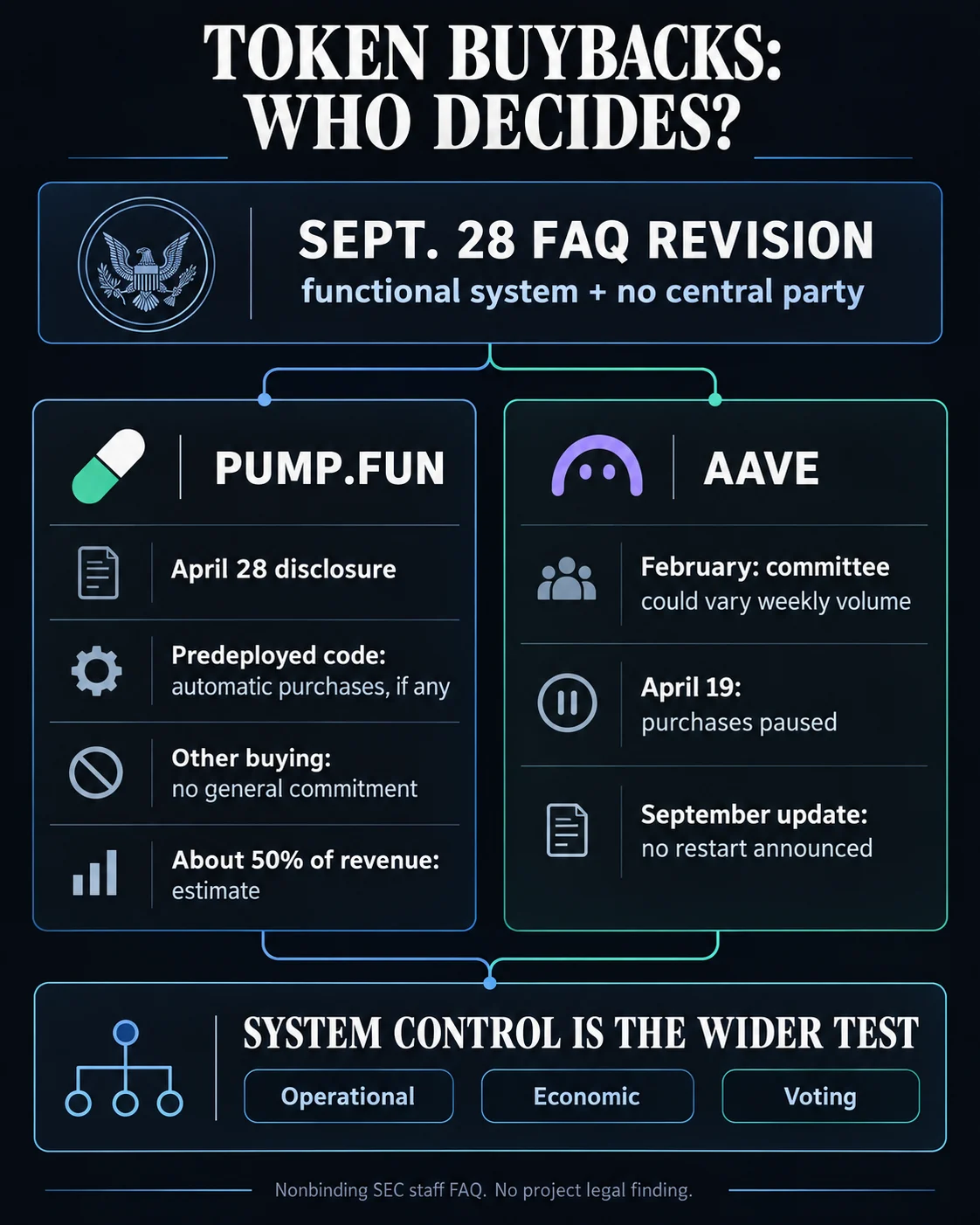
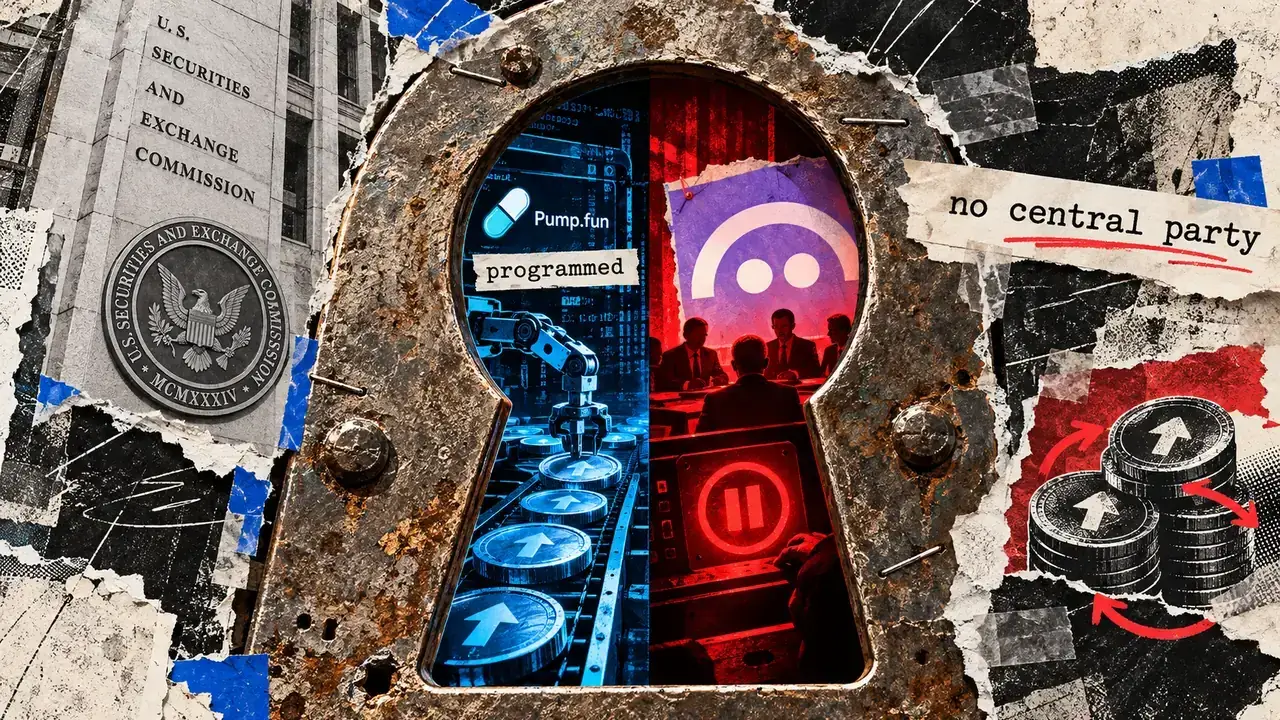
The U.S. Securities and Exchange Commission (SEC) has swiftly amended its recently issued guidance on cryptocurrency token buybacks, introducing a critical new condition that could significantly impact numerous projects within the digital asset space. Initially published on September 25th, the guidance stipulated that a token issuer could announce a buyback without it being construed as a promise to manage the token’s value, provided the underlying crypto system was already functional. However, a mere three days later, on September 28th, the agency revised this interpretation, adding a stringent requirement: the system must also possess "no central party." This alteration represents a pivotal shift, as many cryptocurrency projects currently engage in buyback programs while retaining some degree of human or organizational oversight over these operations.
The SEC staff’s updated FAQ now clarifies that an announcement of a buyback for a non-security crypto asset would not, in isolation, constitute an implicit promise of essential managerial efforts if the system is both operational and demonstrably lacks a central governing entity. This nuanced addition underscores the agency’s increasing focus on the operational and governance structures of decentralized finance (DeFi) and other blockchain-based projects.
The significance of this development cannot be overstated, particularly as token buybacks have surged in prominence across the crypto ecosystem. Through late August, cryptocurrency projects collectively spent a record $638 million on token buybacks, according to previous reporting by CryptoSlate. This substantial financial commitment highlights the growing strategic importance of buyback mechanisms for project treasuries and tokenomics management.
It is crucial to note that the SEC staff’s FAQ reflects their interpretive views and does not carry the force of law, nor does it definitively classify any particular token as a security. Nevertheless, this revised guidance poses a practical challenge for projects utilizing buybacks: discerning who truly exercises control over the purchasing decisions. While a project might have deployed millions of dollars in buyback activities, this figure alone does not reveal who has the authority to initiate or cease future purchases, determine their volume, or alter the program’s parameters.
The Underlying Question: Defining Centralization in Buybacks
The SEC provided a more comprehensive definition of a "central party" in its March interpretation of crypto-asset rules. This definition encompasses any individual, company, or group that exerts operational, economic, or voting control over a crypto system. Conversely, a decentralized system is characterized by its absence of such centralized control.
This definition pertains to the crypto system in its entirety. Consequently, control over a project’s treasury or its buyback program does not automatically equate to the entire system being centrally controlled. However, such control can serve as a significant indicator when evaluating economic oversight. This distinction becomes particularly relevant in scenarios where projects blend automated buyback mechanisms with discretionary human decision-making.
For instance, a smart contract might be programmed to execute token purchases automatically under certain predefined conditions. Simultaneously, a company, a committee, or a Decentralized Autonomous Organization (DAO) might retain the authority to decide whether additional purchases occur, their scale, or the program’s overall duration. The pivotal question, therefore, transcends mere automated execution; it probes whether human actors still possess substantial influence over the system’s operations and economic outcomes.
Case Studies: Pump.fun and Aave Illuminate the Nuances
The platform Pump.fun offers a relevant example of how projects are navigating these complexities. In an April 28th disclosure, the platform clarified that references to "PUMP purchases" and a "buyback program" generally described planned actions or smart-contract functionalities rather than an absolute commitment to acquire tokens. An exception was made for purchases that were already programmed to execute automatically via on-chain code deployed before April 28, 2026, UTC.
Pump.fun further stated that declarations regarding the allocation of approximately 50% of platform revenue for token purchases were estimates, not guarantees. It also indicated that third parties might execute certain purchases. The platform’s PUMP token page elaborates that 50% of defined platform revenue was programmatically locked and earmarked for burning for one year, commencing April 28. However, it also notes that future purchases could generally be initiated, halted, or modified unless they were already automated by on-chain code.
Interestingly, these two disclosures present slightly different dates concerning the cutoff for automated purchases. The April 28th announcement refers to code deployed before April 28th UTC, while the token page references activity programmed before April 29th. Regardless of these minor discrepancies, the core message is that Pump.fun delineates two distinct categories of activity: some token purchases are pre-programmed and automatic, while others remain contingent on future decisions. This dichotomy does not definitively establish whether Pump.fun operates with a "central party" according to the SEC’s criteria. Determining that would necessitate a broader examination of who controls the overarching system, not solely its buyback mechanisms.
The decentralized finance lending protocol Aave provides another compelling illustration of how human discretion can influence token buyback programs. In a February 28th funding update, TokenLogic, a DAO service provider, indicated that the Aave Finance Committee possessed the authority to adjust weekly AAVE buyback volumes within a 75% flexibility range. These adjustments could be made based on factors such as liquidity, market volatility, timing, and protocol revenue. TokenLogic reported that the DAO had allocated $42 million for the purchase of over 205,000 AAVE during the program’s initial ten months.
The committee’s discretionary power became evident in April. A governance notice dated April 22nd announced the pause of AAVE buybacks effective April 19th, following an rsETH bridge incident the preceding day. TokenLogic explained that the pause was intended to provide the treasury with greater flexibility while the implications of the incident were assessed. The notice also stated that any resumption of buybacks would be communicated through a standard funding update.
A subsequent August/September funding update included AAVE among the assets eligible for purchase under revised token budgets. However, this update did not explicitly confirm the restart of AAVE buybacks, nor did it provide a record of completed purchases post-pause. The April notice thus definitively established that the program was halted at that time. The later update indicated the capacity for AAVE purchases existed, but did not clearly confirm whether such purchases had resumed.
Aave’s experience underscores the critical importance of the SEC’s revised wording. The ability of human actors to alter the buyback program’s volume and subsequently pause its operations in response to changing market conditions is a key point. This scenario does not automatically classify Aave as having a central party under the SEC’s definition, as the agency’s test is broader and considers control over the entire crypto system. However, for investors seeking to gauge the true decentralization of a buyback initiative, a clear question now emerges: who possesses the authority to initiate, terminate, or modify upcoming purchases, and what other forms of control do they wield over the broader system?
Broader Implications for the Crypto Market
The SEC’s rapid revision of its guidance on token buybacks signifies a heightened level of regulatory scrutiny and a more granular approach to defining decentralization within the crypto space. This development has several far-reaching implications:
- Increased Compliance Burden: Projects that rely on token buybacks will need to rigorously re-evaluate their governance structures and operational frameworks to ensure compliance with the "no central party" mandate. This may involve redesigning smart contracts, redistributing decision-making power, or providing more transparent documentation of decentralized governance processes.
- Shift Towards True Decentralization: The guidance incentivizes projects to move towards more robust decentralized governance models. Those that can credibly demonstrate the absence of a central party in their buyback mechanisms may gain a regulatory advantage and enhanced investor confidence.
- Potential for Market Reconfiguration: Projects that cannot meet the new criteria may face challenges in publicly announcing or promoting their buyback programs, potentially impacting their tokenomics strategies and market perception. This could lead to a market segmentation between truly decentralized projects and those with more centralized control.
- Impact on Investment Decisions: Investors will likely pay closer attention to the governance structures underlying token buyback programs. The clarity provided by the SEC’s guidance, albeit evolving, empowers investors to make more informed decisions by assessing the degree of decentralization and the potential for regulatory risk.
- Evolving Regulatory Landscape: This rapid amendment highlights the dynamic and sometimes fluid nature of crypto regulation. It suggests that the SEC will continue to refine its interpretations and guidance as the market matures and new use cases emerge. Projects must remain adaptable and proactive in staying abreast of these changes.
The surge in token buybacks, reaching hundreds of millions of dollars, indicates their perceived utility in managing token supply, enhancing value, and fostering community engagement. However, the SEC’s latest guidance injects a layer of complexity, demanding that such programs be embedded within genuinely decentralized systems to avoid potential regulatory entanglement. The onus is now on crypto projects to demonstrate not just the existence of buyback mechanisms, but their decentralized governance and operational autonomy, a distinction that will undoubtedly shape the future trajectory of token buyback strategies in the digital asset economy.








