
 James Watt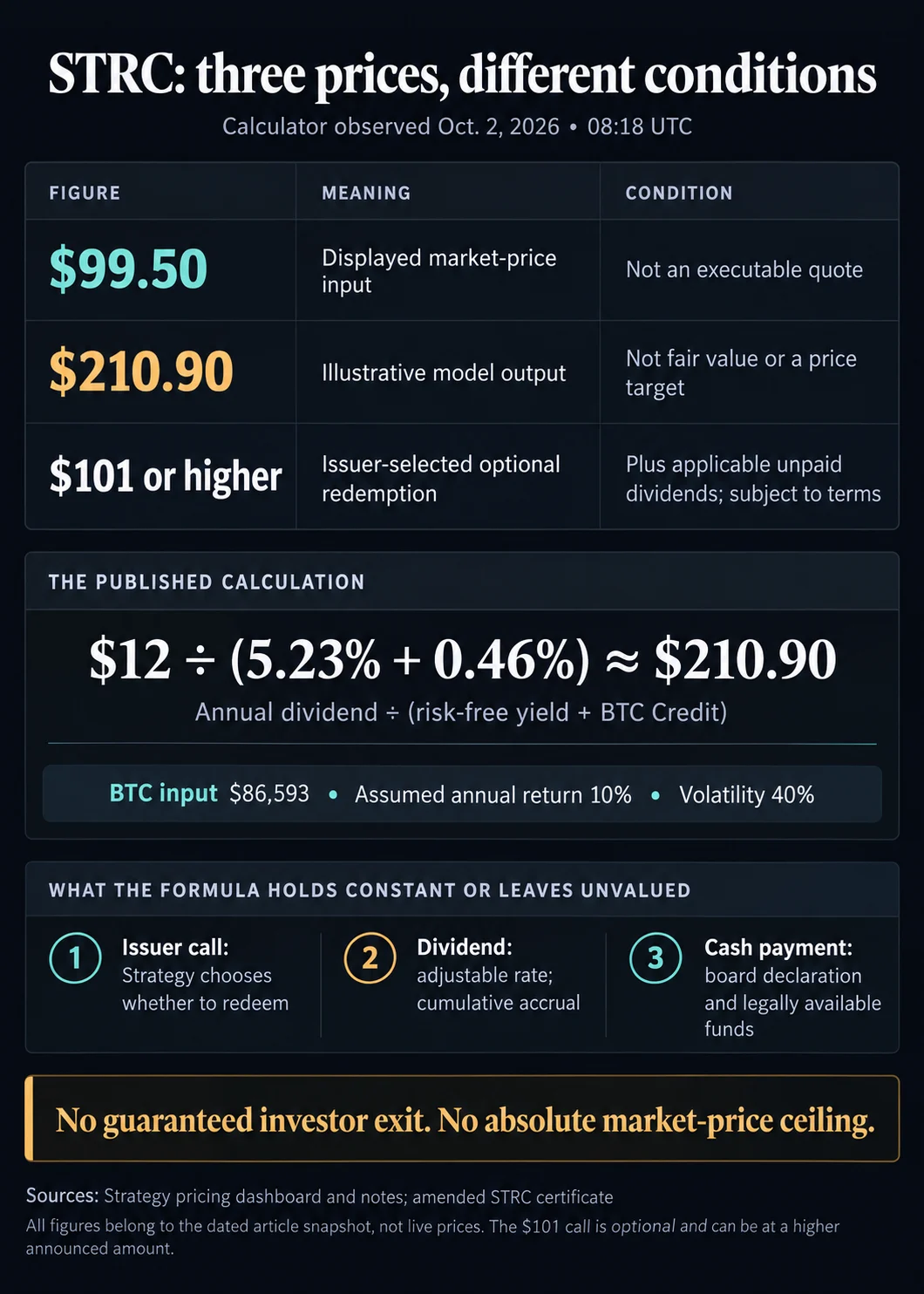
The financial markets witnessed a significant divergence in the valuation of Strategy’s perpetual preferred stock, known as STRC, on October 2, 2024, as the company’s proprietary Bitcoin credit calculator produced an illustrative price of $210.90 while the market price languished at $99.50. This massive gap—where the modeled price is more than double the actual trading value—highlights the friction between theoretical digital-credit modeling and the pragmatic realities of fixed-income trading, issuer optionality, and liquidity constraints. While Strategy’s dashboard offers a visionary look at how Bitcoin’s collateral value might compress credit spreads, investors remain tethered to the contractual terms of the security, which include an issuer call option at $101 and a complex dividend reset mechanism.
The Mechanics of the $210.90 Valuation
To understand the origin of the $210.90 figure, one must look at the specific inputs utilized by Strategy’s dashboard at approximately 08:18 UTC on October 2. The calculator employed a Bitcoin price input of $86,593, alongside an assumed annual return of 10% and a volatility index of 40%. These parameters are used to derive "BTC Credit," a modeled credit spread that Strategy proposes as a replacement for traditional market-driven spreads.
The arithmetic of the valuation is straightforward but relies on a fundamental substitution. The published formula takes the annual dividend—currently $12.00 per share—and divides it by the sum of the risk-free yield and the BTC Credit spread. On the morning of October 2, the dashboard displayed a risk-free yield of 5.23% and a BTC Credit spread of a mere 46 basis points (0.46%). The resulting calculation ($12 / (0.0523 + 0.0046)) equals approximately $210.90.
The primary driver of the discrepancy is the spread substitution. While the model uses a 46-basis-point spread, the actual market spread implied by the $99.50 trading price was 684 basis points. By replacing the market’s perceived risk (684 bps) with the model’s estimated Bitcoin-backed risk (46 bps), the discount rate is drastically lowered, which mathematically inflates the present value of the dividend stream. However, Strategy has explicitly cautioned that this "Derived Price" is an illustrative output based on selected assumptions and does not constitute a fair-value determination or an executable price target.
Chronology of Strategic Financial Adjustments
The evolution of STRC and its associated valuation tools follows a series of aggressive financial engineering milestones by Strategy. Understanding the timeline is essential for contextualizing why the market remains skeptical of the $210.90 model output.
- July 21, 2025: Strategy announces the IPO of STRC, originally proposing a monthly dividend payment schedule to attract retail and institutional interest in a Bitcoin-linked yield product.
- June 30, 2026: An amended certificate of designations becomes effective, shifting the payment frequency from monthly to twice-monthly. This amendment also refined the "optional redemption" terms, giving the issuer more flexibility in managing its capital structure.
- September 28, 2026: Strategy provides a reserve update, disclosing a $5.02 billion USD Reserve specifically earmarked for preferred dividends and debt interest, alongside $1.00 billion in general USD Cash.
- September 30, 2026: The company takes action to maintain the 12% annual dividend rate for the period beginning October 16, declaring a $0.50 payment for the semi-monthly period ending October 31.
- October 2, 2026: The Bitcoin credit calculator hits the $210.90 illustrative peak, drawing sharp contrast to the $99.50 market price.
- October 28, 2026 (Upcoming): Shareholders are scheduled to vote on a "daily-dividend" proposal. If approved, Strategy intends to implement daily record dates starting November 1, with payments following on the next business day.
The Call Option: A Structural Ceiling on Price
A critical factor that the $210.90 model ignores is the issuer’s right to redeem the shares. Under the amended certificate of designations, Strategy retains the option to call STRC shares at $101 per share (or a higher announced amount), plus any accumulated unpaid dividends.
In traditional finance, a call option usually acts as a "soft ceiling" on a security’s market price. If an issuer can buy back a stock at $101, rational market participants are rarely willing to pay significantly more than that, as they face the risk of an immediate capital loss if the call is exercised. The fact that Strategy’s model produces a value of $210.90—nearly $110 above the call price—demonstrates that the model is valuing the dividend stream as if it were a perpetual certainty, without accounting for the issuer’s right to terminate that stream at a much lower price point.
Furthermore, the terms of the partial optional redemption require that at least $250 million of the stated amount remains outstanding after a call. This ensures a minimum level of liquidity but also gives the issuer significant leverage to "prune" the outstanding shares if the cost of maintaining the 12% dividend becomes too high relative to other financing options.
Dividend Durability and the SOFR Link
The 12% annual dividend, which serves as the numerator in the $210.90 calculation, is not fixed in perpetuity. The STRC dividend rate is subject to periodic resets based on the Secured Overnight Financing Rate (SOFR). While ordinary rate reductions are constrained by a 25-basis-point allowance and specific SOFR floors, the board of directors retains ultimate discretion over declarations.

For a holder to realize the $210.90 value, the 12% dividend would need to remain stable while the market’s perception of risk converged with the 46-basis-point "BTC Credit" spread. However, the market currently demands a 684-basis-point spread, suggesting that investors see significant risks that the Bitcoin-centric model does not capture. These risks include:
- Regulatory Uncertainty: Changes in how Bitcoin-backed securities are treated by the SEC or other bodies.
- Liquidity Risk: The potential inability to exit a large position at the "displayed" market price.
- Credit Hierarchy: STRC sits junior to Strategy’s debt and STRF (Senior Preferred) claims. In a liquidation scenario, Bitcoin assets are not pledged directly to STRC holders, meaning senior creditors would be satisfied first.
Bitcoin Coverage vs. Dollar Liquidity
Strategy Executive Chairman Michael Saylor has frequently argued that Bitcoin represents "digital credit," a superior form of collateral that should command lower interest rates. In a September 29 address, Saylor described Bitcoin capital and dollar liquidity as two distinct but complementary pillars of the company’s treasury strategy.
However, from a journalistic and analytical perspective, "coverage" is not the same as "capacity." While Strategy may have billions of dollars worth of Bitcoin covering its liabilities, the dividends must be paid in US Dollars. This requires Strategy to either maintain a massive cash reserve or periodically sell or borrow against its Bitcoin.
As of September 27, Strategy reported a $5.02 billion USD Reserve. During the week of September 21–27, the company utilized $22.1 million of this reserve for preferred dividends and $48.1 million of separate USD Cash to fund STRC repurchases. These repurchases are a double-edged sword: they signal management’s belief that the stock is undervalued at current market prices, but as Saylor himself noted, they do not guarantee a price floor.
Market Implications and the Daily Dividend Proposal
The upcoming October 28 shareholder vote on daily dividends represents an attempt to further modernize the security. By moving to a daily payment cycle, Strategy aims to reduce the "accrued dividend" risk and provide more immediate cash flow to holders. While this might increase the attractiveness of the stock to certain yield-seeking investors, it does not fundamentally change the credit profile of the issuer or the underlying volatility of the Bitcoin collateral.
The $111.40 gap between the model and the market on October 2 serves as a stark reminder of the "Saylor Premium" or "Strategy Gap." Proponents of the model argue that the market is simply slow to price in the revolutionary nature of Bitcoin-backed credit. Skeptics, however, point to the $101 call option and the junior status of the shares as insurmountable barriers to the stock ever reaching the $200+ range.
Conclusion: The Limits of the Model
The Bitcoin credit calculator is a powerful tool for visualizing a hypothetical future where Bitcoin is the world’s primary collateral. However, as of late 2024, it remains a "view of the security under selected assumptions" rather than a reflection of realizable value.
For the $210.90 price to become a reality, several unlikely events would need to occur: Strategy would need to waive its $101 call right indefinitely, the market would need to accept a credit spread for a junior preferred stock that is lower than that of many AAA-rated corporate bonds, and Bitcoin’s volatility would need to be viewed as an asset rather than a liability by fixed-income desks.
Until then, the three prices of STRC—the $99.50 market price, the $101 call price, and the $210.90 model price—will continue to tell three very different stories about the future of digital finance. Investors are left to decide whether they trust the cold reality of the current market spread or the optimistic projections of the Bitcoin credit formula.









