
 James Watt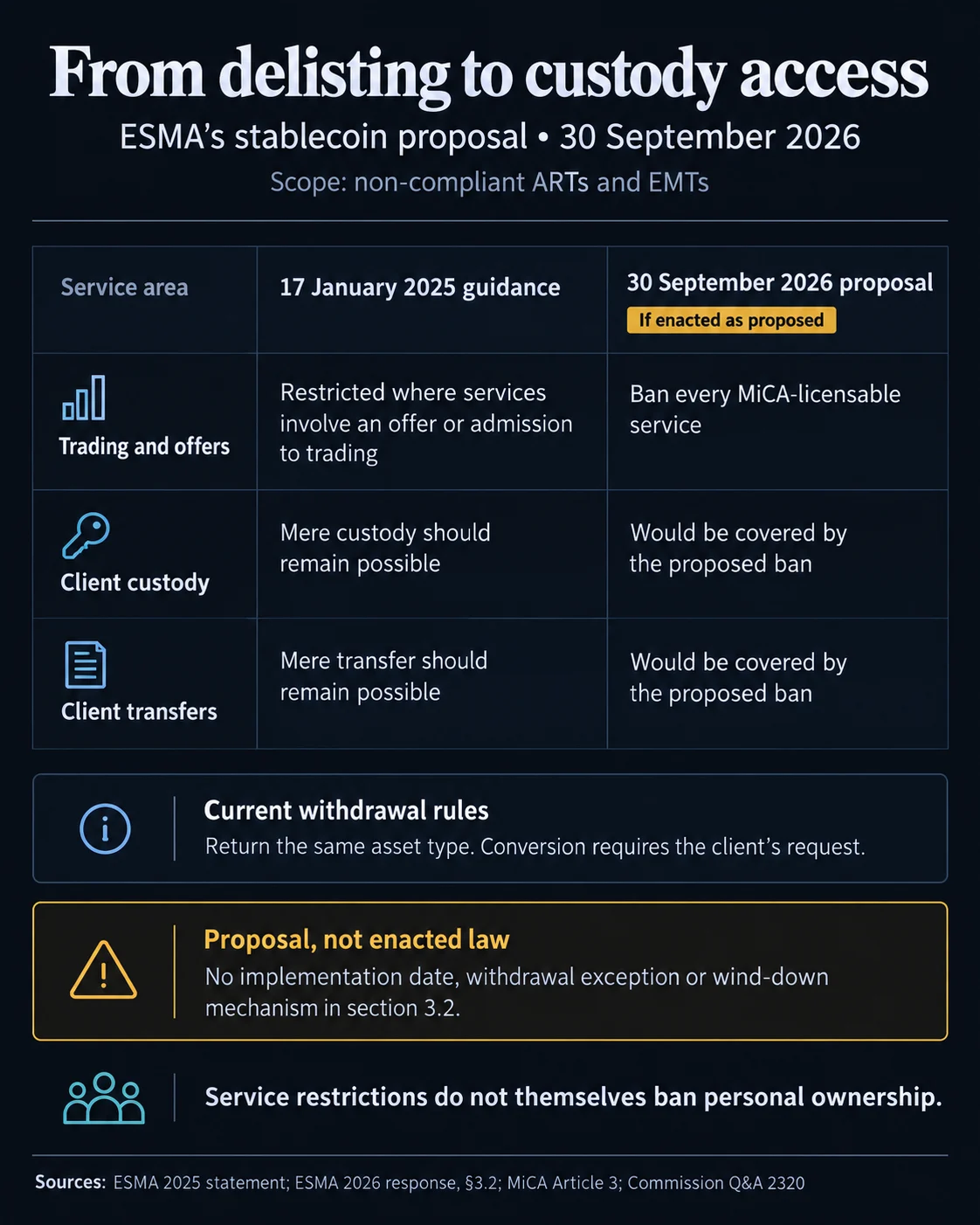
The European Securities and Markets Authority (ESMA) has formally recommended a significant expansion of the European Union’s regulatory perimeter regarding stablecoins that fail to meet the standards set by the Markets in Crypto-Assets (MiCA) regulation. In a policy submission delivered to the European Commission on September 30, 2026, the regulator proposed extending existing prohibitions beyond the mere trading of non-compliant tokens to include essential infrastructure services such as custody and transfers. If adopted into law, this shift would effectively eliminate the ability of European investors to hold non-compliant stablecoins within licensed financial institutions, potentially forcing a massive migration of assets or a total exit from the regulated European crypto ecosystem for certain popular digital assets.
The proposal marks a pivot from ESMA’s previous regulatory stance. While earlier guidance focused on restricting the "offer to the public" and admission to trading platforms, the new recommendation targets the underlying services that allow customers to keep and move their assets. By reclassifying custody and transfer services as prohibited activities for non-compliant tokens, ESMA aims to close what it perceives as a loophole that facilitates regulatory arbitrage and creates an uneven playing field between compliant issuers, such as those behind Euro-backed tokens or MiCA-compliant dollar tokens, and those operating outside the EU’s legal framework.
The Evolution of Stablecoin Regulation in the European Union
To understand the weight of ESMA’s September 2026 response, it is necessary to examine the trajectory of MiCA’s implementation. The MiCA regulation, which entered into force in June 2023, established a comprehensive framework for crypto-assets, with specific and stringent rules for stablecoins—categorized as Asset-Referenced Tokens (ARTs) and E-Money Tokens (EMTs). These rules became applicable in June 2024, requiring issuers to hold specific licenses, maintain robust reserves, and adhere to strict transparency standards.
On January 17, 2025, ESMA issued a statement that provided a transitionary roadmap for exchanges and service providers. At that time, the regulator distinguished between active services, such as trading and public offering, and passive services, such as custody and transfers. Under that guidance, platforms were expected to cease trading pairs for non-compliant tokens by the end of the first quarter of 2025. However, investors were permitted to maintain their existing balances in regulated wallets, and service providers were allowed to facilitate the withdrawal or transfer of those assets to external, non-custodial environments.
This distinction was critical for market stability. It allowed a "sell-only" or "withdrawal-only" period, preventing a sudden liquidity crisis or the immediate freezing of consumer funds. For example, in March 2025, Binance announced it would delist nine stablecoin trading pairs for users in the European Economic Area (EEA) to comply with MiCA, while explicitly stating that deposits, withdrawals, and custody services would remain available. ESMA’s latest proposal would effectively revoke this permission, treating the act of "safekeeping" a non-compliant token as a prohibited service in itself.
Chronology of MiCA Stablecoin Enforcement
The path toward the current proposal has been marked by several key regulatory milestones:
- June 2023: MiCA officially enters into force, setting a countdown for stablecoin issuers to meet EU standards.
- June 30, 2024: Title III and Title IV of MiCA, governing ARTs and EMTs, become applicable. Several major issuers begin the licensing process, while others remain non-compliant.
- January 17, 2025: ESMA issues guidance distinguishing between trading (to be restricted) and custody/transfers (permitted for existing holders).
- March 2025: Major exchanges, including Binance, delist non-compliant stablecoin pairs for EEA users but maintain custody services.
- February 18, 2026: A Q&A from the European Commission clarifies that providers must return the "same type" of asset held when a client requests withdrawal, complicating the path for forced conversions.
- July 2026: Academic research highlights a shift in trading volumes from non-compliant to compliant tokens on "regulated-facing" exchanges.
- September 30, 2026: ESMA submits its response to the MiCA review, calling for a total prohibition of all services for non-compliant stablecoins.
Legal Basis and the Definition of Prohibited Services
ESMA’s argument for a broader prohibition rests on the definitions provided in Article 3 of the MiCA regulation. Under this article, "custody and administration of crypto-assets on behalf of clients" is defined as the safekeeping or controlling of crypto-assets or the means of access to such assets, such as private keys. "Transfer services" involve the movement of crypto-assets from one ledger address or account to another on behalf of a client.
By invoking Article 82, which sets the requirements for client agreements regarding transfers, and Article 59, which governs the authorization of Crypto-Asset Service Providers (CASPs), ESMA asserts that a provider’s license is not an umbrella that covers all assets. Instead, the regulator argues that the legality of the service is inextricably linked to the compliance of the asset being serviced.
The September 2026 proposal argues that allowing the continued custody of non-compliant tokens "facilitates regulatory arbitrage." In the regulator’s view, if a customer can still hold and move a non-compliant token through a regulated EU business, the token retains a level of legitimacy and utility that undermines the goal of MiCA. The proposed change would shift the test from an "activity-by-activity" basis to a "broad asset-compliance" test. If the asset is non-compliant, no licensed service—whether it be trading, lending, custody, or transfer—can be legally provided.
The Custody Paradox: Returning Assets vs. Service Prohibition
One of the most complex implications of the ESMA proposal is the potential conflict with existing consumer protection laws. Article 75 of MiCA requires CASPs to have rigorous procedures in place to return clients’ crypto-assets or their means of access "as soon as possible" upon request. Furthermore, an official interpretation from the European Commission dated February 18, 2026, clarified that the assets returned must be of the same type as those held by the provider.
If the European Commission adopts ESMA’s proposal to prohibit the service of custody for non-compliant tokens, a legal paradox emerges. A licensed provider would be legally forbidden from "safekeeping" the asset, yet simultaneously obligated by Article 75 to "return" the asset. If the provider is also prohibited from "transferring" the asset (another service on the prohibited list), they would have no legal mechanism to return the non-compliant tokens to the customer’s private wallet.

The proposal does not currently include a wind-down mechanism or a forced conversion timetable. Without such provisions, the industry faces the risk of "trapped" assets. Legislators would need to determine whether providers would be forced to perform a compulsory conversion into a compliant asset (like USDC or a Euro-stablecoin) or fiat currency before the custody ban takes effect. However, as the February 2026 Q&A noted, a provider must have specific permissions to offer conversion services, and the client must generally request such a conversion.
Market Impact: Lessons from the 2025 Trading Shift
The potential impact of these restrictions can be gauged by analyzing the market’s reaction to the 2025 trading restrictions. A July 2026 study by Nicola Borri and Kirill Shakhnov examined the trading dynamics of USDT (Tether) and USDC (Circle) across 14 major exchanges during the period surrounding the April 1, 2025, implementation of trading restrictions.
The researchers categorized exchanges like Coinbase, Kraken, Bitstamp, and Gemini as "regulated-facing" due to their significant audience share in the EU and US. Their findings indicated that around the event date, USDC’s share of the combined USDT and USDC trading volume rose by approximately six percentage points on regulated-facing exchanges compared to global, less-regulated venues.
Crucially, the study found that USDT trading volume on these regulated-facing exchanges fell by roughly 20% relative to global venues. However, the increase in USDC volume was not statistically significant in a way that suggested a direct one-to-one migration. Instead, the "USDC gain" was primarily a result of the contraction in USDT trading. This suggests that when faced with restrictions, many European users did not necessarily switch to a compliant alternative; rather, they either moved their activity to non-EU platforms or reduced their trading activity altogether.
If custody and transfers are also prohibited, the contraction in the regulated European market could be even more pronounced. Unlike a trading ban, which allows an investor to "HODL" and wait for better conditions, a custody ban forces the investor to move their assets.
Broader Implications for the Global Crypto Landscape
The ESMA proposal signals a hardening of the "Brussels Effect" in the crypto-asset space. By targeting custody, the EU is moving toward a model where non-compliant stablecoins are not just restricted in the marketplace but are effectively excised from the regulated financial system.
For issuers like Tether (USDT), which has historically maintained a cautious approach to MiCA compliance due to the regulation’s reserve requirements and "significant" asset thresholds, the proposal represents a maximum-pressure tactic. If USDT cannot be held in a regulated European wallet, its utility as a collateral asset or a medium of exchange within the European fintech sector would drop to near zero.
Conversely, compliant issuers like Circle (USDC) and various Euro-denominated stablecoin providers stand to gain a government-mandated monopoly on regulated custody. This could lead to a bifurcation of the global stablecoin market: a "regulated zone" dominated by MiCA-compliant assets and an "offshore zone" where non-compliant assets continue to circulate through decentralized protocols and non-EU exchanges.
Analysis of Potential Outcomes and Next Steps
The European Commission is now tasked with reviewing ESMA’s submission. The consultation period for the MiCA review ended on September 30, 2026. The resulting report from the Commission may be accompanied by a legislative proposal to amend MiCA.
There are three primary paths the Commission could take:
- Full Adoption: Adopting ESMA’s proposal in its entirety. This would necessitate a clear "exit" protocol for existing holders to avoid legal chaos and mass asset loss.
- Modified Restriction: Prohibiting new custody agreements for non-compliant tokens while allowing "legacy" holdings to be maintained or withdrawn over a multi-year period.
- Rejection/Status Quo: Maintaining the current distinction between trading and custody, acknowledging that the right to "safekeeping" is a fundamental consumer protection that should not be stripped away based on the asset’s regulatory status.
The final decision will likely hinge on whether the Commission views the "regulatory arbitrage" mentioned by ESMA as a greater threat than the potential for significant consumer harm caused by a sudden ban on custody services. As the European crypto market matures, the tension between strict regulatory compliance and the practical realities of global, borderless digital assets remains the central challenge for Brussels. Investors and service providers now await a definitive legislative text, which will determine the future of stablecoin ownership in the European Union.









