
 James Watt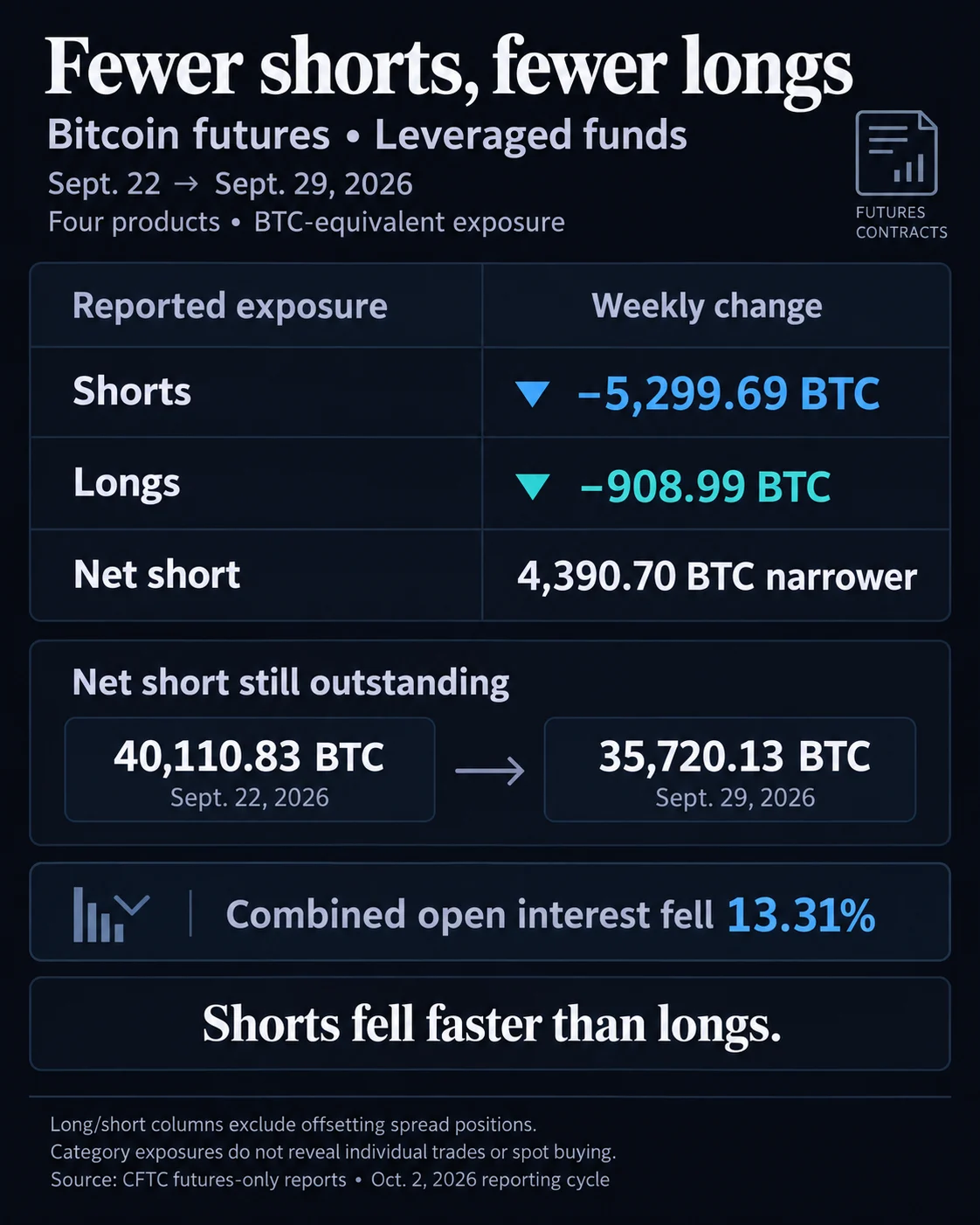
According to the data, reported short positions held by leveraged funds fell by approximately 5,299.69 BTC-equivalent across four major regulated products: the CME Group’s standard and micro Bitcoin futures, as well as Coinbase Derivatives’ nano Bitcoin and nano perpetual-style futures. While the reduction in shorts was substantial, it was accompanied by a decline in long exposure, which fell by 908.99 BTC-equivalent. Consequently, the aggregate net short position for these funds narrowed by 4,390.70 BTC-equivalent, moving from 40,110.83 to 35,720.13. Despite this contraction, the total short exposure maintained by leveraged funds continues to exceed their long positions, a trend consistent with the hedging strategies typically employed by hedge funds and commodity trading advisors.
The Landscape of Regulated Bitcoin Derivatives
The CFTC’s report offers a granular look at the professional trading landscape, converting various contract sizes into a unified BTC-equivalent metric to provide a clear picture of market sentiment. It is important to distinguish that these figures describe futures-only positions—contracts that track the price of Bitcoin—rather than the movement of physical or spot Bitcoin.
The four products tracked in this cycle represent the primary avenues for institutional and retail participation in regulated U.S. derivatives markets. The CME standard Bitcoin futures contract, which represents 5 BTC, remains the flagship instrument for large-scale institutional players. The CME micro Bitcoin futures, sized at 0.1 BTC, cater to smaller institutional and sophisticated retail traders. Coinbase Derivatives’ nano products provide even more granular access. The divergence in performance across these products during the week of September 29 suggests that market participants were not acting with a singular consensus, but rather adjusting to specific liquidity and expiry conditions.
While the standard CME futures accounted for a 4,310 BTC-equivalent reduction in shorts, leveraged funds actually increased their longs in this specific product by 1,175 BTC-equivalent. This localized bullishness was offset by a decline in longs across CME micro futures and both Coinbase nano products, which ultimately led to the aggregate decline in long exposure for the category.
Chronology of the September Position Shift
To understand the significance of the September 29 snapshot, one must look at the preceding week’s data and the internal calendar of the futures market. In the prior reporting period ending September 22, leveraged funds had seen a widening of their net short positions. The reversal observed in the most recent report suggests a tactical retreat or a realization of profits following a period of bearish posturing.

A critical factor in this chronology is the expiration of the September CME micro futures, which occurred on September 25. The period between the September 22 and September 29 snapshots encompassed this expiry date, which often triggers a "roll" where traders close out expiring front-month contracts and open new positions in the following month. The 13.31% decline in combined open interest—from 119,208.26 to 103,343.14 BTC-equivalent—suggests that many traders chose to close their positions entirely rather than rolling them forward. This contraction indicates a temporary reduction in market participation or a "de-leveraging" event as the third quarter drew to a close.
Divergent Institutional Strategies: Leveraged Funds vs. Asset Managers
The CFTC categorizes market participants based on their primary business activities, providing a window into how different "types" of money are moving. Leveraged funds, which include hedge funds and various proprietary trading firms, often engage in "basis trading." This involves going long on spot Bitcoin or Bitcoin ETFs while simultaneously shorting the futures market to capture the "basis"—the price difference between the two. The narrowing of their net short positions could imply a narrowing of this basis, making the trade less profitable, or a broader reduction in their overall exposure to Bitcoin.
In contrast, the "Asset Manager" category—which includes mutual funds, pension funds, and other institutional investors—showed a different trend. Their net long position across the four tracked products increased by 2,137.90 BTC-equivalent, reaching a total of 18,069.10. This improvement in their net position was driven by a modest increase in longs (up 573.10 BTC-equivalent) and a significant reduction in shorts (down 1,564.80 BTC-equivalent). Unlike leveraged funds, asset managers are typically "long-only" or use futures to gain synthetic exposure to the asset class, making their increased net long position a potentially more optimistic signal for long-term price appreciation.
Understanding the Role of Spreading and Hedging
A nuanced reading of the COT report requires an analysis of "spreading" positions. Spreading occurs when a trader holds equal long and short positions in different delivery months or different products to profit from the change in the price spread. In this latest report, leveraged funds’ spreading positions fell by a massive 11,231.11 BTC-equivalent.
The 5,300 BTC-equivalent reduction in shorts mentioned in the headline refers to the "outright" short column, excluding these spreading legs. The fact that both outright shorts and spreading positions declined simultaneously reinforces the narrative of a broad market contraction.
Market analysts caution against interpreting a reduction in shorts as a purely bullish signal. Because futures are frequently used as hedges, a trader might close a short position not because they expect the price to rise, but because they have sold the underlying spot Bitcoin they were hedging. Therefore, while the "net short" has narrowed, it does not necessarily establish a fresh wave of spot demand or a definitive reduction in bearish conviction. It may simply represent a reduction in the total "size" of the bets being placed on the Bitcoin market.

Market Implications and Volatility Outlook
The 13.31% drop in open interest is perhaps the most telling statistic for the immediate future of Bitcoin’s price action. Open interest represents the total number of outstanding derivative contracts that have not been settled. High open interest often correlates with higher volatility, as a sudden price move can trigger a "liquidation cascade" where traders are forced to close their positions, further accelerating the price trend.
With over 15,000 BTC-equivalent of exposure leaving the market in a single week, the "coiled spring" of leverage has been somewhat loosened. This could lead to a period of more stable, albeit perhaps lower-volume, price action as the market searches for a new catalyst. However, the reduction in liquidity that often accompanies lower open interest can also make the market more susceptible to "slippage," where even moderate-sized trades cause larger-than-expected price swings.
Future Outlook and Reporting Cycles
The CFTC’s commitment to transparency through the COT reports remains a vital tool for market participants seeking to gauge institutional sentiment. However, these reports have inherent limitations. They do not reveal individual transactions, nor do they account for positions held on unregulated offshore exchanges, which still command a significant portion of global Bitcoin trading volume. Furthermore, the reports do not capture the offsetting holdings in the spot market or the burgeoning Bitcoin ETF market, which are essential for a holistic view of institutional "net" exposure.
The next reporting cycle is scheduled for release on October 9. This upcoming data will be crucial in determining whether the contraction observed in late September was a temporary phenomenon related to the quarterly expiry and "window dressing" by fund managers, or if it marks the beginning of a more prolonged retreat from Bitcoin futures.
If the net short positions of leveraged funds continue to shrink while asset managers maintain or grow their net longs, it could signal a transition in market leadership from speculative, short-term traders to more stable, long-term institutional holders. Conversely, if open interest begins to climb again without a corresponding increase in long exposure, it may suggest that the market is once again bracing for a period of downward pressure or heightened volatility.
As the Bitcoin market matures, the interaction between regulated futures and the spot price will continue to evolve. For now, the late September data suggests a market in a state of flux—shedding leverage, narrowing its bets, and waiting for the next clear signal to dictate the direction of the final quarter of 2026. Professional observers will be watching closely to see if the "smart money" returns to the short side or if the current reduction in bearish posturing is the prelude to a sustained recovery.









