
 James Watt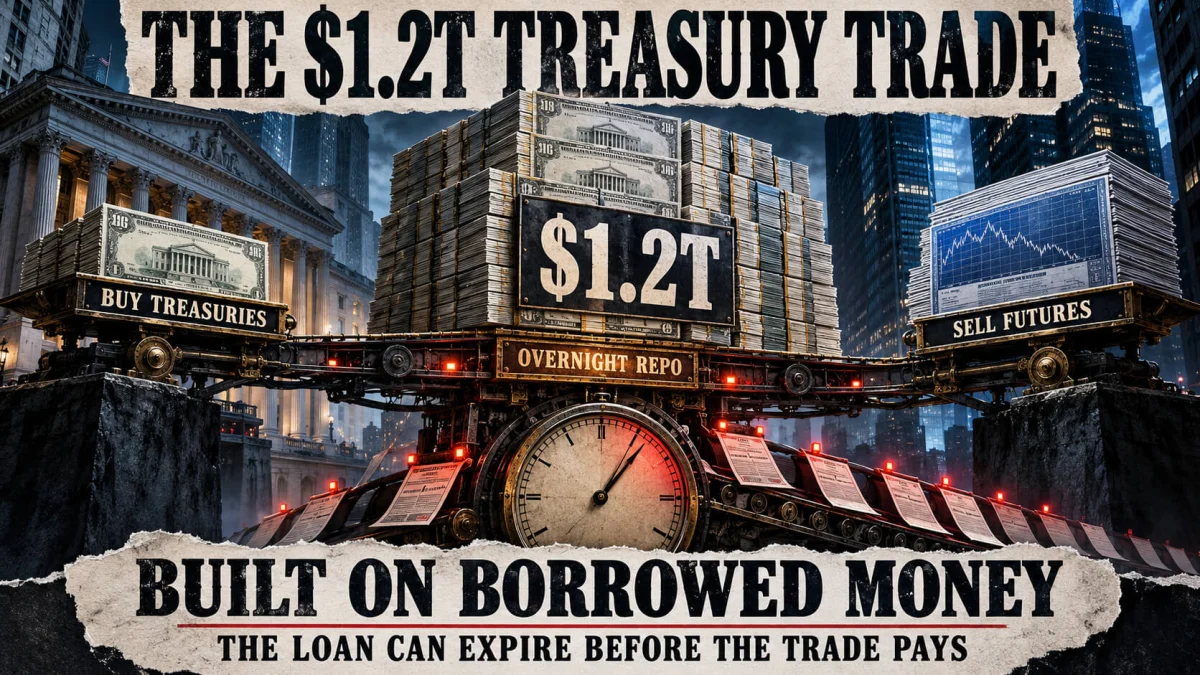
The landscape of the United States Treasury market is undergoing a significant transition as hedge funds begin to scale back one of the most lucrative and controversial strategies in high finance: the cash-futures basis trade. Recent data suggests a notable retreat from these positions, which involve a complex interplay of government debt, derivatives, and massive leverage. As the federal government continues to issue record amounts of debt to fund its deficit, the shifting appetite of these institutional players carries profound implications for bond yields, market stability, and the overall cost of government borrowing.
According to recent reports from Morgan Stanley issued in late September, positions in the Treasury cash-futures basis trade have declined by approximately 20% this year, falling to an estimated $1.2 trillion. While the bank noted that this reduction has not yet triggered broad market stress, the sheer scale of the deleveraging process has captured the attention of regulators and central bankers. The basis trade, which relies on thin margins amplified by significant borrowing, represents a critical but fragile pillar of liquidity in the world’s most important sovereign debt market.
The Mechanics of the Cash-Futures Basis Trade
To understand the current shift, one must first grasp the mechanics of the basis trade. At its core, the strategy exploits a small price discrepancy between a "cash" Treasury bond and its corresponding futures contract. In a typical scenario, a futures contract—which is an agreement to buy or sell a bond at a set price on a future date—may trade at a slight premium to the actual bond currently available in the market.
Hedge funds close this gap by purchasing the physical Treasury security and simultaneously selling (shorting) the futures contract. By doing so, they "lock in" the difference between the two prices. However, because these price gaps are often as small as a few basis points (hundredths of a percentage point), the trade is only profitable if it is executed with massive amounts of leverage. Funds typically borrow the vast majority of the purchase price, often putting up as little as 1% to 2% of their own capital.
The primary vehicle for this borrowing is the repurchase agreement (repo) market. In a repo transaction, a fund sells its newly purchased Treasury bond to a lender (usually a bank or a money market fund) with an agreement to buy it back the following day at a slightly higher price. This effectively creates an overnight loan secured by the bond itself. As long as the cost of borrowing in the repo market remains lower than the yield earned from the basis trade, the strategy generates a steady, albeit leveraged, return.
Chronology of the Basis Trade and Recent Market Evolution
The history of the basis trade is marked by periods of quiet accumulation followed by sudden, volatile unwinds. In late 2019, a sudden spike in repo rates—the cost of overnight borrowing—forced many funds to exit their positions simultaneously, causing significant turbulence in the Treasury market. This was followed by the "dash for cash" in March 2020 at the onset of the COVID-19 pandemic, where the basis trade unwound violently, requiring emergency intervention from the Federal Reserve to restore market functioning.
Following the 2020 crisis, the trade largely disappeared as interest rates hit zero. However, it saw a massive resurgence in 2023 and early 2024 as the Federal Reserve raised interest rates to combat inflation. Higher rates and increased volatility created wider discrepancies between cash and futures prices, attracting hedge funds back into the fray. By mid-2024, estimates of the total size of the trade ranged from $800 billion to over $1 trillion.
The recent 20% contraction identified by Morgan Stanley suggests a cooling period. This shift is driven by several factors: narrowing price gaps, rising costs of financing, and a proactive regulatory environment. As the Federal Reserve signaled a shift toward interest rate cuts in September 2024, the volatility that fueled the basis trade began to settle, prompting some managers to take profits and reduce their exposure to overnight financing risks.
The Hidden Risks: Financing Mismatches and Margin Calls
The fundamental danger of the basis trade lies in its reliance on short-term funding for long-term positions. While the U.S. government’s ability to repay its debt is rarely questioned, the hedge fund’s ability to repay its repo lender is a daily negotiation. If a lender suddenly demands a higher "haircut"—the difference between the loan amount and the value of the collateral—the fund must provide more of its own cash. If that cash is not available, the fund is forced to sell the bond, often at an inopportune time.
Furthermore, the futures side of the trade introduces "variation margin" risk. If bond prices rise, the value of the fund’s short futures position falls. The exchange where the futures are traded will demand immediate cash payments to cover these losses. Even if the fund’s physical bonds have increased in value by an equal amount, that gain is "unrealized" and tied up in the security. This creates a liquidity mismatch: the fund owes cash today but won’t see the profit from its bond until the trade is closed or the bond is sold.
This dynamic creates a "forced selling" loop. When one large fund is forced to liquidate to meet a margin call, it pushes bond prices down. This, in turn, hurts other funds holding the same trade, potentially triggering a cascade of liquidations. This systemic risk is why the Federal Reserve and the Securities and Exchange Commission (SEC) have increased their monitoring of "non-bank financial intermediaries," the technical term for hedge funds and other private investment vehicles.
Comparative Data and Regulatory Perspectives
Tracking the exact size of the basis trade is notoriously difficult because much of it occurs in the "bilateral" repo market, where trades are negotiated privately between two parties without central clearing. In June 2024, Federal Reserve researchers published a note estimating basis positions at approximately $830 billion as of late 2023, based on available regulatory filings. The discrepancy between the Fed’s $830 billion figure and Morgan Stanley’s $1.2 trillion estimate highlights the opacity of the market; different analysts use different proxies, such as the "net short" positions of leveraged funds in futures markets reported by the Commodity Futures Trading Commission (CFTC).
Regulators have responded to these risks with new mandates. The SEC has finalized rules that will require a significant portion of Treasury and repo trades to be centrally cleared by 2026. Central clearing involves a central counterparty (CCP) stepping between the buyer and the seller, standardizing margin requirements and reducing the risk that one party’s default will topple the entire system. While this is expected to make the market more resilient, it may also increase the cost of the basis trade, potentially explaining why some funds are exiting the strategy now before the full weight of the new regulations is felt.
Broader Implications for Government Borrowing and Market Liquidity
The retrenchment of hedge funds from the basis trade raises a critical question: who will buy the Treasury bonds instead? Hedge funds have effectively acted as a "bridge," absorbing the supply of Treasury bonds that exceeds the immediate demand from long-term investors like pension funds and foreign central banks.
When hedge funds exit, the market must find new owners. These new owners—often called "real money" investors—typically do not use the same levels of leverage. However, they may demand a higher yield to compensate for the lack of immediate liquidity or the absence of the arbitrage opportunity. Consequently, an orderly exit from the basis trade might lead to a structural increase in interest rates for the U.S. government, even if the Federal Reserve is cutting its benchmark rate.
Moreover, the capacity of primary dealers (the large banks that facilitate Treasury auctions) is limited by post-2008 capital requirements. Banks cannot simply hold an infinite amount of debt on their balance sheets without hitting regulatory ceilings. If hedge funds stop providing the "lubricant" of the basis trade, the Treasury market could become "thinner," meaning that even small trades could cause larger-than-expected price swings.
Institutional Liquidity and the Connection to Other Markets
The implications of the basis trade deleveraging extend beyond the bond market. Large multi-strategy hedge funds often manage the basis trade alongside other portfolios, including equities and digital assets. While the link between Treasury basis trades and Bitcoin is not direct, it exists through the lens of institutional liquidity.
When a fund faces a margin call on its Treasury futures, it does not necessarily sell more Treasuries; it sells whatever is liquid and available. This can include high-growth stocks or cryptocurrencies. Therefore, periods of stress in the Treasury repo market often correlate with "de-risking" across all asset classes. However, analysts caution against assuming that every dip in the crypto market is a result of Treasury volatility. Rather, the connection lies in the "broader balance sheet" health of the firms involved. If a firm’s capital is tied up in meeting higher haircuts for Treasury repos, it has less "dry powder" to support positions in other markets.
Conclusion: A Transition Toward a More Stable, but Costly, Market
The reduction in Treasury basis trade positions reported by Morgan Stanley marks a transition point for the financial system. The "mountain of debt" owned by hedge funds is slowly being redistributed. While a smaller basis trade reduces the risk of a catastrophic, leverage-driven market "blow-up," it also removes a significant source of demand for government securities.
The shift toward central clearing and the move of bonds into the hands of long-term, unleveraged investors are generally viewed by regulators as positive steps for systemic stability. However, this stability comes at a price. Without the aggressive arbitrage provided by hedge funds, the gap between cash and futures may widen, and the Treasury may find itself paying a premium to attract the next generation of bondholders. As the market moves away from its dependence on overnight loans, the era of "cheap" liquidity provided by the basis trade appears to be entering a period of significant recalibration.









