admin
admin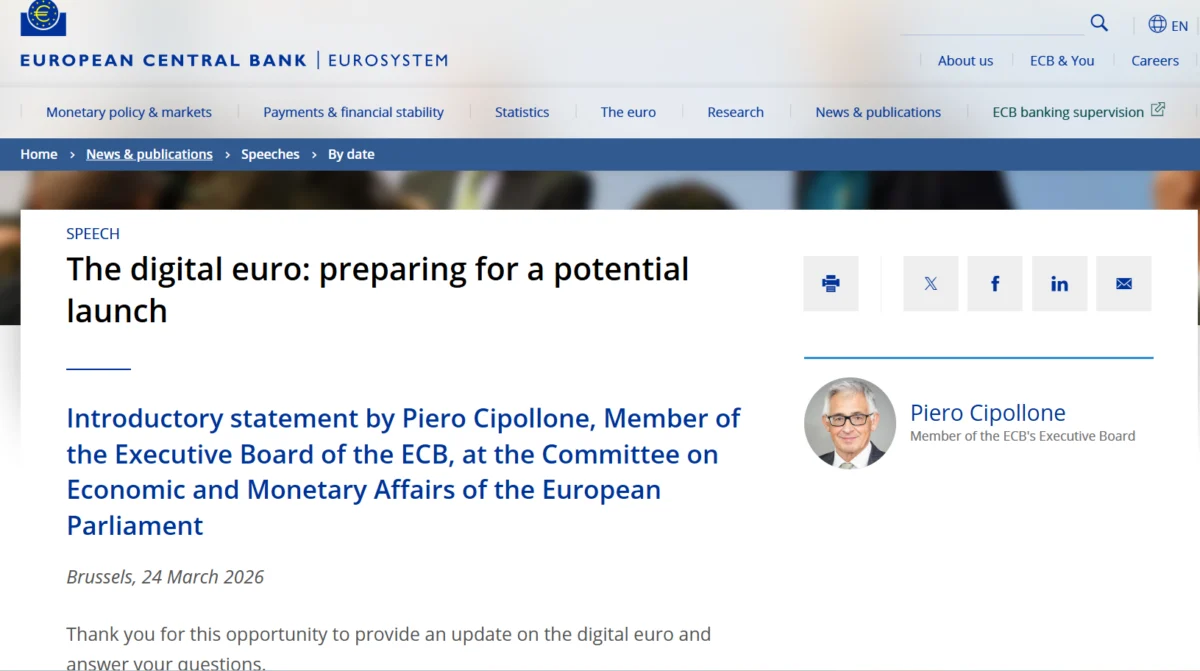
The European Central Bank (ECB) has accelerated its preparations for a sovereign digital currency, with Executive Board member Piero Cipollone announcing on Tuesday that the institution expects to unveil the technical standards for a potential digital euro by this summer. This strategic move is designed to provide payment service providers and merchants with the necessary lead time to adapt their systems and infrastructure well before a formal decision on issuance is reached. Speaking before European Union lawmakers, Cipollone emphasized that establishing these standards early will allow the private sector to begin embedding the required "rails" into payment terminals and digital applications, ensuring that the European financial ecosystem is technically prepared for a new era of digital payments.
The Strategic Roadmap Toward a Digital Euro
The announcement marks a critical juncture in the Eurosystem’s investigation into a central bank digital currency (CBDC). According to Cipollone, the finalization of the "rulebook" or technical framework will serve as a blueprint for market participants. By releasing these standards in the coming months, the ECB aims to synchronize technical development with the legislative process. The central bank anticipates that EU legislation governing the digital euro will be finalized and in place by 2026.
Following the legislative milestone, the ECB plans to launch a comprehensive digital euro pilot program in the second half of 2027. This pilot, which recently saw a call for licensed payment service providers to participate, is scheduled to run for 12 months. During this period, the ECB will test various use cases, including person-to-person (P2P) transfers and point-of-sale (POS) transactions, within a controlled, real-world environment. If the pilot proves successful and lawmakers provide the necessary legal sign-off, the technical infrastructure could be ready for a formal issuance around 2029.
This timeline reflects the ECB’s cautious yet deliberate approach to modernization. The goal is not merely to create a digital version of the euro but to ensure that the infrastructure supporting it is robust, secure, and seamlessly integrated into the existing financial fabric of the Eurozone.
Economic Considerations and the Burden of Implementation
One of the primary concerns surrounding the digital euro is the cost of implementation for the private sector. Recent analysis conducted by the ECB estimated that the digital euro could cost European Union banks between 4 billion and 6 billion euros over a four-year rollout period. While these figures appear substantial, the central bank has sought to put them into perspective, noting that this expenditure represents approximately 3% of the banking sector’s annual information technology maintenance budgets.
Cipollone urged lawmakers and industry stakeholders to weigh these upfront costs against the long-term strategic benefits. Currently, the European payment landscape is heavily reliant on international card schemes, such as Visa and Mastercard. By establishing a homegrown digital payment infrastructure, the ECB believes that European merchants could retain a larger share of transaction fees that are currently diverted to non-European entities. Furthermore, a unified digital euro would allow for the scaling of European payment schemes across the entire euro area, reducing fragmentation and enhancing the competitive posture of European financial institutions.
The ECB’s vision is to provide a "public payments infrastructure." In this model, the central bank provides the foundational rails, while private intermediaries—such as commercial banks and payment service providers—act as the interface for consumers. These private entities would be responsible for offering digital euro wallets and value-added services, ensuring that the ECB does not compete directly with the private sector for consumer deposits or retail services.
Technical Design: Inclusivity, Privacy, and Co-Badging
A significant portion of Cipollone’s address focused on the design philosophy of the digital euro. He reiterated that the digital currency is intended to complement, rather than replace, physical cash and traditional bank deposits. To ensure that the digital euro is accessible to all segments of society, the ECB is embedding inclusivity features into the reference app design from the very beginning. These features include voice-command capabilities and large-font displays to assist the elderly and those with visual impairments.
Privacy also remains a cornerstone of the project’s design. While the digital euro must comply with anti-money laundering (AML) and "know your customer" (KYC) regulations, the ECB has explored "offline" payment options that would allow for a higher degree of privacy in small-value transactions, mimicking the anonymity of physical cash.
Furthermore, the ECB is championing the concept of "co-badged" cards. This would allow a single physical or digital card to support both domestic payment schemes and the digital euro. Such an arrangement would allow users to switch between different payment rails seamlessly, whether they are shopping at a local boutique or traveling across borders within the euro area. This interoperability is seen as essential for achieving the scale necessary to challenge dominant international incumbents.

The Wholesale Frontier: Pontes and Appia Projects
While the retail digital euro often captures the headlines, the ECB is equally focused on the wholesale application of central bank money. Cipollone highlighted the importance of central bank money remaining the "anchor" for future wholesale markets, particularly as financial assets become increasingly tokenized.
The ECB is currently spearheading several initiatives in this space, most notably the "Pontes" project and the "Appia" roadmap. The Pontes project is designed to test the settlement of tokenized securities in central bank money across various distributed ledger technology (DLT) platforms. By providing a bridge between traditional central bank money and DLT-based financial markets, the ECB aims to ensure that the settlement of high-value transactions remains safe and efficient in a decentralized environment.
The Appia roadmap, meanwhile, outlines a vision for a tokenized European financial ecosystem. In a separate address, Cipollone detailed how tokenized central bank money could serve as the ultimate settlement asset for private-sector innovations, such as stablecoins and tokenized deposits. By acting as a neutral and risk-free settlement layer, the ECB hopes to prevent the fragmentation of the financial system and maintain the integrity of the single currency in the digital age.
Financial Stability and the Role of Commercial Banks
The prospect of a digital euro has sparked a vigorous debate regarding financial stability. Commercial banks have expressed concerns that a digital euro could lead to "disintermediation," where consumers move their deposits out of commercial bank accounts and into digital euro wallets held at the central bank. Such a shift could potentially reduce the lending capacity of banks and increase their funding costs.
To mitigate these risks, the ECB has proposed several safeguards. Chief among these is a cap on the amount of digital euro any individual can hold. While the exact limit is still under discussion, figures ranging from 3,000 to 4,000 euros have been suggested. Additionally, the digital euro would likely be non-interest-bearing to ensure it is used primarily as a medium of exchange rather than a store of value.
Cipollone’s testimony suggests that the ECB views the digital euro as a tool to strengthen, rather than weaken, the banking sector. By providing banks with a modern platform to offer new services, the ECB believes it is helping the European financial industry stay relevant in a world where "Big Tech" firms and foreign CBDCs are increasingly encroaching on traditional banking territory.
Global Context and Competitive Implications
The Eurozone is not alone in its pursuit of a CBDC. According to the Atlantic Council, over 130 countries, representing 98% of global GDP, are currently exploring digital versions of their currencies. China’s digital yuan (e-CNY) is already in an advanced pilot stage, while the United Kingdom and the United States continue to research the implications of a "Britcoin" and a digital dollar, respectively.
For the ECB, the digital euro is a matter of strategic autonomy. In an era of geopolitical volatility, the reliance on foreign-owned payment rails is seen as a potential vulnerability. By developing its own digital currency, Europe aims to safeguard its monetary sovereignty and ensure that its payment systems remain resilient to external shocks or political pressures.
Implications for the Future of Payments
The announcement of technical standards this summer will be the first major test of the ECB’s ability to coordinate with the private sector. For merchants, the arrival of these standards means they can begin planning for hardware upgrades and software integrations. For payment providers, it provides a clear set of rules for developing the next generation of digital wallets.
As the 2026 legislative deadline approaches, the dialogue between the ECB, EU lawmakers, and the banking industry is expected to intensify. The success of the digital euro will ultimately depend on its adoption by the public, which in turn depends on its ease of use, security, and the perceived value it adds over existing digital payment methods.
By setting a clear timeline and focusing on the technical "rails" of the system, the ECB is positioning the digital euro not just as a currency, but as a comprehensive infrastructure project designed to future-proof the European economy. The move toward summer standards is a signal to the market that the digital euro is moving out of the realm of theory and into the phase of practical implementation.