James Watt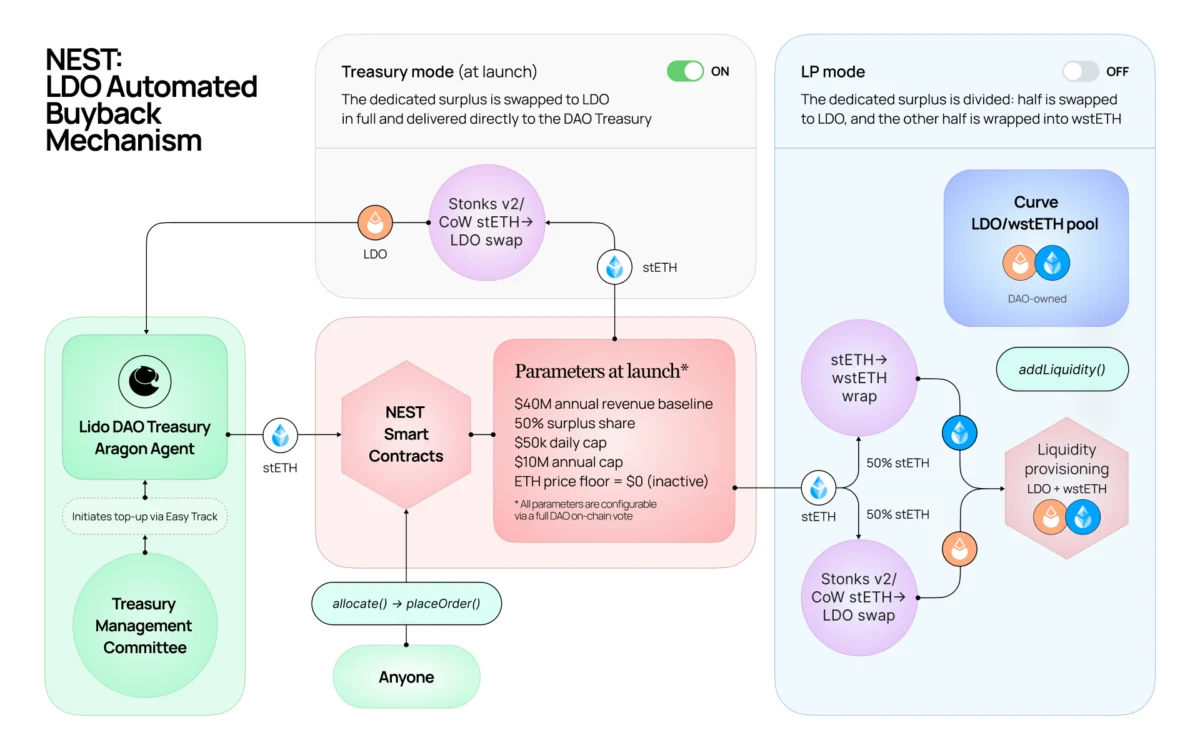
The Lido DAO has officially launched NEST (Network Economic Support Tokenomics), an innovative on-chain mechanism designed to directly link the success of the Lido protocol to its native governance token, LDO. This strategic initiative, a key goal identified in Lido’s open strategic cycles for both 2025 and 2026, establishes an automated, transparent, and permissionless system for LDO acquisition, funded by surpluses from the DAO treasury. NEST represents a significant evolution in decentralized finance (DeFi) tokenomics, aiming to foster long-term sustainability and deepen the economic alignment between the protocol’s performance and its token holders.
Background: Understanding Lido DAO and Liquid Staking
To fully appreciate the significance of NEST, it’s crucial to understand the foundational elements of the Lido ecosystem. Lido DAO is a leading decentralized autonomous organization (DAO) in the liquid staking space, primarily focused on Ethereum. Liquid staking allows users to stake their cryptocurrencies (like Ethereum’s ETH) to earn rewards while still maintaining liquidity through a derivative token (such as stETH). This innovation addresses a significant drawback of traditional staking, where assets are locked, preventing their use in other DeFi protocols.
Lido operates by allowing users to deposit their ETH, which is then distributed among a network of professional node operators. In return, users receive stETH, a tokenized representation of their staked ETH plus accumulated staking rewards. stETH can then be used across various DeFi platforms, unlocking capital efficiency. The Lido DAO governs this complex network, making critical decisions regarding protocol upgrades, fee structures, and treasury management. The LDO token serves as the governance token, granting its holders voting rights over the DAO’s strategic direction and operational parameters.
The "LDO alignment" goal, prominently featured in the DAO’s strategic roadmap, seeks to ensure that as the Lido protocol grows and generates more revenue, the LDO token directly benefits. This alignment is vital for incentivizing participation in governance, attracting long-term holders, and creating a more robust economic feedback loop within the ecosystem. NEST is the culmination of this strategic objective, transforming theoretical alignment into a tangible, programmatic reality.
The Genesis of NEST: A Strategic Imperative and Transparent Governance
The development of NEST is rooted in Lido DAO’s commitment to transparent, secure, and decentralized governance. Operating within publicly defined strategic cycles, the DAO meticulously sets goals and mandates the Lido Foundations to execute them. The pursuit of LDO alignment was identified as a paramount objective for 2025 and reaffirmed for 2026, signaling a long-term vision for the token’s integration into the protocol’s economic success.
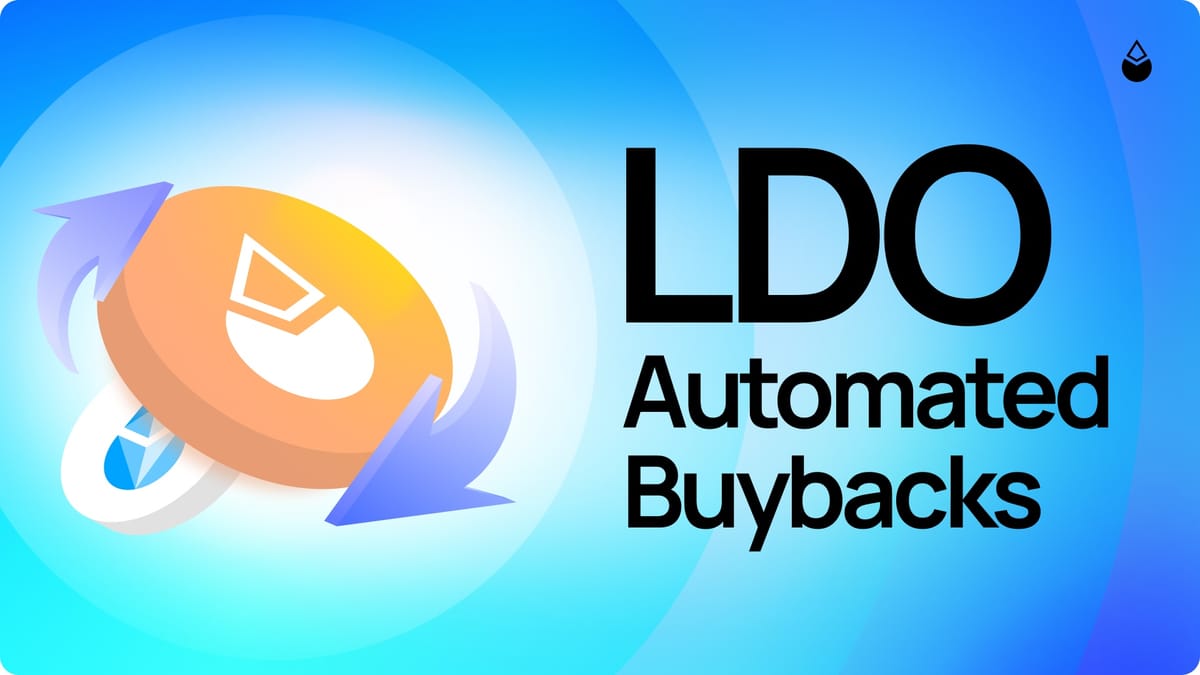
The DAO’s governance mechanisms are built to the highest industry standards. Protocol upgrades, for instance, are passed through fully on-chain votes, ensuring immutability and community consensus. A distinctive feature, Dual Governance, provides stETH holders with inherent oversight of DAO decisions, adding another layer of checks and balances. Even routine treasury allocations are managed through optimistic Easy Track motions, streamlining operations while maintaining security. This rigorous approach was extended to the LDO buyback mechanism, where simpler, less transparent paths were deliberated and ultimately rejected in favor of a robust, on-chain solution.
The community’s commitment to these principles led to the comprehensive approval of NEST. The technical architecture was greenlit through a Snapshot vote on its "technical rails" (0x4267fe277e52a3550e82286af96948a258392ddd303df6b479c4d8f4664acdd0), followed by a separate vote solidifying the "mechanism design" (0x022e901a6368573d18b150eecda563dd2ee17ad2aa6a0ef9772151cc7ba55187). These approvals underscore the community’s desire for a system that is not only effective but also fully auditable, permissionless, and under the direct control of the DAO. The design choices prioritize transparency and decentralization, ensuring that LDO buybacks operate without human intervention or discretionary decision-making, thereby minimizing potential for manipulation or bias.
NEST Unveiled: Mechanism and Operation
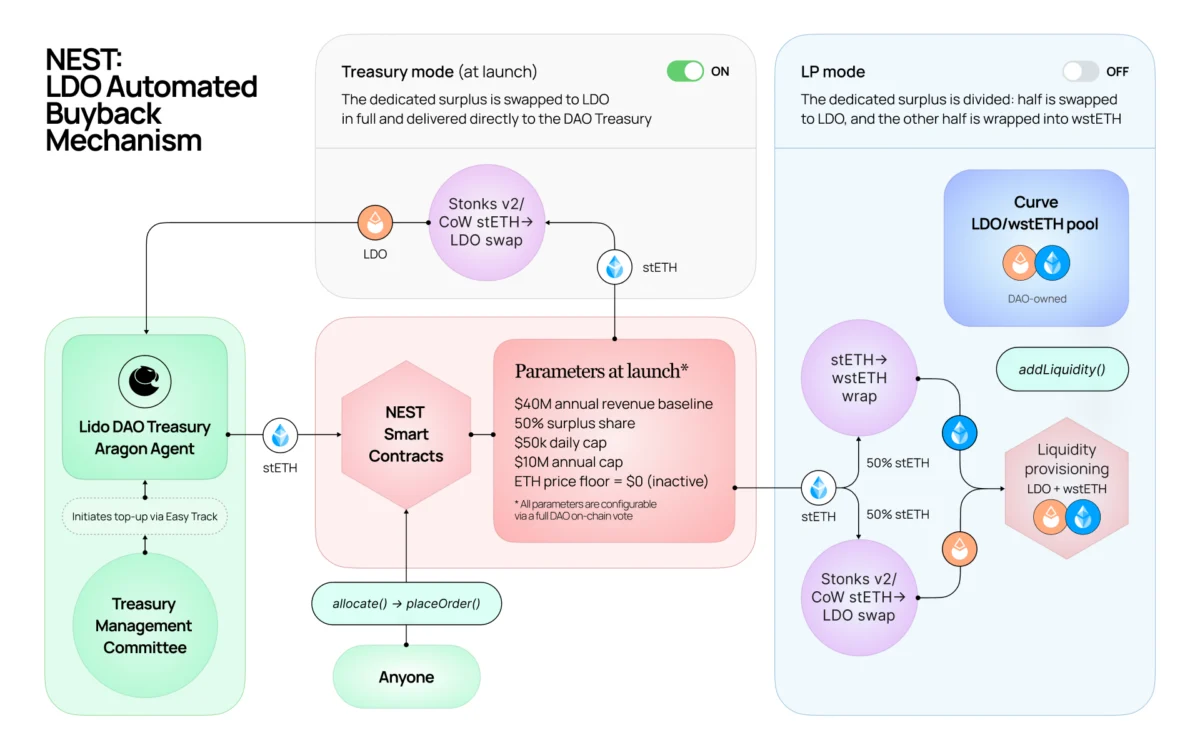
At its core, NEST is a programmatic system that systematically uses a predefined portion of the Lido protocol’s revenue to acquire LDO tokens. This process is contingent on specific thresholds and conditions meticulously detailed in Lido Improvement Proposal (LIP-36). The fundamental principle is straightforward: when the protocol’s staking revenue surpasses an established operating baseline, a bounded share of this surplus is automatically converted into LDO. This conversion is facilitated through CoW Swap, a decentralized exchange aggregator renowned for its MEV protection and efficient order execution. Consequently, a direct relationship is established: the greater the protocol’s earnings, the higher the volume of LDO acquired.
The mechanism operates on a daily comparison basis. Each day, NEST evaluates the DAO’s allocated share of staking revenue against a predetermined revenue baseline. If the revenue exceeds this baseline, 50% of the difference (the current share set at launch) is added to a continuously accumulating NEST balance. As long as this balance remains positive, NEST proceeds with daily LDO purchases, adhering strictly to predefined caps. Should the balance fall into negative territory, purchases are paused until new protocol surpluses replenish the balance. This cumulative model is a deliberate design choice, crafted to circumvent the pitfalls of a purely daily-spend approach, such as overspending during periods of exceptionally high revenue or the inability to carry forward unused capacity during leaner times.
Dual Operational Modes for Optimal Performance
Recognizing that on-chain LDO liquidity can fluctuate, NEST’s buyback mechanism is engineered with two distinct operational modes, designed to optimize performance and adaptability:
-
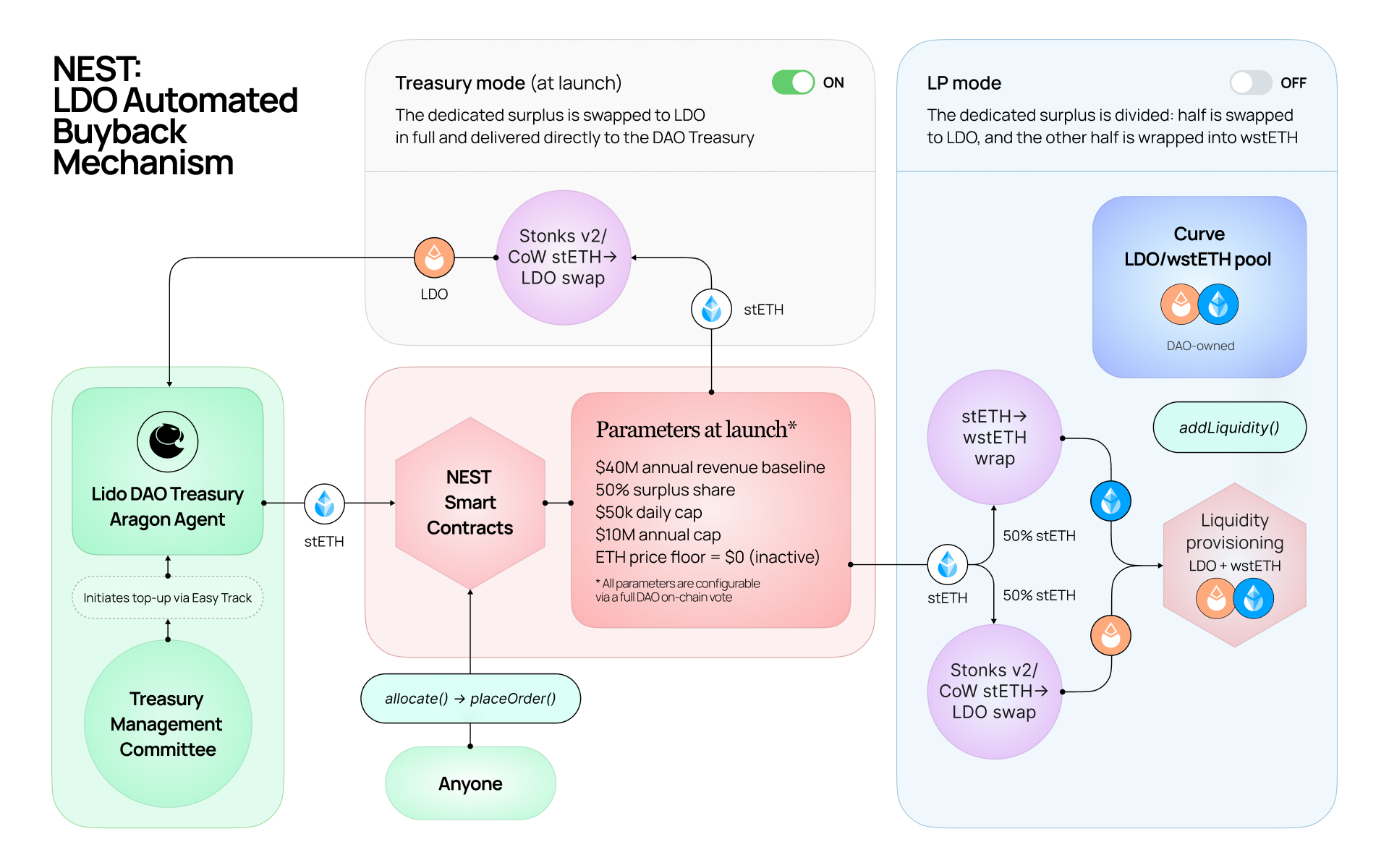
Treasury-only Mode: In this initial mode, the daily allocation designated for LDO acquisition is converted in full. The acquired LDO tokens are then directly transferred to the DAO treasury via an Aragon Agent contract (0x3e40D73EB977Dc6a537aF587D48316feE66E9C8c). This mode is straightforward and ensures that the DAO directly accumulates LDO, strengthening its holdings and governance power. NEST is launched in this Treasury-only mode, providing a stable and predictable start to the program.
-
LP Mode (Liquidity Provision Mode): This mode is designed to enhance on-chain LDO liquidity under specific market conditions. When activated, the daily allocation is split: half is used to purchase LDO, while the other half is wrapped into wstETH (wrapped stETH). Both components are then deposited as DAO-owned liquidity into a Curve v2 NG pool. The resulting LP (Liquidity Provider) tokens remain under direct DAO ownership, allowing the DAO to earn trading fees and potentially deepen LDO’s liquidity across the DeFi ecosystem. The Curve pool required for this mode has already been deployed, meaning a transition to LP mode would simply necessitate an on-chain DAO vote, highlighting the mechanism’s inherent flexibility.
The decision to launch in Treasury-only mode reflects a pragmatic approach, as the full benefits of LP mode are realized only under particular market dynamics. This phased rollout allows the DAO to observe the initial impact of NEST and make an informed decision about transitioning to LP mode when market conditions are most favorable for liquidity provision.
Key Parameters and Transparent Controls
The initial configuration of NEST, as approved by the DAO, incorporates several critical parameters that ensure its controlled and secure operation:
- Surplus Allocation: 50% of the daily staking revenue surplus (above the baseline) is directed towards the NEST balance.
- Daily LDO Purchase Cap: A daily limit of $50,000 is imposed on LDO purchases. This serves as a primary safety guardrail, effectively bounding the DAO’s exposure to approximately $300,000 over a typical six-day governance response window, offering ample time for intervention if necessary.
- Cumulative Balance Model: The mechanism uses a running NEST balance, ensuring that unspent capacity from previous days can be utilized, and preventing overspending during consecutive high-revenue days.
- Revenue Source: At launch, NEST exclusively tracks Lido protocol staking revenue. However, its architectural design is modular, allowing for future governance votes to incorporate additional revenue sources as Lido’s product line expands, ensuring future adaptability and scalability.
All these parameter values are fully adjustable through a formal DAO vote. This empowers the Lido community to fine-tune NEST’s operation as the protocol’s economics evolve, ensuring its continued relevance and efficiency in dynamic market conditions.
Financial Projections and Backtesting Insights
To validate the efficacy and prudence of NEST’s design, extensive backtesting was conducted using historical revenue data. Analysis of Lido’s revenue streams from 2024 to 2025 demonstrated that the cumulative model would have successfully delivered $7.09 million in LDO acquisitions from a total of $94.18 million in rewards, precisely meeting its target spend. This impressive efficiency, capturing a significant portion of surplus revenue for LDO acquisition, underscores the mechanism’s potential to provide consistent economic alignment without disrupting the protocol’s operational stability.
The detailed calculations and comparisons against alternative buyback designs are meticulously documented in LIP-36 and extensively discussed within the Lido Research forum, providing a transparent record of the decision-making process and reinforcing the DAO’s commitment to rigorous financial modeling.
Mitigating Risks: A Robust Security Framework
The implementation of a programmatic mechanism that daily expends treasury assets inherently introduces specific risks. The NEST mechanism has been designed with comprehensive mitigation strategies to address these concerns:
- Economic Risks: Potential for market manipulation or adverse price impact during large buybacks.
- Mitigation: The $50,000 daily cap significantly limits market impact and prevents sudden large purchases that could be exploited. The use of CoW Swap further minimizes MEV (Maximal Extractable Value) and ensures optimal execution prices by batching orders and leveraging professional solvers.
- Operational Risks: Issues with smart contract execution or external dependencies.
- Mitigation: NEST’s core logic is entirely on-chain and permissionless, meaning it operates autonomously without requiring manual intervention. Its integration with battle-tested DeFi primitives like CoW Swap and Curve v2 NG minimizes exposure to novel smart contract risks.
- Smart Contract Risks: Vulnerabilities within NEST’s own code.
- Mitigation: The mechanism’s design has undergone rigorous internal review and external audits (though specific audit details are not provided in the original text, this is a standard practice for Lido). Its modular nature also limits the blast radius of any potential vulnerability. All NEST-purchased assets remain DAO-owned, and any movement outside the mechanism’s defined operational paths requires explicit DAO authorization through a vote, adding a crucial layer of security.
- Governance Risks: Potential for malicious or suboptimal parameter changes.
- Mitigation: All parameter adjustments require a full DAO vote, ensuring broad community consensus before any changes are enacted. The multi-day voting process and the visibility of proposed changes provide ample time for review and debate, protecting against hasty or malevolent alterations.
Distinguishing NEST from the LDO Accumulation Program
It is crucial to differentiate NEST from the LDO Accumulation Program, a separate and distinct initiative. The LDO Accumulation Program, approved by the Lido DAO on April 13, 2026 (0x43be9ee8ce820d444f706e9dd763a223ebabf37be27931cc056888e6c2e48814), is a one-time, discretionary treasury operation. Unlike NEST, which is a structural, automated, and permissionless mechanism, the Accumulation Program is committee-executed and designed to utilize specific market opportunities through targeted trades. Its batch parameters, execution updates, and further details are published on the Research forum (research.lido.fi/t/utilizing-market-opportunities-steth-ldo-trade/11358), clearly separating its design and governance from NEST. This distinction is vital for understanding Lido’s multifaceted approach to treasury management and LDO tokenomics.
Broader Implications and Future Outlook
The launch of NEST marks a significant milestone not only for Lido DAO but also for the broader DeFi landscape. By implementing a fully automated, on-chain revenue-sharing mechanism tied directly to its governance token, Lido sets a new precedent for sustainable tokenomics.
The implications are far-reaching:
- Enhanced LDO Value Proposition: By creating a continuous, programmatic demand for LDO, NEST aims to strengthen the token’s value proposition. This direct link to protocol success can foster greater confidence among holders and encourage long-term participation in the Lido ecosystem.
- Improved Treasury Management: NEST provides an efficient and transparent method for deploying DAO treasury surpluses, ensuring that excess funds are strategically reinvested into the ecosystem’s foundational token rather than remaining idle.
- Decentralization and Transparency: The permissionless and on-chain nature of NEST reinforces Lido’s commitment to decentralization. Every transaction is transparent and auditable, aligning with the core ethos of blockchain technology.
- Model for Other DAOs: NEST could serve as a blueprint for other decentralized autonomous organizations seeking to create more robust and economically aligned tokenomics models. Its transparent design and rigorous risk mitigation strategies offer valuable insights for protocols grappling with similar challenges.
- Future Growth Potential: The modular architecture of NEST, allowing for the integration of additional revenue sources as Lido’s product line expands, positions it as a dynamic mechanism capable of evolving with the protocol. As Lido ventures into new liquid staking opportunities or introduces new services, NEST can adapt to ensure continued LDO alignment across the entire ecosystem.
In conclusion, NEST is more than just an automated buyback program; it is a foundational pillar for Lido DAO’s long-term sustainability and economic health. By intertwining the protocol’s success with the value of its governance token through a transparent and resilient on-chain mechanism, Lido DAO reinforces its position as a leader in innovative DeFi governance and tokenomics. As NEST begins its operation, it promises to usher in a new era of economic alignment, fostering a stronger, more resilient, and more decentralized future for the Lido ecosystem.