James Watt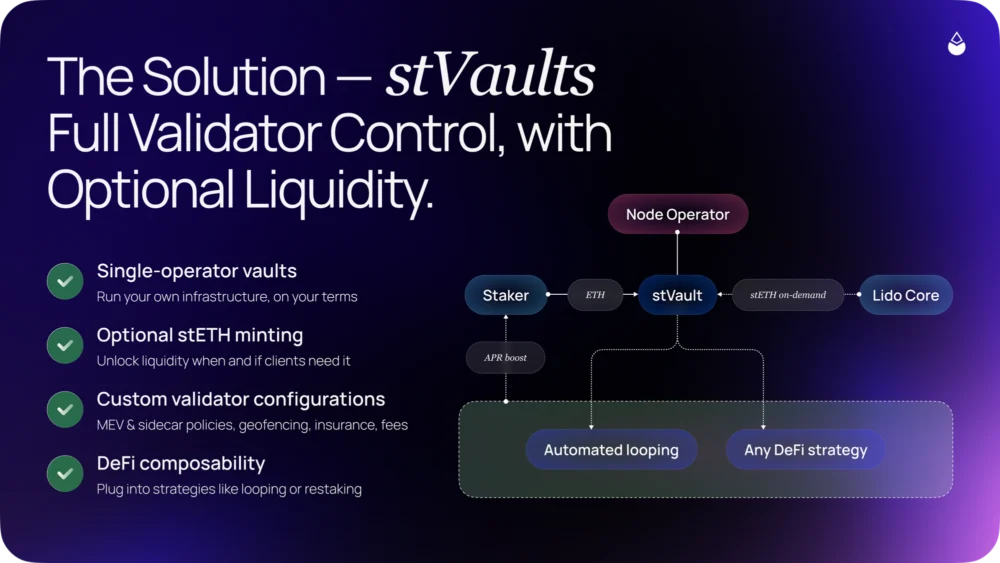
London, UK – January 15, 2026 – Lido Finance, a leading decentralized autonomous organization (DAO) in the liquid staking sector, has announced the successful mainnet launch of Lido V3 on the Ethereum network. This pivotal upgrade introduces stVaults, a novel modular staking primitive designed to fundamentally transform how businesses and individuals interact with Ethereum staking, offering unprecedented customization, control, and liquidity. The rollout positions Lido to expand beyond its established pooled liquid staking model, ushering in an era of composable staking infrastructure for a diverse range of market participants.
The launch on Ethereum mainnet marks the culmination of an extensive and rigorous validation process, emphasizing security and community collaboration. This multi-stage approach included multiple public testnet deployments, comprehensive security audits by leading blockchain security firms, and a controlled mainnet soft-launch period. Lido contributors designed this meticulous public launch strategy to uphold the same principles of durability and reliability that have characterized Lido Core: a relentless focus on security, transparent community input, and an unwavering commitment to open-source software development.
A New Paradigm for Ethereum Staking
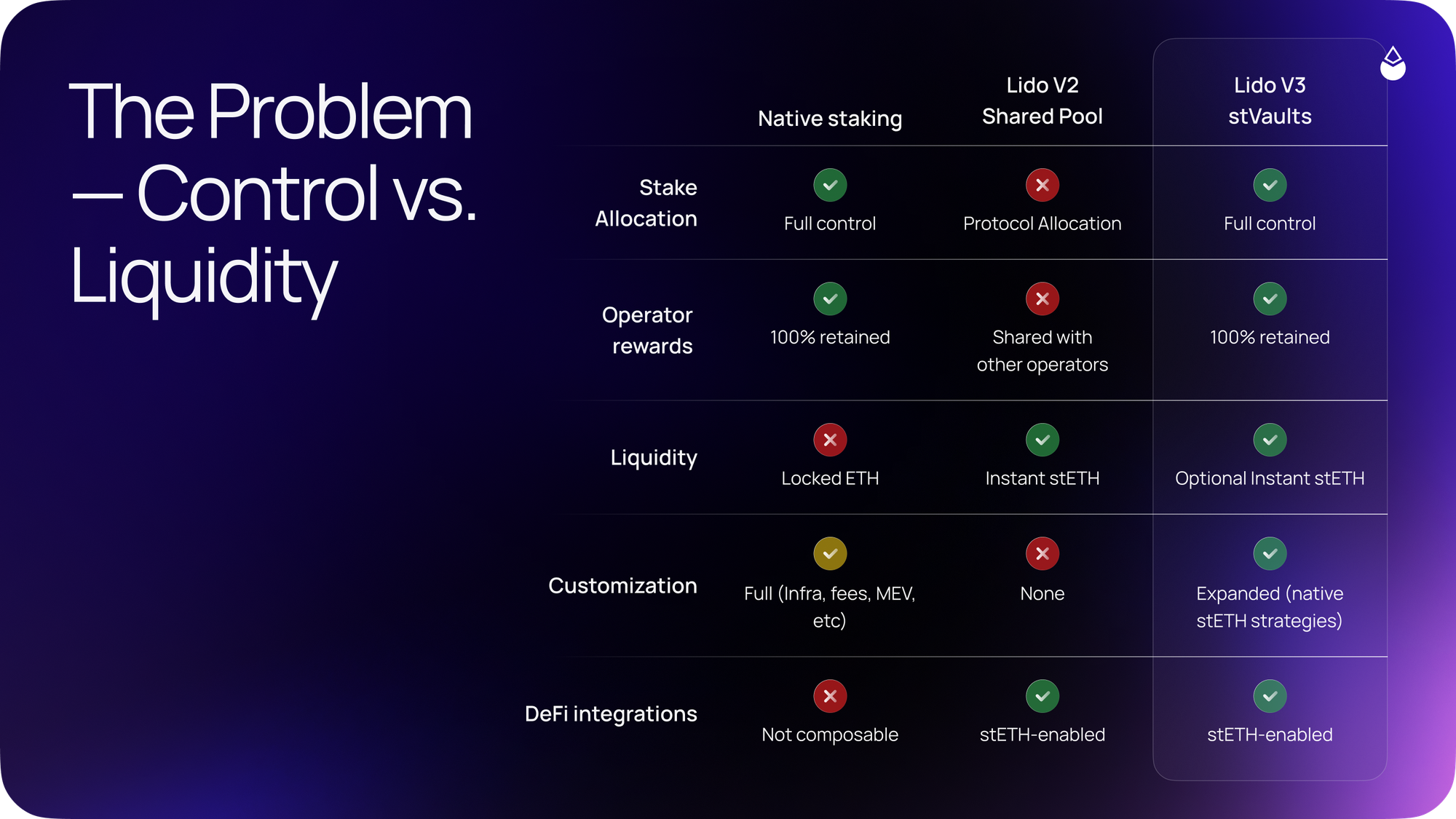
At its core, Lido V3 addresses a long-standing structural trade-off faced by Ethereum stakers. Historically, participants have been forced to choose between the bespoke control offered by solo staking or dedicated infrastructure and the liquid utility provided by pooled liquid staking solutions like Lido. While solo staking grants granular control over validator operations, operator selection, and risk parameters, it often comes with significant capital requirements, technical overhead, and, crucially, illiquidity due to withdrawal queues. Conversely, pooled liquid staking, pioneered by Lido, offers immediate liquidity through tokens like stETH, enabling participation in DeFi, but typically involves surrendering direct control over specific validator parameters to the protocol’s aggregated pool.
stVaults are engineered to resolve this dilemma, offering a hybrid solution that merges the best of both worlds. They empower stakers to customize critical parameters such as operator selection, fee structures, reward logic, and risk policies, all while retaining access to the profound liquidity and extensive network effects of stETH. This innovation is poised to unlock a new paradigm for Ethereum staking offerings, enabling any team, from institutional asset managers to specialized node operators and DeFi builders, to construct tailored staking businesses leveraging the most powerful network effects in the decentralized finance (DeFi) ecosystem.
From Pooled Liquid Staking to Composable Infrastructure
Lido’s initial success with its Core protocol underscored a fundamental truth: combining staking with a liquid token dramatically amplifies market forces. The introduction of stETH (staked ETH) transformed illiquid staked assets into a usable and transferable token across the DeFi landscape. stETH quickly became a cornerstone of DeFi, serving as collateral for lending protocols, underpinning liquidity provider (LP) positions, and facilitating a myriad of other financial strategies, all without subjecting stakers to the often-long and unpredictable withdrawal queues inherent to native Ethereum staking. As of early 2026, stETH maintains a market capitalization exceeding $30 billion, making it one of the largest and most integrated assets by Total Value Locked (TVL) in DeFi.
Lido V3 extends this foundational concept to a broader spectrum of staking models. With stVaults, the protocol evolves into a more versatile and modular infrastructure. Key advancements include:
- Customizable Staking Strategies: Stakers can now define unique strategies that align with their specific risk appetites, compliance needs, or operational preferences.
- Differentiated Operator Offerings: Node operators gain the ability to offer specialized staking products, differentiating themselves based on performance, geographical location, regulatory compliance, or underlying infrastructure.
- Regulated Institutional Staking: The modularity of stVaults provides the necessary framework for regulated financial institutions to participate in Ethereum staking while adhering to stringent compliance and operational requirements.
- Embedded Staking for Layer 2s: Layer 2 (L2) scaling solutions can integrate native ETH yield directly into their ecosystems, creating new economic models and user experiences.
This adaptable structure supports a new generation of staking businesses, fostering innovation across the ecosystem and paving the way for wider adoption of Ethereum staking by diverse entities.
Rigorous Validation and Security at the Forefront
The journey to Lido V3’s mainnet launch was characterized by a meticulous and transparent development and validation process, beginning with conceptual discussions within the Lido DAO in late 2024. The development roadmap prioritized security and resilience, drawing lessons from the protocol’s extensive operational history.
Public testnet deployments, commencing in mid-2025, allowed developers, node operators, and potential users to experiment with stVault functionalities in a simulated environment. This iterative feedback loop was crucial for identifying and refining core features. Multiple independent security audits by renowned blockchain security firms were conducted, thoroughly scrutinizing the smart contract code for vulnerabilities. These audits are a non-negotiable step in Lido’s commitment to safeguarding user funds and protocol integrity. Following successful audits and extensive testing, a phased mainnet soft-launch was initiated to monitor real-world performance under controlled conditions before the full public release in January 2026. This comprehensive chronology underscores Lido’s dedication to delivering robust and secure decentralized infrastructure.
Institutional Staking Without Compromising Liquidity
The institutional adoption of liquid staking has been a significant trend, yet many traditional asset managers and corporate treasuries have encountered limitations with existing models. Their requirements often include:
- Jurisdictional Compliance: The need to adhere to specific regulatory frameworks in different regions.
- Segregation of Assets: Strict mandates for segregating client funds or corporate assets for accounting and risk management purposes.
- Specific Operational Policies: Demands for particular validator infrastructure, geographic distribution, or security protocols.
- Custom Fee Structures: Negotiated or tailored fee arrangements that fit institutional financial models.
Traditional staking models frequently fall short for modern asset managers, particularly due to long exit queues and inherent illiquidity risk, which are incompatible with treasury management and fund liquidity requirements. stVaults directly address these challenges by enabling segregated vault structures that can be linked to dedicated validator infrastructure. Crucially, these segregated structures can still offer optional stETH liquidity, providing institutional clients the flexibility to manage their staked assets actively within DeFi, or to hold them as a long-term yield-bearing asset, without sacrificing the control they require.
Early deployments of stVaults already illustrate this expansive design space:
- A regulated financial institution deploying a vault with specific geographical constraints for its validators to comply with local regulations.
- A corporate treasury utilizing a stVault with a predefined set of audited node operators and a custom risk management policy.
- An asset manager creating a vault with dedicated capital and a bespoke fee structure for its clients, offering transparent performance reporting on their specific allocation.
The outcome is an institution-grade staking experience that eliminates the forced choice between customization and liquidity, opening up Ethereum staking to a significantly broader institutional audience.
Empowering Node Operators and Differentiated Products
Lido V3 also fundamentally alters the business case for Node Operators, providing them with new avenues for growth and differentiation. In the pre-stVaults era, operators largely chose between running their own independent staking services, which required significant capital and marketing efforts, or participating in large pooled protocols like Lido, where differentiation beyond uptime and basic performance was challenging.
stVaults create fertile ground for operator-led products, allowing node operators to design and manage vaults mapped to their specific validator infrastructure, complete with customized operational policies, branding, and service level agreements. For example, P2P.org, a prominent staking provider, is leveraging stVaults to build dedicated offerings that enable institutional clients to stake through segregated vaults directly linked to P2P.org’s validator operations. This facilitates unparalleled customization, transparent performance reporting, and the ability to offer specialized services. Such a foundation also supports a wider array of products, from conservative staking exposures to more advanced, curator-driven DeFi vault strategies built around the robust liquidity of stETH.
This innovation empowers operators to compete on factors beyond just price, focusing instead on performance, specific vault configurations, regulatory compliance, and value-added services. The expanded design space for staking strategies includes:
- Risk-Adjusted Vaults: Tailoring risk parameters and operator selection for clients with specific risk appetites.
- Geographically Distributed Vaults: Catering to institutions requiring validators in specific jurisdictions for regulatory or decentralization purposes.
- ESG-Focused Staking: Creating vaults that only utilize node operators committed to environmental, social, and governance (ESG) principles.
- Curated DeFi Strategies: Building vaults that actively manage stETH within DeFi protocols to generate enhanced yield or implement specific hedging strategies.
Complementing this strategy flexibility is a robust tooling ecosystem designed to reduce time-to-market for teams launching user-facing staking products. Lido V3 includes the "DeFi Wrapper" toolkit, aimed at facilitating low-code deployments of end-user staking products. This toolkit encompasses:
- Modular Smart Contracts: Reusable components for building custom staking logic.
- Developer Libraries: APIs and SDKs to easily integrate stVaults into existing applications.
- Pre-integrated Curated Strategies: Ready-to-use strategies that allow builders to ship differentiated products without developing curation logic from scratch.
- Custom Strategy Integration: The flexibility to integrate unique competitive advantages for specific market segments.
This comprehensive suite of tools significantly lowers the barrier to entry for innovators looking to build on Lido’s robust infrastructure.
Embedded Staking for Layer 2s: Native Yield at Scale
The modularity inherent in stVaults also enables a transformative shift: bringing staking closer to where users already hold their ETH. Layer 2 scaling solutions, designed to alleviate congestion and reduce transaction costs on Ethereum, can now route bridged ETH directly into staking through stVaults. The resulting yield can then be strategically utilized to support critical ecosystem initiatives, such as funding network incentives, bootstrapping liquidity programs, or subsidizing gas fees, all without requiring users to navigate a separate staking journey.
Early collaborative efforts in this direction include L2 implementations from platforms like Linea, which demonstrate how staking can be seamlessly integrated into network economics. By making yield a native component of L2s, these solutions can attract more users, enhance capital efficiency, and foster a more vibrant and self-sustaining ecosystem.
This pattern is significant because it redefines staking as fundamental infrastructure—a yield-bearing base layer that protocols can integrate and leverage, rather than merely a standalone action users must explicitly undertake. This abstraction of complexity is crucial for mainstream adoption and for realizing the full potential of a yield-generating Ethereum.
Building on Lido V3: An Open Invitation
Lido V3 represents a significant evolution, transforming liquid staking from a singular product category into a versatile infrastructure layer for a broad spectrum of staking businesses. stVaults make it possible to:
- Deploy institutional-grade staking solutions with enhanced control and compliance features.
- Launch operator-led staking products that offer greater differentiation and value.
- Build structured DeFi vaults with customized strategies and risk profiles.
- Integrate L2-native staking solutions for embedded yield and enhanced ecosystem economics.
Lido contributors extend an open invitation to teams and developers actively building in these areas to engage with the Lido DAO. The protocol is designed to support the next wave of innovation in Ethereum staking.
To incentivize early adoption and foster rapid development, Lido is offering a special promotional campaign. Until March 31st, 2026, the standard Lido Infrastructure fee for stVaults will be reduced from 1% to 0%. This significant reduction applies to identified vaults with a Total Value Exceeding 250 ETH. Interested parties are encouraged to contact the stVaults team to participate in this campaign and begin building on Lido V3 today. Further details on the campaign and the underlying risk assessment framework can be found in the Lido research forum.
Developers and teams can initiate their building journey by exploring the comprehensive stVaults Documentation Center. For a deeper dive into the technical intricacies, including concepts such as Reserve Ratios, risk tiers, and forced rebalancing mechanisms, the official Lido V3 Whitepaper provides an exhaustive resource. With stVaults, Lido V3 is poised to redefine the landscape of Ethereum staking, making it more accessible, flexible, and powerful for all participants.