James Watt
The close of 2025 marked a pivotal period for Lido, with its latest Q4 2025 VaNOM (Validator Node Operator Metrics) report highlighting substantial progress in enhancing the decentralization, resilience, and operational diversity of its Ethereum validator set. The comprehensive report, now live and accessible, details strategic advancements across Lido’s staking modules, underscoring a concerted effort to fortify the protocol’s contribution to the broader Ethereum ecosystem. Key achievements include the expansion of permissionless staking, significant strides in Distributed Validator Technology (DVT) adoption, a more balanced client diversity profile, and improved infrastructure and geographic distribution, collectively reinforcing Lido’s commitment to long-term network health.
Strategic Evolution of Staking Modules: Empowering Community and Diversification
The final quarter of 2025 saw significant evolution across Lido’s core staking modules, driven by key governance decisions and robust community engagement. A cornerstone change in late September, approved by LDO tokenholders, elevated the Community Staking Module (CSM) stake share limit from 3% to 5% for 2025. This increase coincided with the mainnet activation of the CSM v2 upgrade and the introduction of the Identified Community Staker (ICS) framework, designed to empower independent operators.
The ICS framework quickly gained meaningful traction, evaluating 482 applications by January 1, 2026, with 345 approvals and 220 operators successfully claiming ICS status. By offering tailored conditions and transparent eligibility criteria, ICS aims to dismantle structural barriers for truly independent operators, directly fostering a more diversified operator composition and bolstering decentralization within both the Lido protocol and Ethereum at large. ICS status unlocks enhanced validation parameters, including a 6% reward share for the first 16 validators, deposit priority for the initial 10 validators, a reduced bond requirement for the first validator, lower removal fees, and more flexible performance thresholds compared to the general permissionless CSM operator type.
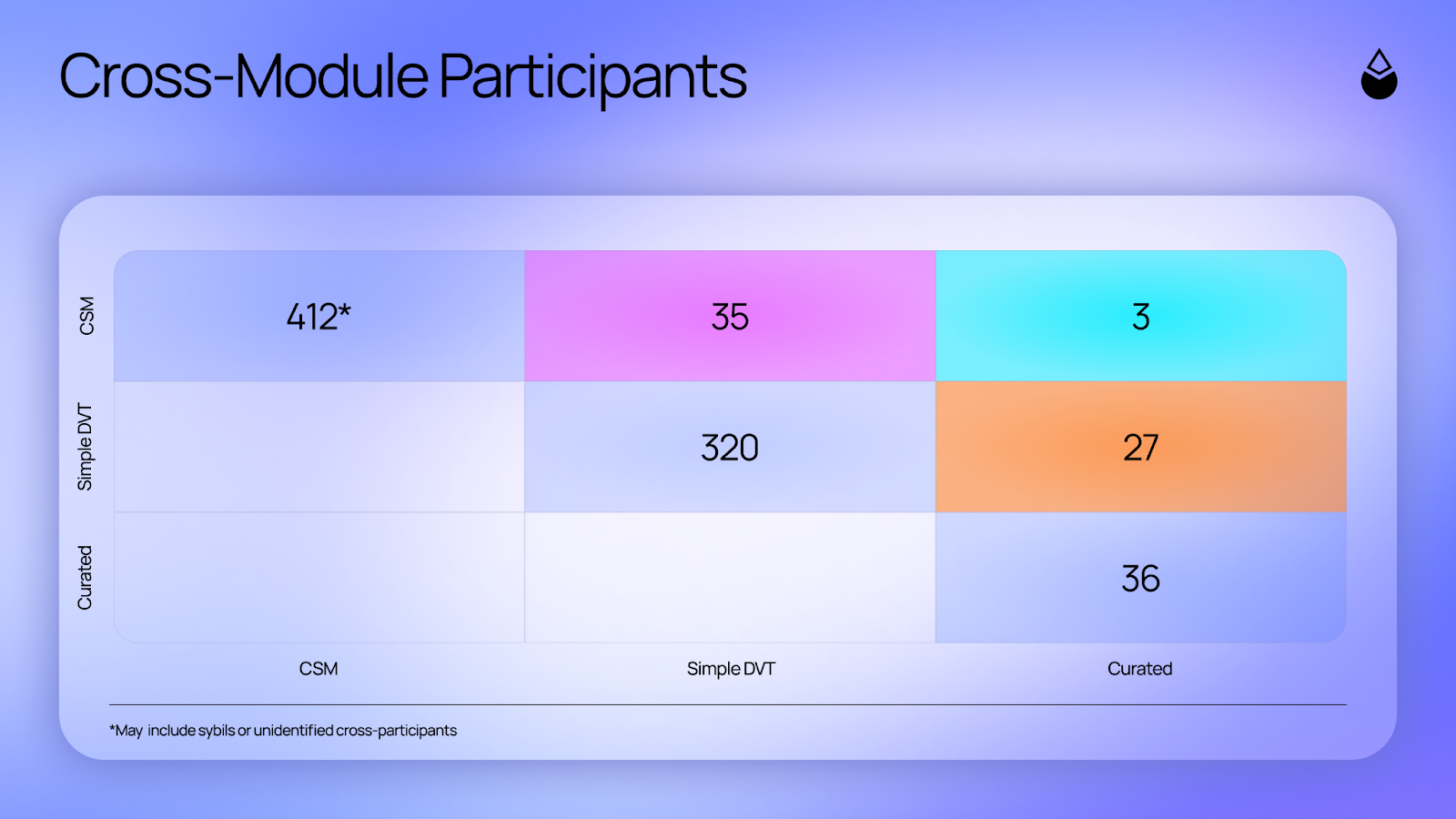
Following renewed deposit inflows, the CSM reached its new 5% stake share limit in December, marking a robust 29.35% quarter-over-quarter (QoQ) growth. Annually, the module added an impressive 377,664 ETH, a clear indicator of strong community interest in permissionless validator participation within the Lido protocol. The operator composition within CSM remains predominantly independent, with 345 (83.74%) of 412 active operators qualifying under the ICS type. Additionally, 35 operators participate across both CSM and the Simple DVT Module, alongside three Curated Node Operators (P2P, Stakely, and Launchnodes) also active within CSM, showcasing a healthy blend of participation.
Simultaneously, the Simple DVT Module (SDVTM) also experienced a capacity adjustment in December, with the DAO approving an increase in its target stake share from 4% to 4.3%. This strategic move addressed an allocation bottleneck, ensuring the module could maintain its stake cap while completing validator allocations to clusters yet to reach their approved capacities (80 validators for regular clusters and 500 for Super Clusters). This change guarantees operational continuity and prevents underutilization of approved cluster infrastructure, solidifying the protocol’s commitment to integrating Distributed Validator Technology (DVT). As of January 1, 2026, the decentralized modules – CSM and SDVTM – collectively represented nearly 800,000 ETH, or 2.2% of total Ethereum stake. This marks a 0.53 percentage point increase from Q3 2025 and nearly a threefold expansion from the end of 2024, demonstrating tangible progress in diversifying Lido’s validator set over the year.
Strategic Rebalancing within the Curated Module
December also brought notable reconfigurations within the Curated Module (CM), Lido’s largest staking module, further aligning its internal distribution with decentralization objectives. A41, a long-standing node operator, announced its decision to wind down node operations across all networks and formally requested that the Lido DAO reduce its validator limit to zero. This enabled the protocol to process validator exits seamlessly. Concurrently, Pier Two, which had been operating 3,766 validators, was allocated an additional 3,200 validators, bringing its total to 6,966 by year-end. This increase brought Pier Two’s validator count into parity with other operators in the Curated Module, significantly improving stake distribution balance.

By the end of 2025, the Curated Module showcased an exceptionally balanced distribution, reflected in a Gini coefficient of 0.001 and an HHI (Herfindahl-Hirschman Index) of 0.0278. For context, a Gini coefficient closer to zero indicates higher equality, while a lower HHI signifies reduced market concentration. These metrics confirm a near-equal stake allocation among participating Node Operators, with each of the 36 active Curated NOs operating consistently between 6,967 and 6,967 validators. This total accounted for approximately 0.71% of all Ethereum validators, well below the 1% soft cap defined in the Lido Scorecard and Operator Set Strategy. This achievement represents a structural improvement in stake distribution within the Curated Module. While it remains the largest Lido Staking Module, its internal allocation now demonstrates significantly reduced concentration risk and stronger alignment with the protocol’s long-term decentralization objectives for Ethereum.
Enhancing Ethereum’s Resilience: Validator Set Client Diversity
Lido’s validator set continues to prioritize and maintain a balanced distribution across both Consensus Layer (CL) and Execution Layer (EL) clients. This commitment is crucial for mitigating correlated failure risks and bolstering Ethereum’s overall resilience. While client distribution naturally varies by module design and operator composition, Lido consistently demonstrates a stronger client balance than the broader pan-Ethereum average.
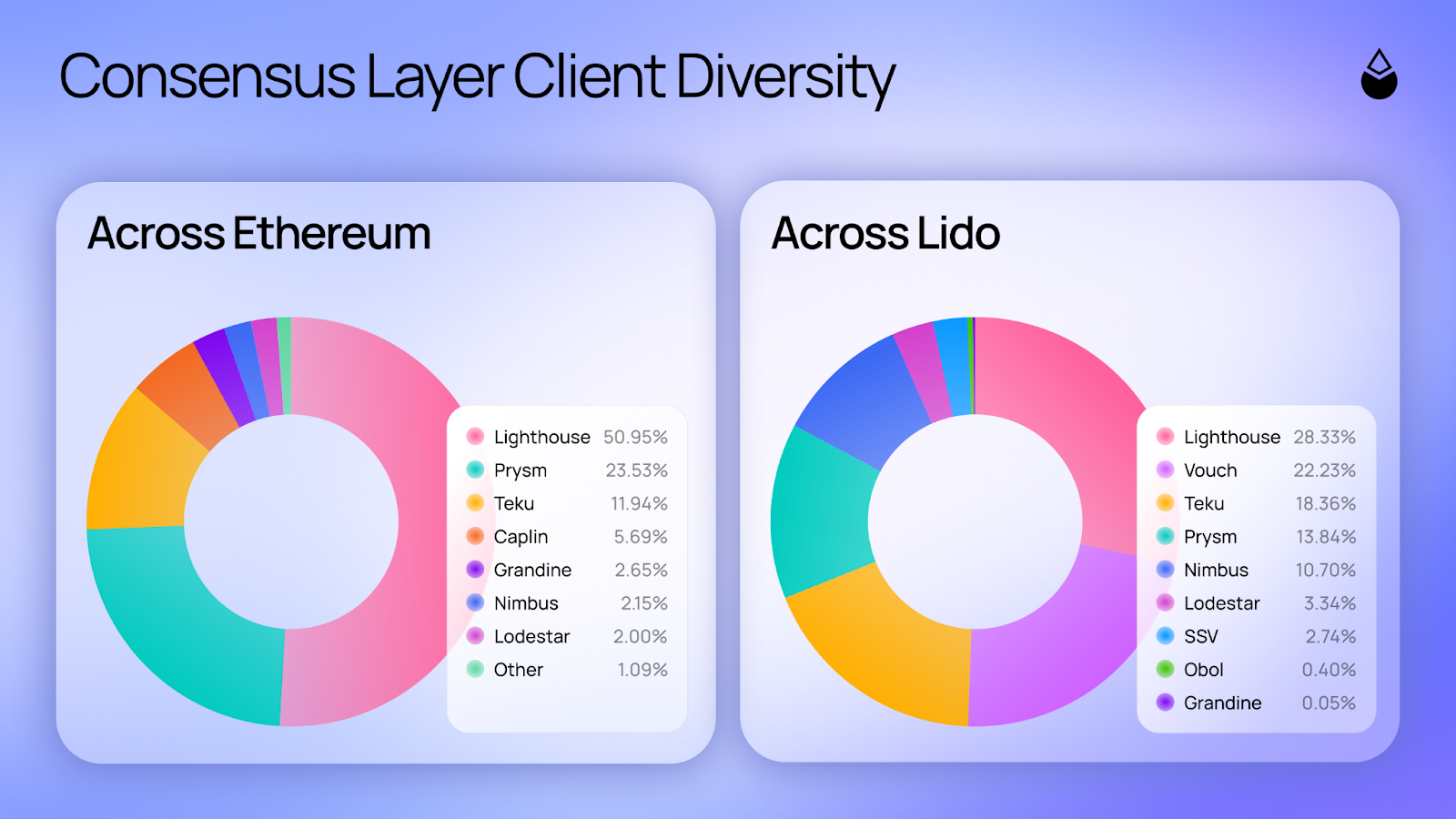
In the broader CL landscape, Lighthouse remains dominant, accounting for 50.95% of validators, an increase of 5.03 percentage points year-over-year (YoY). In contrast, Lido validators reflect a more meaningfully distributed profile, with no Beacon Node (BN) client exceeding 33% of the total validators. This strategic diversification actively mitigates supermajority and finality risks that could arise from excessive client concentration. Notably, multi-node setups now represent more than a quarter of Lido’s validators (27.86%), a significant increase of 4.72 percentage points, largely propelled by the growing adoption of DVT within the Curated Module. At the module level, both the Curated and Community Staking Modules achieve an exemplary balance, with their most popular clients, Lighthouse and Nimbus, accounting for 27.53% and 35%, respectively. Within the SDVTM, Lighthouse still leads with 52.63% of validators, though this marks a 3.87 percentage point decrease from the previous year, indicating a gradual shift towards greater diversity.
Improving EL client diversity has been a sustained focus for Lido DAO contributors and Node Operators since the Ethereum Merge in Q3 2022. Since then, deliberate efforts – both operator-driven and governance-driven – have steadily reduced dependency on any single dominant client. As minority clients matured and stabilized post-Merge, Node Operators progressively expanded their Lido Execution Layer configurations. This commitment became increasingly transparent in early 2024 when Curated Node Operators began publicly sharing their commitments on the Lido Research Forum to further reduce majority client exposure. Two years later, the impact is measurable: across the Curated Module, no EL client holds a supermajority. Erigon’s presence remains low at 0.6% (a 3 percentage point decrease compared to the end of 2024), following earlier rotations by operators like Figment and Stakely towards Reth, Geth, and Nethermind.
The top five EL clients are also consistently represented across both the CSM and Simple DVT modules. In Simple DVT, Nethermind remains the most widely used client at 54.51%, representing a 6.61 percentage point decrease compared to year-end 2024. In CSM, Nethermind accounts for 60%, followed by Geth (21%), Besu (14%), Reth (3%), and Erigon (1%). While Nethermind retains a leading position in the decentralized Staking Modules, the broader EL landscape across Lido’s validator set remains multi-client, largely due to the Curated set, which operates 91.09% of the protocol stake. Here, distribution is more structurally balanced, with four EL clients meaningfully active. The heatmap data visually illustrates how validators are distributed across various combinations of EL and BN clients, highlighting real-world operator preferences and compatibility trends. This diversity across pairings further diminishes correlated client risks and strengthens the overall robustness of the Lido validator ecosystem.

The Rise of Distributed Validator Technology (DVT) Adoption
The year 2025 marked a significant acceleration in the adoption of Distributed Validator Technology (DVT) across all Lido Staking Modules. By year-end, DVT powered 22,233 validators, representing 711,456 ETH. This staggering growth translates to a 537,792 ETH increase year-over-year, or over four times growth from 2024. In total, Lido DVT-powered validators now account for 1.99% of total Ethereum stake, making a meaningful protocol-level contribution to Ethereum’s resilience through diversified, DVT-based infrastructure.
A major catalyst for this expansion was the accelerated adoption of Obol and SSV Network within the Curated Module, following Lido DAO approval of intra-operator setups. Expanding DVT adoption by extending it beyond Lido’s decentralized modules into its largest staking module significantly strengthens fault tolerance and represents a structural enhancement to Lido’s validator architecture. As a direct result, combined DVT utilization across Curated validators reached 3.45%, with continued testing and staged mainnet adoption anticipated to further increase this share.
By the end of 2025, all 70 Regular clusters and 10 Super Clusters of the Simple DVT Module became fully allocated. Compared to Q3, this represented an additional 80 Obol and 38 SSV Network validators, bringing the module to its governance-approved allocation and accounting for 4.0% of the Lido protocol. Within the Community Staking Module, where DVT utilization remains fully voluntary, its adoption also expanded meaningfully. Compared to Q3, 1,249 additional validators (+78.45%) adopted Obol or SSV Network solutions. Among CSM operators who reported their infrastructure choices, 35.38% utilize DVT-based setups. While SafeStake – used exclusively within CSM – announced its cessation of operations, its footprint was limited to 4 operators running 8 validators, resulting in no material impact on overall DVT adoption.
In 2025, DVT transitioned from an emerging technology to a widely adopted operational choice among Lido Node Operators of various types. Beyond its internal impact, Lido’s growing DVT adoption contributes significantly to broader ecosystem-level validation of distributed validator infrastructure. By deploying DVT across multiple Staking Modules, Lido actively helps stress-test implementations under real economic conditions and production workloads. Collectively, the protocol’s DVT share stands at 8.36%, solidifying Lido’s contribution to a more decentralized, diversified, and robust Ethereum validator ecosystem.
Infrastructure and Geographic Distribution: Pillars of Decentralization

As of the end of 2025, Lido Node Operators collectively utilized 658 nodes, marking a 14.6% increase over the year. Concurrently, validator density per node declined by 14.5%, a crucial shift reflecting a structural improvement in operational risk management. Fewer validators per node reduce correlated downtime risk in the event of hardware or hosting failures, thereby contributing to stronger validator-level resilience across the Lido protocol.
Within the Curated Module, Public Cloud remains the most widely used hosting option at 47.7%, though its share decreased by 3.8 percentage points year-over-year from 50.5%. This shift corresponds with a notable increase in dedicated servers, which grew to 26.44% (+4.04 percentage points) in Q4 2025. Provider diversity remained stable overall, though specific shifts occurred: AWS usage decreased by 3.25 percentage points to 13.59%, while OVH and Hetzner saw modest increases, and Google Cloud usage declined by 1.63 percentage points to 4.79%. This measured rebalancing suggests Lido Node Operators are proactively diversifying hosting exposure rather than concentrating further within cloud providers, a positive signal for decentralization and operational risk mitigation.
A similar reduction in Public Cloud reliance was observed within the Simple DVT Module, where cloud usage declined by 4.22 percentage points to 12.9% by the end of Q4 2025. Consistent with previous quarters, dedicated servers remained the dominant infrastructure choice at 60.67%. Home nodes (9.00%) and Colocation (Colo) setups (8.44%) remained stable quarter-over-quarter, indicating continued participation from independent solo and community stakers within the Simple DVT Module. Within the CSM, Home nodes continue to be the most common hosting choice, underscoring the module’s permissionless and community-oriented focus. Simultaneously, a modest increase in Managed Servers (7.81%) and Public Cloud usage (3.21%) reflects participation from professional staking providers drawn by attractive staking terms. Reducing validator density per machine, diversifying cloud exposure, and maintaining meaningful participation across home, colo, and dedicated environments collectively reduce correlated failure domains within the Lido validator set, enhancing its overall robustness.

Geographic Distribution: Expanding Ethereum’s Global Footprint
The geographic distribution data, unified across all Lido staking modules, illustrates a multi-regional validator footprint. For the Community Staking Module, geographic data is self-reported, reflecting only operators who chose to disclose their infrastructure location. Validator distribution is based on primary server locations, with darker shades indicating higher validator concentration.
Within the Curated Module, the overall geographic footprint remained stable throughout 2024. Germany and the United States continued to host the largest number of validators, with 48,402 and 32,397 respectively. While both jurisdictions experienced a modest decline in validator counts, their relative leadership remained unchanged. The most notable growth was observed in Australia, where the validator count nearly doubled following the additional allocation to Pier Two. This expansion significantly increased Asia-Pacific representation within the Curated Set, contributing to broader geographic dispersion. Overall, while the Curated Module still reflects concentration in historically strong validator regions, these incremental shifts indicate a gradual rebalancing rather than further consolidation.

Geographic distribution within the Simple DVT Module remained broadly stable across Europe, the Americas, and the Asia-Pacific regions, as clusters scaled toward their target validator capacities. Germany and Finland accounted for a meaningful share of validators, but the distribution remained multi-regional. The United States, United Kingdom, France, and Singapore continued to be well represented, while several previously underrepresented jurisdictions expanded their presence as clusters matured. Among CSM operators who reported infrastructure locations, the top ten jurisdictions were diverse, including various European nations, North American countries, and parts of Asia-Pacific. Given that reporting is voluntary, these figures likely underrepresent the total geographic dispersion, but nevertheless suggest a continued expansion of the validator footprint beyond traditional infrastructure hubs. Geographic distribution plays a critical role in validator decentralization, as jurisdictional diversity reduces regulatory concentration risk, improves network liveness under localized disruptions, and strengthens Ethereum’s censorship resistance assumptions. Throughout 2025, Lido’s validator set maintained its multi-regional representation while gradually expanding into new jurisdictions.
Looking Ahead: Continued Evolution Towards Greater Decentralization
Zooming out, 2025 marked a period of continuous and strategic evolution for the Lido validator set. Decentralization advanced not through isolated minor improvements, but through coordinated progress across all modules: expanded permissionless participation via CSM, significant DVT adoption across Curated operators, more even stake distribution within the largest staking module, improved client diversity, reduced infrastructure density per machine, and enhanced geographical distribution. Taken together, these changes reflect a validator ecosystem that is not only more performant but also more distributed across operators, infrastructure, geographies, and software implementations, significantly strengthening Lido’s contribution to Ethereum’s long-term resilience and health.

Looking ahead to 2026, further diversification is anticipated on multiple fronts. The proposed design of CMv2 introduces the ability to create multiple sub-operator profiles of different types under a single entity, including Decentralization Operators, Extra Effort Operators, and Intra- and Multi-Operator DVT Clusters. These configurations are meticulously designed to support individual Node Operator contributions that enhance decentralization and broader ecosystem robustness, while maintaining essential risk controls through calibrated bond requirements and performance guardrails. Simultaneously, a potential future expansion of the CSM toward a 10% stake share, alongside the continued growth in the number of operators qualifying for the Identified Community Staker (ICS) type, is expected to further broaden permissionless participation and integrate more independent operators into the Lido validator set.
As always, Lido DAO contributors will continue to refine the protocol’s metrics and dashboards to accurately reflect its growing complexity and ensure data-driven accountability. The full Q4 2025 VaNOM dashboard is available for exploration, allowing stakeholders to revisit previous reporting periods and stay informed. For ongoing monthly insights into the evolution of the Lido validator set, the Validator Set Updates section of the operator portal provides regular information.