admin
admin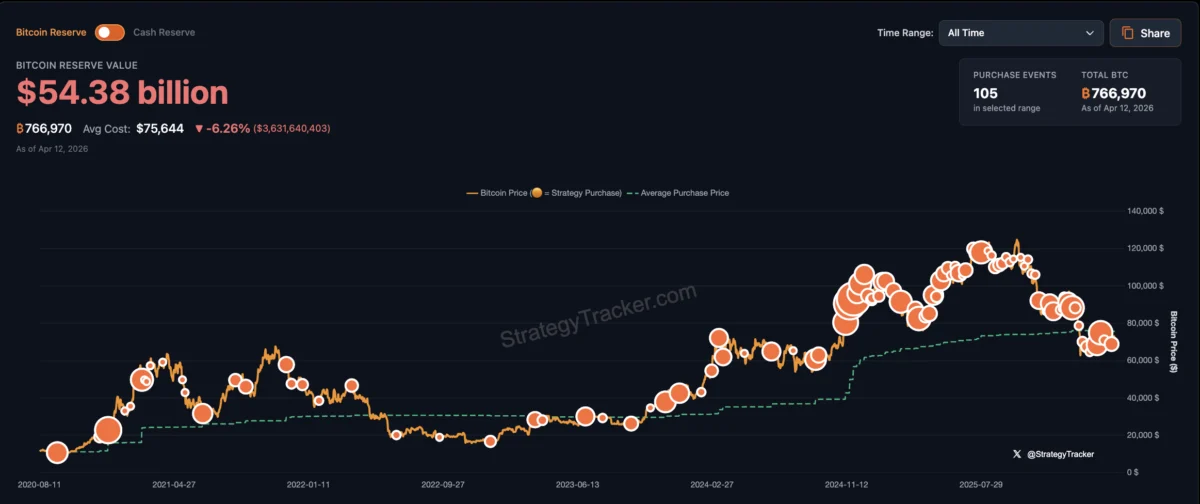
Michael Saylor, the co-founder and executive chairman of the Bitcoin treasury firm Strategy, has once again signaled a robust commitment to the company’s aggressive cryptocurrency acquisition policy, even as the market experiences a notable retreat from recent all-time highs. Following a period where Bitcoin (BTC) surged past the $73,000 threshold, the subsequent price correction has not deterred the Tysons Corner, Virginia-based firm. Instead, Saylor has utilized the market volatility to reinforce his long-term conviction, sharing a cryptic yet characteristic message on social media: “Think bigger.” Accompanying this statement was a detailed chart of the company’s Bitcoin purchase history, a visual cue that has historically preceded significant new capital deployments into the digital asset.
The current market environment presents a complex backdrop for Strategy’s operations. While the company remains the world’s largest corporate holder of Bitcoin, it is currently navigating a challenging financial landscape characterized by substantial unrealized losses. According to recent filings with the U.S. Securities and Exchange Commission (SEC), the firm reported an unrealized loss of nearly $14.5 billion on its Bitcoin holdings for the first quarter of 2026. This financial pressure stems from an average acquisition cost of $75,644 per BTC, a figure that currently sits approximately $5,000 above the prevailing market price at the time of publication.
A Chronology of Aggressive Accumulation
Strategy’s journey toward becoming a "Bitcoin development company" has been marked by a relentless pace of acquisition that often defies broader market sentiment. The company’s most recent confirmed transaction occurred on April 6, 2026, when it successfully acquired 4,871 BTC for a total consideration of approximately $329.8 million. This purchase was executed at a time when the market was showing signs of exhaustion following the peak above $73,000.
This latest acquisition brought the company’s total reserves to a staggering 766,970 BTC. At current market valuations, this treasury is estimated to be worth approximately $54.5 billion. The sheer scale of Strategy’s holdings places it in a category of its own among publicly traded entities. For context, the second-largest corporate holder, Twenty One Capital, maintains a reserve of 43,514 BTC—less than 6% of Strategy’s total accumulation.
The company’s strategy has remained consistent even during the most severe downturns. Throughout the recent bear market, which saw Bitcoin prices plummet to two-year lows, Strategy continued to leverage its balance sheet to acquire more coins. This period of "underwater" holdings—where the market value of the assets is less than the purchase price—has become a recurring theme for the company, yet the leadership remains focused on a multi-decade horizon rather than quarterly price fluctuations.
Financial Performance and the SEC Reporting Framework
The $14.5 billion unrealized loss reported in the Q1 2026 SEC filing highlights the unique accounting challenges faced by companies that hold significant amounts of volatile digital assets. Under current regulatory frameworks, companies must often report impairment charges when the value of their digital assets drops below the carrying value, yet they are restricted in how they can report gains until the assets are actually sold.

Despite these "paper losses," Strategy has maintained a position of high liquidity and strategic flexibility. The company has frequently utilized the issuance of convertible senior notes to fund its Bitcoin purchases, a move that allows it to tap into traditional capital markets to acquire a non-traditional asset. This financial engineering has enabled the company to outpace almost every other institutional player in the space.
In March 2026 alone, Strategy’s accumulation reached 46,233 BTC. When compared to the global production of Bitcoin, the scale of this acquisition becomes even more apparent. During that same 31-day period, Bitcoin miners across the globe produced approximately 16,200 BTC. Strategy, therefore, absorbed nearly three times the total amount of newly minted supply entering the market. This aggressive absorption of circulating supply has led various market analysts to forecast a potential "supply squeeze," where the demand from institutional treasuries significantly outstrips the available liquid supply on exchanges.
The Shift in Market Paradigm: "The Four-Year Cycle is Dead"
Michael Saylor has been vocal about his belief that the traditional understanding of Bitcoin market cycles has fundamentally changed. Historically, the Bitcoin market was thought to be governed by a "four-year cycle" tied to the halving events that reduce the reward for mining new blocks. However, Saylor argues that the entry of massive institutional capital and the integration of Bitcoin into the global financial system have rendered these historical patterns obsolete.
"The global consensus is that BTC is digital capital. The four-year cycle is dead. Price is now driven by capital flows," Saylor stated in an April address. He further emphasized that the growth trajectory of Bitcoin would increasingly be determined by bank credit and digital credit rather than the technical nuances of mining rewards. This perspective views Bitcoin not merely as a speculative currency, but as a foundational layer for a new global economic architecture—"digital capital" that serves as a superior alternative to traditional real estate, gold, or sovereign debt.
This philosophical shift is reflected in how Strategy manages its treasury. By viewing Bitcoin as permanent capital rather than a medium-term investment, the company justifies its decision to continue buying at prices that traditional analysts might consider "local tops."
Divergent Corporate Strategies: Strategy vs. MARA Holdings
While Strategy remains committed to a "buy and hold" mantra, other major players in the Bitcoin ecosystem are adopting more diversified or defensive postures. A notable contrast is found in MARA Holdings (formerly Marathon Digital), one of the world’s largest Bitcoin mining operations.
In March 2026, while Strategy was absorbing three times the monthly supply, MARA Holdings opted to sell 15,133 BTC, generating roughly $1.1 billion in proceeds. This capital was primarily used to repurchase $1 billion of the company’s zero-coupon convertible notes at a discount. Fred Thiel, Chairman and CEO of MARA, explained that the move was designed to enhance "financial flexibility" and provide "strategic optionality."

Unlike Strategy’s "pure-play" focus on Bitcoin accumulation, MARA is actively expanding its business model into digital energy and artificial intelligence (AI) and High-Performance Computing (HPC) infrastructure. This divergence highlights two distinct paths for Bitcoin-centric corporations: one focused on the absolute accumulation of the asset as a reserve, and the other focused on leveraging the underlying technology and energy infrastructure to diversify revenue streams. MARA’s decision to sell into the market strength to clean up its balance sheet stands in stark opposition to Saylor’s "think bigger" approach of leveraging the balance sheet to acquire more.
Market Implications and the Supply Squeeze Theory
The continued accumulation by Strategy has significant implications for the broader Bitcoin market. Analysts suggest that the concentration of such a large percentage of the total Bitcoin supply (21 million coins) in the hands of a few long-term institutional holders could lead to increased price volatility in the short term but greater price appreciation in the long term.
If Strategy continues to absorb supply at a rate that exceeds mining production, the "free float" of Bitcoin—the amount of BTC available for active trading on exchanges—will continue to shrink. In a scenario where demand from spot Bitcoin Exchange-Traded Funds (ETFs) and other corporate treasuries remains steady or increases, a diminishing supply could act as a powerful catalyst for price discovery.
Furthermore, Strategy’s resilience in the face of $14.5 billion in unrealized losses serves as a litmus test for institutional risk appetite. If the company can successfully navigate this period of volatility without being forced to liquidate its holdings, it may provide a blueprint for other corporations considering Bitcoin as a primary treasury reserve asset.
Future Outlook for Strategy
As Strategy prepares for its next phase of growth, the market remains focused on how the company will service its debt and whether it will continue to find favorable terms in the credit markets. The firm’s transition into a "Bitcoin development company" suggests that it may eventually seek to build applications or services on top of the Bitcoin network, moving beyond simple treasury management.
For now, the focus remains on the "Think bigger" philosophy. With over 766,000 BTC in its vault, Strategy has effectively tied its corporate destiny to the long-term success of the Bitcoin protocol. Whether the $14.5 billion unrealized loss is a temporary accounting hurdle or a harbinger of deeper financial strain remains to be seen, but for Michael Saylor and his team, the retreat from $73,000 appears to be nothing more than another opportunity to expand the world’s largest corporate Bitcoin hoard.
The coming months will be critical as the market digests the impact of institutional capital flows and the shifting regulatory landscape. With Strategy leading the charge, the narrative of Bitcoin as a cornerstone of corporate finance continues to evolve, challenging traditional notions of risk, treasury management, and the very nature of capital in the digital age.