admin
admin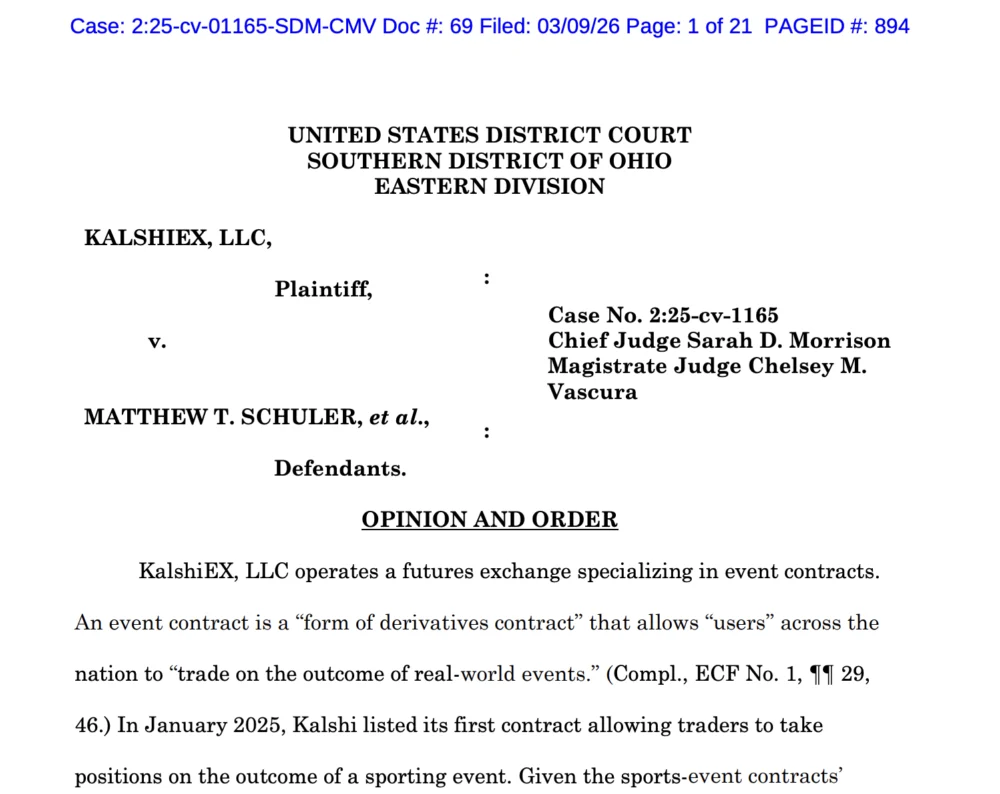
In a significant legal setback for the prediction markets industry, the United States District Court for the Southern District of Ohio has denied a motion for a preliminary injunction filed by KalshiEX LLC against the Ohio Casino Control Commission and the state’s attorney general. The ruling, delivered by Chief Judge Sarah Morrison on Monday, marks a pivotal moment in the ongoing jurisdictional battle between federal commodities regulators and state-level gambling authorities. At the heart of the dispute is whether prediction market contracts involving sporting events should be classified as federally regulated financial instruments or as unlicensed gambling under state law.
Kalshi, a platform that allows users to trade on the outcome of real-world events through event contracts, sought to block Ohio authorities from enforcing state gambling laws against its operations. The company argued that its sports-event contracts fall under the exclusive jurisdiction of the Commodity Futures Trading Commission (CFTC) and that the federal Commodity Exchange Act (CEA) preempts Ohio’s ability to regulate or prohibit these activities. However, the court found that Kalshi failed to meet the high burden required for a preliminary injunction, asserting that the company did not sufficiently demonstrate that its contracts are immune to state oversight.
The Legal Foundation of the Dispute
The conflict between Kalshi and the State of Ohio centers on the interpretation of the Commodity Exchange Act and its relationship with state-level police powers. Kalshi’s business model involves "event contracts," which are essentially binary options that pay out based on whether a specific event occurs. While Kalshi has successfully gained CFTC approval for various markets—such as those tied to economic indicators or weather patterns—its expansion into sports-related contracts has met with fierce resistance from state regulators who view such offerings as traditional sports betting.
In its filing, Kalshi argued that its sports-event contracts should be categorized as "swaps" or "commodity interests." Under the CEA, the CFTC maintains "exclusive jurisdiction" over accounts, agreements, and transactions involving swaps or contracts of sale of a commodity for future delivery. Kalshi’s legal team contended that because the platform is a CFTC-regulated Designated Contract Market (DCM), any attempt by Ohio to apply its gambling statutes constitutes an unconstitutional intrusion into a field occupied by federal law.
Judge Morrison’s opinion, however, pushed back on the notion that CFTC registration provides a blanket shield against state law. The court noted that Kalshi had not definitively proven that sports-event contracts are swaps within the meaning of the CEA. More importantly, the judge ruled that even if the contracts were classified as swaps, Kalshi failed to show that Congress intended the CEA to entirely displace state gambling regulations, particularly in the context of sports wagering.
The Doctrine of Preemption and State Sovereignty
The court’s analysis delved deeply into the legal doctrines of "field preemption" and "conflict preemption." Field preemption occurs when federal regulation is so pervasive that it leaves no room for state supplementation. Conflict preemption occurs when it is impossible to comply with both state and federal laws, or when state law stands as an obstacle to the accomplishment of federal objectives.
Kalshi argued that Ohio’s sports gambling laws were both field and conflict preempted by the CEA. The company asserted that by allowing the state to intervene, the court would create a "patchwork" of regulations that would undermine the uniform federal oversight intended by Congress. The court remained unconvinced, stating that Kalshi had not established that the CEA was designed to override state laws that have historically governed gambling and public morals.
"Kalshi fails to establish that Congress intended the CEA to preempt state laws on sports gambling," Judge Morrison wrote. This distinction is critical, as it reinforces the traditional authority of states to regulate betting within their borders, even as financial technology evolves to blur the lines between "trading" and "wagering."
A Timeline of Regulatory Tension
The Ohio ruling is the latest chapter in a broader national struggle over the future of prediction markets. The following timeline highlights the escalating tension between platforms like Kalshi and regulatory bodies:
- 2021: Kalshi receives designation as a DCM from the CFTC, allowing it to offer event contracts to U.S. retail investors under federal oversight.
- Late 2023: As prediction markets gain mainstream traction, several U.S. states begin investigating whether these platforms are circumventing state-level licensing requirements for sportsbooks.
- February 2024: CFTC Chair Michael Selig publicly asserts that the federal regulator has "exclusive jurisdiction" over prediction markets. He warns state authorities against pursuing enforcement actions that could interfere with federal oversight.
- Early 2024: Kalshi faces legal challenges in multiple states, including Tennessee and Ohio, over allegations of operating unlicensed sports betting platforms.
- May 2024: A federal court in Tennessee grants a preliminary injunction in favor of Kalshi, temporarily blocking state authorities from cracking down on the platform. This creates a split in legal precedents between different federal districts.
- June 2024: The Southern District of Ohio denies Kalshi’s request for an injunction, siding with state regulators and highlighting the agency’s "inaction" as a reason to doubt federal exclusivity.
The Role of the CFTC and Internal Agency Dynamics
The Ohio court’s decision also addressed the stance of the CFTC itself. While CFTC Chair Michael Selig has been a vocal proponent of federal exclusivity, the court noted that the agency has not formally exercised its authority to explicitly authorize or regulate the specific sports-event contracts offered by Kalshi in a way that would trigger preemption.
"This Court does not endeavor to explain why the CFTC has not exercised its authority… with respect to the sports-event contracts," the filing stated. "But the agency’s inaction is not proof that the sports-event contracts are regulated by or permissible under the CEA—and the Court has concluded they are not."
This observation highlights a potential rift between the CFTC’s leadership rhetoric and its administrative actions. Chair Selig, who is currently the sole Senate-confirmed commissioner on a panel that typically includes five members, has described prediction markets as "truth machines" that provide valuable data to the public. However, the lack of a full commission and formal guidance has left a vacuum that state regulators are now filling.

The CFTC has indicated that it is working to provide clearer guidance on prediction markets "in the very near future." This guidance is expected to address the definition of "public interest" and whether certain types of event contracts, such as those involving elections or sports, are contrary to the public good.
Comparative Legal Landscapes: Ohio vs. Tennessee
The denial of the injunction in Ohio stands in stark contrast to a recent ruling in Tennessee. Just weeks prior, a federal judge in Tennessee granted Kalshi a preliminary injunction, finding that the platform likely would succeed on the merits of its preemption argument.
The divergence between the Tennessee and Ohio rulings creates a complex legal environment for prediction markets. In Tennessee, the court emphasized the need for national uniformity in commodity markets, whereas the Ohio court prioritized state police powers and the historical regulation of gambling. This split increases the likelihood that the matter will eventually be settled by a federal appellate court or, potentially, the U.S. Supreme Court.
Kalshi has already signaled its intent to fight the Ohio decision. In a statement to the press, a spokesperson for the company expressed respect for the judicial process but noted that they "respectfully disagree with the Court’s decision" and will "promptly seek an appeal."
Broader Implications for the Prediction Market Industry
The outcome of this case carries heavy implications for the broader prediction market ecosystem, including competitors such as Polymarket and PredictIt. If states are permitted to apply gambling laws to CFTC-regulated exchanges, it could force these platforms to seek individual licenses in every state where they operate—a process that is both costly and time-consuming.
Furthermore, the ruling may embolden other state attorneys general to take action against prediction markets. If sports-event contracts are viewed as gambling, regulators may argue that other "event" contracts—such as those involving the Oscars, the Grammys, or political elections—also fall under state jurisdiction. This could lead to a fragmented market where certain contracts are legal in some states but prohibited in others, undermining the liquidity and efficiency that make prediction markets valuable as forecasting tools.
From a financial perspective, the classification of these contracts is vital. If they are deemed commodities, they benefit from federal tax treatments and regulatory protections. If they are deemed gambling, they are subject to different tax codes and a more restrictive set of operational requirements.
Fact-Based Analysis of Market Impacts
The prediction market industry has seen explosive growth over the last two years, driven largely by interest in the 2024 U.S. presidential election and a growing appetite for alternative hedging instruments. Data from platforms like Kalshi and Polymarket show that trading volumes for non-financial events have reached record highs, with hundreds of millions of dollars at stake.
The Ohio ruling introduces a layer of "regulatory risk" that may deter institutional investors from participating in these markets. Institutional players typically require a clear and stable legal framework before committing significant capital. The threat of state-level prosecution, despite federal registration, creates a level of uncertainty that could stifle innovation in the sector.
However, some analysts argue that state oversight is necessary to protect consumers. Unlike traditional sportsbooks, which are subject to rigorous state-level auditing, age verification, and responsible gaming requirements, prediction markets operate under a different set of rules. State regulators argue that without their intervention, consumers are left vulnerable to market manipulation and a lack of recourse in the event of disputes.
Conclusion and Future Outlook
The denial of Kalshi’s motion in Ohio serves as a reminder that the transition of traditional activities into the digital and financial realms is rarely seamless. While Kalshi views itself as a cutting-edge financial exchange, Ohio views it as a digital bookmaker operating outside the law.
As the case moves toward the discovery phase and eventual appeal, the industry will be watching closely for the promised CFTC guidance. A formal rule-making process from the federal regulator could provide the clarity needed to resolve these jurisdictional disputes. Until then, Kalshi and its peers remain caught in a tug-of-war between two different visions of oversight—one focused on the global efficiency of commodity markets and the other on the localized protection of public order.
The legal battle in Ohio is far from over, but for now, the state’s gambling laws remain in full force, and Kalshi must navigate a landscape where its federal credentials may not be enough to bypass state-level enforcement. The resolution of this conflict will ultimately define the boundaries of the "event contract" industry and determine whether the future of prediction markets lies in the world of finance or the world of wagering.