
 James Watt
The digital asset market has long been a breeding ground for innovative, albeit often controversial, financial modeling techniques. From the early days of Bitcoin’s inception, analysts and researchers have sought to decode its volatile price action through a variety of lenses, ranging from simple scarcity-based calculations to high-dimensional machine learning algorithms. However, as the asset matures, a growing body of academic literature suggests that even the most sophisticated models struggle to outperform the simplest of benchmarks: the "naive forecast," which assumes that the best predictor for tomorrow’s price is today’s price.
This skepticism was brought to the forefront by a May 2026 preprint study conducted by Carlos Baquero of the University of Porto. In a comprehensive review of peer-reviewed Bitcoin prediction research, Baquero reached a sobering conclusion: no existing model has demonstrated a durable, superior ability to beat a naive benchmark over horizons of one to six months across multiple market regimes. This finding challenges the validity of a multi-billion dollar industry built on price predictions and highlights the inherent difficulty of modeling an asset that is undergoing rapid structural evolution.
The Persistence of the Naive Benchmark
In the world of quantitative finance, the "naive forecast" is often viewed as the lowest bar for success. It requires no complex mathematics or historical data beyond the current market price. If Bitcoin is trading at $100,000 today, a naive model predicts it will be $100,000 tomorrow. Because financial prices—particularly those of high-liquidity assets—exhibit high persistence, this "dumbed-down" approach often yields a very low percentage error.
The academic struggle to beat this benchmark is rooted in the efficiency of the market. When a model predicts a price of $100,100 based on a complex set of on-chain variables, and the price indeed reaches that level, the model often receives credit for information that the market had already priced in. To truly add value, a forecaster must predict the return or the direction of the move beyond what is already implied by current momentum and volatility. As the forecasting horizon expands from days to months, the challenge intensifies. Relationships that appear stable in a specific three-month window often decay as the market evolves, a phenomenon known as non-stationarity.
A Chronology of Market Regime Shifts
One of the primary reasons forecasting models fail over time is the shifting nature of the Bitcoin market itself. Each "epoch" of Bitcoin’s history has been defined by different participants, liquidity structures, and regulatory environments.
- The Early Era (2009–2016): Characterized by low liquidity, retail hobbyists, and the absence of institutional infrastructure. Models during this period focused heavily on basic network growth and mining costs.
- The Retail Mania (2017): The rise of Initial Coin Offerings (ICOs) and the first major retail wave. Price action was driven by speculative fervor and the introduction of Bitcoin futures on the CME, though retail spot trading remained the dominant force.
- The Institutional and Derivative Era (2020–2021): The entry of public companies like MicroStrategy and the explosion of the crypto-derivative market. This era introduced complex hedging and arbitrage strategies that fundamentally altered how price discovery functioned.
- The ETF Era (2024–Present): The approval of spot Bitcoin ETFs in the United States created a permanent bridge for traditional capital. This shift brought massive, consistent inflows and integrated Bitcoin into the broader macroeconomic portfolio-rebalancing cycle.
A model calibrated to the retail-led 2017 cycle would likely fail in the ETF-dominated market of 2024 because the underlying variables—such as the influence of whale wallets versus institutional fund flows—have changed.

Methodological Pitfalls: The Overfitting Trap
The academic review by Baquero examined hundreds of papers, ultimately selecting 23 for close scrutiny based on their methodology and use of genuine out-of-sample evaluation. The review highlighted a recurring issue in Bitcoin research: backtest overfitting.
As formalized by David Bailey and his colleagues, the probability of backtest overfitting increases as researchers try more model variations. In a digital environment where data is abundant, a researcher can test thousands of combinations of variables, lookback windows, and machine-learning architectures. Eventually, by sheer chance, one combination will yield a "perfect" historical result. If only the winning result is published, it creates the illusion of a "crystal ball" when, in reality, the model has simply "memorized" the noise of the past.
Furthermore, many papers suffer from "information leakage." This occurs when a model is trained on data that inadvertently contains information from the future. For example, normalizing a dataset using the maximum price of a five-year period before splitting that data into training and testing sets gives the model a subtle hint about the eventual peak of the market. Such errors can be difficult for peer reviewers to spot, especially when obscured by complex neural network layers.
The Failure of Popular Valuation Frameworks
Beyond academic machine learning, several "intuitive" valuation models have gained immense popularity in the Bitcoin community. These models often provide a narrative that is easy to understand but statistically fragile.
Stock-to-Flow (S2F)
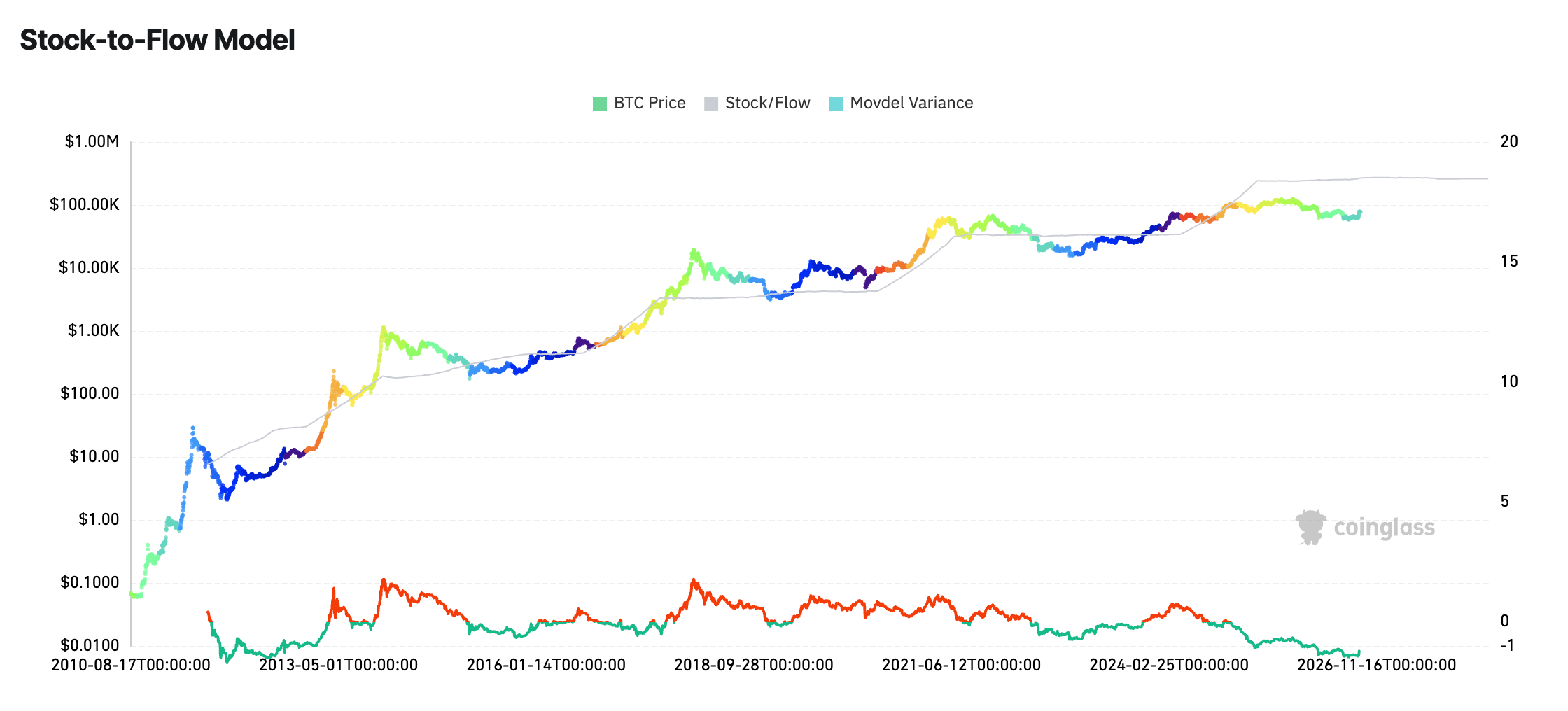
The Stock-to-Flow model, popularized by the analyst PlanB, posits that Bitcoin’s price is a function of its scarcity, measured by the ratio of existing supply to annual new production. While the model showed a high correlation with price for several years, its predictive power collapsed after 2021. Peer-reviewed research by Alexander Shelton in 2024 found that once "time effects" were accounted for, the statistical significance of the S2F ratio vanished. Essentially, both the S2F ratio and Bitcoin’s price were moving upward over time, creating a "spurious correlation" that did not imply causation. By 2024, Bitcoin was trading hundreds of thousands of dollars below the levels projected by the original S2F curves.
Metcalfe’s Law
Metcalfe-style models suggest that the value of a network is proportional to the square of its number of users. While this provides a strong economic intuition for Bitcoin’s growth, it faces an identification problem. Does a higher price attract more users, or does a larger user base drive the price higher? Research by Savva Shanaev and others utilized instrumental variables to untangle this relationship, finding that once autocorrelation was removed, the predictive power of network activity on future price was negligible.
The Power-Law Model
The Power-Law model draws an ascending corridor through Bitcoin’s history on a log-log scale. Proponents argue that this represents a stable mathematical relationship between price and time. While this model has been more resilient than S2F, critics point out that a high R-squared (a measure of how well data fits a line) on a historical chart does not guarantee future accuracy. Baquero’s review noted that the Power-Law literature has yet to undergo rigorous sensitivity testing regarding its starting dates or its performance across non-overlapping market regimes.
Sophistication vs. Performance in Machine Learning
In a separate study, Francesco Puoti, Fabrizio Pittorino, and Manuel Roveri compared 12 different forecasting approaches—including XGBoost, LSTM networks, and N-BEATS—across five major cryptocurrencies. Their findings mirrored the broader academic consensus: simple naive models consistently produced better forecasts than their deep-learning counterparts at one-day, seven-day, and 30-day horizons.
The reason for this is that complex models are highly sensitive to "noise." Bitcoin offers millions of data points, but as the researchers noted, the number of independent market cycles is still small. A model might "learn" everything there is to know about the 2018 bear market, but those lessons may be entirely irrelevant to a liquidity shock caused by a global pandemic or a sudden change in Federal Reserve policy. When patterns are weak or temporary, a complex model tends to over-fit the noise, whereas a simple model (or a naive one) remains more robust.
Broader Impact and the Need for New Standards
The implications of these findings are significant for both institutional and retail investors. If the most advanced models cannot reliably beat a naive forecast, it suggests that Bitcoin remains an "un-modeled" asset, driven more by exogenous shocks and shifts in global liquidity than by internal, predictable patterns.
To improve the quality of forecasting, researchers and analysts are calling for a new "gold standard" in Bitcoin price modeling:
- Mandatory Naive Benchmarking: Every forecast should be published alongside a naive benchmark to show exactly how much "value" the model adds beyond the current price.
- Walk-Forward Evaluation: Instead of a single historical backtest, models should be tested using a rolling window that retrains the model as it moves through time, simulating a real-world trading environment.
- Transparency of Failed Attempts: Researchers should disclose how many model variations were tested before arriving at the published result to account for the probability of backtest overfitting.
- Economic Realism: Models must account for trading costs, slippage, and liquidity constraints. A model that predicts a 1% move with 90% accuracy is useless if the cost of executing that trade is 1.5%.
The "forecast bazaar" of social media and speculative finance will likely continue to produce dramatic targets and colorful charts. However, the academic record provides a necessary reality check. As Bitcoin integrates further into the global financial system, the "dumb" naive model remains the most formidable opponent for any analyst attempting to map the future of the world’s most famous cryptocurrency. For now, the most honest forecast a model can provide may often be a value of zero—a signal that, beyond the price already visible to everyone, there is still much we do not know.








