
 James Watt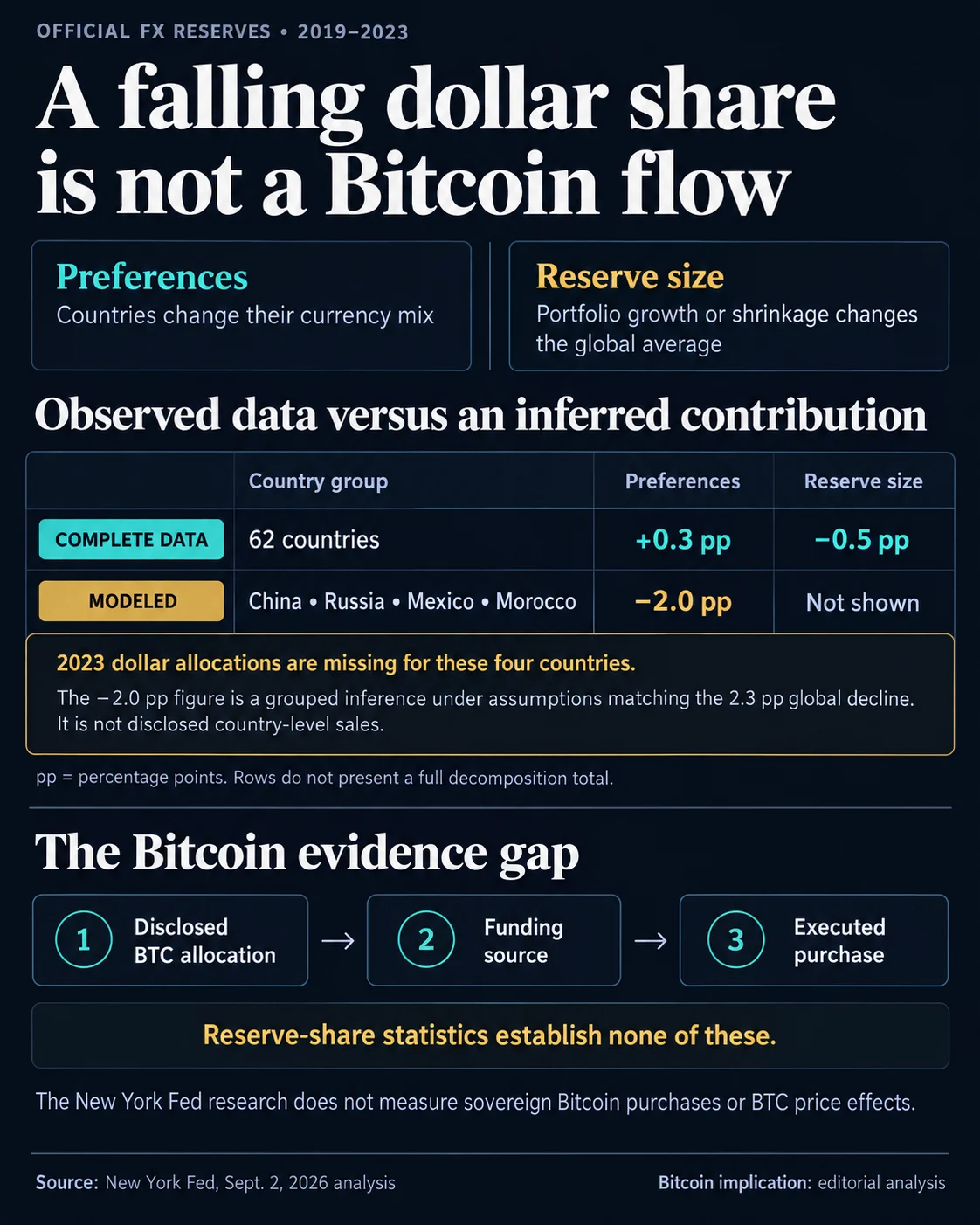
A comprehensive analysis released on September 2, 2026, by researchers at the Federal Reserve Bank of New York has provided a nuanced correction to the prevailing narrative regarding the decline of the U.S. dollar in global finance. For years, proponents of decentralized digital assets have pointed to the shrinking share of the dollar in global foreign-exchange reserves as a primary indicator of an impending shift toward sovereign Bitcoin adoption. However, the New York Fed’s report suggests that this decline is less a result of a broad-based retreat from the greenback and more a consequence of technical shifts in the size and composition of a few massive national portfolios.
The analysis, authored by Linda S. Goldberg, Oliver Hannaoui, and Sneha Parthasarathy, utilizes data from the International Monetary Fund’s (IMF) Currency Composition of Official Foreign Exchange Reserves (COFER) to track the dollar’s trajectory. According to the findings, the dollar’s share of global official reserves fell from 64% at the end of 2015 to 56% by the end of 2025. While this eight-percentage-point drop is significant, the researchers argue that the underlying drivers do not support the conclusion that central banks are pivoting toward Bitcoin or other volatile digital assets as a primary reserve replacement.
The Mechanics of Reserve Shifts: Preferences vs. Scale
To understand why the dollar’s share is declining, the New York Fed researchers categorized central bank behavior into two distinct channels: the "preferences" channel and the "reserve-size" channel. This distinction is critical for market analysts who often conflate a lower percentage with a deliberate policy of de-dollarization.
The preferences channel refers to a conscious decision by a central bank to change the currency mix of its portfolio—for example, selling U.S. Treasuries to purchase Euros, Gold, or Yen. The reserve-size channel, conversely, describes a situation where a country’s total reserves grow or shrink, thereby changing that country’s weight in the global aggregate.
The report highlights Switzerland as a prime example of the reserve-size channel in action. Between 2015 and 2019, the Swiss National Bank (SNB) significantly expanded its total reserves. Because Switzerland maintains a below-average allocation to the U.S. dollar compared to the global mean, the sheer growth of its portfolio pulled down the worldwide dollar share. Crucially, this occurred even as Switzerland’s own internal allocation to the dollar was actually increasing. In this scenario, the global "de-dollarization" was a mathematical byproduct of Swiss reserve growth, not a move away from the dollar by the SNB or a broad coalition of central banks.
A Chronology of Shifting Reserves: 2015–2025
The decade spanning 2015 to 2025 was marked by significant geopolitical and macroeconomic volatility, which the New York Fed report breaks down into two distinct periods of reserve decomposition.
From 2015 to 2019, the researchers examined a 79-country exercise, with 76 countries providing complete data. During this window, the contribution of "preferences" (active selling of dollars) accounted for a 1.2 percentage point decline in the global dollar share. Meanwhile, "reserve-size" changes (the mathematical weighting of different nations) accounted for a 1.5 percentage point decline. This suggests that during the late 2010s, the decline was almost equally split between active policy shifts and passive structural changes.
The period from 2019 to 2023 tells a different story. For the 62 countries with complete data, the preferences channel actually contributed a positive 0.3 percentage point increase to the dollar share. However, this was offset by a negative 0.5 percentage point contribution from reserve-size changes. The global decline observed during this period was largely driven by a specific group of nations—China, Russia, Mexico, and Morocco—which lacked complete dollar-allocation data for 2023.
Under assumptions matching the observed 2.3-percentage-point global decline for that period, the researchers inferred a combined negative 2.0-percentage-point preferences contribution for this specific quartet. The geopolitical context here is vital: Russia’s reserves were largely frozen by Western sanctions in 2022, and China has been transparent about its desire to diversify away from U.S.-denominated assets amid trade tensions. The Fed’s analysis suggests that the "de-dollarization" trend is highly concentrated among a few specific geopolitical actors rather than being a systemic global movement.
Liquidity Needs vs. Investment Portfolios
Central to the New York Fed’s argument is the distinction between reserves held for liquidity and those held for investment. This concept is explored in depth in Staff Report 1087, originally issued in March 2024 and revised in February 2026.
Central banks maintain reserves primarily for three reasons: to facilitate trade payments, to service foreign-currency debt, and to stabilize their own national currency. These "precautionary" reserves must be held in highly liquid, stable assets—predominantly the U.S. dollar. The New York Fed models liquidity needs using metrics such as three months of import coverage or the level of short-term external debt.
When a central bank’s reserves exceed these liquidity requirements, they may move into an "investment" phase, where diversification becomes a higher priority. It is within this "excess" portion of reserves that diversification into non-traditional assets typically occurs. However, the researchers emphasize that diversification beyond liquidity needs does not automatically identify the money’s destination. While central banks have indeed increased their holdings of "non-traditional" currencies (such as the Australian dollar, Canadian dollar, and Chinese renminbi) and gold, there is no empirical data in the IMF COFER reports to suggest that Bitcoin is capturing this flow.
The Case of the Czech National Bank
The report addresses the rare instances where central banks have experimented with digital assets, using the Czech National Bank (CNB) as a cautionary example for Bitcoin bulls. On November 13, 2025, the CNB announced the creation of a $1 million digital-asset test portfolio. This project included Bitcoin, alongside a dollar-pegged stablecoin and a tokenized deposit.

While the crypto industry initially hailed this as a milestone for sovereign Bitcoin adoption, the New York Fed points out the critical fine print: the purchase was explicitly made outside of the CNB’s international reserves. The $1 million allocation—a negligible sum for a central bank—was designated as a technical test of the infrastructure rather than a shift in reserve policy. This distinction is vital for investors to understand; a central bank holding Bitcoin in a research-and-development "sandbox" is fundamentally different from a central bank utilizing Bitcoin as a reserve asset to back its national currency or meet external obligations.
Implications for the Bitcoin "Reserve Asset" Narrative
The New York Fed’s analysis serves as a reality check for the "Strategic Bitcoin Reserve" narrative that has gained traction in political and financial circles. As of late 2025 and early 2026, Bitcoin’s market capitalization sits at approximately $1.58 trillion, with a circulating supply of 20.08 million coins. While its growth has been meteoric, its volatility remains a significant barrier to its utility as a reserve asset.
For a currency to serve as a reserve, it must offer "liquidity on demand" during times of crisis. The Fed’s data shows that when global markets experience stress, central banks consistently retreat to the dollar because of its deep, liquid Treasury market. Bitcoin, which can experience 10% price swings in a single day, does not yet fulfill the "liquidity" or "stability" requirements of the precautionary reserve models used by the Fed.
Furthermore, the researchers note that a sovereign Bitcoin demand case requires three pieces of evidence that are currently missing from the global aggregate data:
- Disclosed Allocations: Clear, audited reports from central banks listing Bitcoin as part of their official foreign-exchange reserves.
- Identified Funding Sources: Evidence that the purchase was funded by the sale of existing reserve assets (like USD or EUR) rather than surplus tax revenue or specialized innovation funds.
- Distinction of Holdings: Proof that the Bitcoin is held as a reserve asset rather than an "outside" investment or a technical experiment.
The Broader Impact: Is the Dollar in Danger?
While the New York Fed report deconstructs the Bitcoin-buying myth, it does not deny that the dollar’s dominance is slowly eroding. The decline from 64% to 56% is a decade-long trend that reflects a more multipolar global economy. However, the report suggests this is an "orderly transition" toward a more diversified basket of traditional currencies and gold, rather than a chaotic flight toward digital assets.
The "bearish" sentiment for the dollar’s share is balanced by the fact that the dollar remains the most-used currency for global trade and debt issuance. The Fed’s analysis implies that as long as the U.S. dollar remains the primary medium for international liquidity, its role as the dominant reserve asset is secure, even if its percentage share of the total pie continues to drift lower due to the growth of emerging market reserves.
In conclusion, the New York Fed’s analysis warns that a shrinking dollar share should not be used as a proxy for sovereign Bitcoin demand. The two phenomena are driven by different forces: one by the mathematical weighting of global portfolios and concentrated geopolitical shifts, and the other by speculative interest and technological experimentation. For Bitcoin to truly enter the realm of sovereign reserves, it will need to provide its own evidence through transparent central bank balance sheets, rather than relying on the "omission" of the dollar in global statistics. For now, the "de-dollarization" story remains a tale of traditional currency diversification and the unique reserve-management strategies of a few large nations, with Bitcoin remaining firmly on the periphery of the official global reserve system.








