Nila Kartika Wati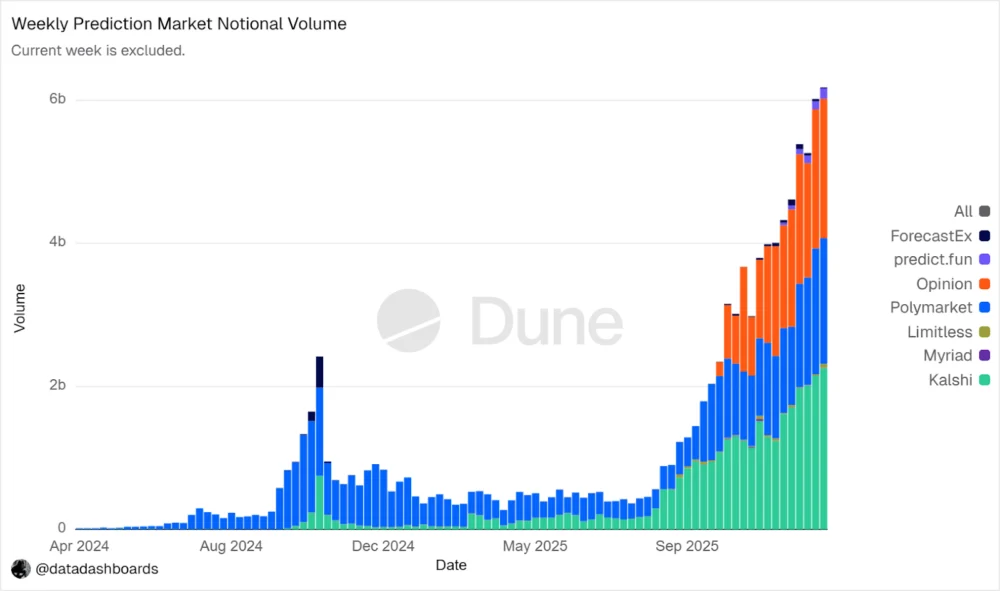
Prediction markets, once considered an experimental niche within the broader cryptocurrency ecosystem, have demonstrably transcended their nascent phase, emerging as a significant financial category characterized by sustained trading volume, diversified participation, and growing institutional interest. Industry analysis now points to these markets solidifying their role as a new "arbitrage arena" for crypto traders, with their underlying infrastructure undergoing a critical transformation.
Rapid Expansion and Diversification Across Verticals
The growth trajectory of prediction markets has been steep and sustained. According to a joint research report from Dune and Keyrock, monthly notional volume in these markets surged dramatically from less than $100 million in early 2024 to an impressive $13 billion by late 2025. This exponential growth underscores a fundamental shift in perception and utility. The expansion has not been confined to a single domain but has diversified across numerous verticals, including sports, political events, and macroeconomic indicators, signaling a broad appeal and increasing sophistication of market offerings. This diversification is crucial, as it indicates that participants are engaging with a wider array of events, moving beyond speculative interest in a few high-profile outcomes to a more integrated financial tool.
The data further reveals a robust and sustained level of activity, even after major events such as elections, which often serve as significant volume drivers. This "post-election activity" suggests that the markets are not merely reactive to singular, large-scale events but possess an inherent liquidity and participant base that supports continuous trading across a spectrum of less prominent, yet still impactful, future occurrences. This resilience in trading volumes, even amidst recent regulatory scrutiny and actions aimed at restricting prediction markets, highlights their entrenched position and the demand they fulfill within the digital asset landscape.
The Evolution of Trust: From Product Features to Core Infrastructure
As the prediction market category matures, the primary challenges and inherent risks are evolving. Early concerns revolved around fundamental issues such as achieving sufficient liquidity and attracting a critical mass of users. These hurdles, while still important, are increasingly being overcome. The new binding constraint, according to market analysts, is trust. This trust extends beyond traditional notions of regulatory compliance and secure custody, delving into a more fundamental aspect: the architecture of resolution.
This shift mirrors the developmental journey of other critical components within the crypto and decentralized finance (DeFi) sectors. Functions such as custody, execution, and liquidation, which were initially conceived as mere product features offered by individual platforms, gradually transformed into essential system properties. Institutions and sophisticated traders came to expect these properties to be predictable, transparent, auditable, and resilient. Any ambiguity or unreliability in these areas posed significant financial risk, deterring serious capital. Resolution in prediction markets is now undergoing this very same transition, moving from a discretionary operational task to a foundational infrastructural requirement.

Resolution Becomes the Bottleneck: Navigating Contentious Domains
The architecture of resolution has become paramount because prediction markets are expanding into increasingly complex and contentious domains, where the precise definition and determination of an outcome can be fraught with ambiguity.
Consider sports markets, for instance. While many outcomes are straightforward (e.g., final score), edge cases frequently arise concerning officiating decisions, precise timing of events, or the specific data sources used to verify results. A goal disallowed by VAR, a race decided by a photo finish, or a statistical discrepancy in player performance data can all lead to disputes that challenge a simple "yes" or "no" outcome.
Political markets, arguably the most contentious, hinge on a multitude of factors beyond just vote counts. Definitions of victory (e.g., popular vote vs. electoral college), certification procedures that can be challenged, and intricate legal interpretations of electoral laws all introduce layers of complexity. A market on "Will Candidate X win the election?" can become highly ambiguous if legal challenges prolong the outcome or if a specific victory condition (e.g., winning a particular state) is not explicitly defined.
Macroeconomic markets, too, present their own set of resolution challenges. Predictions based on economic data (e.g., inflation rates, GDP growth) can be complicated by methodology changes implemented by statistical agencies, revisions to historical data, or shifts in release schedules. A market contingent on "Q3 GDP growth exceeding 2%" requires absolute clarity on which release (initial, revised, final) is definitive and which methodology is being applied.
As the "surface area" of events covered by prediction markets expands into these more nuanced territories, the frequency of contested outcomes inevitably increases. When the process for resolving these disputes is opaque, slow, or subject to discretionary judgment, user engagement quietly but steadily declines. Conversely, when resolution mechanisms are adversarial yet economically secured, transparent, and auditable, users begin to perceive them as robust financial infrastructure, suitable for serious capital allocation.
Resolution as Infrastructure: The Deterministic Conversion of Claims
At its core, every prediction market makes a fundamental promise: traders purchase conditional claims on a future outcome, and the underlying system must deterministically convert these claims into redeemable value once the specified event has occurred. If this conversion process is slow, ambiguous, or discretionary, traders are compelled to price in "resolution risk" into their positions. When resolution risk becomes a material factor, serious capital tends to concentrate only in a handful of headline markets with highly unambiguous outcomes, shying away from the vast majority of markets where uncertainty about settlement lingers. This dynamic severely limits the overall utility and growth potential of the prediction market ecosystem.

This is precisely why a robust and well-designed resolution architecture is rapidly becoming one of the most critical layers in the modern prediction market stack. It is the bedrock upon which trust is built, enabling the seamless and predictable settlement of conditional claims.
In typical decentralized prediction market designs, the process unfolds as follows:
- Market Creation: A market is initiated for a specific event, explicitly linked to an oracle question. This question includes precise resolution criteria, defining what constitutes a "yes" or "no" outcome.
- Trading: Users trade "YES" or "NO" outcome tokens, which represent their conditional claims. These claims are usually implemented using conditional token standards, meaning they can only be redeemed for their underlying value once the oracle has finalized the event’s outcome.
- Outcome Proposal (Optimistic Oracle): Once the event has occurred, an initial answer to the oracle question is proposed by a designated party or anyone willing to stake a bond. Optimistic oracle designs operate on the assumption that this proposed answer is correct by default. The proposer must post a financial bond, which serves as a disincentive against submitting an incorrect or malicious answer, as this bond would be forfeited if the answer is successfully challenged.
- Challenge Window: A fixed challenge window then opens. During this period, any participant who believes the proposed outcome is incorrect can dispute it. To do so, they must post a larger financial bond than the original proposer. This mechanism creates an economic incentive for honest reporting and a financial cost for manipulation. Each subsequent challenge typically requires an even larger bond, progressively raising the economic hurdle for any coordinated attempts to subvert the outcome.
- Finalization or Escalation: If no dispute occurs within the challenge window, the proposed answer is accepted as final, the oracle formalizes the outcome, and the market settles accordingly. The successful proposer’s bond is returned, often with a reward. However, if a dispute does occur, the case escalates to a higher level of arbitration. This often involves decentralized jurors or a dispute resolution protocol, where a community of stakeholders reviews the evidence and rules on the correct outcome. This decision is then enforced back into the oracle state, ensuring the integrity of the settlement process.
From Product Feature to Trust Anchor: Engineering for Reliability
As prediction markets mature and increasingly function as vital information infrastructure, the locus of trust fundamentally shifts. It moves away from superficial user interfaces or short-term incentive programs and instead anchors itself in the robust architecture of resolution. This encompasses the explicit set of rules, the economic bonds required for participation and dispute, the defined challenge windows, and the predictable arbitration paths that collectively ensure the deterministic conversion of outcomes into enforceable settlement.
The next significant wave of growth in prediction markets will not be driven by platforms that merely acquire the most first-time traders during a single, high-profile event. Instead, success will accrue to those who meticulously build infrastructure where resolution is as reliable, transparent, and predictable as the execution of a trade itself. This demands a profound reorientation of core engineering and governance priorities for platform builders.
Key imperatives for this new era include:
- Explicitness of Rules: Resolution rules must be painstakingly explicit and defined before markets go live. Relying on ad-hoc decisions or attempting to retrofit rules after disputes emerge is a recipe for eroding trust.
- Minimizing Ambiguity in Question Design: The design of market questions must minimize any potential for ambiguity at the point of creation. Clear, verifiable criteria for outcomes are essential, reducing the reliance on subjective or discretionary judgment during settlement.
- Scalable Bonds and Challenge Windows: Bond sizes and challenge windows must be dynamically scalable, adapting to the open interest and potential financial impact of a market. Static parameters that fail to account for market growth can create vulnerabilities or inefficiencies.
- Predictable and Enforceable Arbitration: Arbitration paths must be clearly defined, predictable, and, crucially, enforceable on-chain. Participants need assurance that disputes will be handled fairly and that the final decision will be upheld by the system.
- Resolution Latency as a Core Metric: The speed and efficiency of resolution—"resolution latency"—must be treated as a primary product metric, not an operational afterthought. Delays in settlement directly impact capital efficiency and trader confidence.
When these properties are engineered with deliberate precision and foresight, prediction markets transcend their perception as speculative products. They begin to function as reliable financial systems and critical information infrastructure that individuals, institutions, and even other decentralized applications can depend upon for verifiable, real-world data and risk hedging. This evolution promises to unlock the full potential of prediction markets, integrating them deeper into the fabric of the digital economy.