
 admin
admin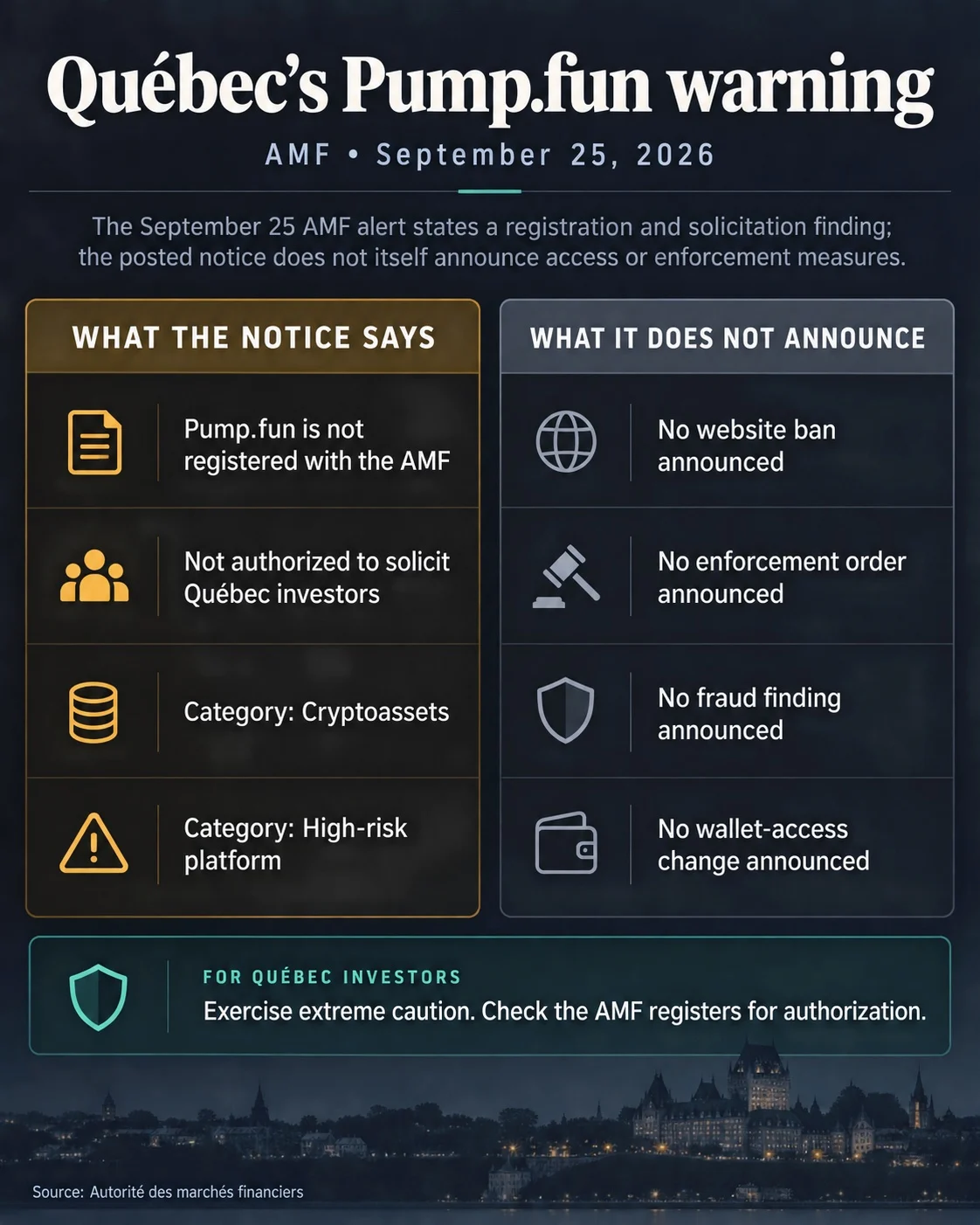
Québec’s financial markets regulator issued a stern warning on September 25, 2026, declaring that Pump.fun, a platform facilitating the creation and trading of user-generated digital assets, is not registered and therefore not authorized to solicit investment from residents of the province. This regulatory action by the Autorité des marchés financiers (AMF) categorizes the platform as a high-risk entity within the burgeoning cryptoasset landscape, raising significant questions for potential investors in Québec. The AMF’s announcement specifically addresses the platform’s registration status, without detailing immediate actions such as a website ban, enforcement orders, findings of fraud, or alterations to users’ wallet access. The core of the concern lies in Pump.fun’s alleged failure to comply with Québec’s securities laws, specifically regarding its solicitation activities within the province.
The AMF’s formal notice, publicly accessible on its website, provides a clear pronouncement on Pump.fun’s regulatory standing. This alert has also been disseminated and listed by the Canadian Securities Administrators (CSA), with the AMF identified as the originating authority. While the CSA entry reiterates the findings of registration deficiency and unauthorized solicitation, it does not indicate any separate enforcement measures initiated by the CSA itself against the platform. The current warning is therefore narrowly focused on the issue of Pump.fun’s authorization to engage with investors in Québec, and readers are cautioned against inferring broader enforcement actions or findings of wrongdoing beyond this specific regulatory concern. The general fraud-prevention advice included on the AMF’s pages is not to be interpreted as a case-specific accusation of fraudulent activity against Pump.fun.
Background and Chronology of Regulatory Scrutiny
The digital asset space, characterized by rapid innovation and evolving regulatory frameworks, has consistently presented challenges for securities regulators worldwide. Platforms like Pump.fun, which enable users to launch new tokens with relative ease, often operate in a grey area where the lines between decentralized innovation and regulated financial activity can become blurred. The AMF’s intervention is part of a broader global trend of increased scrutiny over cryptoasset platforms, particularly those that facilitate the creation and trading of speculative digital assets, often referred to as "memecoins" or "shitcoins." These assets are known for their extreme volatility and potential for rapid price swings, making them attractive to some investors seeking quick profits but also inherently risky.
Pump.fun, as a platform, has gained traction for its user-friendly interface that allows individuals to create their own cryptocurrency tokens on the Solana blockchain in a matter of minutes. This accessibility, while democratizing token creation to some extent, also presents significant risks, as the quality, legitimacy, and underlying utility of these user-generated tokens can vary wildly. The ease with which new tokens can be launched, often with minimal oversight or due diligence, has led to concerns about market manipulation, rug pulls, and the proliferation of low-value or scam projects.
The AMF’s action on September 25, 2026, marks a specific point in time where Québec’s regulatory body has officially flagged Pump.fun for non-compliance. While the exact date Pump.fun began actively soliciting investors in Québec is not specified in the AMF’s warning, the regulator’s action implies that such activities have been identified. The AMF’s mandate is to protect investors and maintain fair and orderly financial markets. When a platform operates without the necessary registrations, it circumvents the established safeguards designed to protect the public from financial harm. These safeguards typically include requirements for disclosure, capital adequacy, and adherence to ethical business practices.
The inclusion of the warning on the Canadian Securities Administrators’ website signifies a coordinated effort among Canadian regulators to share information and alerts regarding entities operating within their jurisdictions. This cross-provincial communication is crucial for maintaining a consistent regulatory approach to the dynamic cryptoasset market. The CSA, acting as a coordinating body for provincial and territorial securities regulators, plays a vital role in harmonizing regulations across Canada, although direct enforcement actions remain largely within the purview of individual provincial bodies like the AMF.
Key Findings of the AMF Warning
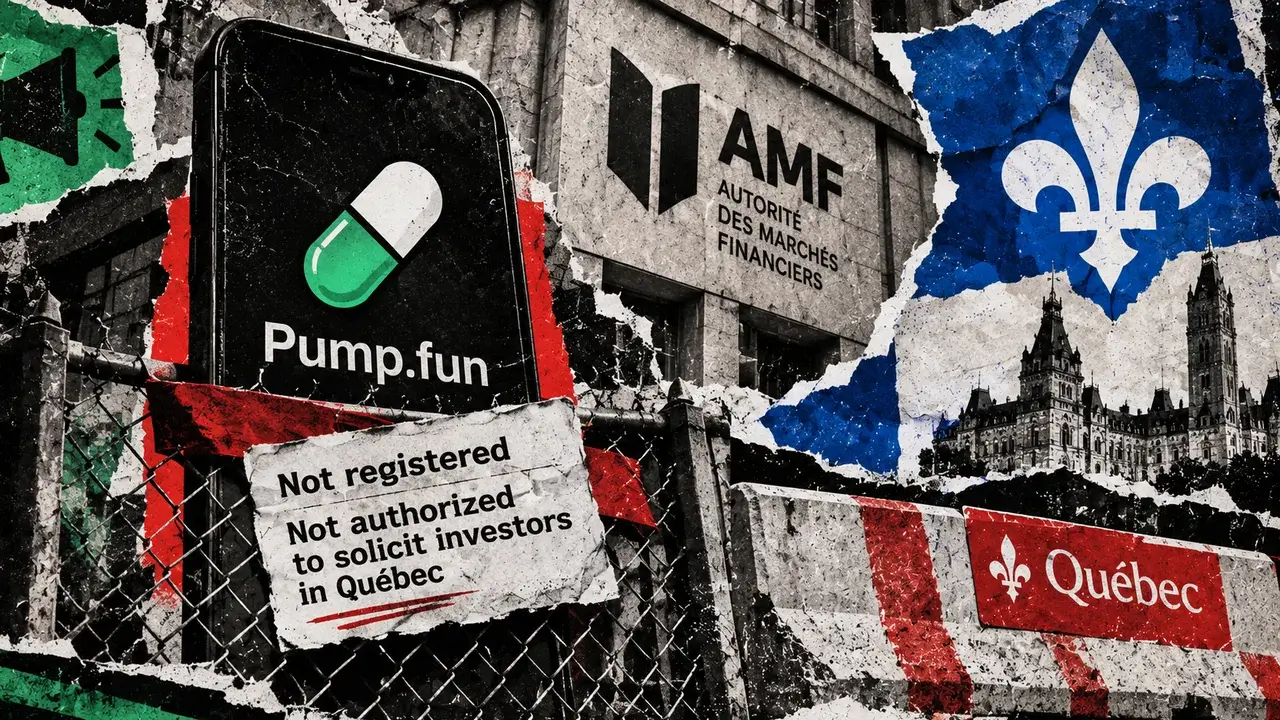
The AMF’s warning is precise in its scope. It explicitly states that Pump.fun is not registered with the AMF and lacks the necessary authorization to solicit investors within Québec. This is a critical distinction from broader allegations of fraud or misconduct. The regulator is not, at this stage, claiming that Pump.fun has engaged in fraudulent activities or that its services are inherently scams. Instead, the focus is on regulatory compliance and the protection of Québec residents from unregistered financial activities.
The platform’s terms of use, as highlighted by the original article, also contain their own risk disclosures. These terms typically warn users about the significant potential for value fluctuation in user-generated digital assets. However, these internal disclaimers do not absolve a platform from the obligation to comply with provincial securities regulations. The AMF’s concern is about the regulatory framework, not solely about the inherent risks of the assets themselves. Investor protection, in the eyes of regulators like the AMF, involves ensuring that any entity offering investment opportunities is properly licensed and subject to oversight, regardless of the inherent volatility of the products being offered.
For residents of Québec, the AMF’s warning serves as a direct alert to exercise caution. The regulator strongly advises prospective investors to consult its registers to verify whether any firm or individual is authorized to conduct business in the province. This proactive step empowers investors to make informed decisions by checking the credentials and regulatory status of entities they consider engaging with. The Pump.fun entry on the AMF’s warning list is a specific red flag, while the general registers serve as a comprehensive tool for due diligence.
Supporting Data and Broader Market Context
The cryptoasset market has seen explosive growth in recent years, with market capitalization reaching trillions of dollars at its peak. This rapid expansion has inevitably attracted regulatory attention. As of late 2026, the global cryptocurrency market cap, while fluctuating, remains a significant financial sector. Within this ecosystem, platforms facilitating the creation of new tokens, often driven by social media trends and speculative fervor, have become a notable segment.
The success of platforms like Pump.fun, despite the inherent risks associated with user-generated tokens, can be attributed to several factors:
- Low Barrier to Entry: The ability to create a token with minimal technical knowledge and financial outlay appeals to a wide range of individuals, from aspiring entrepreneurs to those seeking quick speculative gains.
- Community and Hype: The success of many meme coins and user-generated tokens is heavily reliant on community building, social media engagement, and viral marketing. Platforms that facilitate this ecosystem can become popular hubs for such activities.
- Decentralization Ethos: For some users, the appeal lies in the perceived decentralization and permissionless nature of these platforms, allowing for innovation outside of traditional financial gatekeepers.
However, this environment also presents significant risks. Data from various cryptocurrency analytics firms has consistently shown that a large percentage of newly launched tokens fail to gain traction or are abandoned by their creators, leading to substantial losses for investors. Furthermore, the unregulated nature of many such token launches makes them prime targets for malicious actors engaging in "rug pulls," where developers abandon a project and abscond with investors’ funds.
The AMF’s action against Pump.fun is not an isolated incident. Regulators in other jurisdictions have also taken steps to address the risks associated with unregulated cryptoasset platforms. For instance, the U.S. Securities and Exchange Commission (SEC) has been actively pursuing enforcement actions against entities offering unregistered securities, including certain types of digital assets and the platforms that facilitate their trading. The European Union, through its Markets in Crypto-Assets (MiCA) regulation, is establishing a comprehensive framework for cryptoasset service providers, aiming to bring greater clarity and consumer protection.
The implication of the AMF’s warning is that Pump.fun, by soliciting investors in Québec without proper registration, is operating outside the established legal framework designed to protect the public. This could lead to a number of potential consequences, even if not explicitly stated in the current warning:
- Increased Regulatory Scrutiny: The warning could be a precursor to more stringent enforcement actions if Pump.fun continues to solicit investors in Québec or if further violations are identified.
- Investor Redress Difficulties: If investors in Québec lose money through dealings with an unregistered platform, their ability to seek redress through regulatory channels or legal recourse may be significantly diminished.
- Market Confidence Erosion: Such regulatory actions, while aimed at protecting investors, can also contribute to a perception of increased risk and uncertainty within the broader cryptoasset market, potentially impacting investor confidence.
Official Responses and Stakeholder Perspectives

The AMF’s statement is a direct official response from a regulatory body. Its clarity on the registration status and solicitation authorization is intended to be unambiguous for Québec residents. As of the publication of this report, there has been no explicit public statement or response from Pump.fun regarding the AMF’s warning. Typically, platforms facing such regulatory notices may choose to:
- Comply: Engage with the regulator, seek registration, or cease soliciting investors in the affected jurisdiction.
- Dispute: Argue that their activities do not fall under the purview of securities regulations or that they are not actively soliciting investors in that jurisdiction.
- Remain Silent: Continue operations without publicly addressing the warning, which can increase the risk of further regulatory action.
The Canadian Securities Administrators (CSA), in their role of disseminating the alert, also implicitly endorse the AMF’s findings and their importance to investors across Canada. Their involvement underscores the collaborative nature of securities regulation in the country and the shared interest in safeguarding investors from unregistered activities.
The broader implication for the cryptoasset industry is the ongoing tension between innovation and regulation. While platforms like Pump.fun aim to foster user-driven token creation, regulators are tasked with ensuring that such activities do not expose investors to undue risk or circumvent established financial protections. The AMF’s warning serves as a reminder that the digital asset frontier is subject to the same legal principles of investor protection that govern traditional financial markets.
Analysis of Implications for Investors and the Platform
The AMF’s warning has immediate implications for individual investors in Québec. They are now formally advised that Pump.fun is not a registered entity and is not authorized to solicit their investments. This means that any transactions undertaken with the platform by Québec residents are done at their own risk, without the oversight and protections afforded by regulatory registration. The AMF’s guidance to check their registers before engaging with any firm or person is a fundamental principle of investor due diligence. The distinction between the platform’s own risk warnings about asset volatility and the AMF’s warning about regulatory non-compliance is crucial. One addresses market risk, while the other addresses legal and compliance risk.
For Pump.fun, the warning signifies a potential barrier to its operations within Québec. If the platform continues to solicit investors in the province, it could face more significant enforcement actions, including potential fines, injunctions, or even complete blocking of access for Québec residents. The platform’s business model, which relies on a broad user base, could be impacted if it faces similar warnings or restrictions in other jurisdictions. The long-term viability of such platforms often depends on their ability to navigate the complex and evolving regulatory landscape.
The AMF’s approach, by clearly delineating the scope of its warning, provides a degree of clarity. It avoids creating a panic by not announcing immediate, drastic measures, but it firmly establishes the regulatory boundary. This measured approach allows investors to make informed decisions based on verified information about a platform’s legal standing, rather than solely on market sentiment or the perceived potential for high returns. The continued growth of the cryptoasset market necessitates a robust regulatory framework that can adapt to new technologies while upholding the core principles of investor protection. The AMF’s action against Pump.fun is a testament to this ongoing regulatory effort.








