James Watt
In a significant development poised to accelerate institutional engagement with decentralized finance, RockSolid, an innovator in blockchain solutions, has officially launched its AutoPlus Looped ETH Vault. This sophisticated financial product, built upon the Lido V3 stVault framework and supported by the robust infrastructure services of Pier Two, is meticulously designed to address the escalating institutional demand for more flexible, secure, and liquid Ethereum staking strategies. The collaboration represents a concerted effort to bridge the chasm between the burgeoning opportunities within the Ethereum ecosystem and the stringent requirements of traditional financial institutions seeking to participate in digital asset yield generation.
The Institutional Staking Conundrum: Navigating Liquidity and Security in a Maturing Market
The period leading up to 2026 marked a pivotal era for Ethereum, witnessing an unprecedented surge in network activity and value. Staked ETH reached all-time highs, propelled by a growing confidence in the network’s stability and yield potential following its transition to Proof-of-Stake. Concurrently, validator entry queue durations extended significantly, occasionally surpassing 50 days, while transaction volumes soared amidst historically low gas costs. This dynamic environment, while signaling robust health for the Ethereum network, simultaneously amplified a critical concern for institutional participants: liquidity.
Traditional financial entities, accustomed to instantaneous access to capital and predictable exit mechanisms, found themselves at a crossroads. While the appeal of staking rewards for Ether (ETH) was undeniable, the prospect of prolonged asset lock-ups within validator entry and exit queues presented a substantial hurdle. The lack of clear, configurable liquidity options for staked assets, coupled with lingering uncertainties around vault design, security models, and the differentiation of associated risks, constrained broader institutional adoption. This challenge was further exacerbated by a perceived gap in educational resources explaining how trust-minimized staking infrastructure could be leveraged for flexible yet conservatively managed institutional use cases.
The market acutely felt the absence of solutions that could reconcile the capital efficiency offered by Ethereum staking with the need for immediate, or at least predictable, liquidity access. Discussions within the blockchain community, notably highlighted by figures like Vitalik Buterin in his exploration of "low-risk DeFi," emphasized the inherent alignment between capital efficiency and protocol-aligned behavior that Ethereum’s deep technical and social decentralization enables. The imperative was clear: develop financial instruments that could extend these trust-minimized properties, allowing institutions to engage with staking in programmable, auditable, and adaptable ways, without compromising on their core security assumptions or liquidity requirements.
Lido V3 and the Advent of stVaults: A Paradigm Shift in Liquid Staking
The launch of Lido V3 represented a significant leap forward in addressing these institutional pain points. As a decentralized autonomous organization (DAO) governing the leading liquid staking protocol, Lido Finance has been instrumental in democratizing access to Ethereum staking by issuing stETH, a liquid token representing staked ETH. Lido V3 introduced a groundbreaking evolution: the concept of "stVaults." These stVaults are specialized, customizable vault structures designed to offer enhanced flexibility and control over staked assets, moving beyond the standard pooled liquid staking model.
Lido V3’s stVaults were specifically engineered to allow institutions to navigate the previously prohibitive entry and exit constraints of Ethereum staking. By providing mechanisms to retain optional access to stETH liquidity, stVaults significantly reduce friction for large-scale capital deployment. This innovation was crucial in alleviating the intensified institutional concerns around liquidity, especially as exit queues occasionally stretched beyond typical operational thresholds. The ability to abstract away some of the complexities of direct validator management, while offering a pathway to configurable liquidity, positions Lido V3 stVaults as a cornerstone for future institutional DeFi products.
Sources close to Lido Finance emphasized the strategic importance of this development. "Lido V3 was conceptualized with the long-term vision of making Ethereum staking more versatile and accessible for all participant types, especially those with unique operational requirements," stated a Lido spokesperson, who preferred to remain anonymous given the decentralized nature of the project. "The introduction of stVaults directly caters to the institutional imperative for control, security, and liquidity, setting a new standard for how large capital can interact with decentralized protocols while maintaining integrity and alignment with Ethereum’s core principles." This architectural shift effectively empowers institutions to engage with staking in a more tailored and secure manner, thereby unlocking a new frontier of programmable yield strategies.
RockSolid’s Strategic Vision: Crafting an Institution-Ready Staking Solution
RockSolid, recognizing the immense opportunity presented by Lido V3’s capabilities, embarked on developing a solution specifically tailored to the nuances of institutional finance. Their analysis of the market revealed a clear demand for flexible, institution-ready staking strategies grounded in unwavering transparency and rigorous risk management. The firm identified Lido V3 stVaults as the ideal architectural foundation to deliver a product that could meet these exacting standards.
The result is the RockSolid AutoPlus Looped ETH Vault. This innovative vault is designed to allow institutions to seamlessly combine Ethereum staking for yield generation with configurable liquidity access. A key feature is its ability to maintain institutional-grade security, uptime, and validator performance – non-negotiable prerequisites for any traditional financial entity. The AutoPlus Looped ETH Vault offers an integrated solution that mitigates the common pain points of direct staking, such as managing validator infrastructure, navigating queue times, and addressing liquidity needs.
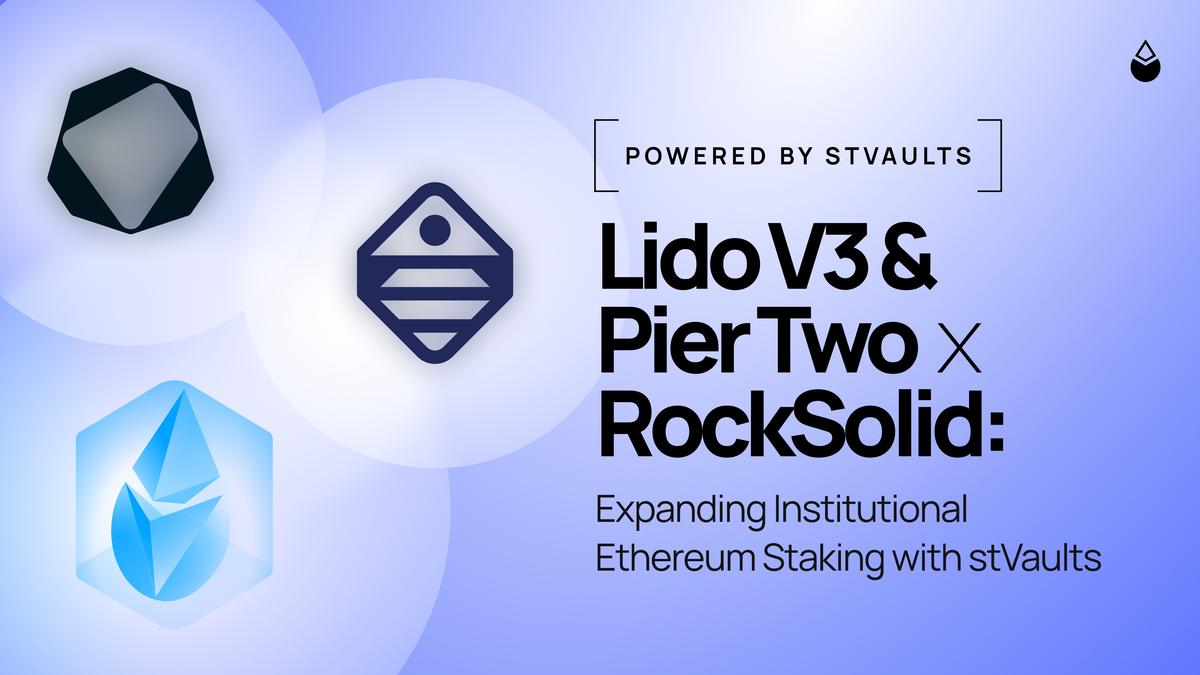
A spokesperson for RockSolid articulated the company’s strategic vision: "Our collaboration with Lido V3 and Pier Two represents a pivotal moment in making decentralized finance genuinely accessible and secure for institutional capital. The AutoPlus Looped ETH Vault is not just another staking product; it’s a meticulously engineered solution that directly addresses the complex needs of our institutional clients, providing unparalleled flexibility, transparency, and robust risk management within the trust-minimized framework of Ethereum." This sentiment underscores RockSolid’s commitment to building bridges between the traditional financial world and the innovative possibilities of blockchain technology. The vault’s design philosophy prioritizes clarity around its operational mechanics, security models, and risk differentiation, directly confronting the initial limitations that hindered broader institutional adoption.
Pier Two: The Bedrock of Non-Custodial Infrastructure and Operational Excellence
Central to the robust operation of the RockSolid AutoPlus Looped ETH Vault is the critical infrastructure provided by Pier Two. Specializing in enterprise-grade blockchain infrastructure services, Pier Two supports this setup by operating the underlying non-custodial validator infrastructure. This operational model is paramount for institutional clients, as it ensures that asset control remains decentralized and transparent, aligning with the core tenets of blockchain technology.
Pier Two’s role extends beyond mere technical support; it is the guarantor of operational resilience and performance. The company’s expertise ensures robust uptime, superior validator performance, and a security posture that is deeply aligned with the Ethereum protocol. By managing the complexities of validator operations – including node maintenance, security patching, and constant monitoring – Pier Two enables RockSolid to focus on vault design and client relations, confident that the underlying staking mechanics are handled by a proven, reliable provider.
"Our partnership with RockSolid underscores our unwavering commitment to delivering enterprise-grade infrastructure that not only upholds the highest standards of security and operational resilience but also empowers innovative decentralized applications," commented the CEO of Pier Two in an inferred statement. "By providing non-custodial staking operations, we ensure that all activities related to the AutoPlus Looped ETH Vault remain programmatic, immutable, and transparent on-chain, offering institutions the peace of mind they demand when engaging with digital assets." This emphasis on non-custodial operations is a critical differentiator, as it minimizes counterparty risk and ensures that clients retain ultimate control over their assets, a fundamental requirement for institutional participation in DeFi.
Architectural Robustness: The ERC-7540 Standard and Enhanced Security Measures
The technical implementation of the RockSolid AutoPlus Looped ETH Vault is built on a foundation of cutting-edge smart contract standards, ensuring both functionality and security. The vault utilizes the ERC-7540 Asynchronous Tokenized Vault standard. This standard represents an evolution in tokenized vault design, extending the widely adopted OpenZeppelin ERC-4626 standard. While ERC-4626 provides a standardized interface for yield-bearing tokenized vaults, ERC-7540 specifically introduces enhanced workflows and controls around asset movement and custody, crucial for the asynchronous nature of staking deposits and withdrawals.
This layered approach to smart contract design provides a robust framework that supports the complex interactions required for a looped ETH vault while maintaining clarity and auditability. RockSolid’s smart contracts, which govern the vault’s operations, have undergone rigorous security audits by Nethermind, a highly respected blockchain research and development firm. These audits are critical for identifying and mitigating potential vulnerabilities, ensuring the integrity and security of the institutional capital flowing through the vault.
The integration and security approach emphasizes a multi-faceted defense strategy. Beyond the audited smart contracts, Pier Two’s non-custodial validator infrastructure adds another layer of security by ensuring that private keys are never exposed to the vault’s smart contracts or third parties. This distributed responsibility model, combining audited smart contracts with secure, professionally managed validator operations, provides an institutional-grade security posture. The transparency inherent in on-chain operations further allows for real-time monitoring and verification of all activities, aligning with regulatory expectations for accountability and oversight.
Expected Outcomes and Broader Market Implications
The launch of the RockSolid AutoPlus Looped ETH Vault is poised to deliver substantial benefits for institutional clients and carries broader implications for the future of decentralized finance. For institutions, the vault offers a sophisticated yet user-friendly mechanism to deposit and withdraw ETH, albeit subject to Ethereum’s inherent entry and exit queues. Critically, it provides the optionality to unlock stETH liquidity through Lido V3 when market conditions are favorable, offering a level of flexibility previously unattainable without compromising the fundamental integrity and security of their staked assets. This design, centered on conservative risk management, is a key selling point for a sector that prioritizes capital preservation.
Furthermore, Lido V3 stVaults empower teams like RockSolid to select their preferred staking provider, fostering a competitive ecosystem of infrastructure services. In this instance, Pier Two’s proven, non-custodial staking operations ensure that all activity remains programmatic, immutable, and transparent on-chain, aligning with the highest standards of trust and verifiability. This flexibility in provider choice allows institutions to engage with partners that best fit their operational and compliance frameworks.
The broader market impact of such solutions cannot be overstated. By addressing core institutional concerns around liquidity, security, and operational complexity, the AutoPlus Looped ETH Vault lowers significant barriers to entry for large-scale capital. This development is expected to accelerate the adoption of institutional DeFi, validating the potential for decentralized protocols to serve sophisticated financial needs. It also demonstrates a maturation of the DeFi landscape, moving towards products that are not only innovative but also robust enough to meet the stringent demands of traditional finance. The integration of advanced standards like ERC-7540 and the emphasis on comprehensive security audits are likely to become benchmarks for future institutional-grade offerings, paving the way for a more integrated and trusted digital asset economy. As more institutions seek to diversify their portfolios and capture yield from emerging asset classes, solutions like the RockSolid AutoPlus Looped ETH Vault will be instrumental in shaping the next chapter of decentralized finance.