
 admin
admin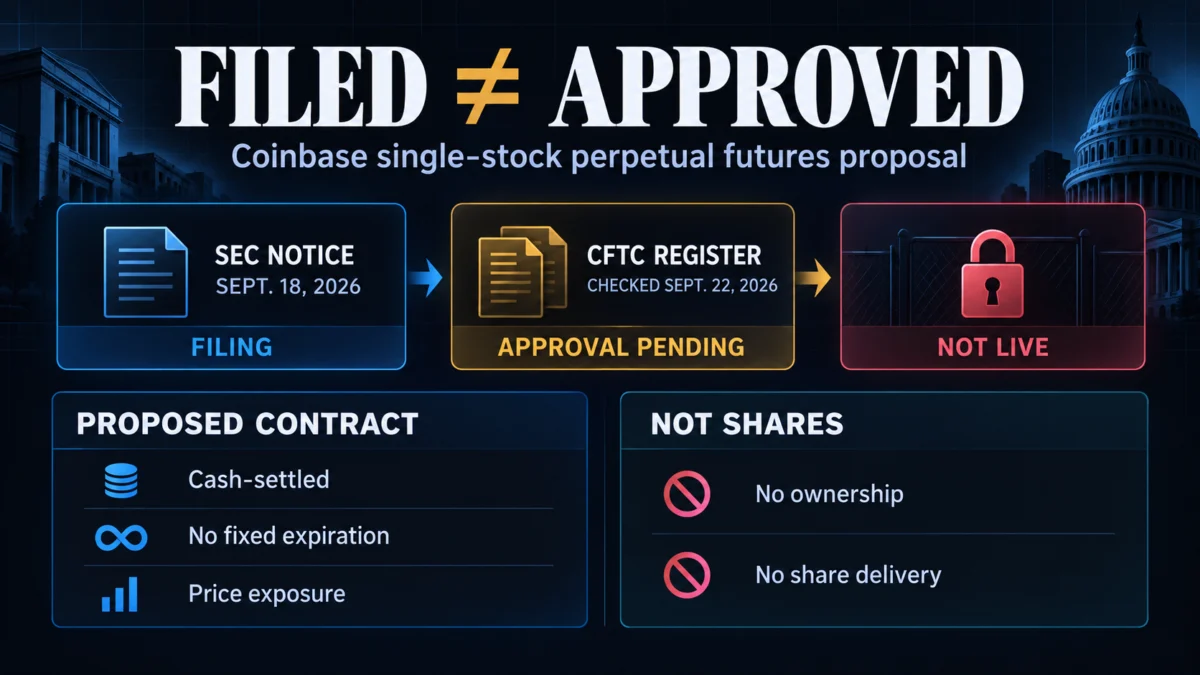
Coinbase Derivatives has formally submitted a proposed framework for perpetual futures contracts tied to individual U.S. stocks and exchange-traded funds (ETFs), a move that, if approved, could significantly expand the derivatives market accessible to retail and institutional investors. However, these innovative contracts remain in regulatory limbo, awaiting the green light from the Commodity Futures Trading Commission (CFTC). The Securities and Exchange Commission (SEC) published a notice of the filing on September 18, detailing Coinbase’s submission to the CFTC. As of September 22, the CFTC’s product register still listed the "Single Stock Perpetual Futures Contract" with a status of "Approval Pending," indicating that the proposed rule change has been formally lodged but has not yet received regulatory endorsement. This public proposal serves as a detailed outline of Coinbase’s intended product structure, rather than an announcement of immediate market availability.
A New Frontier in Derivatives: Perpetual Stock Futures
The core of Coinbase’s proposal centers on the creation of cash-settled perpetual futures contracts. This means that rather than the physical delivery of underlying shares or ETF units upon contract expiration, all gains and losses will be settled through monetary payments. This structure is designed to offer traders a way to gain price exposure to individual equities and ETFs without the complexities and responsibilities of direct ownership, such as holding shares, voting rights, or receiving dividends.
The concept of perpetual futures, widely popular in the cryptocurrency space, offers contracts with no fixed expiration date. This allows traders to hold positions indefinitely, provided they meet margin requirements and pay any applicable funding fees. The application of this model to traditional U.S. equities represents a novel development, potentially bridging the gap between the crypto derivatives market and the more established equity markets.
The Mechanics of Cash-Settled Perpetual Futures
Under the proposed framework, these cash-settled contracts would derive their value from the reference price of the underlying equity security or ETF. Crucially, holding these futures contracts would not confer any ownership rights in the actual shares. Any profits or losses would be realized solely through the futures trading position, independent of any changes in the underlying asset’s ownership. This distinction is vital for investors seeking speculative price movements without the commitment of holding the asset itself.
A key component of perpetual futures contracts is the funding mechanism. Open positions are subject to periodic funding payments, which aim to keep the futures contract price closely aligned with the spot price of the underlying asset. The proposed rule framework does not prescribe a universal funding rate or interval for all contracts. Instead, it indicates that the specific methodology, payment mechanics, interval, publication practices, and operational timing for each individual product would be detailed in a product appendix or through identified market reference materials. This suggests a flexible approach, allowing for customized funding arrangements tailored to the liquidity and volatility characteristics of each underlying security.
Trading Hours and Regulatory Scrutiny
Coinbase Derivatives has proposed a trading week that would commence on Sunday at 8:00 p.m. Eastern Time and conclude on Friday at 5:00 p.m. Eastern Time. This extended trading window, often referred to as a "24/5" style of exposure, is consistent with the operational hours of many cryptocurrency derivatives exchanges, offering continuous market access for a significant portion of the week. However, the proposed schedule would be subject to interruptions for holidays, scheduled maintenance, and other exchange-specified periods. Furthermore, trading activity would remain under the purview of regulatory oversight, with the possibility of pauses, suspensions, and halts mandated by regulatory bodies.
This proposed trading schedule echoes earlier communications from Coinbase. An official post from the @coinbase account on the social media platform X (formerly Twitter) highlighted the company’s intention to "work to bring" such a product to the U.S. market, emphasizing its prospective nature. The wording at the time underscored that the product was in the filing stage and not yet operational.
The CFTC’s Gatekeeping Role
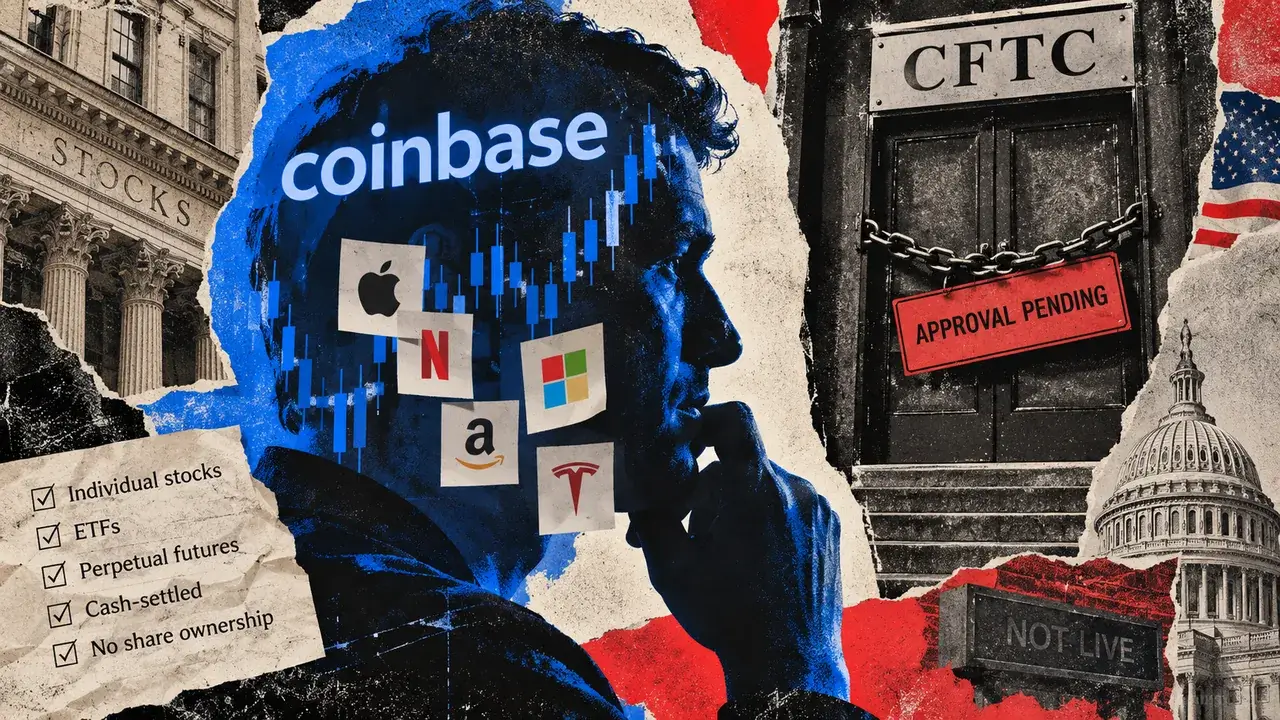
The Commodity Futures Trading Commission (CFTC) plays a pivotal role in regulating derivatives markets in the United States. For Coinbase’s proposed single stock perpetual futures to become available to traders, they must navigate the CFTC’s rigorous approval process. The "Approval Pending" status on the CFTC’s product register signifies that the application is under review, and the commission is likely evaluating various aspects, including market integrity, investor protection, and systemic risk.
The CFTC’s scrutiny is particularly important given the novelty of applying perpetual futures to traditional equities. While these contracts have a proven track record in the crypto space, their introduction into the more regulated equity derivatives market may present unique challenges and considerations for regulators. The commission will likely be assessing how the cash settlement mechanism, the perpetual nature, and the funding arrangements interact with existing market regulations and practices.
Background and Context: A Strategic Move by Coinbase
This regulatory filing represents a strategic move by Coinbase, a leading cryptocurrency exchange that has been actively seeking to diversify its product offerings and expand its footprint in the broader financial markets. The company has consistently advocated for clearer regulatory frameworks to enable innovation within the digital asset space and adjacent financial sectors. By proposing these stock-based perpetual futures, Coinbase is leveraging its expertise in derivatives trading, honed through its cryptocurrency offerings, to tap into the massive U.S. equity market.
The U.S. equity derivatives market is substantial, with significant trading volumes in options and futures contracts on major stock indices and individual stocks. Introducing a product that offers perpetual exposure could attract a new segment of traders or provide existing market participants with alternative hedging and speculative tools. The success of such a product would depend not only on regulatory approval but also on its ability to attract sufficient liquidity and offer competitive pricing.
Implications for Investors and the Market
The potential introduction of single stock perpetual futures by Coinbase could have several implications:
- Increased Accessibility: These contracts could make it easier for a broader range of investors to gain exposure to equity price movements without the need for direct share ownership, potentially lowering the barrier to entry for certain speculative strategies.
- Enhanced Hedging Tools: For institutional investors and sophisticated traders, these products might offer new ways to hedge existing equity portfolios or express short-term views on individual stocks.
- Market Innovation: The move signals a growing convergence between traditional finance and digital asset markets, potentially paving the way for further innovation in financial product development.
- Regulatory Precedent: The CFTC’s decision on Coinbase’s filing could set a precedent for future applications of cryptocurrency-inspired derivatives in traditional asset classes.
However, the "Approval Pending" status serves as a critical reminder that these are not yet available products. Any claims of current approval or availability are premature. The regulatory process is often complex and can involve multiple stages of review, feedback, and potential revisions to the proposed rules. Investors and market observers will be closely watching the CFTC’s deliberations.

A Timeline of the Application Process
The timeline leading up to this point can be pieced together through regulatory disclosures:
- Initial Filing: Coinbase Derivatives submitted its proposed rule change to the CFTC.
- SEC Notice: The Securities and Exchange Commission published a notice regarding this filing on September 18, 2026, making the proposal publicly accessible. This notice typically serves to inform the public and solicit comments.
- CFTC Review: The CFTC is currently reviewing the proposal. The "Approval Pending" status indicates that the application is active and under consideration.
- Market Availability: Until the CFTC grants approval and Coinbase releases the final, product-specific terms and conditions, the single stock perpetual futures contracts will remain unavailable for trading.
Official Statements and Related Parties
While no direct statements from the CFTC regarding the specifics of Coinbase’s application have been publicly released beyond the status update, regulatory bodies typically engage in thorough due diligence. The CFTC’s mandate includes ensuring the integrity of the derivatives markets, preventing manipulation, and protecting market participants. Their review will likely involve assessing Coinbase’s operational capabilities, risk management systems, and the compliance framework for these new products.
Coinbase, through its public filing and previous communications, has demonstrated its intent to bring these products to market. The company’s broader strategy involves seeking regulatory clarity and compliance across various jurisdictions, aiming to position itself as a trusted provider of both digital asset and traditional financial services.
Broader Market Impact and Future Outlook
The potential success of Coinbase’s single stock perpetual futures could encourage other exchanges and financial institutions to explore similar offerings. It signifies a growing interest in derivative products that offer flexible exposure to traditional assets, mirroring trends seen in the cryptocurrency market.
The market’s reaction to such products will be influenced by several factors, including the perceived risks and rewards, the efficiency of the trading mechanism, and the competitive landscape. Should these contracts gain traction, they could lead to increased price discovery and liquidity for the underlying equities, although the speculative nature of perpetual futures also carries inherent risks for traders.
Ultimately, the regulatory approval from the CFTC is the critical gating factor. The commission’s decision will not only determine the future of Coinbase’s proposed product but also provide valuable insights into the evolving regulatory environment for innovative financial instruments that bridge the gap between traditional and digital asset markets. Until that approval is granted, the Coinbase single stock perpetual futures remain a promising but unrealized prospect, a chained doorway awaiting the key of regulatory endorsement.








