admin
admin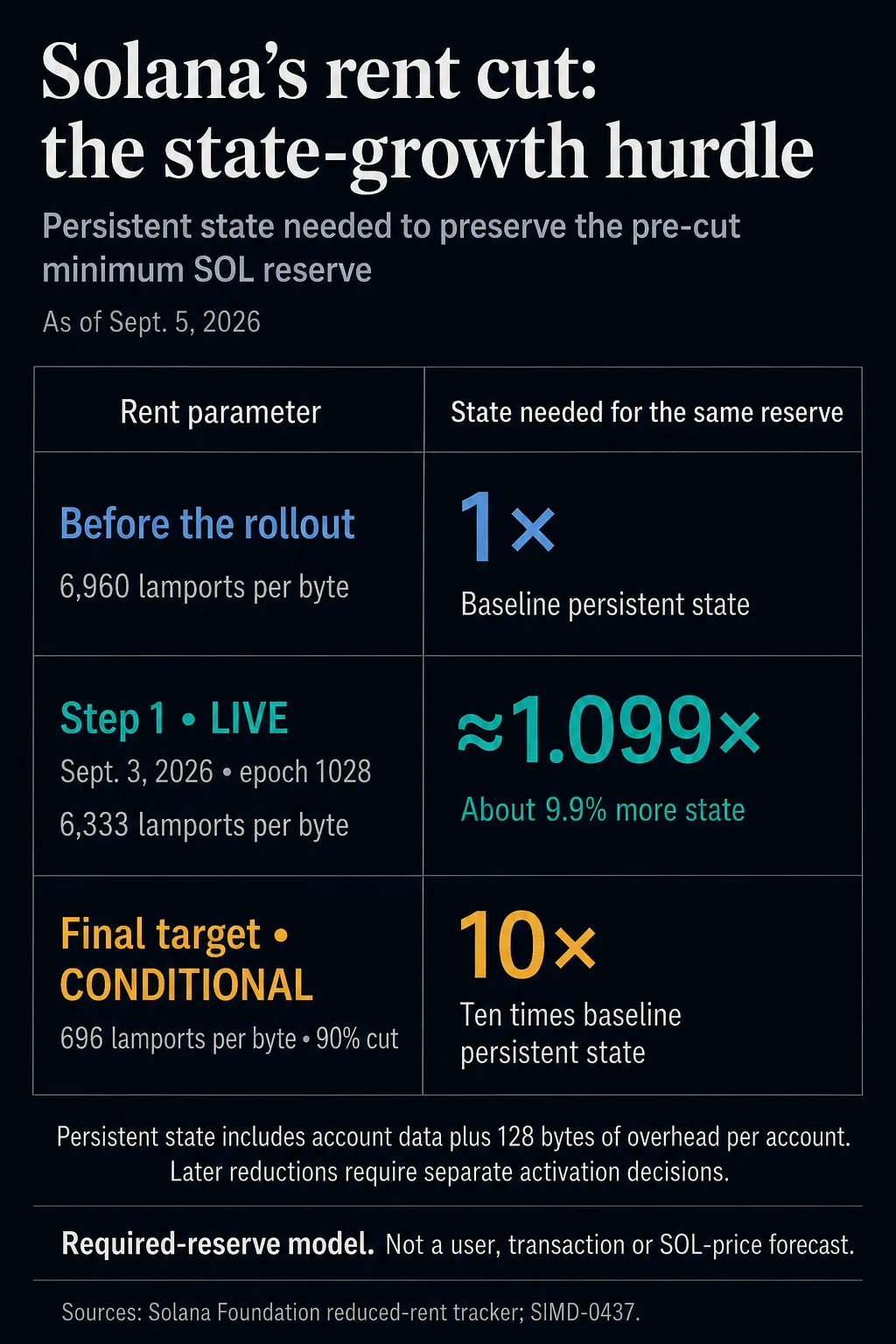
Eligible Solana token-account owners can now reclaim excess SOL previously held to ensure their token accounts remained active following the network’s first rent reduction, which went live on September 3. This pivotal change, part of a multi-stage plan to decrease the SOL required for account storage, also significantly lowers the upfront capital needed for businesses to fund new account creations. The long-term vision is to enable a tenfold increase in account growth without necessitating a proportional rise in SOL reserves, potentially paving the way for substantial network adoption and reduced barriers to entry.
The Solana Foundation’s official tracker confirms that the initial reduction, representing approximately a 9% decrease in the rent-per-byte parameter, has been successfully implemented on the mainnet. This initial step already lowers reserve requirements for existing accounts. The ambitious goal of a tenfold increase in account capacity relative to SOL reserves is contingent on the successful activation of the full five-stage reduction plan, which aims to dramatically decrease the SOL required to maintain persistent account state.
Understanding Solana’s "Rent" Mechanism and the Reduction Plan
In the Solana ecosystem, "rent" refers to a balance held as collateral against account storage. Unlike a recurring subscription fee, this balance is generally recoverable when an account is closed. The reduction in the required reserve balance directly translates into new accounts being able to launch with a smaller SOL investment and allows existing accounts to hold more SOL beyond their minimum operational needs.
The rent reduction is being implemented incrementally, with the first stage occurring at epoch 1028 on September 3. This initial adjustment saw the reserve parameter decrease from 6,960 lamports per byte to 6,333 lamports per byte. The ultimate target of the five-stage plan is to bring this parameter down to a mere 696 lamports per byte.
According to SIMD-0437, the official specification for the rent reduction, the minimum SOL reserve for an account is calculated by multiplying its data size, plus 128 bytes of overhead, by the current lamports-per-byte parameter. For a standard token account, which typically holds 165 data bytes, its effective size amounts to 293 bytes.
To illustrate the impact of these reductions, consider a scenario involving one million identical standard token accounts:
| Scenario | Lamports per Byte | Required Reserve (for 1 million accounts) | Reduction vs. Original |
|---|---|---|---|
| Before Rent Reduction | 6,960 | 2,039.28 SOL | Baseline |
| First Step (Live Sept. 3) | 6,333 | 1,855.569 SOL | 183.711 SOL |
| Final Target (Conditional) | 696 | 203.928 SOL | 1,835.352 SOL |
These figures represent the calculated minimum reserves required for a fixed number of accounts. The substantial reduction to the final target, if fully realized, would free up an estimated 1,835.352 SOL for this hypothetical million-account population. This amount, while significant for this example, represents a fraction of Solana’s total circulating supply. As of September 5, 2026, Solana’s circulating supply was approximately 585.36 million SOL, according to CryptoSlate market data. The actual network-wide impact on SOL reserves will depend on the total number of accounts, their individual sizes, balances, and the reclaimability of those balances.
The "tenfold hurdle" refers to the point at which the network’s total persistent state, including per-account overhead, could grow tenfold while still requiring the same minimum SOL reserves as before the rent reduction. This metric focuses specifically on storage requirements and is distinct from user counts, transaction volumes, or SOL prices. The initial reduction, however, sets a more immediate precedent: approximately 9.9% more rent-bearing state can be supported at the new 6,333 lamports-per-byte rate while maintaining the original minimum SOL reserve.
Timeline of the Rent Reduction Stages
The implementation of Solana’s rent reduction is a carefully staged process, designed to allow for monitoring and adjustment:
- September 3, 2026: The first rent reduction was activated on the Solana mainnet at epoch 1028. This brought the lamports-per-byte parameter down from 6,960 to 6,333.
- Mid-September 2026 (Expected): The second reduction, targeting 5,080 lamports per byte, is slated for activation on the mainnet. This stage is currently undergoing testing on the testnet.
- November 2026 (Expected): The remaining three stages of the rent reduction are anticipated to be rolled out with the Agave 4.4 network upgrade. This will bring the parameter down to the final target of 696 lamports per byte.
Each stage of this rollout is subject to a review of network state growth. The Solana Foundation has indicated that a fallback mechanism exists, allowing for the restoration of the original parameter if necessary, ensuring network stability throughout the process.
Reclaiming Excess Capital and Implications for Developers
The immediate and most tangible benefit for existing token-account owners is the ability to reclaim SOL that was held in excess of the new, lower minimum requirements. The Solana Foundation released a detailed reclamation guide on September 3, outlining the WithdrawExcessLamports instruction available through both the standard Token program and the newer Token-2022 program.

Crucially, the authority to initiate these withdrawals rests with the account owner. For token accounts, this means the individual or entity that owns the account must authorize the transaction. In cases where a mint authority has been revoked, the mint account itself may be able to sign for withdrawals related to token mints. Accounts managed by custom programs require the owning program to implement specific withdrawal logic and verify the relevant authorities.
This distinction in withdrawal authority is economically significant. For instance, a payments provider that funded a customer’s token account cannot automatically assume it has the right to reclaim excess SOL simply by having provided the initial deposit. The party designated as the authorized signatory for the withdrawal may differ from the original SOL provider, underscoring the importance of clear contractual agreements and program design.
The process of withdrawing excess SOL involves an authorized transaction that ensures the minimum reserve requirement is maintained. This operation effectively moves existing SOL between accounts without creating new tokens or altering the token balance within the account. While the guide provides the technical means for reclamation, it does not currently offer aggregate data on the volume of SOL withdrawn or its subsequent market impact.
For developers and businesses looking to launch new applications or onboard users onto Solana, the rent reduction offers a more direct advantage: a lower upfront capital requirement to create new token accounts. This could enable service providers to support a greater number of customer accounts with the same amount of capital, particularly in scenarios where users do not directly purchase SOL themselves. The extent to which existing surplus SOL can be redeployed, however, remains dependent on the specific authority and program configurations governing those accounts.
Analyzing Network Growth and SOL Demand
The long-term sustainability of these accounts is a key factor in determining the ongoing reserve requirements for the network. While gross account creation can inflate metrics, the true measure of persistent state on-chain is more indicative of actual resource utilization.
A study conducted by Solana Foundation researcher Umberto Natale in July 2026 analyzed account-creation events and found that a significant percentage, 75.5%, of accounts in the analyzed cohort were closed within the same transaction. It’s important to note that these observations were not deduplicated by address, meaning repeated creation and closure by the same entity could be counted as separate events. Such workflows can generate on-chain activity without leaving substantial persistent account storage.
However, Natale’s study cautioned that these findings do not definitively predict user behavior in response to the current rent reduction. Furthermore, the study identified weak and unstable correlations between SOL prices and account activity, indicating that these correlations are descriptive rather than causal. It cannot be definitively stated how reduced rent will influence demand.
Therefore, a comprehensive assessment of the policy’s success will require tracking persistent account bytes and their associated minimum reserves alongside overall network activity. Simply counting new accounts may not provide an accurate picture of whether the network is effectively absorbing the lower reserve rate.
Beyond account reserves, SOL continues to serve other critical functions within the Solana ecosystem. Under Solana’s fee structure, transactions incur SOL costs. A portion of the base fee is burned, while the remainder, along with the entire priority fee, is directed to validators. These transaction fees represent a distinct demand channel for SOL, separate from refundable account reserves. Increased network activity can lead to higher fee utilization, but this does not directly correlate with the total amount users pay or the balances they retain.
Additionally, SOL holders can delegate their stake to validators, a process essential for securing the network and earning rewards. Reclaimed capital from reduced rent requirements could potentially be staked or used to fund further account creation. However, the existing data does not provide quantitative evidence to support either of these outcomes as direct results of the rent reduction. These possibilities remain potential avenues for SOL deployment but do not currently offer a quantified offset to the reduced reserve requirements.
A recent analysis by CryptoSlate examining network usage and fee economics highlighted a crucial distinction: network activity and token economics can operate independently. The rent reduction introduces a specific mechanism through which network growth can occur with a reduced SOL requirement per unit of persistent state.
Future Outlook and Network Stability
As Solana progresses through its rent reduction roadmap, the activation of subsequent stages will determine the full extent of capital savings. Monitoring persistent state growth and actual SOL reclamation will be key to understanding how these savings translate into increased account capacity, reusable working capital, or a reduction in the overall SOL held against storage. The continued review of state growth at each gate is designed to ensure that the network can absorb these changes, with the provision for a fallback mechanism serving as a safeguard for network stability. The success of this policy hinges on its ability to foster greater adoption and utility for the Solana network without compromising its underlying economic security.