
 James Watt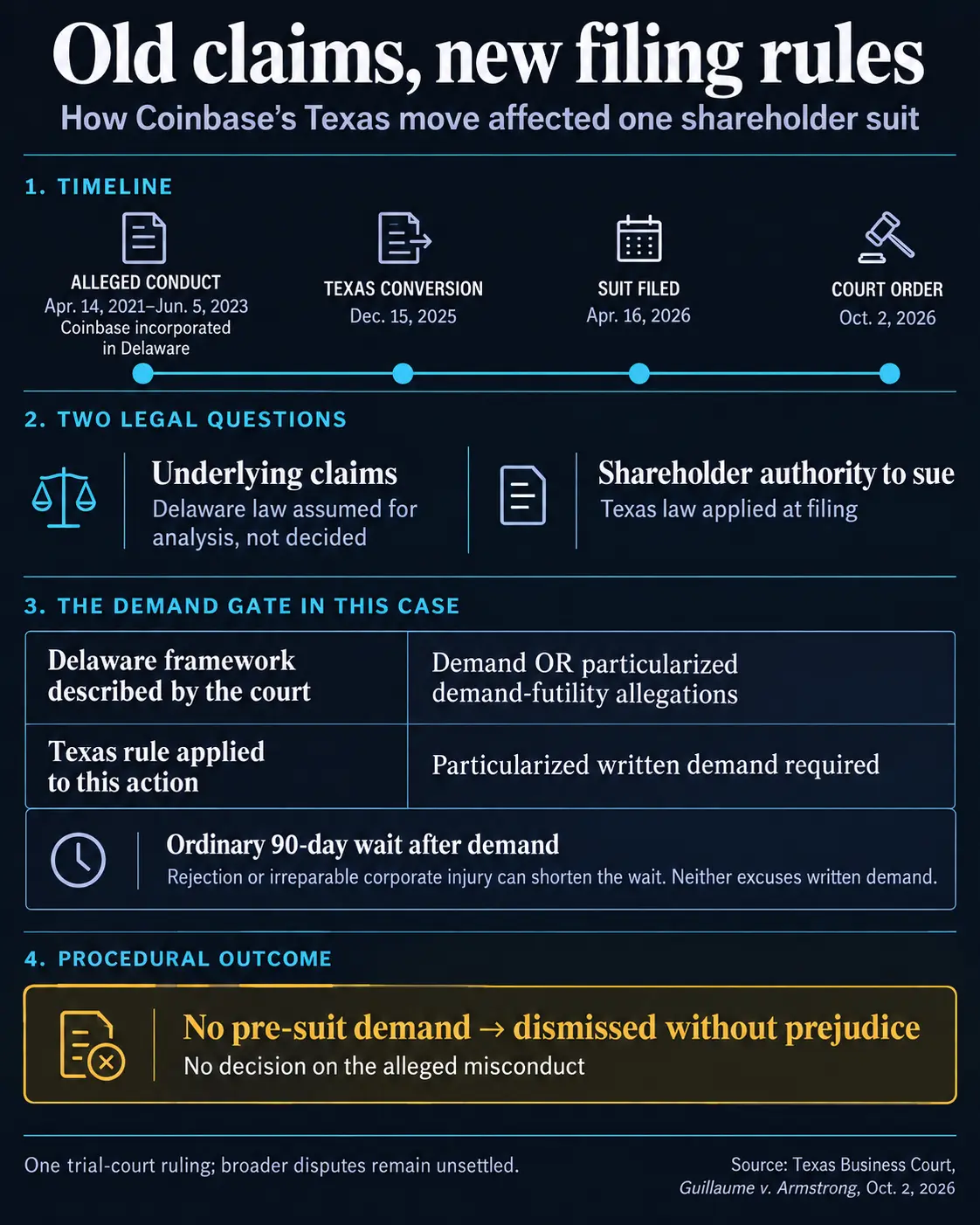
The Texas Business Court has issued a landmark ruling that clarifies the procedural hurdles shareholders face when a corporation relocates its legal home. In an October 2, 2026, decision, Judge Andrea K. Bouressa dismissed a derivative action filed by shareholder Gary Guillaume against the directors of Coinbase Global, Inc. The court’s findings emphasize that the act of reincorporation can fundamentally alter the rules governing how shareholders may challenge past corporate conduct, even if that conduct occurred while the company was under a different state’s jurisdiction.
The dismissal centered on a critical procedural requirement known as the "demand rule." Under Texas law, a shareholder must formally demand that the company’s board of directors take action on a claim before filing a lawsuit on the company’s behalf. Because Guillaume failed to satisfy this requirement after Coinbase’s move to Texas, his suit was dismissed without prejudice. While the court did not rule on the underlying merits of the alleged misconduct, the decision serves as a powerful signal to public companies considering a move to the Lone Star State and a cautionary tale for the shareholders who monitor them.
The Legal Mechanics of Derivative Actions and the Demand Rule
A derivative action is a unique legal vehicle that allows a shareholder to step into the shoes of a corporation to pursue a claim that the company itself has failed to bring. Because the claim belongs to the corporation rather than the individual shareholder, the law typically requires the shareholder to demonstrate that they have exhausted internal remedies. This is where the "demand requirement" becomes the primary gatekeeper of corporate litigation.
In the Coinbase matter, the dispute was not initially about whether the directors had committed the alleged wrongs, but rather about which state’s rules governed the permission to sue. The parties agreed that the lawsuit was filed on April 16, 2026, and concerned conduct alleged to have occurred between April 14, 2021, and June 5, 2023. During that period, Coinbase was incorporated in Delaware, a state known for its well-developed Chancery Court and specific rules regarding shareholder standing.
Under Delaware’s framework, a plaintiff can bypass the demand requirement by pleading "demand futility." To do this, a shareholder must provide specific, particularized allegations showing that a majority of the board is incapable of making an impartial decision. This involves proving that directors received a material personal benefit from the alleged wrong, face a substantial likelihood of personal liability, or lack independence from a self-interested party. Guillaume attempted to follow this Delaware route, arguing that making a demand on the Coinbase board would have been futile.
However, Coinbase’s legal landscape changed on December 15, 2025, when its conversion to a Texas corporation became effective. Texas law for public companies does not recognize a "futility" exception in the same manner. Instead, it mandates a particularized written demand that identifies the conduct in question and requests specific corporate action. Following this demand, the shareholder must generally wait 90 days before proceeding with a lawsuit, unless the demand is rejected earlier or the corporation would suffer irreparable injury. By failing to submit this written demand, Guillaume ran afoul of Texas procedural law, leading to the court’s dismissal.
Chronology of the Coinbase Reincorporation and Litigation
The timeline of Coinbase’s jurisdictional shift is essential to understanding why the Texas Business Court reached its conclusion. The events unfolded over a five-year period, bridging the company’s time in Delaware and its eventual establishment in Texas:
- April 2021 – June 2023: The period of alleged misconduct cited in the shareholder complaint. During this time, Coinbase was a Delaware corporation.
- October 31, 2025: The record date for a major corporate decision. At this time, a consenting group associated with CEO Brian Armstrong and co-founder Fred Ehrsam held approximately 78.40% of the company’s voting power.
- November 4, 2025: The majority voting group approved the conversion from Delaware to Texas by written consent.
- November 2025: Coinbase issued an information statement detailing the board’s recommendation to move to Texas, citing a committee’s evaluation of Delaware, Nevada, and Texas.
- December 15, 2025: The conversion to a Texas corporation became legally effective.
- February 2026: Coinbase filed its annual report, noting that Armstrong and an independent trustee collectively exercised majority voting rights.
- April 16, 2026: Gary Guillaume filed the derivative action in the newly established Texas Business Court.
- October 2, 2026: Judge Andrea K. Bouressa signed the order dismissing the action for failure to meet the Texas demand requirement.
- October 9, 2026: CEO Brian Armstrong publicly praised the ruling as a precedent that would encourage more companies to incorporate in Texas.
The Internal Affairs Doctrine and Procedural Divergence
The most significant legal finding in Judge Bouressa’s opinion concerned the "Internal Affairs Doctrine." This doctrine generally holds that the law of the state of incorporation governs the internal relations of the corporation. Guillaume argued that because the alleged misconduct occurred while Coinbase was in Delaware, Delaware law—including the demand futility exception—should apply to his right to sue.
The court accepted, for the sake of analysis, that Delaware law might govern the substance of the claims (whether the directors breached their duties). However, it drew a sharp distinction between the underlying claims and the authority of a shareholder to assert those claims. The court reasoned that a shareholder does not possess a "vested right" to bring a derivative suit under a specific state’s procedural rules just because the claim arose while the company was in that state.
Instead, the court determined that the law of the state of incorporation at the time the lawsuit is filed governs the shareholder’s standing and authority. Because Coinbase was a Texas entity when Guillaume filed his suit in April 2026, the Texas demand requirement applied. This ruling illustrates a "procedural divergence": a company’s past actions may be judged by one state’s standards, but the ability of a shareholder to bring those actions to court is dictated by the current state of incorporation.
Corporate Governance and Concentrated Voting Power
The governance structure of Coinbase played a pivotal role in the company’s ability to move jurisdictions and, subsequently, its defense against the derivative suit. According to SEC filings, Coinbase utilizes a dual-class share structure where Class B shares carry 20 votes each, compared to one vote for Class A shares.
In its April 24, 2026, proxy statement, Coinbase reported that Brian Armstrong held 49.6% of the voting power, while Fred Ehrsam held 10.6%. Other Armstrong-associated entities and trusts with an independent trustee accounted for an additional 18.9%. This concentration of power allowed the "consenting group" to approve the Texas move via written consent without a full shareholder meeting, a move the board claimed would provide greater litigation predictability and defense cost savings.
The court also addressed Guillaume’s argument that Coinbase’s own conversion disclosures promised that shareholders would retain their standing to bring claims concerning earlier conduct. Judge Bouressa found this interpretation too broad. The court noted that while the disclosures preserved the eligibility of shareholders to sue (subject to continued ownership), they did not guarantee that Delaware’s procedural rules would follow the company to Texas. In fact, the disclosures explicitly stated that Texas law would govern the company’s affairs post-conversion.
Strategic Implications for the Texas Business Court System
The dismissal of the Guillaume action is a significant victory for the Texas Business Court system, which was recently established to compete with Delaware for corporate registrations. By providing a forum that strictly enforces the demand requirement, Texas offers a level of protection for boards of directors that may not be available in Delaware, where the "futility" argument is a frequent and often successful tool for plaintiffs.
In his endorsement of the ruling, Brian Armstrong thanked Texas Governor Greg Abbott, highlighting the state’s "crypto-friendly" environment and the predictability of its legal system. For Coinbase, the move to Texas was framed as a strategic decision to align with a jurisdiction that understands digital asset innovation while providing a more stable litigation environment.
The broader implications for corporate America are substantial. The Coinbase precedent suggests that boards of directors facing potential derivative litigation may find relief by reincorporating in jurisdictions with more stringent demand requirements. This "jurisdictional arbitrage" allows companies to reset the procedural clock on older claims, forcing shareholders to comply with new, often more difficult, pre-suit hurdles.
Analysis of Shareholder Impacts
For public shareholders, the ruling underscores the importance of monitoring corporate domicile. When a company moves from a shareholder-friendly jurisdiction like Delaware to a more management-friendly environment like Texas, the window for challenging past board decisions can narrow significantly.
Judge Bouressa pointed out that Guillaume failed to provide evidence that making a formal demand was impossible or would have caused irreparable harm. This suggests that while the Texas rules are stricter, they are not an absolute bar to litigation. However, they do require a more methodical and time-consuming approach. Shareholders must now be prepared to engage in a formal 90-day demand process, giving the board an opportunity to investigate the claims—and potentially kill the litigation—before it ever reaches a courtroom.
As more companies like Tesla and Coinbase look toward Texas and Nevada as alternatives to Delaware, the legal landscape for corporate accountability is shifting. The Coinbase ruling confirms that reincorporation is not just a change of address; it is a change of the very rules of engagement between a company and its owners. This shift places a higher burden on activist shareholders and underscores the power of concentrated voting blocks to reshape the legal risks facing a corporation.








