
 James Watt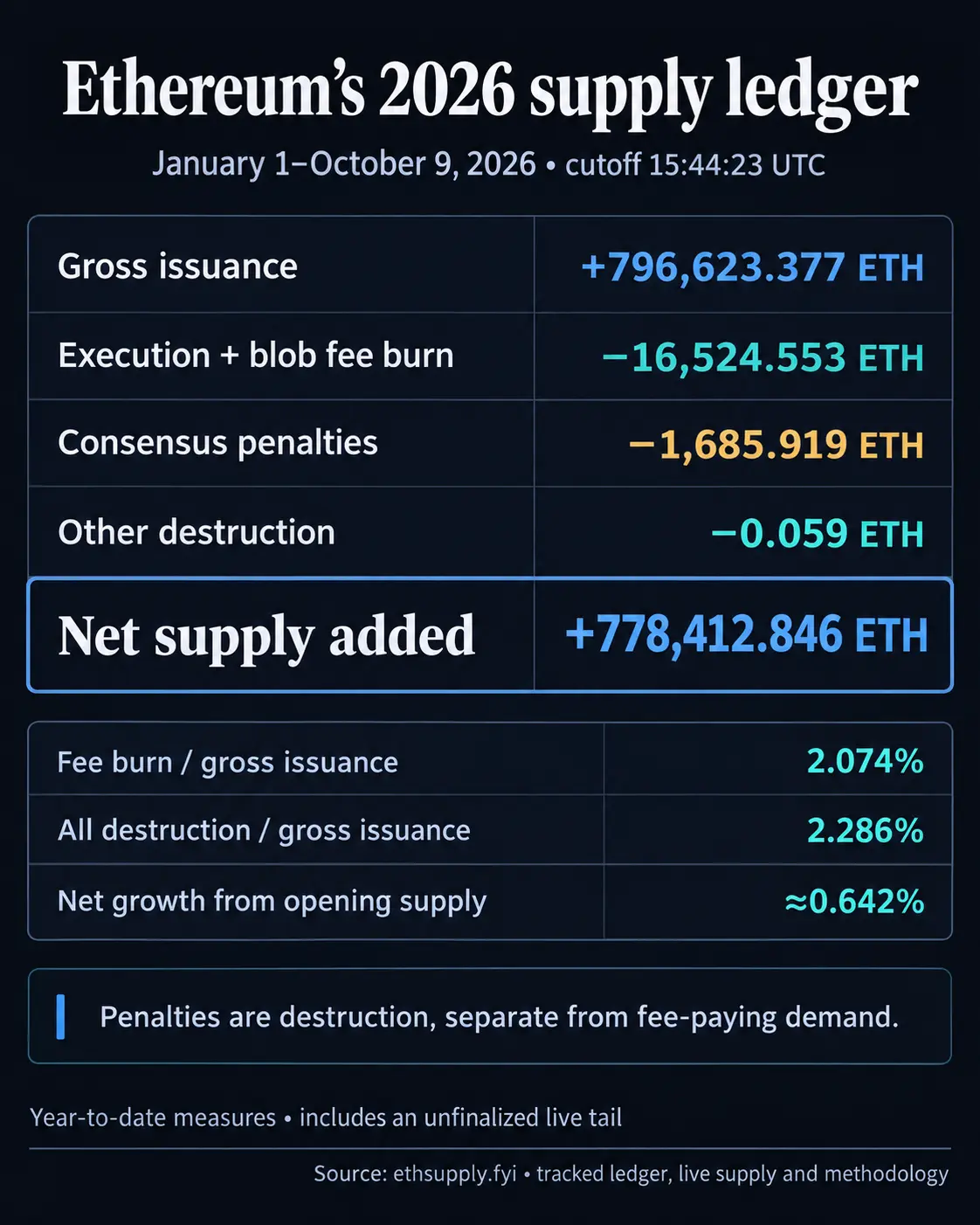
The Ethereum network has experienced a significant expansion in its total circulating supply throughout 2026, as the mechanism designed to make the asset deflationary has struggled to keep pace with new coin issuance. According to a comprehensive supply ledger finalized on October 9, 2026, transaction fee burns have offset only 2.07% of the new ETH issued during the year. This data highlights a widening gap between the network’s issuance of rewards to validators and the destruction of tokens through transaction activity, resulting in a net addition of approximately 778,413 ETH to the ecosystem. This represents a 0.64% increase in total supply since the beginning of the year, a trend that challenges the "ultrasound money" narrative that gained prominence following the network’s transition to Proof-of-Stake.
The current supply dynamics are largely driven by a combination of high staking participation, which increases gross issuance, and relatively low network congestion, which keeps base fees—and thus the burn rate—at modest levels. As developers prepare for the upcoming "Glamsterdam" upgrade, which proposes a conditional increase in the gas limit to 200 million, the community is closely examining how scalability improvements might further impact the scarcity of the asset. While a higher gas limit allows for more transactions, it also lowers the required fee per unit of gas needed to process those transactions, potentially creating a higher hurdle for reaching a supply-neutral state.
Detailed Breakdown of the 2026 Supply Ledger
The data provided by the ethsupply.fyi retained ledger offers a granular look at the network’s accounting from January 1, 2026, at 00:00:11 UTC through October 9, 2026, at 15:44:23 UTC. During this nearly ten-month window, the Ethereum protocol generated 796,623.377 ETH in gross issuance. These coins are primarily distributed as rewards to the global set of validators who secure the network and finalize blocks.
In contrast, the amount of ETH permanently removed from circulation via the EIP-1559 burn mechanism remains a small fraction of the total issuance. Specifically, 16,524.553 ETH was destroyed through execution and blob transaction fees. When accounting for other forms of supply reduction, such as the 1,685.919 ETH removed through consensus penalties (slashing and inactivity leaks) and 0.059 ETH in miscellaneous execution destruction, the total amount of ETH destroyed reaches 18,210.531 ETH.
Subtracting these removals from the gross issuance leaves a net supply increase of 778,412.846 ETH. This data confirms that while the fee-burn offset sits at 2.074%, the total destruction offset (including penalties) is slightly higher at 2.286%. However, industry analysts note that relying on validator penalties to offset supply is not a sustainable or desirable metric for network health, as it represents protocol failure or malicious behavior rather than genuine economic demand from users.
The Evolution of Ethereum’s Fee Mechanism
To understand the current supply surplus, it is necessary to look back at the implementation of EIP-1559 in August 2021. This upgrade introduced a "base fee" for every transaction, which is burned rather than paid to miners or validators. The goal was to create a direct link between network utility and asset scarcity. For a period following "The Merge" in late 2022, Ethereum frequently saw days where the burn exceeded issuance, leading to a shrinking total supply.
However, the landscape of 2026 is vastly different. The rise of Layer-2 (L2) scaling solutions and the introduction of "blobs" via EIP-4844 have successfully moved a massive volume of transaction activity off the Ethereum mainnet. While this has achieved the goal of making Ethereum more usable and affordable, it has significantly reduced the upward pressure on mainnet gas prices. Because L2s settle their data in "blobs"—a specialized and cheaper storage space—they contribute less to the L1 burn than equivalent transaction volumes would have in previous years.
Currently, the Ethereum supply snapshot reports approximately 122.116 million ETH in circulation. Based on the net additions recorded this year, the supply at the opening of 2026 was roughly 121.338 million ETH. The 0.64% increase suggests that unless mainnet activity increases dramatically or issuance parameters are adjusted, Ethereum may remain in an inflationary phase for the foreseeable future.
Modeling the Impact of the Glamsterdam Upgrade
The Ethereum Foundation and core developers are currently focused on the "Glamsterdam" upgrade, a major milestone on the technical roadmap. A central component of this upgrade is the pursuit of a conditional 200 million maximum gas limit, a significant jump from the current 60 million limit. The upgrade incorporates Proposer-Builder Separation (PBS) and block-level access lists, which are designed to help the network handle increased throughput without compromising decentralization.
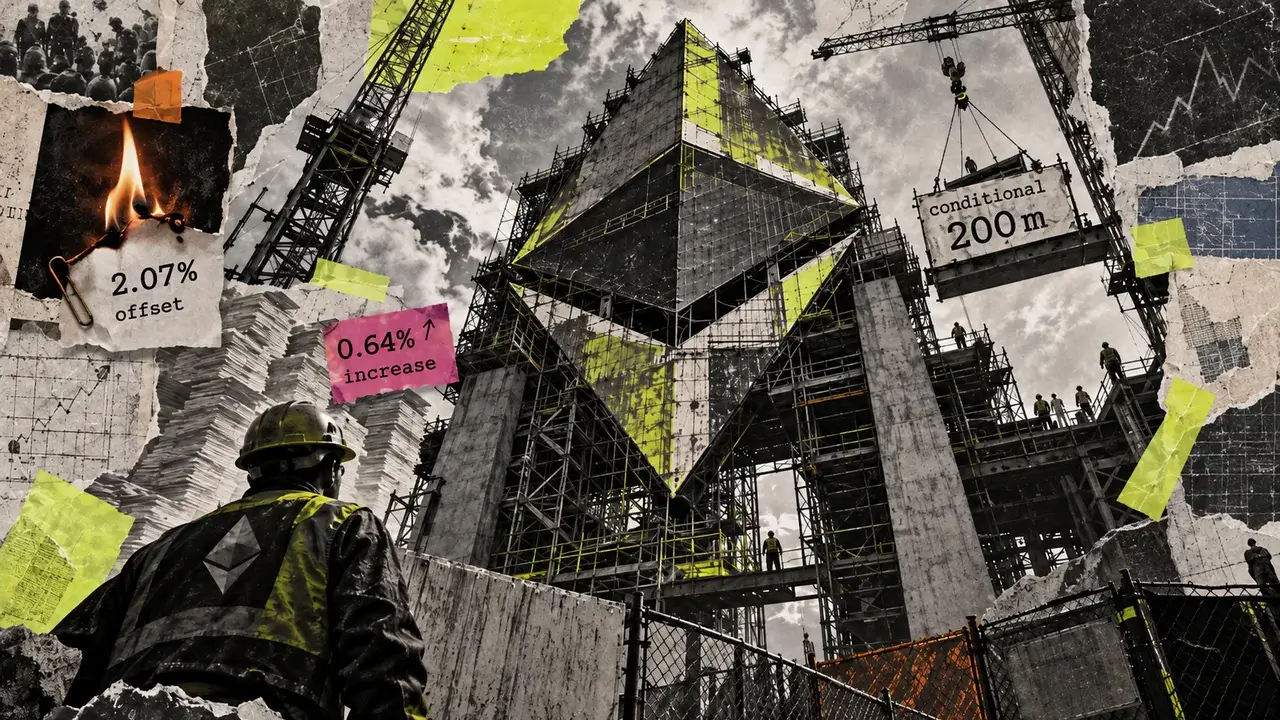
The implications for ETH supply are mathematically complex. Using a finalized accounting sample from October 9, researchers have modeled the "equilibrium" base fee required to achieve zero net growth (where burn equals issuance). Under the current 60 million gas limit (with a 30 million gas target), the execution base fee would need to average approximately 13.85 gwei to offset gross issuance.
If the gas limit is increased to 200 million (with a 100 million target), the required base fee drops to just 4.16 gwei. In both scenarios, the network would need to burn roughly 2,992 ETH daily to remain supply-neutral. The challenge for holders is that a larger gas limit creates more "space" for transactions. If demand does not fill that space, the base fee will naturally drift lower, making it harder to reach the total burn target. Conversely, if the increased capacity invites a massive influx of new applications and users, the aggregate burn could eventually surpass the issuance despite the lower per-transaction cost.
Staking Participation and Issuance Pressures
One of the primary reasons for the sustained high issuance in 2026 is the success of Ethereum’s staking ecosystem. Recent snapshots show approximately 43.754 million ETH—nearly 36% of the total supply—is currently locked in active effective stake. This stake is managed by over 853,000 active validators.
Ethereum’s issuance model is designed so that as more ETH is staked, the total amount of ETH issued as rewards increases (though the individual yield per validator decreases). This creates a paradox for the network: high staking participation is excellent for security and decentralization, but it puts constant upward pressure on the inflation rate.
Market observers point out that the current "burn budget" must account for this massive validator set. For the network to become deflationary again, the demand for block space must not only cover the cost of the transactions themselves but also the "security budget" paid out to those 43 million staked ETH. This has led to ongoing discussions within the Ethereum research community regarding the potential for "issuance curves" to be adjusted in future upgrades to prevent the supply from expanding too rapidly during periods of high staking interest.
Chronology of Recent Network Milestones
The path to the current supply state has been marked by several key technical developments throughout late 2025 and 2026:
- May 11, 2026: The Ethereum Foundation releases a protocol update identifying 200 million gas as a "credible" post-Glamsterdam target, contingent on performance metrics.
- September 17, 2026: Official announcement of the Glamsterdam testnet schedule, signaling the beginning of the end-stage trials for the 200 million gas push.
- September 28, 2026: Developers provide a specific timeline for the Sepolia testnet activation, which occurred on October 6.
- October 1, 2026: Analytical reports confirm that the 200 million gas target is validator-dependent and will not be an automatic shift, but rather a capacity that the network can grow into.
- October 9, 2026: The finalized ledger data reveals the 0.64% supply increase, sparking renewed debate over the balance between scalability and the asset’s economic model.
Broader Implications for the Ethereum Ecosystem
The realization that Ethereum is currently inflationary has broader implications for investors, developers, and the competitive landscape of Layer-1 blockchains. For years, the "ultrasound money" thesis was a primary marketing point for Ethereum, distinguishing it from both the fixed supply of Bitcoin and the inflationary models of competitors like Solana.
However, the 2026 data suggests that Ethereum is prioritizing its role as a "settlement layer" for a global financial system over its role as a strictly deflationary store of value. By focusing on the Glamsterdam upgrade and increasing gas limits, the protocol is signaling that it values throughput and low fees for users—particularly for Layer-2 networks—more than the immediate reduction of circulating supply.
Analysts suggest that the "missing denominator" in many fee comparisons is the matched-period issuance. While other networks may generate higher fees in certain windows, Ethereum’s massive security spend (issuance) means it requires a much higher level of activity to reach break-even. As Layer-2 growth continues to explode, the industry will be watching to see if the volume of "settlement" transactions from these sub-networks will eventually be enough to bridge the 778,000 ETH gap currently seen in the 2026 ledger.
For now, the Ethereum network remains in a state of transition. With the mainnet activation date for Glamsterdam still unconfirmed, the community is left to monitor the daily burn rates and staking balances. The goal of a shrinking supply remains a theoretical possibility, but the October ledger serves as a factual reminder that capacity and scarcity are often in a delicate, shifting balance.








