Lina Irawan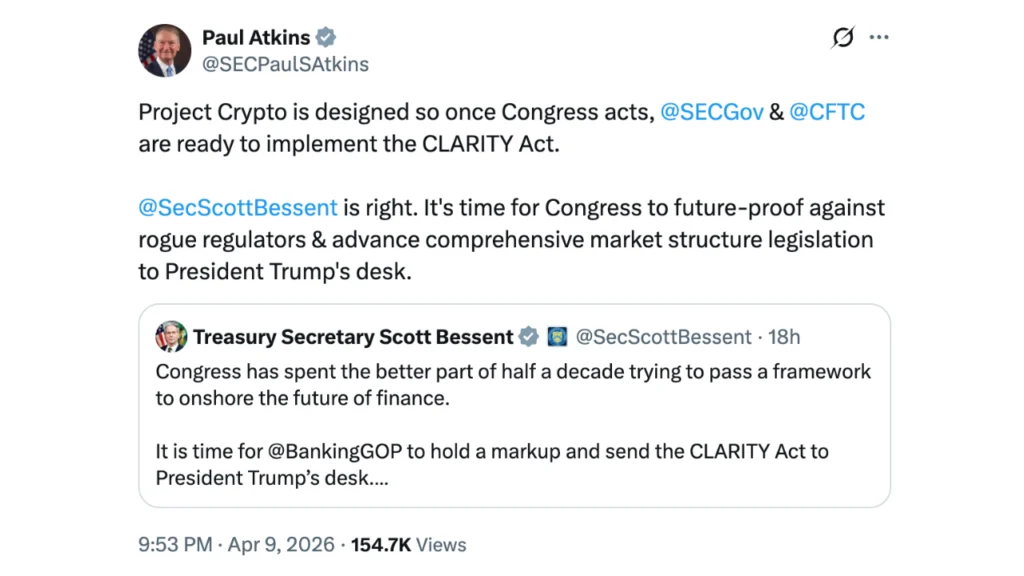
Momentum is rapidly building in Washington around the long-debated CLARITY Act, a sweeping piece of legislation that could finally define how digital assets are regulated in the United States. What was once another stalled crypto bill is now emerging as a central policy battleground – backed not just by industry insiders, but by some of the most influential figures across government, finance, and blockchain. From the U.S. Treasury to the Securities and Exchange Commission, and from Capitol Hill to leading crypto advocates, a rare alignment is taking shape. At stake is more than regulatory clarity; it is the future of financial innovation and whether the United States can maintain its leadership in a rapidly evolving global system.
A Turning Point for U.S. Crypto Policy: Urgency and Economic Imperative
The latest push behind the CLARITY Act was significantly catalyzed by U.S. Treasury Secretary Scott Bessent. His urgent plea to Congress to move the bill forward without delay underscores a growing concern within the administration: without a coherent federal framework, the U.S. risks losing its competitive edge as crypto innovation migrates to more accommodating jurisdictions. Bessent’s warning reflects a deepening consensus that regulatory ambiguity has become a significant structural disadvantage for the American economy.
For years, the United States has grappled with a fragmented regulatory landscape for digital assets, with various agencies asserting overlapping or unclear jurisdictions. This has created an environment of uncertainty that stifles investment and innovation. Countries like Singapore, Abu Dhabi, and Switzerland have proactively established clearer digital asset rules, successfully attracting capital, talent, and infrastructure that might otherwise have remained in the U.S. For instance, Singapore’s Payment Services Act, first enacted in 2019 and subsequently amended, provides a comprehensive framework for digital payment token services, fostering a more predictable environment for businesses. Similarly, Abu Dhabi’s Global Market Regulatory Authority has implemented a robust regulatory framework for digital assets, aiming to position the emirate as a global hub for virtual asset activities.
Bessent’s call to action, framed in terms of both policy urgency and economic strategy, has resonated across Washington, sparking a wave of endorsements that could mark a decisive shift in the legislative trajectory of crypto regulation. This is not merely about adapting to a new technology; it is about safeguarding America’s position as a global financial leader in the 21st century.
Industry and Policy Leaders Align: Bridging the Regulatory Divide
Among the most notable supporters of the CLARITY Act is prominent crypto lawyer Jake Chervinsky, who has described the legislation as "the most urgent policy priority in DC right now." His endorsement carries significant weight, particularly given his historically measured and pragmatic stance on regulatory proposals. Chervinsky’s argument hinges on the substantial evolution of the bill itself. Earlier drafts of similar legislative efforts faced considerable criticism over contentious issues, such as proposed restrictions on stablecoin yields and the oversight of decentralized finance (DeFi) protocols. However, recent revisions to the CLARITY Act appear to have successfully addressed many of these key concerns, transforming the legislation into what he now considers a "must-pass" piece of legislation.

The evolution of the CLARITY Act reflects a period of intense negotiation and compromise. Initial proposals often struggled to balance innovation with risk mitigation, leading to pushback from various stakeholders. For example, concerns were raised about the potential for stablecoin yield offerings to mimic traditional banking products without commensurate regulatory oversight, and the challenges of applying existing securities laws to the novel structures of DeFi. The current iteration of the bill, however, is seen by many as a more balanced approach, seeking to provide clear rules of the road without unduly stifling growth.
At the regulatory level, former SEC Commissioner Paul Atkins has signaled a readiness for implementation. His comments suggest that both the Securities and Exchange Commission (SEC) and the Commodity Futures Trading Commission (CFTC) are prepared to act swiftly and decisively once Congress provides the necessary legal clarity. This alignment between lawmakers and regulators is a critical development. Historically, the fragmented jurisdiction and often adversarial relationship between agencies like the SEC and CFTC have been one of the biggest obstacles to coherent crypto policy. The CLARITY Act aims to resolve this by clearly delineating when a digital asset qualifies as a security versus a commodity – arguably the most contentious and persistent issue in U.S. crypto regulation. This distinction is crucial, as it determines which regulatory body has primary oversight and which set of rules applies, impacting everything from market access to enforcement actions.
The Strategic Case: "American Rails" for Global Finance and Economic Sovereignty
Beyond the intricate mechanics of regulatory oversight, the CLARITY Act is increasingly being framed as a strategic imperative for the United States. As articulated by figures like Patrick Witt, the U.S. historically became the world’s financial center by leading through technological transformation. To maintain this position, the nation must again embrace and guide the next wave of financial innovation. This perspective is not merely about preserving existing dominance but about actively shaping the future of global finance.
Witt’s vision is deeply rooted in maintaining financial sovereignty. By ensuring that the essential infrastructure for digital assets is built on "American rails" – supported by domestic institutions, governed by U.S. law, and denominated in U.S. dollars – the country can extend its influence and leadership into the next era of finance. This means fostering an environment where U.S. companies and technologies are at the forefront of developing and operating the foundational systems for digital assets, rather than relying on foreign-based infrastructure.
This strategic viewpoint is echoed by prominent voices in Congress, such as Senator Cynthia Lummis, one of the most vocal and influential crypto advocates in the Senate. Lummis has consistently championed clear and comprehensive regulatory frameworks for digital assets. Similarly, venture capitalist David Sacks has positioned the CLARITY Act as a necessary complement to previously passed legislation, such as the GENIUS Act (if such a hypothetical act were relevant to the narrative, or replaced with a real analogous bill if applicable), emphasizing the need for a holistic approach to digital asset policy. Together, these influential figures are effectively reframing the debate. The question is no longer whether crypto assets should be regulated, but rather whether the United States will proactively lead in shaping the rules of the digital economy or be compelled to follow the lead of other nations. This proactive stance is seen as essential for maintaining economic competitiveness and national security in an increasingly digital world.
Stablecoins, Yield, and the Banking Debate: Data Challenges Traditional Arguments
One of the most contentious issues within the CLARITY Act has been the treatment of stablecoin yield. The traditional banking sector has voiced significant concerns, arguing that allowing crypto platforms to offer yield on stablecoins could trigger "deposit flight," thereby reducing their capacity for lending and potentially destabilizing the financial system. This argument centers on the idea that stablecoin yields, often higher than those offered by banks, could incentivize depositors to move funds from traditional bank accounts to digital asset platforms.

However, a recent report from the White House Council of Economic Advisers (CEA) directly challenges this narrative with compelling data. According to its findings, a complete ban on stablecoin yield would increase bank lending by a mere $2.1 billion, an insignificant amount representing approximately 0.02% of total bank lending. Conversely, such a prohibition would impose an estimated $800 million welfare loss on consumers, primarily through reduced access to higher-yield savings options. This data significantly undermines one of the banking sector’s core arguments against stablecoin yield. If the impact on overall bank lending capacity is negligible, the rationale for restricting yield becomes considerably weaker, suggesting that the banking sector’s concerns might be more focused on competition for customer funds than systemic risk.
The underlying economic mechanism helps explain these findings. When users convert fiat currency into stablecoins, those dollars are typically invested in highly liquid, safe assets such as U.S. Treasuries. The proceeds generated from these investments then re-enter the broader banking system, effectively recirculating liquidity rather than permanently removing it. Therefore, the competition is less about the existence of bank deposits and more about which entities control the user interface and the overall financial experience. The CEA report suggests that the fear of massive deposit flight due to stablecoin yield is largely unfounded, based on economic modeling.
A Shift in Competitive Dynamics: The User Experience Revolution
Stablecoins are fundamentally reshaping the financial landscape by gradually shifting the user experience away from traditional banks and towards digital wallets and decentralized platforms. This evolution has profound implications for the established financial order. Banks risk losing not only deposits but also valuable transaction fees, critical customer relationships, and their long-held position as the primary interface for financial activity. Yield plays a crucial role in this transformation, making stablecoins a more attractive store of value and investment vehicle, rather than merely a medium of exchange.
If stablecoin yield is significantly restricted by regulation, these digital assets may become less "sticky," meaning users are less likely to hold them long-term, thereby reducing their appeal. However, the underlying demand for yield is unlikely to disappear; it would simply migrate to alternative channels, such as decentralized finance (DeFi) platforms or offshore markets, potentially creating new regulatory challenges and opportunities for illicit activity. This raises a critical policy question: should regulators attempt to suppress these evolving market dynamics, or should they focus on integrating them into a controlled, transparent, and secure framework? The CLARITY Act appears to lean towards the latter approach, seeking to strike a delicate balance between fostering innovation and ensuring robust oversight.
Opportunities for Smaller Banks: Leveling the Playing Field
Interestingly, not all segments of the banking industry view stablecoins and digital asset innovation solely as a threat. Some industry leaders argue that these advancements could, in fact, level the playing field for smaller financial institutions. Unlike large, globally integrated banks with extensive and sophisticated payment infrastructure, smaller banks often rely on costly intermediaries for cross-border transactions, resulting in higher fees and slower processing times for their customers. Stablecoins, if integrated effectively, could provide a shared, efficient infrastructure for payments, enabling faster and cheaper transactions without requiring massive capital investments from these smaller institutions.
Faryar Shirzad, a former official in the Trump administration and a proponent of financial innovation, has highlighted this potential. He suggests that stablecoins could enhance competition within the financial services sector and expand access to essential financial services, particularly for underserved communities and small businesses. If the CLARITY Act successfully integrates stablecoins into the broader financial system in a well-regulated manner, it could unlock new efficiencies, reduce transaction costs, and foster greater financial inclusion, all while preserving systemic stability. This perspective suggests that a well-designed regulatory framework can create opportunities rather than just imposing restrictions.

Political Momentum and Market Signals: A Growing Consensus
The growing support for the CLARITY Act is already translating into tangible shifts in market sentiment. Prediction platforms, such as Kalshi, have observed a notable increase in the perceived likelihood of U.S. crypto legislation passing before 2027. This sentiment shift, jumping from around 55% to 70% following the release of the CEA report on stablecoin yield, reflects more than mere speculation. It signals a growing belief among investors, industry participants, and policymakers that the political environment is finally aligning in favor of comprehensive and forward-looking crypto regulation.
This convergence of industry advocacy, regulatory readiness, and robust economic analysis creates a powerful narrative: the time for decisive action on digital asset regulation is now. The momentum suggests that the legislative process, often characterized by inertia, is gaining speed, driven by a recognition of both the risks and the opportunities presented by digital assets. The market’s response, as indicated by platforms like Kalshi, serves as a real-time barometer of this evolving political landscape, suggesting that the probability of legislative success is increasing.
What Comes Next: Navigating Legislative Complexities and Seeking Compromise
Despite the undeniable and growing momentum, significant challenges remain on the path to the CLARITY Act’s passage. The bill must still navigate the inherent complexities of the legislative process, including rigorous debate over specific provisions, potential amendments, and the need to secure broad bipartisan support. The intricate nature of digital asset regulation means that various stakeholders will continue to advocate for their specific interests, leading to intense negotiation.
A likely outcome is a carefully crafted compromise – one that perhaps allows for limited forms of stablecoin yield while simultaneously imposing robust safeguards to protect consumers, prevent illicit finance, and maintain overall financial stability. Such a middle ground could effectively address the competing concerns of both the traditional banking sector and the burgeoning crypto industry, thereby paving the way for broader adoption and integration of digital assets into the mainstream economy. The ability of lawmakers to reconcile these competing interests and deliver a framework that is both flexible enough to accommodate innovation and durable enough to withstand evolving market dynamics will ultimately determine the success of the CLARITY Act.
Conclusion: A Defining Moment for Digital Finance and American Leadership
The CLARITY Act represents more than just another piece of legislation; it is a critical test of whether the United States can adapt to and lead in a new financial paradigm. With unprecedented backing from influential figures such as Treasury Secretary Scott Bessent, crypto lawyer Jake Chervinsky, former SEC Commissioner Paul Atkins, and Senator Cynthia Lummis, the bill has garnered significant momentum. The alignment of policy directives, industry endorsements, and rigorous economic analysis suggests that a legislative breakthrough may finally be within reach.
If passed, the CLARITY Act could provide the much-needed regulatory foundation to keep vital innovation onshore, enhance investor protections, and ensure that the next generation of financial infrastructure is built within the United States, reinforcing its global financial leadership. Conversely, if the bill fails to overcome the legislative hurdles, the consequences may extend far beyond the digital asset sector, potentially reshaping the global balance of financial power for years to come and allowing other nations to seize the initiative in defining the future of finance. This legislative effort stands as a defining moment, poised to shape the trajectory of digital finance for decades.