admin
admin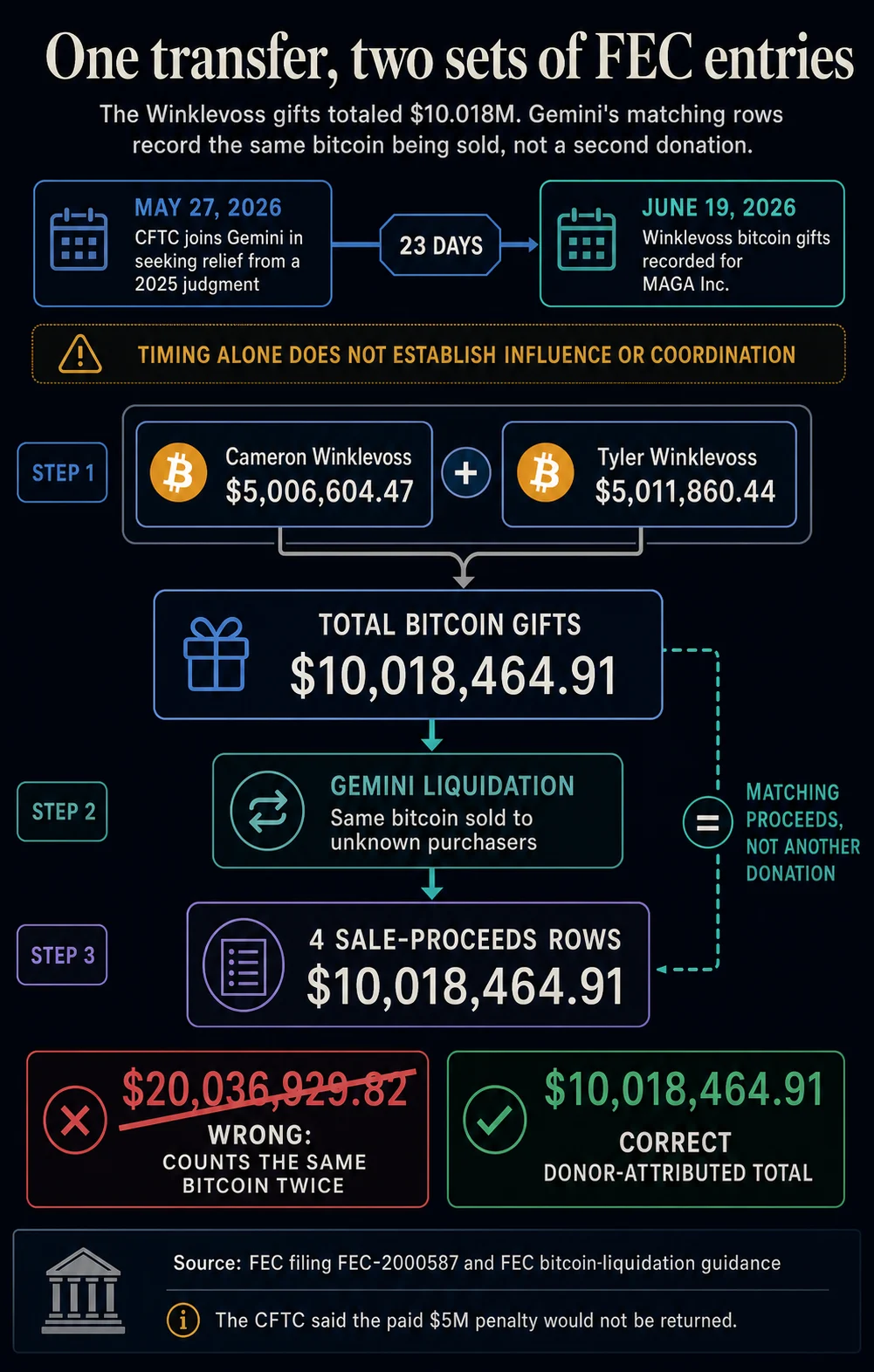
Newly filed federal election records reveal a significant financial contribution from Cameron and Tyler Winklevoss, the co-founders of the cryptocurrency exchange Gemini, to MAGA Inc., the prominent super PAC supporting former President Donald Trump. The records, filed with the Federal Election Commission (FEC), detail a donation of $10.018 million in Bitcoin made on June 19, 2026. This substantial contribution arrived just 23 days after the Commodity Futures Trading Commission (CFTC) announced its decision to join Gemini in seeking relief from a contentious 2025 judgment.
The FEC filing explicitly states that MAGA Inc. liquidated the donated Bitcoin through Gemini. While the timing of this transaction, occurring shortly after the CFTC’s action regarding Gemini, has drawn attention, the official records themselves provide no direct evidence to suggest a causal link between the donation and the regulatory agency’s move. There is no indication within the filings of coordination between the donors, the super PAC, and the CFTC, nor any suggestion of a quid pro quo arrangement.
Breaking down the contribution, Cameron Winklevoss’s individual records account for $5,006,604.47 of the total, while Tyler Winklevoss’s records show $5,011,860.44. The FEC filing lists four separate entries on June 19 that specifically name Gemini, collectively totaling $10,018,464.91. These entries detail the sale of Bitcoin through the exchange to unidentified purchasers. This practice aligns with FEC regulations, which mandate that political committees selling donated Bitcoin must disclose the exchange used for the transaction. The identity of the buyer, however, can remain anonymous and does not count as a contributor under campaign finance law. The image accompanying this report visually clarifies that these multiple Gemini entries represent the liquidation of a single Bitcoin donation, rather than separate contributions.
The CFTC’s Reassessment of the Gemini Case
The CFTC’s decision to seek relief from the 2025 judgment against Gemini stemmed from a thorough review of its own enforcement actions. According to a statement from the agency, its internal review concluded that the initial complaint against Gemini likely would not have been filed under current enforcement standards. Several factors contributed to this reassessment.

Primarily, the CFTC identified credibility issues with a key whistleblower account that formed part of the basis for the original complaint. Additionally, the agency noted weaknesses in the evidence presented, including crucial supporting materials that were requested by a commissioner but not provided prior to the authorization of the case. Furthermore, the CFTC acknowledged that objections related to privilege and relevance had impeded Gemini’s ability to present a full defense. The agency also indicated that its regulatory authority may have been improperly utilized as leverage in settlement negotiations.
Background: Gemini’s Legal Challenges and the CFTC’s Intervention
The situation traces back to a 2025 judgment against Gemini, which involved a $5 million penalty. The details of this original judgment and the specific allegations that led to it are crucial for understanding the context of the CFTC’s subsequent actions. At the time, Gemini, co-founded by the Winklevoss twins, was facing scrutiny from regulators regarding its operations and the handling of customer assets, particularly in the wake of broader market volatility and alleged misconduct within the digital asset space.
The CFTC’s amended joint motion, filed with the court, sought to either vacate the consent order entirely or, at a minimum, lift its remaining prospective provisions, including a permanent injunction against Gemini. It is important to note that the $5 million penalty initially imposed in 2025 had already been paid by Gemini and remained satisfied. The CFTC’s motion did not seek the return of these funds.
The CFTC’s rationale for joining Gemini’s bid for relief was multifaceted. Beyond the issues with the original evidence and process, the agency cited Gemini’s status as a victim of fraud in other contexts, suggesting a potential mitigating factor. Moreover, the agency highlighted a significant shift in federal digital-asset policy, indicating a potential evolution in how such cases are viewed and handled by regulatory bodies. This evolving landscape suggests a more nuanced approach by the CFTC to enforcement actions in the rapidly developing cryptocurrency sector.
A Pattern of Support for MAGA Inc.
The recent $10 million Bitcoin donation is not the first instance of the Winklevoss twins supporting MAGA Inc. Earlier filings reveal a preceding contribution. A filing dated July 2025 attributed approximately $1.015 million in Bitcoin, donated in January of that year, to the twins. The magnitude of the most recent donation, nearly ten times larger than the previous one, signifies a substantial increase in their financial commitment to the super PAC.

Broader Implications for Regulatory Independence and Political Influence
The timing and scale of these donations, particularly in relation to the CFTC’s actions concerning Gemini, are likely to intensify scrutiny regarding the independence of regulatory bodies. As lawmakers continue to debate proposals aimed at granting the CFTC a more prominent role in shaping the structure of the cryptocurrency market, instances like these highlight the potential for significant financial influence to intersect with regulatory policy.
This situation underscores a broader trend where a small number of influential industry executives are capable of directing substantial financial resources toward political committees, while their companies remain subject to the decisions and enforcement policies of regulatory agencies. The proximity of the $10 million Bitcoin donation to the CFTC’s decision to support Gemini’s relief bid, occurring within a 23-day window, is close enough to warrant careful examination. However, it is critical to emphasize that timing alone, while raising questions, does not constitute definitive proof of undue influence or a quid pro quo.
The cryptocurrency industry, characterized by its rapid innovation and significant capital flows, is increasingly intertwined with the political landscape. The substantial sums now being channeled into political campaigns by key figures in the crypto space raise important questions about transparency, accountability, and the potential for policy to be shaped by financial interests. As the digital asset market matures and regulatory frameworks evolve, the relationship between industry wealth, political engagement, and regulatory oversight will undoubtedly remain a focal point of public and governmental attention. The Winklevoss twins’ substantial contribution to MAGA Inc. serves as a prominent example of these complex dynamics at play.