
 admin
admin
The European Banking Authority (EBA) has formally requested the European Commission to undertake a comprehensive examination of the implications of new Markets in Crypto-Assets (MiCA) regulations as they pertain to crypto firms that facilitate customer access to decentralized finance (DeFi) loans. This significant development, detailed in the EBA’s response dated September 24th to a targeted consultation by the Commission, advocates for a thorough cost-benefit analysis concerning potential new duties for entities involved in intermediated crypto borrowing and lending. The focus is specifically on crypto-asset service providers (CASPs) that offer clients access to DeFi lending protocols, either through user-friendly interfaces or integrated product offerings.
This recommendation places companies that act as conduits between traditional users and on-chain DeFi protocols squarely within the Commission’s review purview. It is crucial to note that the EBA’s submission is a call for legislative assessment and does not, in itself, alter any existing lending rules. The regulator has explicitly stated that its impetus for this examination stems from identified consumer risks within the burgeoning DeFi landscape.
EBA’s Proposed Framework for DeFi Intermediation
The EBA has outlined two primary avenues for potential regulatory adjustments under the MiCA framework to address the evolving DeFi lending ecosystem.
The first proposed change involves the explicit inclusion of intermediating crypto borrowing and lending activities within MiCA’s existing list of regulated CASP services. This would bring a broader range of financial activities within the established regulatory perimeter, potentially subjecting them to similar oversight as traditional financial services.
The second, and perhaps more nuanced, proposal focuses on establishing specific requirements for CASPs that provide users with access to DeFi lending protocols. This could encompass a wide array of services, from simple user interfaces that connect individuals to platforms like Aave or Compound, to more complex product offerings that bundle exposure to various DeFi lending opportunities. The intention is to ensure that even when the underlying lending mechanism is decentralized, the point of access for retail consumers is subject to a degree of regulatory scrutiny and consumer protection.
The European Commission will now be tasked with meticulously weighing several critical factors before deciding whether to pursue legislative action. These include the sheer scale and growth of these intermediated DeFi activities, the extent of retail investor participation, and the seriousness of the associated risks. The Commission’s assessment will be informed by the feedback received during its ongoing targeted consultation, which closes on September 30th.

Addressing Consumer Risks in DeFi Lending
The EBA’s call for examination is underpinned by a detailed analysis of potential consumer harms prevalent in the current DeFi lending space. These risks, which the proposed regulatory adjustments aim to mitigate, include:
- Information Asymmetry: Consumers may lack complete and transparent information regarding fees, projected yields, and crucially, the dynamic collateral requirements inherent in DeFi lending. This can lead to unexpected losses.
- Amplified Losses: The use of leverage in DeFi, while potentially attractive for yield generation, can significantly amplify losses when market conditions turn unfavorable.
- Operational and Security Risks: Consumers are exposed to risks stemming from the commingling of funds, platform outages, smart contract vulnerabilities leading to hacks, and inadequate record-keeping practices. These issues can result in irreversible loss of assets.
- Absence of Creditworthiness Checks: Unlike traditional lending, many DeFi protocols do not perform creditworthiness assessments, potentially leading to a situation where individuals over-indebted themselves without adequate risk assessment.
- Collateral Volatility: The value of collateral used in DeFi loans can be highly volatile, increasing the risk of liquidation and loss for borrowers.
To counter these risks, the EBA has suggested several potential regulatory tools that the Commission could consider. For instance, suitability tests could be implemented to ascertain whether a particular customer is adequately informed and equipped to participate in DeFi lending activities. Furthermore, introducing leverage caps and mandating fuller disclosures about risks and potential outcomes could help protect borrowers.
Safeguarding Access to Decentralized Protocols
Regarding the facilitation of access to DeFi lending protocols, the EBA has put forth specific recommendations. A key suggestion is for CASPs to provide explicit warnings to users, informing them that activities conducted through truly decentralized protocols may operate outside the established regulatory safeguards. This aims to foster a greater awareness of the inherent risks.
The EBA also floated the idea of a certification process for lending protocols, focusing on their resilience to cyberattacks and their overall security posture. This could provide a benchmark for the safety and reliability of platforms that CASPs direct their users to.
Handling Unsanctioned Tokens in Lending Activities
A distinct, yet related, concern raised by the EBA pertains to crypto-assets that fall under MiCA’s definition of asset-referenced or e-money tokens but whose issuers have not obtained the required authorization. The EBA proposes that CASPs could be prohibited from intermediating or facilitating borrowing and lending activities involving such assets. This restriction would effectively limit CASPs’ exposure to, and involvement with, lending activities where the underlying token lacks regulatory approval, thereby creating a potential compliance boundary for firms operating within the EU.
The Interplay Between Traditional Apps and DeFi Protocols
The EBA’s recommendations bring into sharp focus the evolving landscape where traditional applications and services are increasingly bridging the gap to decentralized finance. For example, a user might access a DeFi lending protocol through a well-known digital wallet like MetaMask. MetaMask’s lending guide, for instance, describes in-app access to stablecoin pools on protocols such as Aave, providing mobile-friendly steps for depositing tokens. Similarly, Aave’s own access guide outlines multiple pathways for users to engage with its protocol, including through its native interface, third-party applications, or direct interaction with smart contracts.
These examples illustrate how sophisticated applications can abstract away much of the technical complexity, making DeFi lending accessible to a broader audience. However, the EBA’s current proposal specifically targets CASPs that facilitate this access. The crucial question for future lawmakers will be to precisely define this facilitation and determine how to regulate it. The distinction between a user directly interacting with a smart contract and a user accessing the same functionality through an application interface is a key area that the Commission will need to clarify.
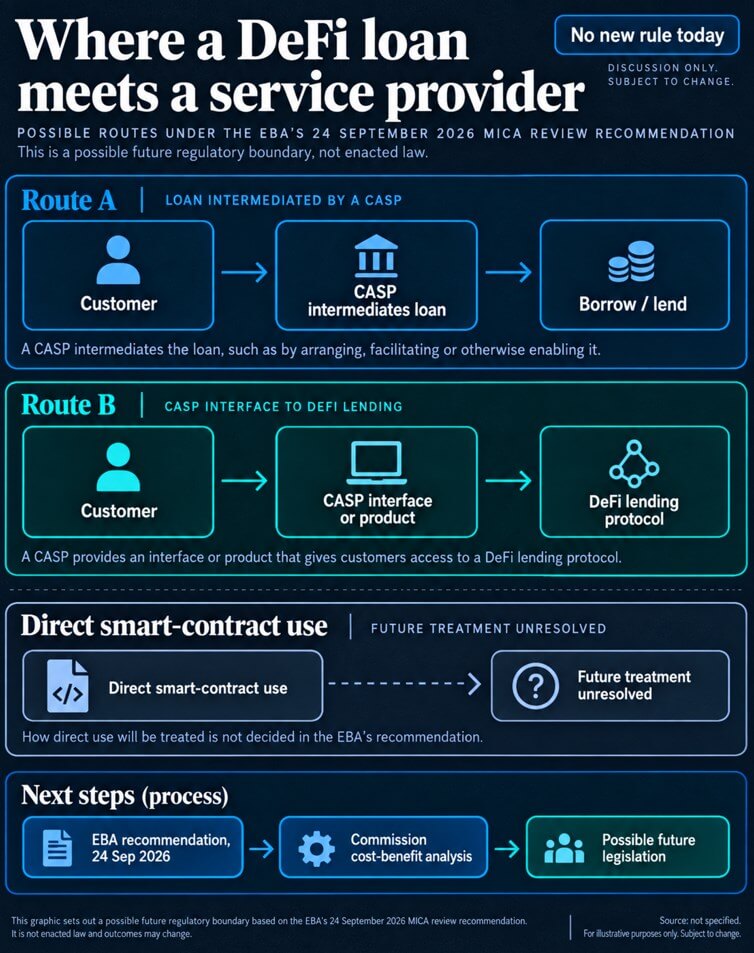
The EBA’s recommendations suggest that while direct smart contract interaction might remain outside the immediate scope of new CASP regulations, the intermediaries that guide users to these protocols could face new obligations. These obligations might include enhanced disclosures, suitability assessments, or even prohibitions on facilitating access to certain types of protocols or tokens.
Timeline and Next Steps
The EBA’s response is a critical input into the European Commission’s ongoing review of MiCA’s implementation. The Commission’s targeted consultation, which provides a platform for industry stakeholders and interested parties to voice their opinions, closes on September 30th at 11:59 p.m. Central European Summer Time. The feedback gathered from this consultation, alongside the EBA’s recommendations, will form the basis of the Commission’s report on MiCA’s application and broader crypto-market developments.
The Commission has indicated that this report may be accompanied by a legislative proposal if deemed necessary. This means that the EBA’s proposals, while not yet enacted law, represent a significant signal of potential future regulatory directions for crypto firms operating within the EU and engaging with DeFi lending. The precise reach and requirements of any future measures will depend heavily on the Commission’s analysis of the scale, nature, and risks associated with these activities.
Broader Implications for the Crypto Market
The EBA’s proactive stance underscores a growing recognition by regulatory bodies that the line between centralized and decentralized finance is becoming increasingly blurred. As CASPs integrate DeFi functionalities into their offerings, regulators are keen to ensure that consumer protection standards keep pace with innovation.
The Commission’s task of analyzing the potential new rules will involve a delicate balancing act. On one hand, there is a clear need to protect consumers from the inherent risks of DeFi. On the other hand, overly stringent regulations could stifle innovation and push legitimate crypto activities outside of the EU’s regulatory purview.
The EBA’s document highlights that any future regulatory measure would need to translate the identified distinctions—such as an interface providing protocol access, a service that intermediates a loan, or a product offering DeFi exposure—into clear, actionable obligations for firms and understandable disclosures for customers. The specific checks and disclosures attached to each route will be a critical element of any future legislation.
Ultimately, the EBA’s request to the European Commission marks a pivotal moment in the regulatory evolution of decentralized finance within the European Union. It signals a shift towards a more granular examination of how intermediaries interact with DeFi protocols, with a clear emphasis on safeguarding retail investors in an increasingly complex financial ecosystem. The coming months will be crucial in determining the shape of future regulations and their impact on the European crypto market.








