
 admin
admin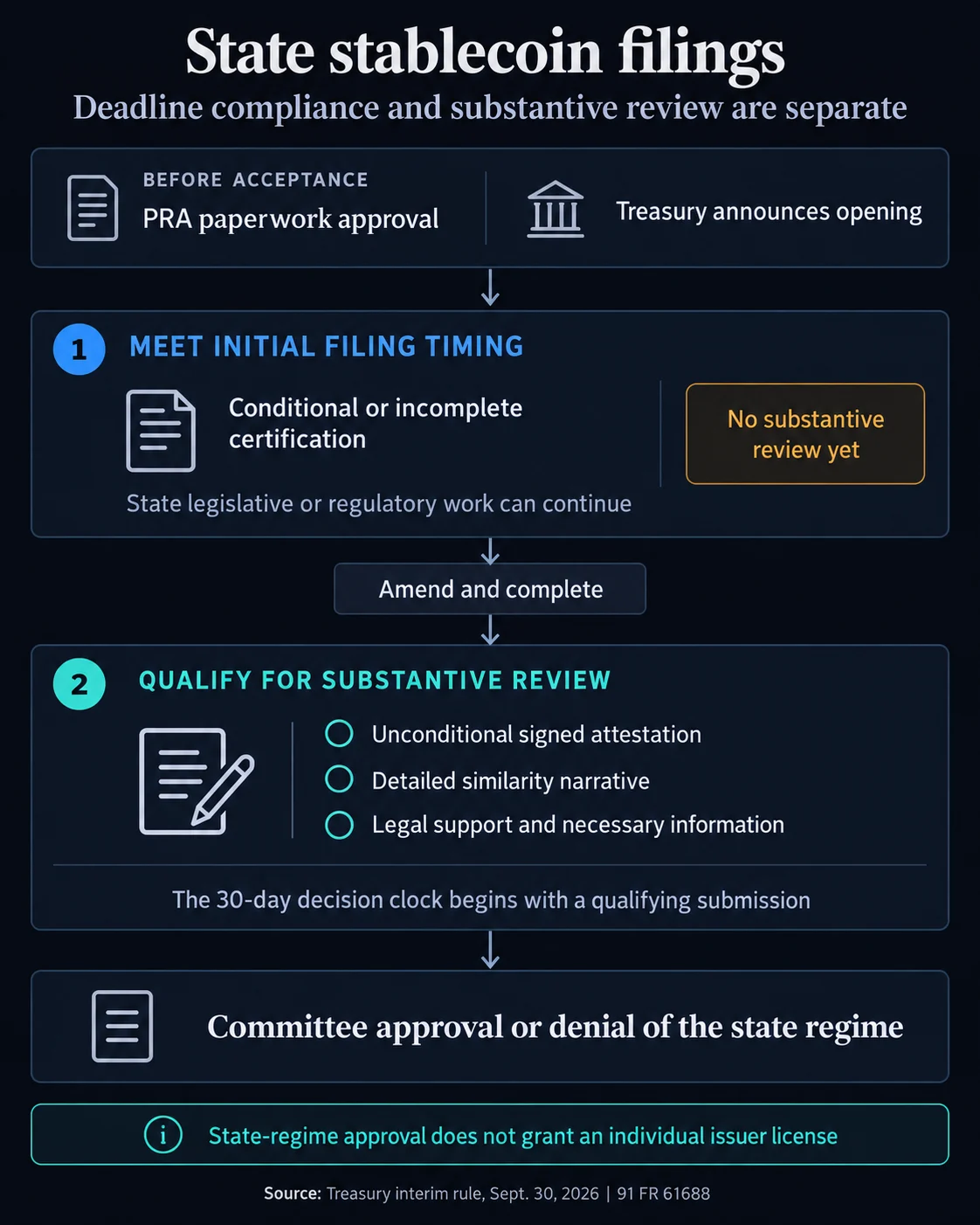
The U.S. Department of the Treasury has introduced a procedural framework that allows states to initiate the process of seeking approval for their stablecoin regulatory regimes, even if their state-level rules are not yet fully finalized. This interim final rule, effective September 30, provides a crucial window for states to meet initial filing deadlines while continuing to refine their legislative and regulatory landscapes. The move is designed to streamline the path toward state-qualified payment stablecoin issuers operating under the forthcoming GENIUS Act, a landmark piece of legislation poised to shape the future of stablecoin regulation in the United States.
The rule establishes the necessary forms and review procedures for the Stablecoin Certification Review Committee, the federal body tasked with evaluating state-level stablecoin oversight frameworks. Importantly, the Committee has indicated that conditional or incomplete certifications will be accepted to satisfy the initial filing timeframe. This flexibility is particularly significant for states that are actively working on their regulatory frameworks but may not have completed all legislative or administrative actions by the statutory deadline. However, it is critical to understand that these conditional filings will not trigger a substantive review or commence the Committee’s formal decision-making process. The 30-day clock for approval or denial will only begin once a certification is submitted in full compliance with the established procedures.
The implications of this procedural flexibility are far-reaching, especially for state-qualified payment stablecoin issuers with consolidated outstanding payment stablecoin issuance not exceeding $10 billion. These entities may opt for state regulation if their respective state regulator can certify that its regime meets the Treasury’s substantial-similarity criteria. Furthermore, such a state regime must receive unanimous approval from the Stablecoin Certification Review Committee, affirming that it meets or exceeds the standards and requirements outlined in Section 4(a) of the GENIUS Act.
Treasury’s separate proposal concerning "substantial similarity" provides the benchmarks against which state and federal regimes will be compared. While this proposal outlines the criteria for equivalence, the September procedural rule does not finalize these specific principles. Instead, it focuses on the mechanics of the application and review process.
The Path to Substantive Review: A Step-by-Step Process
For a state’s stablecoin regime to move beyond an initial conditional filing and enter the substantive review phase, several key steps must be undertaken. A conditional filing, while useful for meeting the initial timing requirements, does not initiate the formal evaluation process. It can be amended at any time, allowing states to incorporate further regulatory developments. The substantive review, and the subsequent 30-day period for the Committee to approve or deny the certification, only commences when a state submits a complete and unconditional attestation.

This unconditional attestation must be signed by an authorized representative of the state. Accompanying this must be a detailed explanation meticulously outlining how the state’s regulatory regime aligns with Treasury’s substantial similarity principles. The submission must also include all supporting legal materials and any additional information deemed necessary by the Committee. This rigorous process ensures that the Committee has all the requisite information to conduct a thorough and informed evaluation of the state’s framework.
The distinction between a conditional and a complete filing is crucial. It grants states the necessary breathing room to finalize their legislative or regulatory work after meeting the initial filing deadline. This procedural grace period does not, however, confer automatic approval of their regimes or grant licenses to individual stablecoin issuers. The responsibility remains with the states to develop robust frameworks that meet federal standards.
Background and Chronology of the GENIUS Act and Stablecoin Regulation
The current regulatory landscape for stablecoins has been evolving rapidly, with the GENIUS Act representing a significant legislative milestone. The genesis of this act can be traced back to growing concerns about the stability and regulatory oversight of payment stablecoins, which have seen exponential growth in market capitalization and adoption. In July of the previous year, CryptoSlate reported on the impending deadline set by the GENIUS Act, highlighting the challenges faced by stablecoin issuers and regulators alike in assessing state equivalence amidst the evolving federal, Treasury, and OCC rulemakings. The introduction of this new procedural rule directly addresses some of those challenges by providing a clear pathway for initial engagement.
The GENIUS Act, enacted with an anticipated effective date of January 18, 2027, mandates a statutory filing deadline for state certifications one year after its effective date. Consequently, the interim rule sets January 18, 2028, as the target date for initial certifications. However, the Act’s effective date itself has a degree of flexibility. Section 20 of the GENIUS Act stipulates that the Act can take effect earlier than the projected date, specifically at the earlier of 18 months after its enactment or 120 days after primary federal payment stablecoin regulators issue any final regulations implementing the Act. This potential acceleration of the effective date underscores the urgency for states to prepare their regulatory frameworks.
The Treasury’s interim rule, published on September 30, 2026, outlines the procedural framework, but comments on these interim procedures are due by November 30, 2026. This comment period allows stakeholders, including state regulators, stablecoin issuers, and industry participants, to provide feedback on the proposed procedures, potentially influencing future refinements.
Supporting Data and Market Context
The stablecoin market has experienced unprecedented growth in recent years. As of late 2023, the total market capitalization of stablecoins exceeded $150 billion, with major players like Tether (USDT) and USD Coin (USDC) dominating the landscape. This rapid expansion has brought increased scrutiny from regulators concerned about financial stability, consumer protection, and the potential for illicit activities.

The GENIUS Act aims to establish a federal framework that ensures the safety and soundness of payment stablecoins while fostering innovation. By allowing states to opt into a federal oversight system through their own regimes, the Act seeks to balance national regulatory consistency with state-level adaptability. The substantial similarity criterion is central to this approach, ensuring that state regulations provide a level of protection equivalent to federal standards.
Official Responses and Industry Reactions
While the interim rule has just been published, the initial reaction from industry participants and state regulators is likely to be one of cautious optimism. The flexibility offered in meeting initial filing deadlines is a welcome development for states that are actively working to comply with the impending federal requirements. However, the ultimate success of this framework will hinge on the clarity and practicality of Treasury’s substantial similarity principles and the Committee’s consistent application of these standards.
Industry observers have often pointed to the complexity of navigating multiple regulatory bodies and varying state laws as a significant hurdle for stablecoin innovation. This rule, by providing a procedural roadmap, could potentially alleviate some of that complexity. However, the ongoing development of federal regulations and the ultimate approval of state regimes will be closely watched by issuers and investors alike. The clarity around the "substantial similarity" criteria will be a key determinant of how many states can successfully establish compliant regimes.
Broader Impact and Implications for the Stablecoin Ecosystem
The Treasury’s interim final rule represents a significant step towards operationalizing the GENIUS Act and establishing a robust regulatory framework for payment stablecoins. The flexibility in filing procedures is a strategic move designed to encourage state participation and ensure that the regulatory apparatus is in place before the Act’s full implementation.
This development has several key implications:
- Accelerated Adoption of State-Regulated Stablecoins: By providing a clear pathway, the rule could accelerate the adoption of state-regulated payment stablecoins, potentially leading to a more diverse and competitive stablecoin market.
- Enhanced Regulatory Clarity: While not final, the procedural rule, coupled with the ongoing development of substantial similarity principles, will contribute to greater clarity for market participants regarding the regulatory expectations for stablecoin issuers.
- Federal-State Collaboration: The framework underscores the importance of federal-state collaboration in regulating emerging financial technologies. The success of the GENIUS Act will depend on effective coordination between Treasury, federal agencies, and state regulatory bodies.
- Focus on Issuer Requirements: The emphasis on unconditional attestations and detailed explanations signifies a commitment to rigorous oversight. This will likely push issuers and state regulators to focus on meeting stringent requirements related to reserves, risk management, and consumer protection.
- Potential for Innovation: A well-defined and predictable regulatory environment can foster innovation. By providing a clear set of rules, the Treasury is aiming to create a stable foundation upon which the stablecoin industry can grow responsibly.
The coming months will be critical as states work to finalize their regulations and prepare their certifications. The Treasury’s commitment to providing a structured and transparent review process, as outlined in this interim rule, signals a proactive approach to managing the evolving landscape of digital finance. The successful implementation of the GENIUS Act and the Treasury’s procedural framework could set a precedent for the regulation of digital assets globally, balancing innovation with the imperative of financial stability.








