
 admin
admin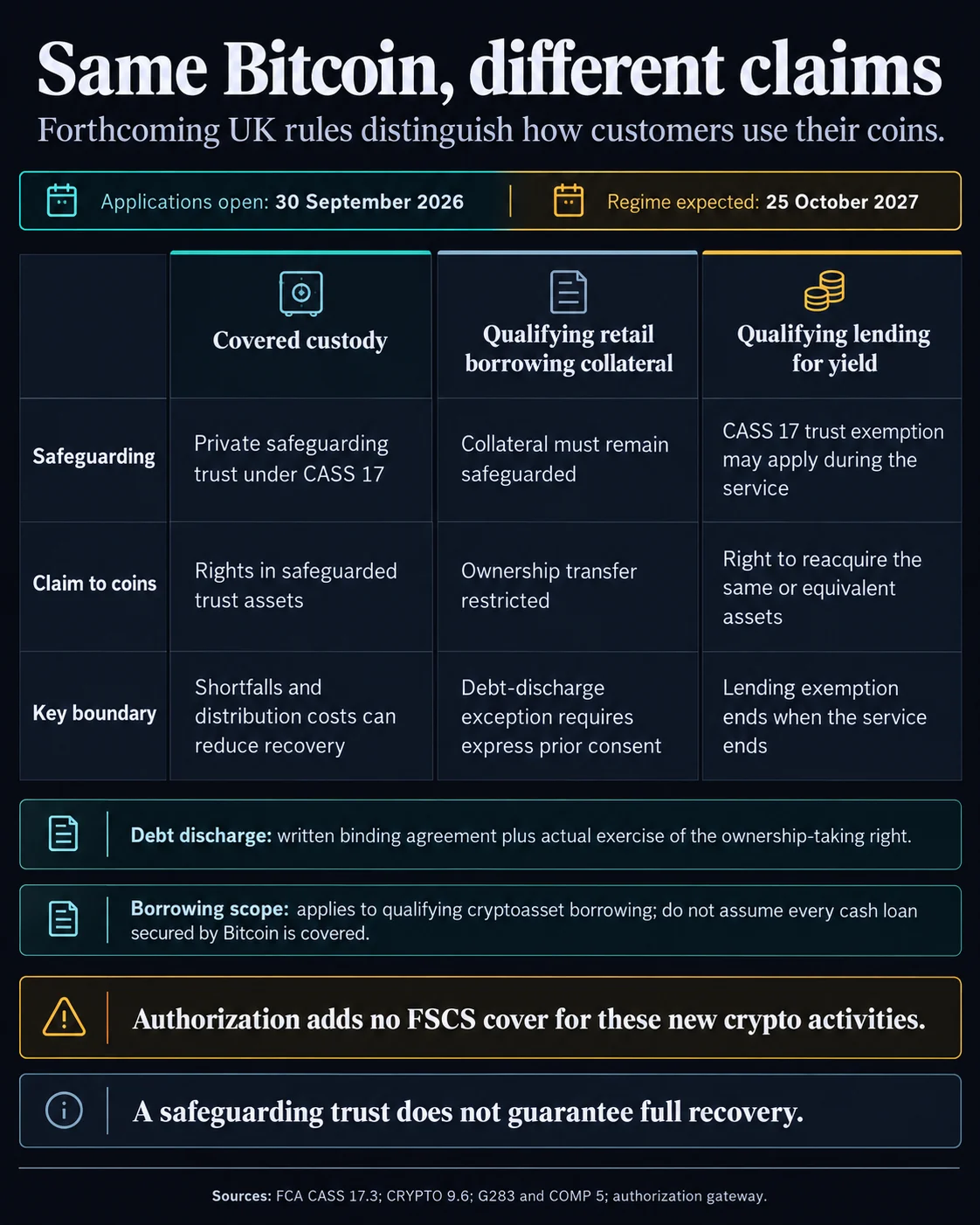
The United Kingdom’s financial regulatory landscape for cryptocurrency firms has taken a significant step forward with the opening of authorization applications on September 30th. This pivotal date marks the beginning of a new era, bringing Bitcoin holders and other crypto asset users closer to a comprehensive rulebook that will fundamentally differentiate between crypto assets pledged as collateral for borrowing and those transferred for yield-generating lending. This crucial distinction is poised to have profound implications, particularly in the event of a platform’s failure, by establishing distinct starting points for customer asset recovery based on whether assets are safeguarded or subject to different contractual arrangements.
The Financial Conduct Authority (FCA) has enabled firms to submit applications for authorization or variations to their existing permissions through its established Connect system. However, it is vital to note that this application window does not equate to immediate authorization or the immediate implementation of the new safeguards. The detailed protections outlined in the rules, finalized on June 30th, are slated to become effective on October 25th, 2027, providing a substantial lead-in period for firms to adapt and for the market to fully absorb the regulatory changes.
Core Distinctions: Safeguarding vs. Lending
At the heart of the forthcoming regulatory regime lies a critical distinction concerning how crypto firms are permitted to handle customer assets. Under the new rules, "covered custody" will generally necessitate the establishment of a safeguarding trust, as stipulated by CASS 17, the dedicated crypto custody chapter within the FCA’s Client Assets Sourcebook. For retail customers utilizing crypto assets as collateral to support an in-scope crypto borrowing service, these assets must remain safeguarded, with only a narrowly defined exception for debt discharge. Conversely, a "qualifying lending service" may benefit from an exemption from the trust requirement while the lending activity is ongoing. This protective framework is specifically tailored to "qualifying cryptoasset borrowing," a precisely defined service, and cannot be broadly applied to every cash loan marketed as being Bitcoin-backed.
The legal underpinning of how customers can reclaim their assets becomes acutely important when a firm experiences financial distress. While recovery will invariably depend on the availability of assets within the failed firm, it is critical to understand that these newly regulated crypto activities will remain outside the purview of the Financial Services Compensation Scheme (FSCS). This means that unlike traditional financial services, there will be no statutory safety net in place to compensate customers for losses arising from the insolvency of a crypto firm.
Pledged Coins: The Imperative of Safeguarding
The forthcoming framework mandates that firms offering "qualifying cryptoasset borrowing" must implement robust safeguarding measures for relevant crypto collateral. This can be achieved either by the firm safeguarding the assets directly, provided it possesses the necessary permissions, or by arranging for an appropriately authorized custodian to undertake this role if the firm has permission to arrange safeguarding.
A significant stipulation is that Bitcoin used as collateral in such arrangements cannot be treated as the firm’s fully owned inventory, thus preventing its deployment elsewhere. The rule explicitly prohibits either the firm or any other party from obtaining full ownership of the collateral unless the retail client has provided explicit prior consent to a transfer of ownership to discharge a debt arising from the borrowing service.
Complementing this is the "debt-discharge provision," which introduces an additional condition. A written, binding agreement must grant the firm the right to take ownership to discharge an obligation, and the firm must then actively exercise this right in accordance with the terms of the agreement. Until such a right is exercised, the mere signing of the agreement does not negate the safeguarding requirement for the pledged coins.
The practical implication of these provisions is clear: pledging coins does not automatically transform them into the platform’s freely usable assets. The safeguarding obligation persists unless a legally permitted change in their treatment occurs. Consequently, borrowing against crypto assets must be distinctly understood as separate from depositing them into a platform for a yield-generating lending service.
For consumers evaluating different financial products, this legal classification is paramount. These rules pertain specifically to "qualifying cryptoasset borrowing," a service whose regulatory treatment is determined by the fundamental nature of the arrangement. The FCA’s perimeter guidance emphasizes that the legal substance of an agreement and the roles of the involved parties are determinative of its characterization. Therefore, the retail collateral rule cannot be automatically extrapolated to every cash loan that is secured by Bitcoin.
Furthermore, distinct boundaries exist between retail and wholesale client classifications. The core lending and borrowing chapter primarily applies to retail clients who are not overseas retail clients. However, certain record-keeping and transfer requirements are designed to have a broader application, extending to clients who are not overseas clients.
Lending Services: Reshaping Customer Claims
The landscape shifts when considering "qualifying cryptoasset lending." In the FCA’s definition, this involves individuals disposing of crypto assets to or through another entity, with an obligation or right to reacquire the same or equivalent assets, typically in exchange for yield.
The right to reacquire these assets is fundamentally different from an instruction to keep them in custody. Under CASS 17.3.4, a firm providing a qualifying lending service can be exempt from acting as a trustee for those assets during the duration of the service. If the firm already holds these assets within a safeguarding trust, this rule permits it to cease treating them as client crypto assets while the exemption remains in effect.
This exemption terminates when the lending service concludes, including instances where the client exercises their right to terminate the service. The actual return of assets remains contingent on their availability, the agreed-upon return timing, and any applicable access restrictions. Consequently, the termination of a lending service can raise practical questions regarding the timeframe within which a customer can expect to receive the assets owed to them.
Crucially, the lending exemption cannot be leveraged for qualifying borrowing collateral. Similarly, a separate exemption that permits ownership transfers for other services is also unavailable for such collateral. The regulatory framework is thus designed to prevent these alternative routes from undermining the collateral safeguard.
For a customer whose crypto assets have been transferred into a lending arrangement outside of the mandated trust structure, a claim under CASS 17 trust provisions cannot be automatically assumed. Recovery may instead be governed by the contractual right to return and the prevailing insolvency treatment. The specific nature of the claim will be determined by the contract and the service’s structure, and the exemption does not confer the same creditor ranking upon all customers engaged in lending services.

The FCA’s forthcoming information requirements aim to embed this crucial distinction within customer communications. Firms will be obligated to provide comprehensive information regarding asset transfer and return, access protocols, yield generation mechanisms, and associated risks. The guidance also mandates the explanation of the implications of ownership transfers, including what transpires in the event of the firm’s or another relevant party’s insolvency.
For a customer earning yield, the governing agreement becomes the central document for understanding the claim behind the balance displayed on their account. It is essential for this agreement to clearly delineate whether the crypto assets remain safeguarded, whether ownership has transferred, and what the terms are for the return of assets upon the conclusion of the service.
Custody: Recovery Hinges on Assets and Costs
In the context of "covered custody," CASS 17 generally mandates that firms safeguard crypto assets as trustees, operating under meticulously documented arrangements. The FCA clarifies that these trusts are established to protect clients’ rights against competing claims, including during the insolvency of the custodian.
These rules require firms to establish private trusts through appropriate legal mechanisms. The safeguarding obligation is contingent upon the implementation of these arrangements, rather than arising automatically from the rules themselves as a statutory trust. The efficacy and operation of these arrangements must satisfy the specified legal and safeguarding requirements.
The classification of assets is another critical factor. CASS 17’s application rules are pertinent to regulated activities conducted from a UK establishment, subject to specific exceptions. The FCA’s final policy overview indicates that the custody of relevant specified investment crypto assets will initially align with the existing CASS 6 requirements. Consequently, different asset types and service structures may fall under varying custody provisions.
Accurate record-keeping is indispensable for establishing ownership within a trust. The forthcoming reconciliation requirements stipulate that firms must calculate what they are obligated to hold for each client, trust, and asset class at least once daily. This process is vital for identifying entitlements. However, it is important to recognize that identifying an entitlement is distinct from possessing all the necessary assets to satisfy it.
The terms of the trust must clearly outline how shortfalls are allocated when multiple clients share a trust. They must also specify whether client assets can be used to cover distribution costs following a trustee’s failure and, if so, the precise methodology for these deductions. The FCA generally anticipates that any shortfall within an asset class in a trust will be shared proportionally among the affected clients.
These provisions provide a concrete framework for understanding the limits of recovery. While a trust can strengthen the basis for an asset claim, it does not guarantee full repayment in the event of losses or associated costs.
It is also important to distinguish staking from lending. The FCA’s collateral guidance stipulates that staking eligible collateral is permissible only if compliance with specific staking rules is maintained, without any transfer of full ownership, and with continued trust safeguarding. This conditional treatment does not establish a lending exemption for borrowing collateral.
Authorization: No Automatic FSCS Protection
A significant aspect of the new regulatory framework is that authorization for these crypto activities will not confer eligibility for Financial Services Compensation Scheme (FSCS) protection. The FCA’s future Handbook glossary will incorporate the new crypto activities into the definition of designated investment business for general Handbook purposes. However, these activities will be explicitly excluded when this definition is applied to compensation rules.
These exclusions encompass a broad range of crypto-related services, including crypto safeguarding, arranging safeguarding, operating trading platforms, dealing and arranging deals in qualifying crypto assets, stablecoin issuance, and arranging staking. Coupled with the protected claim rules, this means that authorization for these novel activities will not introduce FSCS investment compensation protection.
It is possible for a firm to engage in other regulated business activities that may be eligible for FSCS coverage. However, its authorization for an uncovered crypto service cannot retroactively transform that service into a covered investment claim.
The Financial Ombudsman Service (FOS) presents a separate avenue for dispute resolution. The FOS’s jurisdiction rules can permit eligible complaints concerning regulated activities, subject to specific conditions. An eligible complaint typically pertains to the firm’s conduct. Any award made by the FOS is still contingent on the specific circumstances of the case, and FSCS eligibility remains a distinct consideration.
Previous analyses have delved into the authorization timetable and the regulatory perimeter for stablecoins and lending. The approach to overseas platform access also forms a crucial part of the broader regulatory landscape. For consumers, the immediate next step is to understand how specific services will treat their assets once firms obtain the necessary permissions.
In its June policy overview, the FCA indicated its intention to consult later in 2026 on the management of crypto asset firm failures, including distribution rules for failed custodians and stablecoin issuers. The ultimate shape of this failure and distribution framework will also significantly influence the practical outcomes for customers.
As applications now open, the critical distinction for Bitcoin holders and other crypto asset users lies between accessing a regulated service and the specific rights attached to their assets within that service. Custody, qualifying borrowing collateral, and lending for yield are all distinct arrangements that can lead to different asset claims. The comprehensive framework expected in October 2027 will render these distinctions more explicit, while simultaneously underscoring that recovery will ultimately depend on the nature of the arrangement, the availability of assets, and the applicable failure resolution process.








