
 James Watt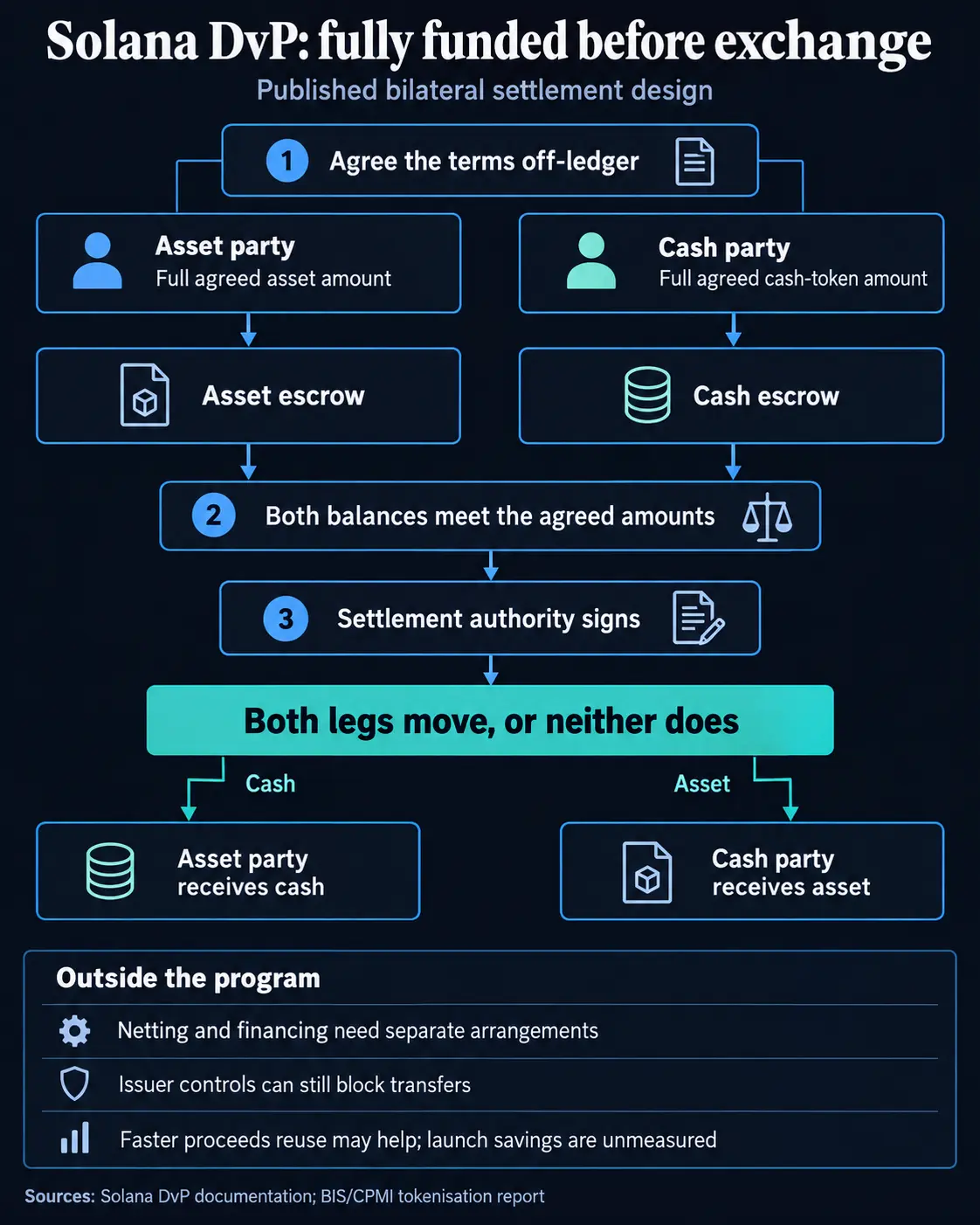
The Solana Foundation has officially introduced Solana DvP, an open-source standard designed to facilitate delivery-versus-payment (DvP) settlement for financial institutions. Announced on October 6, the program aims to provide a robust framework for the atomic exchange of tokenized assets and cash on the Solana blockchain. By utilizing a decentralized ledger to ensure that the transfer of an asset occurs only if the corresponding payment is confirmed, the program seeks to eliminate principal delivery risk—the possibility that one party fulfills its obligation while the counterparty fails to do so. However, the published design of the program reveals a strict requirement for full gross funding of both legs of a trade, presenting a distinct shift from traditional financial systems that often rely on netting and credit-based financing to optimize liquidity.
The core of the Solana DvP program is its atomic transaction capability. In the context of blockchain technology, atomicity ensures that a multi-step operation is treated as a single unit; either every part of the transaction succeeds, or the entire operation fails, leaving no partial state. Under the Solana DvP framework, the design mandates that both the asset leg and the cash leg of a trade must be fully available and moved into separate escrow accounts before the final execution can occur. While this prevents a buyer from paying without receiving the asset, or a seller from losing an asset without receiving payment, the program does not provide the underlying financing or the cash necessary to reach the settlement threshold. Participants must source the full amount for every trade they submit, a requirement that highlights the program’s focus on settlement certainty rather than capital efficiency through internal credit mechanisms.
The Technical Architecture of Atomic Settlement
The Solana DvP program operates as an upgradeable smart contract on the Solana mainnet-beta and devnet. According to the published documentation and source code, a trade record is created to cover a bilateral exchange between two specific parties. The program requires both sides of the trade to be represented by token accounts on the Solana network. This design choice implies that payments made through external banking rails or other blockchain networks fall outside the scope of the atomic exchange. The settlement code, as verified in recent documented source commits, performs a rigorous check to ensure that each escrow balance meets or exceeds the agreed-upon amount for that specific leg before any transfer of funds or assets is authorized.
If either side of the trade is underfunded at the moment of settlement, the transaction is designed to fail automatically. In such instances, any excess tokens that may have been deposited into the escrow accounts are returned to the originating party rather than being distributed to the counterparty. This ensures that the economic responsibility remains entirely with the participants and their respective financing partners. While a lender could theoretically finance a position for a buyer or seller, that relationship would exist as a separate arrangement outside the DvP program’s logic. The funding process itself utilizes standard checked token transfers, allowing treasury systems and custodians to supply the necessary tokens without requiring specialized funding calls within the DvP environment.
Liquidity Management and the Netting Debate
One of the most significant features—and limitations—of the Solana DvP program is its explicit exclusion of netting. In traditional finance, netting is the process of offsetting multiple obligations between parties to arrive at a single smaller balance to be paid. This process significantly reduces the amount of liquidity required to settle a high volume of trades. By requiring gross settlement—where the full value of every individual trade must be funded—Solana DvP demands higher upfront capital from its users.
The Solana Foundation’s announcement did not include measured capital-saving results or a total-cost comparison against traditional netting systems. Instead, the value proposition rests on "funding duration." While gross funding requires a larger amount of capital at the moment of settlement, the speed of the Solana blockchain may allow for the faster reuse of that capital. If a participant receives usable cash or assets in seconds rather than days (the typical T+1 or T+2 cycle in traditional markets), they can immediately deploy those proceeds into a subsequent trade. This rapid turnover could potentially reduce the overall duration for which external financing is required, thereby lowering the opportunity cost of liquidity.
The Bank for International Settlements (BIS) and the Committee on Payments and Market Infrastructures (CPMI) addressed this specific trade-off in an October 2024 report on tokenization. The report noted that while immediate gross settlement can demand significantly more liquidity than traditional netting arrangements, the countervailing benefit is the reduction of settlement risk and the potential for real-time asset velocity. For Solana DvP, the ultimate economic benefit for an institution will depend on the specific timing of usable proceeds and the costs associated with their specific funding arrangements.
Security Audits and Governance Framework
To ensure the integrity of the program, the Solana Foundation engaged the security firm Cantina for a comprehensive audit conducted between May 21 and May 28. The audit covered the initial repository and identified several findings, including four medium-risk issues that have since been marked as fixed. Additionally, three low-risk and six informational findings were acknowledged by the development team. The foundation has stated that the program is now ready for "real funds," though it continues to invite design partners and early participants to test the system ahead of a full-scale production release.

The governance of the program is currently managed through an upgrade authority—a specific address with the power to modify the deployed smart contract. For institutional users, this introduces a layer of dependency on the Solana Foundation’s governance protocols and the stability of the settlement rules. The documentation specifies that operators should recognize a settlement as "final" once the transaction reaches Solana’s finalized commitment level. However, the legal finality of such settlements remains a complex issue that depends on the specific legal agreements between the participating parties and the regulatory regimes of the jurisdictions in which they operate.
Institutional Roles and the Involvement of JPMorgan
The development of Solana DvP saw input from major traditional financial institutions, most notably JPMorgan. However, the bank’s role was strictly limited to providing insights into securities-settlement practices. The official announcement from the Solana Foundation included a disclaimer explicitly stating that JPMorgan was not involved in the design, development, operation, or approval of the program. The bank does not endorse or guarantee the program’s performance, highlighting the cautious approach traditional tier-one banks are taking as they explore public blockchain infrastructure.
This collaboration reflects a broader trend of "tokenized deposit" analysis and the integration of blockchain into the banking sector. Earlier in October, coverage of the "Roughrider" initiative described a bank-payment arrangement on Solana involving 90 North Dakota banks. Unlike the Solana DvP program, the Roughrider project combines token movements with a separate daily netting process for bank-account movements, illustrating that different institutions are pursuing varied strategies to balance blockchain efficiency with traditional liquidity management.
Risk Mitigation and Instrument Dependencies
While the Solana DvP program protects against principal delivery risk, it does not eliminate the risks inherent in the instruments being exchanged. A cash token on the Solana network still carries the credit and redemption risks of its issuer. Furthermore, regulated asset tokens often retain "issuer controls," such as the ability to freeze accounts, pause transfers, or exercise permanent-delegate powers. These controls remain active even while tokens are held within the DvP escrow accounts.
The program includes "unwind" instructions that allow parties to reclaim their own deposits if a trade cannot be completed, or to reject a trade entirely and refund both legs. A settlement authority—a third-party address designated during the creation of the trade—also has the power to cancel the transaction. However, these programmatic powers cannot override an issuer-level freeze. If a token issuer blocks a transfer, a fully funded trade may still fail to settle, and the recovery of funds would then depend on the issuer’s cooperation rather than the smart contract’s logic.
Timeline of Development and Future Outlook
The journey toward the launch of Solana DvP has been marked by several key milestones:
- May 2024: Completion of the Cantina security audit, addressing critical vulnerabilities in the early codebase.
- September 30, 2024: The latest public source revision was committed, finalizing the logic for settlement and escrow management.
- October 2, 2024: Observations confirmed the deployment of the upgradeable program on the Solana mainnet-beta and devnet.
- October 6, 2024: Official public announcement of Solana DvP as an open-source standard for financial institutions.
As the program moves toward broader adoption, the next phase of evidence for its utility will likely come from actual institutional use cases. Market participants will be looking for data on whether the speed of atomic settlement genuinely offsets the lack of netting, and how the costs of gross funding compare to the interest saved by reducing the duration of settlement cycles.
The introduction of Solana DvP represents a significant step in the Solana Foundation’s effort to attract institutional capital to its ecosystem. By providing a standardized, audited, and open-source tool for atomic settlement, Solana is positioning itself as a viable alternative to traditional settlement clearinghouses. However, the transition to a capital-saving service for the global financial industry will ultimately depend on the development of a broader ecosystem of cash tokens, high-quality asset tokens, and flexible financing arrangements that can operate alongside this new atomic exchange standard. For now, Solana DvP offers a precise technical solution to delivery risk, while leaving the complex task of liquidity optimization to the institutions themselves.








