Nila Kartika Wati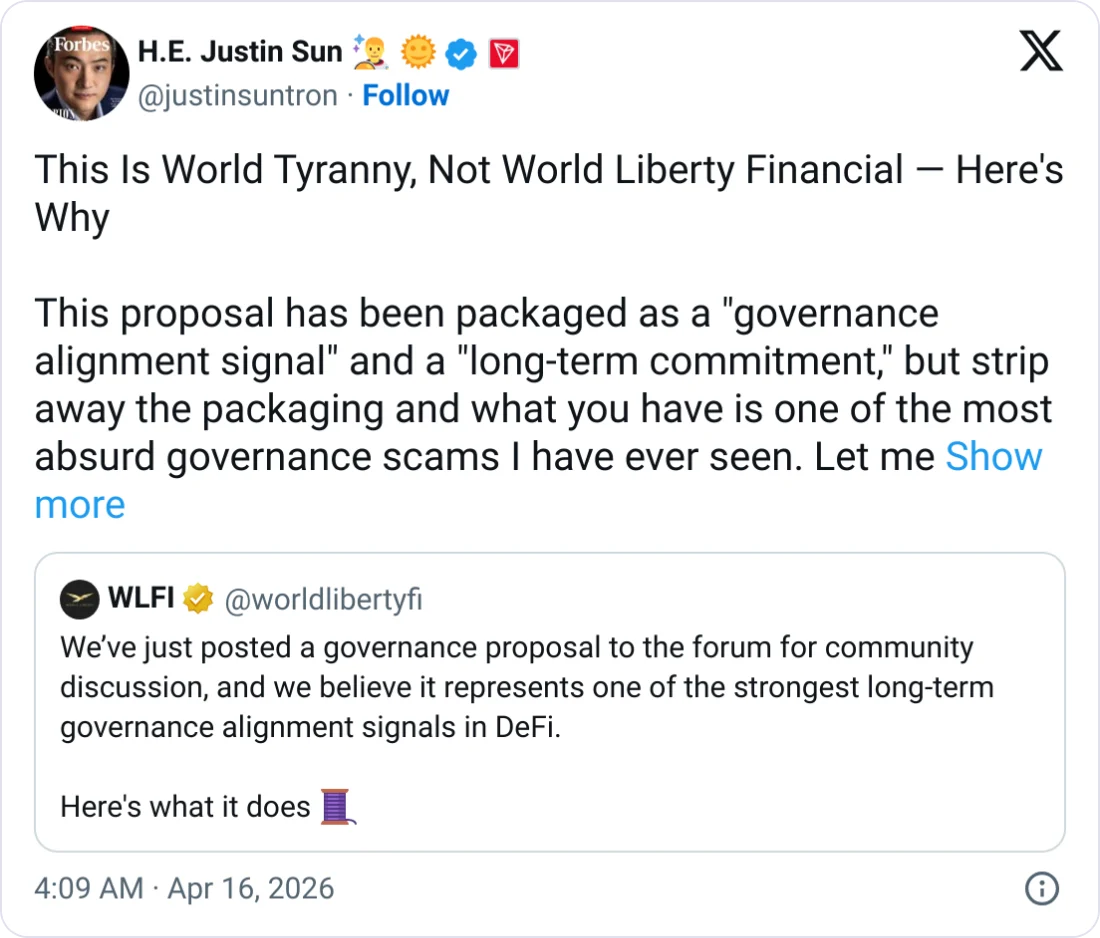
The cryptocurrency platform World Liberty Financial (WLFI), linked to the Trump family, is currently embroiled in a significant controversy following its proposal to extend the lock-up period for tokens purchased by early investors for an additional two to four years, with a contentious clause threatening indefinite locking for those who do not comply. This move has triggered a storm of criticism from prominent figures within the crypto community, raising serious questions about governance, investor rights, and the future viability of the platform.
The Genesis of the Controversy: A Sweeping Lock-up Proposal
On Wednesday, the World Liberty Financial team formally submitted a new proposal to its governance forum, outlining a drastic change to the existing vesting schedule for early WLFI token holders. Under the terms of this new plan, these initial investors would see their tokens, which were already subject to prior vesting agreements, locked for an additional two years. Following this extended lock-up, the tokens would then be released in batches over a subsequent two-year period, effectively pushing the full unlock timeline to a total of four years from the proposal’s implementation.
However, the most contentious aspect of the proposal, and the one that has ignited widespread outrage, is a clause stating that "tokenholders who do not accept the new unlock schedule would continue to have their tokens locked indefinitely." This ultimatum has been widely interpreted as a coercive measure, stripping investors of their autonomy and potentially trapping their capital indefinitely if they dissent from the platform’s proposed changes. The company’s stated rationale for this drastic measure, as conveyed by spokesman David Wachsman to Cointelegraph, is to "further align all the participants in the WLFI ecosystem for the long run." Yet, critics argue that this alignment comes at the prohibitive cost of investor freedom and trust.
Investor Outcry and High-Profile Denunciations
The immediate aftermath of the proposal’s publication saw a swift and vehement backlash from within the crypto community, including some of World Liberty Financial’s most significant stakeholders. Justin Sun, a prominent crypto entrepreneur, advisor to World Liberty Financial, and reportedly its largest individual investor with a $30 million stake, took to social media platform X to express his outrage. Sun unequivocally denounced the plan as "one of the most absurd governance scams I have ever seen," a statement that carries considerable weight given his extensive experience and investments across numerous decentralized finance (DeFi) projects.
Sun’s criticism is particularly impactful as he claims to hold a 4% stake in World Liberty Financial, which he asserts is currently frozen, preventing him from participating in the very governance vote that directly impacts his substantial investment. He further elaborated on this point, stating he was "forced out of this voting process" and claiming that a "large number of holders with significant voting rights are in the same position." This raises critical questions about the fairness and decentralization of the platform’s governance model, particularly when major stakeholders are disenfranchised from crucial decisions. Sun’s specific criticisms centered on the indefinite lock-up clause, which he explicitly labeled as "coercion."
Adding to the chorus of condemnation was Simon Dedic, the founder of venture capital firm Moonrock Capital. Dedic echoed Sun’s sentiments, posting on X that early WLFI investors "who thought they were sitting on solid profits just got rugged." The term "rugged" in crypto parlance refers to a "rug pull," a malicious maneuver in which developers abruptly abandon a project and abscond with investors’ funds, often by selling off their holdings. While World Liberty Financial has not "pulled the rug" in the traditional sense, Dedic’s use of the term highlights the perceived betrayal of trust and financial damage inflicted upon early supporters. Dedic further insinuated a political motivation, adding, "This essentially gives them another shot at squeezing the same lemon they’ve been inflating with hot air for the past two years. Which, what a surprise, lines up perfectly with the remainder of [Donald Trump’s] term." This comment hints at speculation that the extended lock-up might be designed to control token supply and price dynamics through a critical political period.
A Pattern of Prior Controversies and Governance Concerns
The current lock-up dispute is not an isolated incident but rather the latest in a series of controversies that have plagued World Liberty Financial since its inception. Justin Sun himself has been a vocal critic on previous occasions. Earlier, he raised concerns about what he described as the platform’s ability to "blacklist wallets," an accusation that World Liberty Financial vehemently denied. The ability to blacklist wallets implies a centralized control mechanism that contradicts the ethos of decentralized finance and could be used to selectively freeze or restrict access to funds, a power that could be abused.
Moreover, the platform has faced allegations drawing comparisons to "LUNA 2.0," referencing the catastrophic collapse of the Terra-LUNA ecosystem in May 2022, which wiped out tens of billions of dollars in investor wealth. While the circumstances are not identical, such comparisons underscore a deep-seated lack of confidence among some market observers regarding the project’s stability and governance. These earlier accusations, coupled with the current proposal, paint a picture of a project struggling with transparency, decentralization, and investor relations. The broader context of Trump’s crypto ventures has also raised questions about potential conflicts of interest and insider trading, adding another layer of scrutiny to World Liberty Financial’s operations.
Background: World Liberty Financial and the WLFI Token
World Liberty Financial emerged as a crypto platform with explicit ties to the Trump family, aiming to capitalize on the growing interest in digital assets, particularly among politically engaged audiences. The platform’s native token, WLFI, was initially conceived with specific utility within its ecosystem. Originally, the WLFI token was not publicly tradable. However, following a community vote, holders approved its listing on exchanges, and it commenced public trading on September 1. This marked a significant shift, exposing the token to market forces and the broader speculative environment of cryptocurrencies.

The initial token distribution and vesting schedules, while not fully detailed in the provided context, would have been critical in attracting early investors. The expectation for these early backers is typically that their investment, once vested, can be freely traded or held, allowing them to realize profits or manage their portfolios. The current proposal directly challenges these fundamental expectations, retroactively altering the terms of engagement and eroding the trust built during the initial fundraising and launch phases. Such actions are often viewed critically in the crypto space, where the sanctity of smart contract code and pre-agreed terms is highly valued.
WLFI Token Performance: A Troubled Trajectory
The market performance of the WLFI token itself reflects the turbulent journey of the platform. Since its all-time high of 33 cents on September 1, its first day of public trading, WLFI has plummeted by more than 75%. This dramatic decline signifies a significant loss for many early investors who bought at or near the peak. Furthermore, the token has experienced a more than 40% drop year-to-date, contrasting with a broader market recovery seen in many other cryptocurrencies during the same period. In the 24 hours immediately following the controversial proposal, the WLFI token traded flat at 8 cents, indicating a market grappling with uncertainty and potentially pricing in the negative implications of the governance dispute.
This poor performance, combined with the new lock-up proposal, creates a precarious situation for investors. Many who might have been "sitting on solid profits" (as Simon Dedic noted) or hoping to mitigate losses by selling their tokens once unlocked, now face the prospect of their assets being inaccessible for an extended period, or even indefinitely. This lack of liquidity and control over their investments could further depress the token’s value and deter potential new investors, creating a downward spiral of investor confidence and market price.
Implications for Decentralized Governance and Investor Trust
The World Liberty Financial controversy highlights fundamental challenges within the decentralized finance (DeFi) ecosystem, particularly concerning governance and investor protection. The principle of decentralized autonomous organizations (DAOs) and governance tokens is to empower token holders with a say in the project’s direction. However, if a project can unilaterally alter vesting schedules, freeze significant investor tokens, and threaten indefinite locks for dissenters, it undermines the very essence of decentralized governance.
The "coercion" alleged by Justin Sun is a critical point. A truly decentralized system should allow for robust debate and voting, with the outcome reflecting the collective will of the token holders. When a project’s core team can impose such stringent conditions, it raises questions about the actual level of decentralization and whether power is sufficiently distributed. The freezing of large voting blocks, as claimed by Sun, further concentrates power in the hands of the remaining voters, or potentially, the project’s core team, distorting the democratic process.
Such incidents erode investor trust not just in a single project, but potentially in the broader crypto space, especially for projects with prominent public figures at their helm. Investors are increasingly wary of projects where terms can be retroactively changed, or where their assets can be held hostage to governance decisions they disagree with. This environment of uncertainty could lead to greater scrutiny from regulators, who are already grappling with how to oversee the rapidly evolving crypto market.
Official Stance and The Path Forward
Despite the intense backlash, World Liberty Financial has maintained its position, with spokesman David Wachsman reiterating that the proposal is "designed to further align all the participants in the WLFI ecosystem for the long run." This statement, however, has done little to assuage the concerns of disgruntled investors who view the proposal as predatory rather than aligning. The company has not directly addressed the specific criticisms regarding coercion or the indefinite lock-up clause in its public statements, focusing instead on the perceived long-term benefits.
Voting on the contentious proposal is scheduled to commence soon and will run for a week. The outcome of this vote will be pivotal for World Liberty Financial. If the proposal passes, it will solidify the new, extended lock-up terms and potentially set a precedent for future governance decisions. If it fails, the platform will be forced to reconsider its approach, potentially leading to a revised proposal or a deeper crisis of confidence if a stalemate ensues. The fact that a significant investor like Justin Sun, who holds a 4% stake, is reportedly unable to vote, complicates the legitimacy and fairness of the upcoming democratic process.
Broader Industry Implications and Future Outlook
The World Liberty Financial saga serves as a cautionary tale for both investors and developers in the cryptocurrency space. For investors, it underscores the paramount importance of thorough due diligence, understanding the governance mechanisms of a project, and carefully scrutinizing vesting schedules and potential clauses that could alter asset control. It also highlights the risks associated with projects linked to political figures, where external factors and public perception can heavily influence market dynamics and project stability.
For project developers, this incident emphasizes the critical need for transparent, fair, and truly decentralized governance. Retroactive changes to fundamental terms, especially those impacting investor liquidity and control, can severely damage a project’s reputation and erode the community trust essential for long-term success. As the crypto industry matures, fostering an environment of trust and upholding investor rights will be crucial for widespread adoption and sustained growth. The outcome of World Liberty Financial’s controversial proposal will undoubtedly be closely watched, shaping perceptions and potentially influencing future regulatory discussions surrounding investor protection in the digital asset landscape.