James Watt
Wall Street has undergone a dramatic shift in sentiment as the long-anticipated narrative of Federal Reserve interest rate cuts faces a stark reality check. For months, traders and institutional investors have debated the precise timing of when the U.S. central bank would begin easing its restrictive monetary policy. However, following the Federal Open Market Committee (FOMC) meeting on March 18, the conversation has pivoted from the timing of cuts to the alarming possibility that the next move in interest rates could actually be a hike. This hawkish repricing is being driven by a combination of resilient inflation, geopolitical instability, and a surge in energy prices, creating a macroeconomic environment that threatens to usher in a period of stagflation.
The Rapid Erosion of Rate Cut Expectations
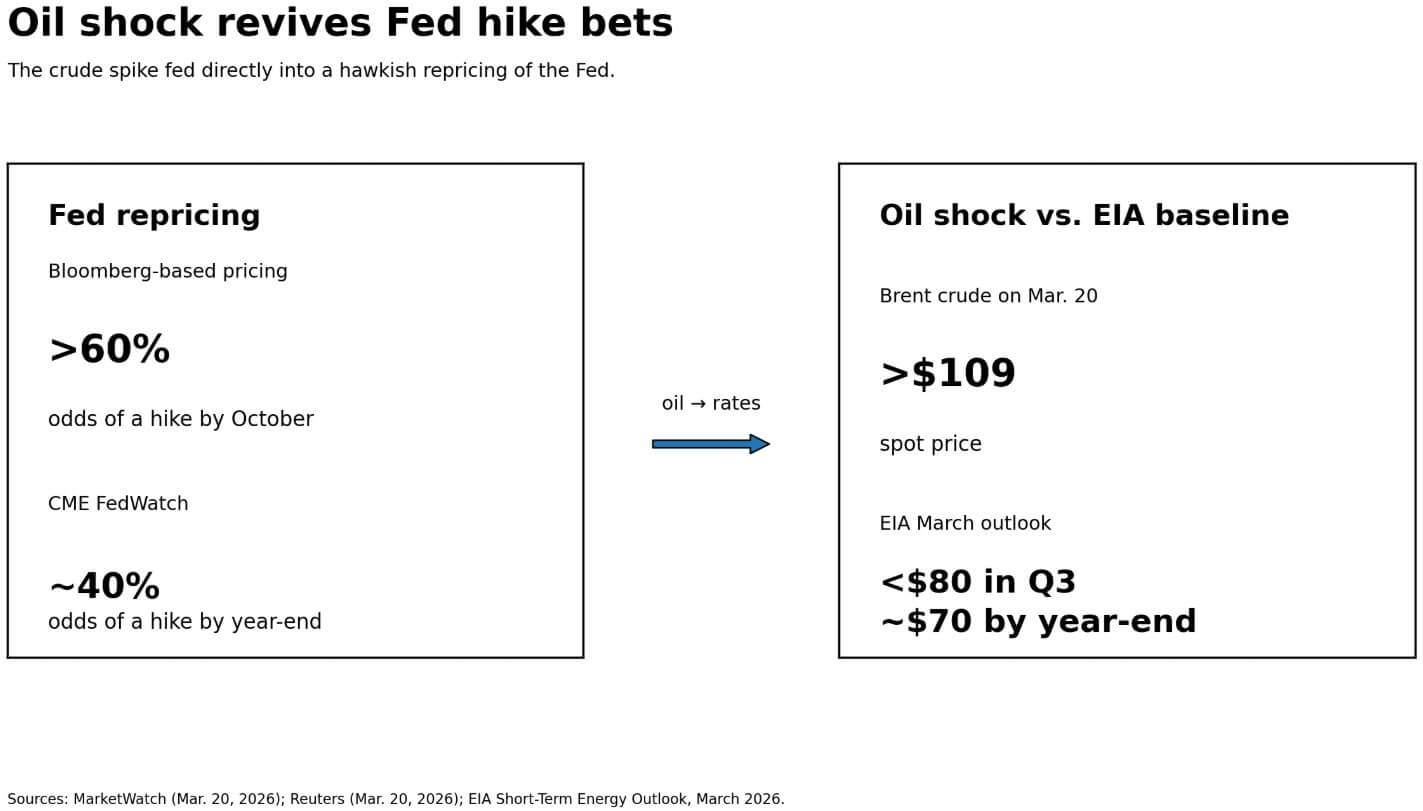
The transition in market expectations has been swift and decisive. Just two days after the Federal Reserve decided to maintain its target interest rate range at 3.50% to 3.75%, market indicators began signaling a reversal in trend. According to Bloomberg-based pricing, the odds of a rate hike occurring by October have climbed above 60%. This pricing reflects approximately 15 basis points of tightening by the fourth quarter of the year. Similarly, data from the CME FedWatch Tool indicates that the probability of a year-end hike is now approaching 40%, a scenario that was almost entirely discounted by market participants at the start of the year.
The immediate outlook has also soured for those hoping for a reprieve. The probability of a rate cut in April, which stood at a modest 17% in February, has effectively hit 0%. Conversely, the odds of a rate hike in the same period have ticked up to 6%. While these figures reflect a genuine disagreement among traders regarding exact timing, the underlying trajectory is clear: the era of "higher for longer" may be evolving into "higher for even longer," with the potential for further tightening if inflationary pressures do not subside.
The Energy Catalyst: Oil and the Strait of Hormuz
The primary driver behind this hawkish shift is the volatile energy market. On March 20, Brent crude prices surged past $109 per barrel, while West Texas Intermediate (WTI) touched $98. The catalyst for this spike is the escalating tension in the Middle East, which has reignited fears of a significant supply disruption in the Strait of Hormuz. As a critical maritime chokepoint that handles nearly 20% of the world’s global oil supply, any sustained closure or interference in the strait would have catastrophic implications for global energy costs.

This market reality stands in sharp contrast to the baseline assumptions held by the U.S. Energy Information Administration (EIA). In its March outlook, the EIA projected that Brent prices would ease below $80 by the third quarter and conclude the year near $70, provided that geopolitical disruptions remained contained. Current market behavior suggests that investors view these projections as overly optimistic. The surge in oil is flowing directly into inflation expectations, as higher energy costs act as a tax on consumers and a primary driver of input costs for businesses.
Capital Flight and the Resurgence of Cash
The repricing of the Fed’s path has sent shockwaves through the traditional financial markets. The 10-year Treasury yield recently climbed to approximately 4.37%, while the 30-year Treasury reached its highest level since September. As yields rise, the attractiveness of riskier assets diminishes. The S&P 500 has reflected this pressure, heading toward its fourth consecutive weekly loss as investors reassess equity valuations in the face of higher discount rates.
The movement of capital underscores a broader "flight to safety" and a preference for liquidity. In the week ending March 18, global equity funds experienced a massive outflow of $20.3 billion. The United States bore the brunt of this retreat, with $24.78 billion exiting U.S. equity funds alone. Where is this capital going? It is largely moving into money market funds, which absorbed $32.57 billion globally during the same period. With cash currently yielding close to 4%, it has become a formidable competitor to risk assets, pulling capital out of both stocks and speculative investments in real time.
Bitcoin and the Inflation Hedge Paradox
Bitcoin, often touted as "digital gold" and a primary hedge against currency debasement, finds itself in a complex position. On March 20, Bitcoin hovered just below the $70,000 mark, falling in tandem with the Nasdaq-100 (QQQ), which dropped 1.75%, and Gold (GLD), which fell 1.93%. This synchronized decline highlights a fundamental contradiction in the inflation-hedge narrative.
While Bitcoin is designed to thrive during periods of long-term currency debasement and monetary expansion, it remains highly sensitive to near-term liquidity conditions. When inflation is driven by supply-side shocks—such as rising oil prices—it often leads to tighter financial conditions, a firmer U.S. dollar, and higher bond yields. In this specific scenario, the Federal Reserve is forced to remain hawkish, which increases the discount rate on speculative assets.

The current environment represents a "worst-case" quadrant for Bitcoin: moderate to high inflation coupled with a central bank that is unable to ease policy. Gold’s 1.8% decline during the same session further proves that even the canonical safe-haven asset cannot always withstand the pressure of a rising dollar and surging yields. For Bitcoin, the "inflation hedge" pitch works best when rising prices signal that a central bank is losing control or is about to flood the market with liquidity to prevent a recession. It struggles when inflation is the very reason the central bank must keep the liquidity taps closed.
Federal Reserve Benchmarks and Economic Thresholds
Federal Reserve Chair Jerome Powell has maintained a cautious stance, noting at the conclusion of the March meeting that the central bank is closely monitoring whether fuel and input costs are leaking into core Personal Consumption Expenditures (PCE) inflation. The Fed’s goal remains a "soft landing," but the path to achieving it is narrowing.
Economic analysts at Bank of America have identified 3.2% as a critical threshold for core PCE inflation. If core inflation drifts above this level, while unemployment remains relatively low (near 4.5%) and oil stays in the $80 to $100 range, the case for a rate hike becomes credible. This setup creates a "moderate-inflation-without-recession" corridor that is particularly hostile to Bitcoin and other growth-oriented assets.
Furthermore, an International Monetary Fund (IMF) working paper has suggested that a single "crypto factor" explains roughly 80% of the variation in cryptocurrency prices. This factor is heavily influenced by U.S. monetary policy, with Fed tightening reducing risk-taking across the board. As institutional capital has become a larger part of the crypto ecosystem, Bitcoin’s correlation with equities—particularly tech stocks—has intensified. This was evident in the recent reversal of Spot Bitcoin ETF flows. After seeing $199.4 million in inflows on March 17, the market saw a combined $253.7 million in outflows over the following two days, according to data from Farside Investors.
The Global Context: A Synchronized Tightening
The inflationary pressure is not confined to the United States. Global brokerages now anticipate that the European Central Bank (ECB) and the Bank of England (BoE) may be forced to consider hikes as early as April. Traders are currently pricing in significant tightening through 2026 for both regions.

The geopolitical significance of the Strait of Hormuz extends beyond oil; it also handles approximately 20% of the global trade in Liquefied Natural Gas (LNG). A sustained disruption would simultaneously drive up energy costs across Europe and Asia, leaving very little room for any major central bank to pivot toward easing. This global contraction of liquidity reinforces the headwinds facing Bitcoin, as the asset trades as a concentrated bet on global liquidity levels.
Chronology of Critical Upcoming Events
The market’s next move will likely be dictated by a series of high-stakes data releases and policy meetings scheduled for April. These events will determine whether the current hawkish repricing is a temporary overreaction or the beginning of a new regime.
- April 3: U.S. Jobs Report: A strong labor market would give the Fed more "room" to hike or maintain high rates without fearing an immediate recession. Conversely, a softening labor market could deflate the hike narrative.
- April 9: February PCE Data: This is the Fed’s preferred inflation gauge. A print above expectations, particularly in the "core" category, would validate the market’s current fears.
- April 28-29: FOMC Meeting: While no rate change is expected at this meeting, the accompanying statement and Jerome Powell’s press conference will be scrutinized for any validation of the market’s hawkish shift.
Analysis of Potential Economic Scenarios
The financial markets are currently balanced between two distinct paths forward, each with vastly different implications for Bitcoin and the broader economy.
The Bull Case for Risk Assets: This scenario relies on the EIA’s baseline projections being correct. If oil prices retrace quickly due to a de-escalation of geopolitical tensions, and if the April labor and PCE data show that inflation is not becoming "sticky," the hike odds could vanish as quickly as they appeared. In this environment, Bitcoin would regain its liquidity tailwind. Citi’s 12-month framework suggests a base-case target of $112,000 for Bitcoin if the Fed resumes an easing path, with a bull-case target of $165,000.
The Bear Case for Risk Assets: If oil remains in the $80 to $100 range through the summer and core PCE stays above 3.2%, the "higher for longer" trade will harden. Money market assets, currently near a record $8 trillion, are unlikely to rotate back into risk assets if cash remains competitive and certain. Under this scenario, Bitcoin may trade as a duration-heavy risk asset, vulnerable to further drawdowns. Citi’s recessionary bear case puts a potential price floor for Bitcoin at $58,000.
Conclusion: A Definitive Test for Bitcoin
The current macroeconomic landscape presents a definitive test for Bitcoin’s identity. The asset is at a crossroads: will it prove to be a resilient hedge against the stagflationary pressures of rising costs and stagnant growth, or will it remain tethered to the ebb and flow of global central bank liquidity?
While long-term inflation expectations remain relatively contained—with five-year forward swaps falling to 2.35%—the near-term policy arithmetic is dominated by the threat of rising energy prices and a hawkish Federal Reserve. For investors, the coming weeks will be a period of intense scrutiny as they navigate a market where the "rate cut" dream has, for now, hit zero. In this environment, the only certainty is that the path to $100,000 for Bitcoin or a new all-time high for the S&P 500 has become significantly more complicated.