James Watt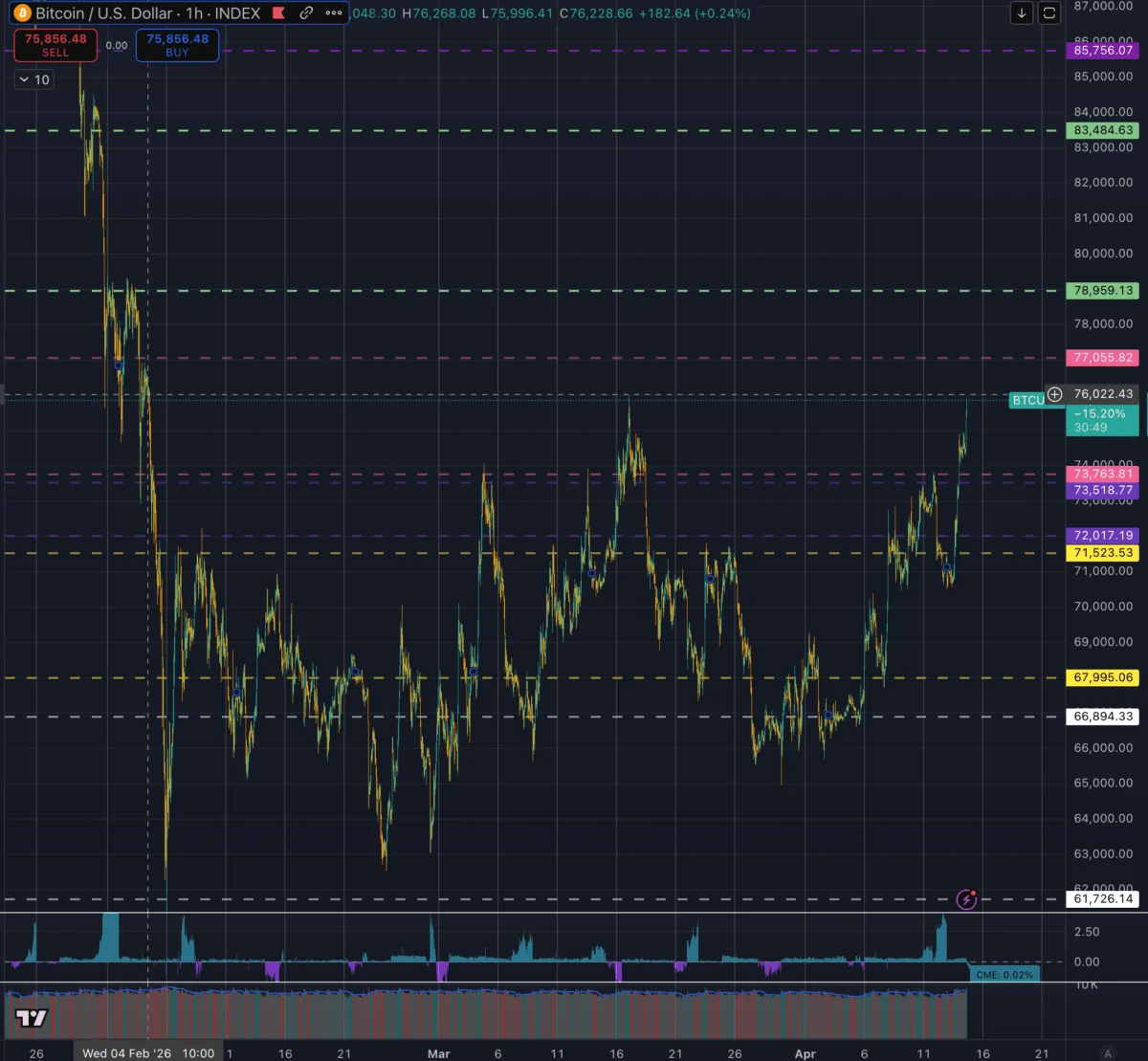
Bitcoin climbed to its highest valuation since the early-February market correction on Tuesday, surging past the $76,000 threshold during early US trading hours. The rally, which added approximately $110 billion to the aggregate cryptocurrency market capitalization within a 24-hour window, was precipitated by a confluence of macroeconomic factors, including softer-than-expected US producer price data, a significant retreat in global energy costs, and a robust performance across traditional equity indices. As risk appetite returned to the forefront of investor sentiment, the sudden upward trajectory triggered a historic liquidation event for bearish traders, marking one of the most significant short squeezes in recent months.
Macroeconomic Catalysts: The March Producer Price Index
The primary driver for Tuesday’s market optimism was the release of the March Producer Price Index (PPI) by the US Bureau of Labor Statistics. The report indicated that while wholesale inflation continues to rise, the pace of that increase has fallen short of Wall Street’s more pessimistic projections. According to the official data, the headline PPI advanced by 4% on a year-over-year basis in March. While this figure represents an acceleration from the 3.6% annual increase recorded in February—reaching its highest annual growth rate in three years—it was notably lower than the 4.7% consensus estimate provided by economists.
On a month-over-month basis, the PPI rose by 0.5%, matching the pace set in February but coming in significantly below the 1.1% surge that many analysts had anticipated. Perhaps more importantly for the Federal Reserve’s policy outlook, the Core PPI—which excludes the often-volatile food and energy sectors—remained flat at 3.8% year-over-year. This was a sharp divergence from market expectations of a 4.2% reading. The "cooler" nature of these figures provided immediate relief to investors who had been bracing for a hawkish pivot from the central bank.
In recent months, the specter of "sticky" inflation has forced market participants to price out the possibility of near-term interest rate cuts. High borrowing costs typically drain liquidity from the financial system, placing downward pressure on risk-sensitive assets like Bitcoin and high-growth technology stocks. However, the March PPI data suggested that the inflationary spike might be stabilizing, offering a window of opportunity for capital to rotate back into risk assets.

The Massive Short Squeeze: $650 Million in Liquidations
As Bitcoin’s price moved decisively upward, it caught a large segment of the trading community off guard. For several weeks, a significant number of traders had positioned themselves for a continued downturn, citing geopolitical instability and the Federal Reserve’s restrictive monetary policy. This bearish positioning created the perfect conditions for a "short squeeze"—a phenomenon where rising prices force short-sellers to buy back assets to cover their positions, further accelerating the upward price momentum.
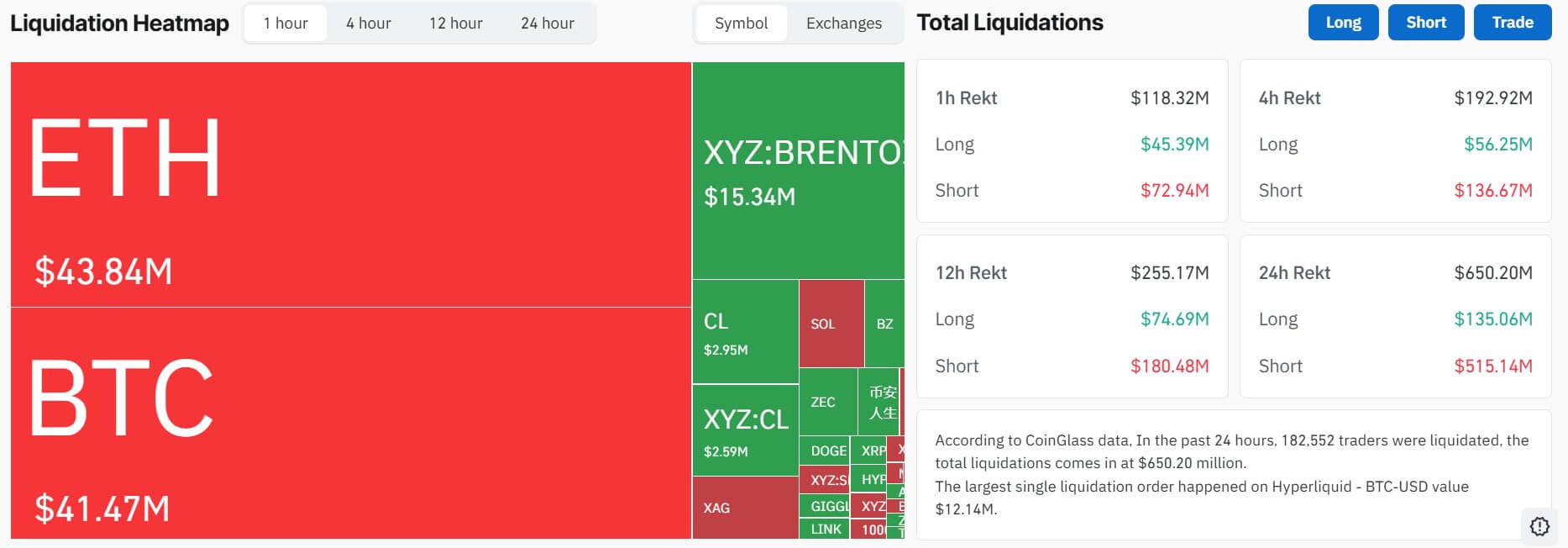
Data provided by the derivatives market analytical platform CoinGlass revealed the scale of the carnage. In a single one-hour window during the US trading session, more than $100 million in leveraged positions were forcibly closed. By the end of the day, total market liquidations across the crypto ecosystem had breached the $650 million mark.
Short-sellers bore the overwhelming brunt of these losses, with an estimated $514.94 million in bearish bets wiped out. This represents the highest level of short liquidations recorded since the period of intense market volatility seen in early February. Joao Wedson, CEO of the blockchain analytical firm Alphractal, characterized the event as a "peculiar and fractal day for Bitcoin," noting that the liquidation of the bears was almost surgical in its timing and execution.
Convergence with Traditional Markets and Energy Prices
The relief rally was not an isolated incident within the digital asset space; it mirrored a broader recovery in traditional financial markets. Bull Theory, a macro-economics analysis platform, reported that US indices absorbed the inflation data with equal enthusiasm, adding a staggering $1.4 trillion in total market capitalization over a two-day span.
The technology-heavy Nasdaq Composite led the charge with a 2.85% leap, adding approximately $960 billion in value. Simultaneously, the Russell 2000 index, which tracks small-cap stocks often viewed as a barometer for domestic economic health, surged by 3%. The S&P 500 advanced by 2.12%, bringing the index to within 100 points of a new historical benchmark.
This "risk-on" environment was further supported by a sharp decline in global energy markets. West Texas Intermediate (WTI) crude oil tumbled by 6%, settling at $93 per barrel. The decline in oil prices was largely attributed to emerging signs of stabilization in the Middle East. High energy costs are a primary driver of cost-push inflation; therefore, the retreat in crude prices provided the Federal Reserve with more breathing room and reduced the immediate pressure on the US economy to sustain higher interest rates.
Geopolitical Friction and the Safe Haven Debate
The recent performance of Bitcoin has also reignited a long-standing debate regarding its role during periods of geopolitical stress. Traditionally, Bitcoin has been classified as a high-beta risk asset that trades in tandem with tech stocks. However, its recent decoupling from traditional safe havens like gold has challenged this narrative.
Bitwise Chief Investment Officer Matt Hougan recently highlighted that Bitcoin has outperformed many traditional assets since the escalation of geopolitical tensions involving US and Israeli military actions in late February. According to Hougan’s analysis, Bitcoin has gained 12% during this period, while the S&P 500 has retreated by 1% and gold—the quintessential safe-haven asset—has fallen by 10%.
This divergence suggests that Bitcoin may be evolving into a multi-faceted asset. On one hand, it remains a speculative vehicle tied to global liquidity cycles. On the other, it is increasingly viewed as a "politically neutral" store of value. This latter role has gained significant traction following the weaponization of the SWIFT international payment network against Russia. As countries look to reduce their exposure to Western financial infrastructure and the US dollar, the appeal of a decentralized, borderless settlement layer like Bitcoin grows.
Hougan noted that while the argument remains contested, the idea of Bitcoin as a hedge against "geopolitical fractures" is becoming a more visible part of the institutional conversation. When traditional rails are threatened or fragmented, the scarcity and neutrality of Bitcoin provide a unique value proposition that gold, which requires physical logistics and is subject to sovereign oversight, cannot easily match.
Chronology of the Rebound
The path to $76,000 was marked by several key turning points over the last 60 days:
- Early February: Bitcoin experiences a sharp sell-off as inflation data comes in hotter than expected, leading to fears of a "higher-for-longer" rate environment.
- Late February: Geopolitical tensions in the Middle East escalate, initially causing a dip in risk assets before Bitcoin begins to decouple and trend upward.
- March 15-31: Market enters a consolidation phase as investors await the next round of PPI and CPI data.
- April 10: Speculation regarding a potential de-escalation in the Middle East begins to drive oil prices down from their peaks.
- April 14 (Morning): The US Bureau of Labor Statistics releases the March PPI report. The lower-than-expected 4% headline figure triggers an immediate spike in Bitcoin and US equity futures.
- April 14 (Mid-day): Bitcoin breaks through the $75,000 resistance level, triggering a wave of automated liquidations for short positions, which propels the price past $76,000.
Future Outlook and Federal Reserve Policy
Despite the current euphoria, market analysts remain cautious regarding the long-term trajectory of the Federal Reserve’s monetary policy. While the March PPI data was a positive signal, inflation remains well above the Fed’s 2% target. The "higher-for-longer" regime is still the baseline for many institutional investors.
Historically, elevated borrowing costs have a lagging effect on the economy. While Bitcoin has shown resilience, a sustained lack of liquidity could eventually cap the current rally. However, if the trend of cooling inflation continues alongside a stabilization of energy prices, the "Goldilocks" scenario—where inflation falls without a major recession—could provide the necessary fuel for Bitcoin to challenge the $80,000 mark.
For now, the narrative has shifted from fear of an inflation-induced crash to the exploitation of a massive short squeeze. The events of April 14 serve as a stark reminder of the volatility inherent in the digital asset markets and the speed with which macroeconomic data can redefine the financial landscape. As the broader crypto ecosystem continues to absorb the $110 billion in new market cap, the focus turns toward the upcoming Consumer Price Index (CPI) readings and the Federal Reserve’s next move in its ongoing battle against inflation.