admin
admin
Pineapple Financial, a technology-driven mortgage brokerage, has officially transitioned more than $1 billion in residential mortgage records onto Injective, a prominent Layer-1 blockchain specifically engineered for decentralized finance and institutional applications. This move represents the first major phase of a comprehensive initiative to migrate the company’s entire historical loan portfolio to a blockchain environment, signaling a significant shift in how traditional mortgage data is managed, audited, and utilized within the broader financial ecosystem. According to statements released by Injective on Friday, the collaboration is set to expand significantly, with Pineapple Financial planning to eventually migrate more than 29,000 funded mortgages—representing a total value exceeding $10 billion—onto the network.
This digital migration does not involve the repackaging of mortgages into new securities; rather, each mortgage is represented by a unique on-chain record that is directly tethered to the underlying loan file. This approach prioritizes data integrity and transparency over secondary market speculation, providing a granular look at the health and history of individual loans. By utilizing Injective’s high-speed, interoperable infrastructure, Pineapple Financial aims to streamline the administrative complexities that have historically plagued the mortgage industry, ranging from verification bottlenecks to the lack of real-time audit trails.
Technical Architecture and Data Granularity
The migration process utilizes a sophisticated tokenization framework where each record contains more than 500 distinct data points. These data points are designed to provide a comprehensive profile of the mortgage, including loan-level information such as payment histories, interest rate structures, property valuations, and borrower risk profiles. The inclusion of such extensive data is intended to support a variety of institutional needs, including real-time verification, automated audit trails, and advanced risk analysis.
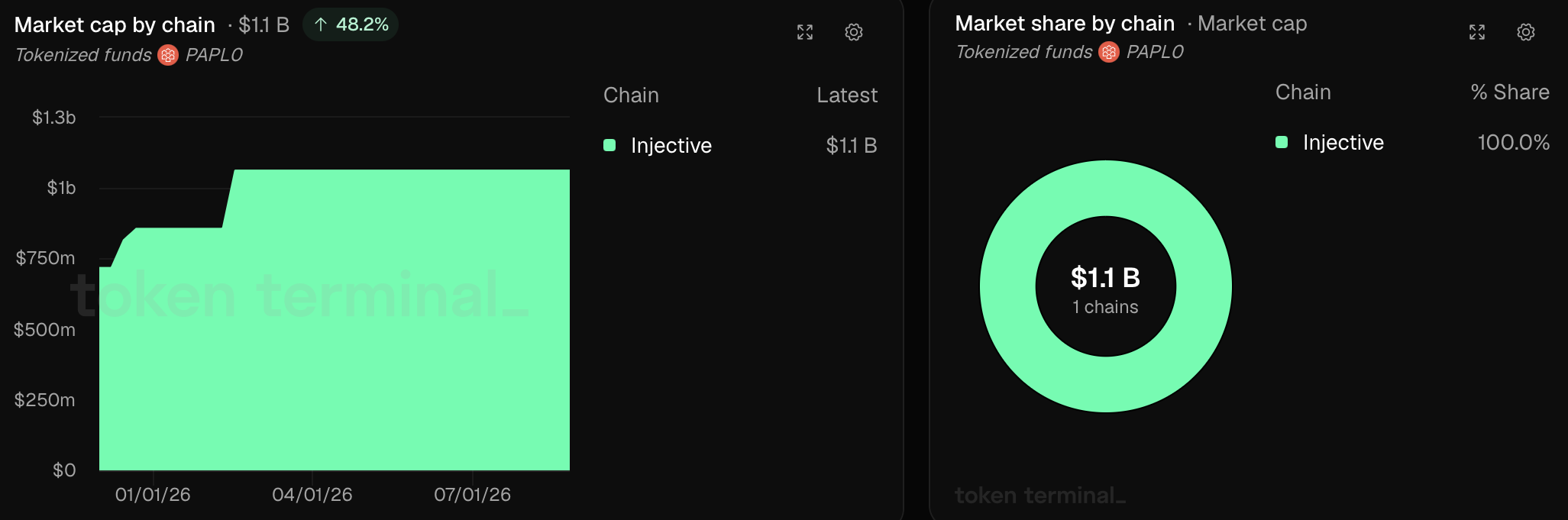
The initiative is tracked via the PAPL0 asset, which serves as the on-chain representation of these mortgage records. According to data provided by Token Terminal, the PAPL0 asset currently maintains a market capitalization of approximately $1.1 billion. This figure represents a 48.2% increase over the past nine months, reflecting the steady pace of the migration effort. It is important to note that these tokens represent the data records themselves rather than direct ownership of the underlying debt or the property assets. This distinction is crucial for regulatory compliance, as it allows Pineapple Financial to leverage blockchain for operational efficiency without immediately triggering the complex legal requirements associated with the sale of fractionalized real estate securities.
The growth of the on-chain portfolio is evident in the company’s digital dashboard. As of early September 2026, the migration includes 2,079 individual mortgage records, a substantial increase from the 1,259 records logged when the initiative originally launched in December 2025. This steady climb suggests a methodical approach to data ingestion, ensuring that each file is correctly validated before being permanently etched into the Injective ledger.
Strategic Partnership with Injective and Kraken
The migration of mortgage records is only one component of a broader strategic relationship between Pineapple Financial and the Injective ecosystem. Parallel to the data migration, Pineapple has established a $100 million Injective (INJ) digital asset treasury. This move aligns the company’s balance sheet with the performance and security of the network it now relies on for its data infrastructure.
To manage this treasury, Pineapple Financial has engaged in staking activities to secure the network and generate yield on its digital holdings. Kraken, one of the world’s longest-standing cryptocurrency exchanges, serves as the primary validator for these holdings. This institutional-grade custody and staking arrangement underscores the professionalization of the project, moving it beyond a mere pilot program and into the realm of core corporate strategy. By staking its INJ tokens, Pineapple Financial not only participates in the governance and security of the Injective Layer-1 but also offsets the operational costs of maintaining its on-chain records through network rewards.

Injective was selected as the host blockchain due to its specific focus on financial applications. Built using the Cosmos SDK, Injective offers sub-second block times and minimal transaction fees, which are essential for processing the vast amounts of data associated with tens of thousands of mortgage files. Furthermore, its interoperability features allow for future integration with other decentralized finance (DeFi) protocols, potentially opening doors for advanced mortgage-backed financial products in the future.
Chronology of the On-Chain Initiative
The timeline of Pineapple Financial’s blockchain integration reflects a phased approach to digital transformation:
- December 2025: Pineapple Financial officially launches its blockchain initiative, migrating the first batch of 1,259 mortgage records to Injective. The PAPL0 tracker is established to monitor the growth and valuation of the on-chain data.
- Early 2026: The company establishes its $100 million INJ digital asset treasury and begins staking operations through Kraken to bolster its long-term commitment to the network.
- June 2026: The asset market cap for PAPL0 begins to see significant appreciation as institutional interest in real-world asset (RWA) data grows.
- September 2026: The number of migrated records reaches 2,079, with the total on-chain value of the records crossing the $1.1 billion mark. Plans are reaffirmed to reach a target of 29,000 mortgages worth $10 billion.
This chronology demonstrates a sustained effort to move away from legacy database systems, which are often siloed and prone to errors, toward a unified, transparent, and immutable ledger.
The Broader Context of Real-World Asset Tokenization
The move by Pineapple Financial comes at a time when the tokenization of Real-World Assets (RWAs) is gaining significant momentum among global financial institutions. Real estate, in particular, has become a focal point because it is traditionally one of the most illiquid and paper-intensive asset classes. By bringing these assets on-chain, institutions can make property interests and loan data easier to divide, transfer, and verify.
Pineapple Financial is joined by several other major players in this space. In June 2026, the Apex Group partnered with Goldman Sachs, Archax, and the LRC Group to launch a tokenized real estate fund. Unlike Pineapple’s focus on data records, the Apex fund issues digital tokens that represent blockchain-based ownership of fund shares. This allows investors to trade interests in real estate portfolios with the same ease as trading stocks or cryptocurrencies.
Similarly, Dubai has emerged as a global leader in the sector. The Dubai Land Department recently entered the second phase of a pilot program that has already seen approximately $5 million in property tokenized on the XRP Ledger. These international efforts highlight a growing consensus that the future of real estate finance lies in distributed ledger technology.
However, despite these high-profile moves, tokenized real estate remains a relatively small niche within the broader RWA market. Data from RWA.xyz indicates that the tokenized real estate sector currently has approximately $226.5 million in distributed value. While this figure has grown by 11.7% in the last 30 days, it is dwarfed by the $38.8 billion across all tokenized RWAs, which includes government treasuries, private credit, and commodities. The $1.1 billion in records moved by Pineapple Financial significantly boosts the data-side of this market, even if it does not represent direct asset ownership.
Implications for the Mortgage and FinTech Industries
The implications of Pineapple Financial’s migration are manifold, affecting everything from operational efficiency to the future of secondary mortgage markets. In the traditional mortgage industry, the process of selling a loan or auditing a portfolio can take weeks or even months, involving dozens of intermediaries and the manual verification of physical documents. By placing 500 data points on-chain for every loan, Pineapple Financial creates a "single source of truth" that can be accessed instantly by authorized parties.
Industry analysts suggest that this level of transparency could significantly reduce the "risk premium" associated with mortgage-backed assets. When auditors and potential buyers can verify the performance of a loan in real-time, the need for extensive due diligence periods is diminished. Furthermore, the use of blockchain prevents the "double-pledging" of assets and ensures that the history of a loan cannot be altered or obscured.
From a regulatory perspective, the move toward on-chain records could simplify compliance. Regulators could theoretically be granted "read-only" access to the blockchain, allowing them to monitor market health and lending practices without the need for intrusive and time-consuming manual audits. This "regtech" application of blockchain is increasingly viewed as a way to prevent the systemic failures seen in the 2008 financial crisis, which were largely driven by a lack of transparency in mortgage-backed securities.
Future Outlook and Challenges
As Pineapple Financial moves toward its goal of $10 billion in on-chain mortgage records, several challenges remain. The primary hurdle is the evolving regulatory landscape. While recording data on a blockchain is generally viewed as a technological upgrade to record-keeping, any move toward tokenizing the actual ownership or cash flows of these mortgages would bring the company under the strict purview of securities regulators in multiple jurisdictions.
There is also the challenge of data privacy. While the blockchain provides security and immutability, ensuring that sensitive borrower information remains protected while still being accessible for verification is a delicate balance. Pineapple Financial’s use of Injective—which supports sophisticated permissioning and encryption—is a strategic choice intended to address these concerns.
Despite these hurdles, the success of the PAPL0 initiative suggests that the appetite for on-chain financial data is growing. If Pineapple Financial successfully migrates its full $10 billion portfolio, it will likely serve as a blueprint for other mortgage providers and financial institutions looking to modernize their legacy systems. The integration of a $100 million treasury and the involvement of major players like Kraken further cement the idea that blockchain is no longer an experimental tool but a foundational component of 21st-century finance.
In the coming months, the market will be watching to see if the PAPL0 asset continues its upward trajectory and whether other mortgage brokerages follow Pineapple’s lead. As the gap between traditional finance and decentralized technology continues to close, the migration of mortgage records onto Injective may be remembered as a pivotal moment in the digital transformation of the global real estate market.