admin
admin
The United States labor market demonstrated unexpected resilience in August, producing job growth figures that more than tripled consensus estimates and immediately recalibrated expectations for the Federal Reserve’s upcoming interest rate decision. According to data released by the Bureau of Labor Statistics on Friday, the U.S. economy added 162,000 nonfarm payroll jobs during the month of August. This figure represents a significant departure from the 56,000 jobs projected by a consensus of leading economists, signaling a robust labor environment that complicates the central bank’s path toward potential monetary easing.
The immediate reaction in the digital asset markets was one of sharp volatility. Bitcoin (BTC), which had been trading near $81,300 prior to the announcement, experienced a rapid sell-off as traders processed the implications of the data. The premier cryptocurrency touched local lows of $78,600 before finding support, eventually stabilizing at approximately $79,500 at the time of writing. This price action reflects a broader market sensitivity to "hot" economic data, which often suggests that the Federal Reserve may maintain higher interest rates for longer to prevent the economy from overheating.
The Labor Market Surprise and Monetary Policy Uncertainty
The August jobs report arrives at a critical juncture for the Federal Open Market Committee (FOMC), which is scheduled to convene on September 15-16. The substantial beat in nonfarm payrolls has introduced a new layer of complexity to the interest rate outlook, which was already characterized by internal division and external political pressure.
Historically, the period leading up to FOMC meetings has been marked by relatively stable market expectations, largely due to the "forward guidance" provided by previous Federal Reserve chairs. However, the current environment under Chair Kevin Warsh has seen a departure from this transparency. Analysts have noted a distinct lack of forward guidance from the Warsh-led Fed, a strategy that appears intended to maintain "maximum optionality" but has instead resulted in heightened market uncertainty.
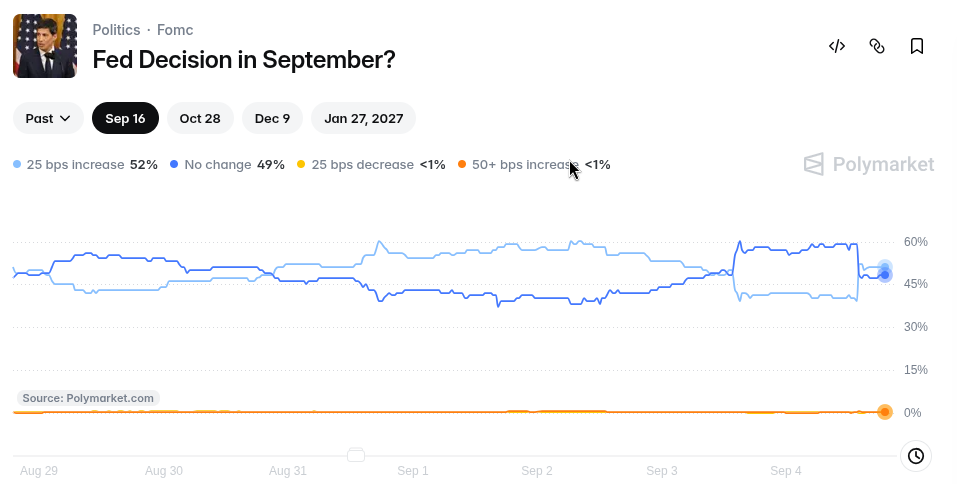
This uncertainty was further exacerbated by comments made on Thursday by Federal Reserve Governor Christopher Waller. Speaking at a pre-blackout event, Waller indicated a preference for a "rate pause," suggesting that the committee should wait for more definitive inflation data before committing to further hikes or cuts. Following Waller’s remarks, decentralized prediction markets, such as Polymarket, saw the probability of a rate pause climb to 60%, with a 40% probability assigned to a 25-basis-point hike.
However, Friday’s labor data effectively erased that lean. The strength of the 162,000 jobs figure drove the implied probabilities back to a 50/50 split. Market participants are now evenly divided on whether the Fed will maintain the current federal funds rate or implement a quarter-point increase to stay ahead of potential inflationary pressures stemming from a tight labor market.
Political Reactions and the Call for "Patriotic" Rate Cuts
The intersection of economic data and presidential politics became more pronounced following the jobs report. U.S. President Donald Trump utilized his Truth Social platform to issue a direct demand for lower interest rates, targeting the Federal Reserve Board and its leadership.
"The Fed Board, with its great new leader, must get smart – BE PATRIOTS for a change," the President stated. He further argued that "High interest rates put the U.S.A. at a very unfair disadvantage, and I won’t allow that to happen!"
This rhetoric marks a notable shift in the President’s relationship with Chair Kevin Warsh. While Trump was a frequent and vocal critic of former Chair Jerome Powell, he had largely refrained from public criticism of Warsh until this week. The demand for "patriotic" rate cuts underscores the tension between the executive branch’s desire for economic expansion and the Federal Reserve’s statutory mandate to maintain price stability and maximum employment. Economists warn that such public pressure can test the perceived independence of the central bank, a cornerstone of global confidence in the U.S. dollar and Treasury markets.
A Technical Schism: The Bitcoin BIP-110 Soft Fork Conflict
While the macroeconomy dominated headlines, the Bitcoin network itself has been undergoing one of its most significant technical and philosophical transitions in years. The conflict traces back to August 7, when the BIP-110 soft fork was activated. BIP-110 was intended to introduce new rules to the protocol via a User-Activated Soft Fork (UASF). However, the activation did not go as planned.
Upon activation, the Bitcoin network briefly split into two competing chains. One chain enforced the new BIP-110 rules, while the other continued under the legacy protocol. In theory, if a majority of miners had supported the new rules, the BIP-110 chain would have become the dominant, longest chain. Instead, the BIP-110 side stalled. The vast majority of the network’s hash power remained on the legacy chain, refusing to extend the BIP-110 branch.
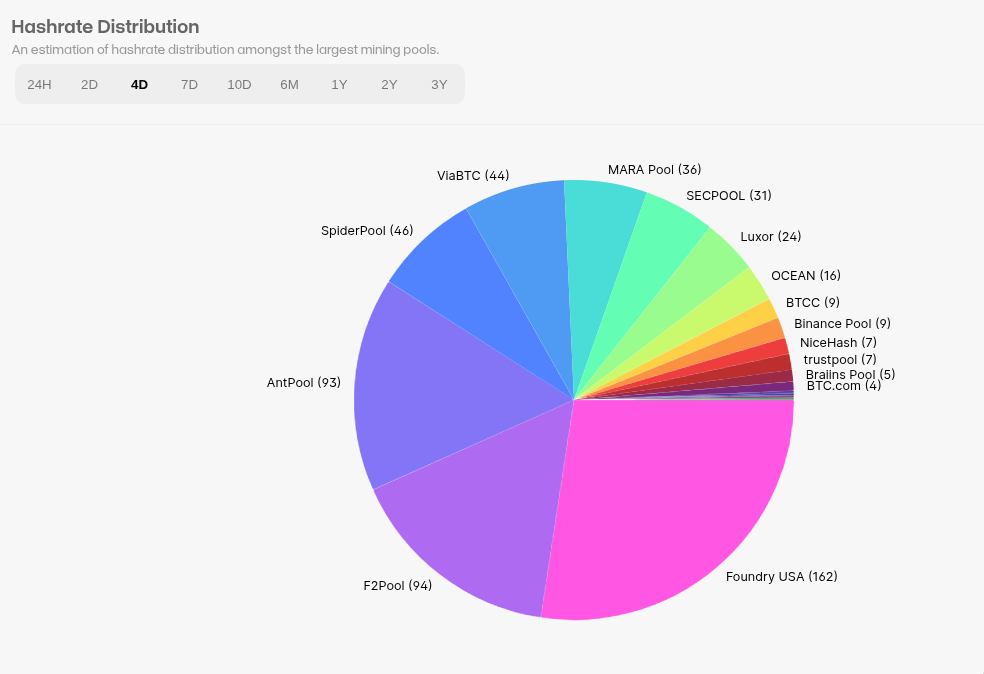
This failure of the UASF to gain miner consensus has reignited a fierce debate regarding the centralization of Bitcoin mining. Supporters of BIP-110 argue that the refusal of miners to follow a user-led initiative is proof that the mining layer has become an oligarchy. Data from Blockchain.com confirms that just five mining pools currently control the overwhelming majority of the Bitcoin hashrate. This concentration of power allows a small number of entities to effectively veto protocol upgrades favored by users and developers.
The situation was further complicated by the lack of an organized "User-Rejected Soft Fork" (URSF) from the Bitcoin Core development side. The absence of a clear counter-signal left the network in a state of limbo, leading to the eventual decision by a subset of the community to pursue a more radical path.
The Emergence of Bitcoin Blake2b and the DATUM Gateway
In response to what they perceive as a "capture" of the SHA-256 mining layer, a group of developers and activists, led by prominent Bitcoin developer LukeDashjr, initiated a hard fork on August 30. This new version of the network, commonly referred to as "Bitcoin Blake2b" or BTCB2, aims to restore decentralization by changing the fundamental proof-of-work (PoW) algorithm.
By moving from the industry-standard SHA-256 algorithm to Blake2b, the proponents of the fork have effectively rendered existing ASIC (Application-Specific Integrated Circuit) mining hardware obsolete on the new chain. The goal is to allow a new, more distributed set of miners to secure the network using more accessible hardware and the DATUM gateway technology. DATUM is designed to decentralize pool mining by allowing individual miners, rather than pool operators, to select which transactions are included in their blocks.
This hard fork created a "snapshot" of the Bitcoin ledger. Every user who held Bitcoin on the SHA-256 chain prior to the August 7 split (and potentially up until the August 30 fork) now holds an equivalent balance of Blake2b Bitcoin.
Market Liquidity and Initial Trading of BTCB2
The market’s reception of this new version of Bitcoin has been cautious but active. Currently, the only platform providing a marketplace for the new tokens is Neoxa Exchange. Initial liquidity is thin, which is common for newly forked assets, but the price discovery process has begun.
As of Friday, Blake2b Bitcoin (BTCB2) is trading at approximately $350 against the USDC stablecoin. The order book shows a spread of roughly 1.1%, indicating that while there is interest, the market is still searching for a stable valuation. For many in the crypto community, the $350 price point represents a "speculative premium" on the idea of a decentralized mining alternative, though it remains a fraction of the $79,500 value of the original SHA-256 Bitcoin.
The thin liquidity presents risks for early traders, as large orders can cause significant price slippage. However, the existence of a trading pair allows for the first real-world economic signaling of the value users place on the BIP-110 rules and the Blake2b PoW change.
Broader Implications for the Financial Landscape
The convergence of these events—the labor market boom, the Federal Reserve’s guidance vacuum, political interference, and the Bitcoin schism—highlights a period of intense transition for the global financial system.
For the Federal Reserve, the 162,000-job print suggests that the economy is not cooling as quickly as some had hoped, potentially requiring a "higher-for-longer" interest rate stance. This puts the Fed on a collision course with a presidency that is increasingly vocal about its desire for cheap credit. The September 15-16 FOMC meeting will likely be the most scrutinized session of Chair Warsh’s tenure to date.
For the cryptocurrency ecosystem, the birth of Bitcoin Blake2b serves as a reminder of the "governance by fork" philosophy that defines decentralized networks. If the new chain gains traction, it could present a long-term challenge to the dominance of SHA-256 mining and force a conversation about how protocol upgrades are achieved. If it fails to gain liquidity, it may serve as a cautionary tale about the difficulties of migrating a network’s security model.
As the mid-September FOMC meeting approaches, market participants will be closely watching for any additional data points—particularly Consumer Price Index (CPI) inflation figures—that could break the current 50/50 deadlock in interest rate expectations. In the meantime, Bitcoin remains caught between its role as a macro hedge and its internal struggles over the future of its technology.