admin
admin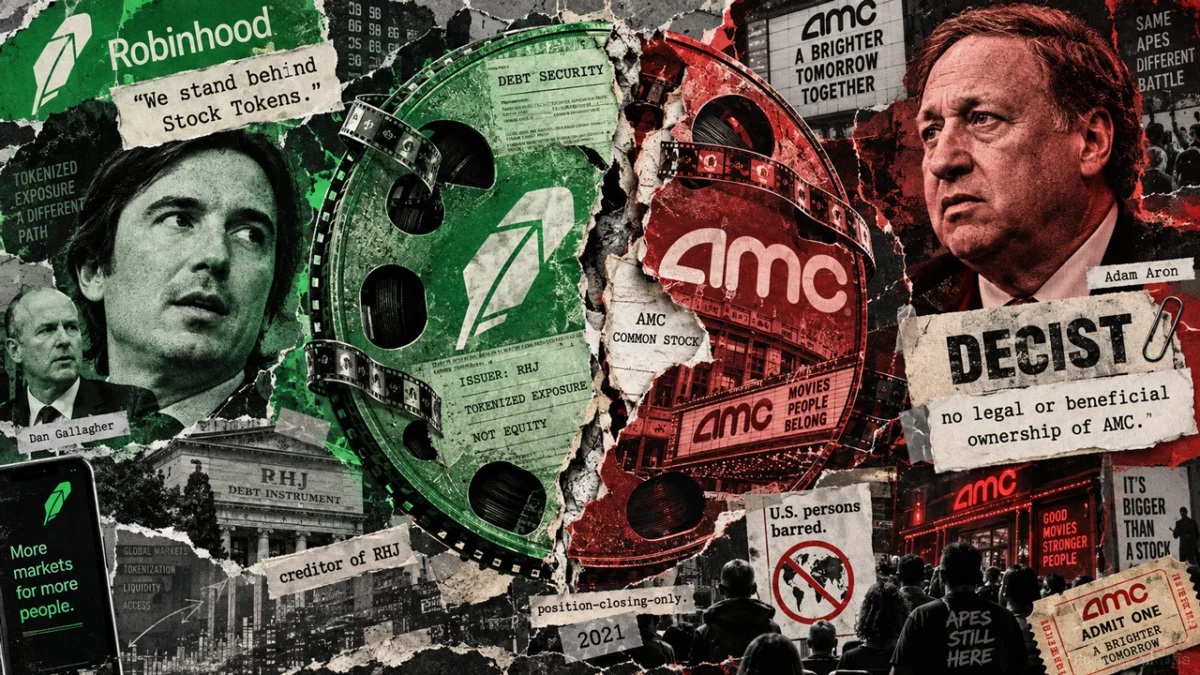
The volatile landscape of cryptocurrency and meme stock trading has erupted into a fresh conflict, this time pitting the popular trading platform Robinhood against AMC Entertainment, the cinema giant that once served as a flagship for the meme stock phenomenon. The dispute centers on Robinhood’s issuance of an "AMC-linked Stock Token," a financial instrument that Adam Aron, AMC’s Chief Executive Officer, has vehemently demanded Robinhood cease offering. Robinhood’s legal and executive leadership has firmly rejected these demands, setting the stage for a potentially significant legal and regulatory showdown.
The crux of the disagreement lies in the fundamental structure and legal nature of Robinhood’s Stock Token. While the token’s value is designed to mirror the economic performance of AMC Entertainment’s common stock, holders of the token do not possess any direct ownership rights or equity in AMC. Instead, they are creditors of a Robinhood affiliate, receiving a debt instrument that tracks the underlying stock’s price movements. This distinction is central to Robinhood’s defense and a primary point of contention for AMC’s leadership.
Dan Gallagher, Robinhood’s Chief Legal, Compliance, and Corporate Affairs Officer, publicly rebuffed Aron’s ultimatum, notably echoing the misspelling of "desist" as "decist" in Aron’s original demand, and advised AMC to engage their legal counsel. Robinhood CEO Vlad Tenev further solidified the company’s stance, stating via social media, "We stand behind Stock Tokens." This resolute position indicates Robinhood’s commitment to its innovative financial product and its belief in its legal and operational framework.
The public exchange began when Adam Aron first voiced his objections, asserting that AMC had no affiliation with the token and that the company’s external securities counsel would investigate the matter. Following Tenev’s inquiry into the nature of AMC’s concerns, Aron articulated a series of specific objections. These included the potential for the token to obscure the line between economic exposure and genuine share ownership, the separation of trading activity from AMC’s capital-raising initiatives, and the denial of fundamental shareholder rights to token holders. Aron also signaled AMC’s intention to escalate the issue to the U.S. Securities and Exchange Commission (SEC), a move that underscores the seriousness with which AMC views the situation.
However, it is crucial to note that Aron’s statements represent allegations from AMC’s perspective. Robinhood’s publicly available documentation provides a detailed account of the Stock Token’s structure, clarifying the technical and legal framework that underpins the dispute.
Understanding the AMC-Linked Stock Token: Structure and Economic Exposure
Robinhood’s official documentation elucidates that its Stock Tokens are essentially tokenized debt securities. These instruments are issued by Robinhood Assets (Jersey) Limited (RHJ), a subsidiary of Robinhood. The primary purpose of these tokens is to offer investors economic exposure to the performance of a specific underlying stock or exchange-traded fund (ETF) without conferring any legal or beneficial ownership in the company whose securities are being referenced.
The AMC-specific final terms document clearly identifies RHJ as the issuer and AMC common stock as the designated reference asset. An examination of Robinhood’s asset registry, accessed on September 4th, confirmed the AMC-linked instrument was listed as active.
| Product Feature | Robinhood’s Disclosed Structure |
|---|---|
| Issuer | Robinhood Assets (Jersey) Limited |
| Legal Form | Debt security linked to AMC common stock |
| Holder Relationship | Creditor of RHJ under the product terms, with no legal or beneficial ownership of AMC |
| Company Rights | No AMC voting rights, meeting attendance, pre-emption rights, or direct dividend entitlements |
| Corporate-Action Economics | Dividends and stock splits are reflected through the product’s mechanics |
| U.S. Distribution | The prospectus explicitly bars offering, sale, or delivery in the United States or to U.S. persons |
The RHJ base prospectus further details the contractual relationship between RHJ and the token holders. It establishes that token holders are creditors of RHJ, with their claims governed by the terms of the debt product. Critically, this arrangement explicitly excludes any claim to AMC’s voting rights, participation in shareholder meetings, pre-emption rights, or direct entitlement to dividends. Instead, economic events such as dividend distributions and stock splits are economically replicated through the product’s underlying mechanics, which often involve an on-chain multiplier.
This structural separation allows the token to track the economic performance of AMC’s stock while remaining entirely outside of AMC’s official shareholder registry. It is precisely this separation that fuels the intense disagreement. Aron perceives the instrument as a means to leverage AMC’s name and stock performance without granting token holders any of the rights or privileges associated with actual share ownership. Robinhood, conversely, positions it as a distinct financial product designed to provide economic exposure to a particular asset class.
Robinhood’s prospectus also emphasizes that these Stock Tokens are not registered under U.S. securities laws. Consequently, they are expressly prohibited from being offered, sold, or delivered within the United States or to any U.S. persons. The product is issued through a Jersey-based entity to cater to eligible customers outside of these restricted distribution boundaries.
These explicit geographical and legal restrictions define the perimeter of the Stock Token’s offering. Aron’s broader challenge to the underlying structure remains a point of contention, and at this juncture, no regulatory body has issued a definitive decision on Robinhood’s AMC-linked instrument. The current public record consists of AMC’s threatened legal and regulatory scrutiny and Robinhood’s unwavering refusal to withdraw the product.
For individual investors, the practical implications are already evident. The token’s nomenclature and its reference asset provide a direct link to AMC’s economic performance, but the associated rights and benefits are derived solely from the terms of RHJ’s debt. This fundamental gap between economic exposure and actual ownership is the core commercial issue driving this high-profile confrontation.
A Meme-Stock Role Reversal: Echoes of 2021
The current dispute carries significant historical weight due to AMC’s prominent role in the 2021 meme stock saga. During that period, a coordinated effort by retail traders, largely organized through online platforms, drove significant volatility in a select group of stocks, with AMC being a central figure.
On January 28, 2021, in the midst of unprecedented market volatility, Robinhood, along with other brokerage firms, controversially placed AMC, GameStop, and other securities into "position closing only" status. This move temporarily restricted new purchases during the frenzy, sparking widespread outrage and leading to subsequent investigations by the SEC into the episode and the market structure pressures that influenced such broker restrictions.
Now, approximately five years later, the same entities find themselves on opposing sides of a new debate concerning access and financial instruments. Robinhood is the issuer of the AMC-linked token, while the CEO of AMC is demanding its cessation.
This historical parallel offers crucial context but does not dictate a legal outcome. The 2021 controversy revolved around a broker’s decision to limit retail investors’ access to AMC shares. The present conflict, however, questions Robinhood’s right to offer economic exposure to AMC through a separate debt instrument over the objection of the company itself.
AMC’s meteoric rise as a meme stock solidified direct share ownership and broad market access for retail investors as central tenets of its public identity. Robinhood’s Stock Token model, by design, decouples the economic performance linked to AMC from the rights and corporate relationship inherently tied to AMC shares.
Adam Aron is actively contesting this separation, while Robinhood is defending its right to offer such a product. This ideological and commercial clash underscores the evolving nature of financial markets and the innovative, and sometimes controversial, products that emerge from them.
Broader Implications for Financial Innovation and Regulation
The Robinhood-AMC Stock Token dispute has far-reaching implications that extend beyond the immediate parties involved. It highlights the growing tension between traditional corporate governance and the emergence of novel financial instruments in the digital asset space.
Regulatory Scrutiny: The mention of an SEC referral by Adam Aron suggests that this conflict could attract significant regulatory attention. The SEC has been actively scrutinizing digital assets and their intersection with traditional securities. The structure of Robinhood’s Stock Token, particularly its debt-based nature and the economic mirroring of a publicly traded stock, presents a complex case for regulators to assess under existing securities laws. The outcome could set precedents for how similar tokenized debt instruments are treated.
Investor Protection: A key concern raised by AMC is the potential for investor confusion and the denial of shareholder rights. The distinction between economic exposure and ownership is crucial for informed investment decisions. Regulators will likely weigh whether Robinhood’s product, despite its clear disclosures, poses an undue risk of misleading retail investors, especially those familiar with the meme stock phenomenon.
Decentralization vs. Centralization: The debate also touches upon the broader discourse surrounding decentralized finance (DeFi) and the role of centralized entities. While Stock Tokens are on-chain instruments, they are issued and managed by a centralized entity (RHJ), differentiating them from fully decentralized token offerings. This hybrid approach could face scrutiny from both proponents of pure decentralization and traditional financial regulators.
Innovation and Market Access: Robinhood’s offering, if deemed compliant, could represent a significant innovation in providing economic exposure to assets without the complexities of direct ownership. This could potentially broaden market access for certain investors. However, the dispute underscores the need for clear regulatory frameworks to govern such innovations, ensuring they do not undermine existing market integrity or investor protections.
The Future of Tokenized Securities: This clash serves as a test case for the future of tokenized securities. As blockchain technology continues to mature, more instruments are likely to emerge that blend traditional financial concepts with digital asset mechanics. The way this dispute is resolved could significantly influence the development and adoption of such products, shaping the landscape of both crypto and traditional finance for years to come. The underlying economics of the token, its legal classification, and the potential for regulatory intervention will all be critical factors in determining the ultimate outcome of this high-stakes confrontation.