admin
admin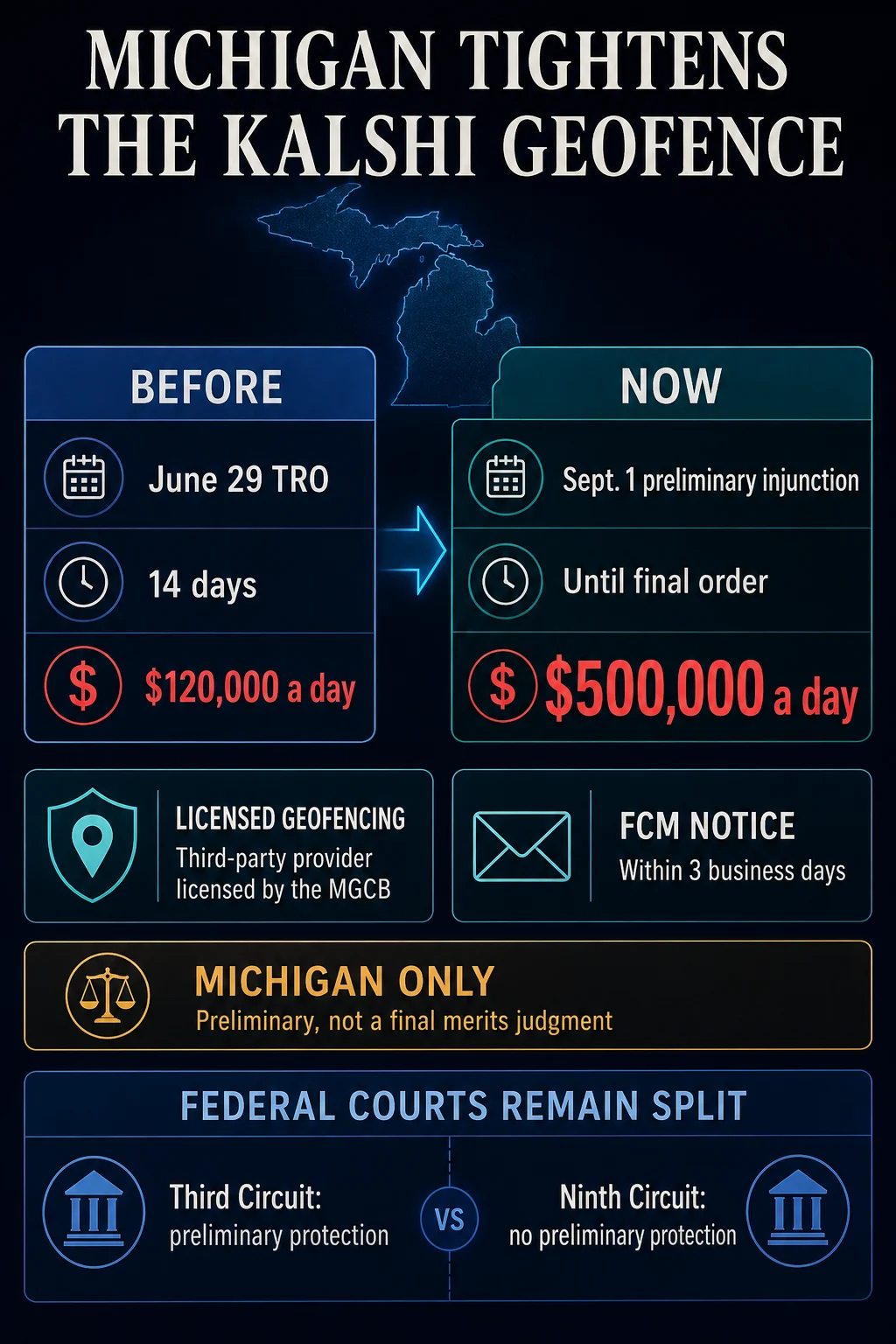
A Michigan judge has imposed a preliminary injunction on the prediction market exchange Kalshi, effectively halting its sports event contracts for individuals within the state until a final court order is issued. This significant ruling escalates the legal dispute, moving it beyond a temporary measure into a prolonged period of mandated compliance, and introduces substantial daily financial penalties for any non-adherence. The core of the contention lies in Kalshi’s classification of its offerings as federally regulated event contracts, a stance directly challenged by Michigan authorities who view these sports-related products as unauthorized internet sports betting, requiring state licensing.
The Scope of the Michigan Injunction
The judicial order, signed on September 1, 2026, prohibits Kalshi and any associated entities from offering, facilitating, or allowing access to "covered internet sports-betting contracts" for anyone physically located in Michigan. This broad prohibition extends to all aspects of such transactions, including deposits, advertising, solicitation, and account access related to functionally similar sports-betting products within the state.
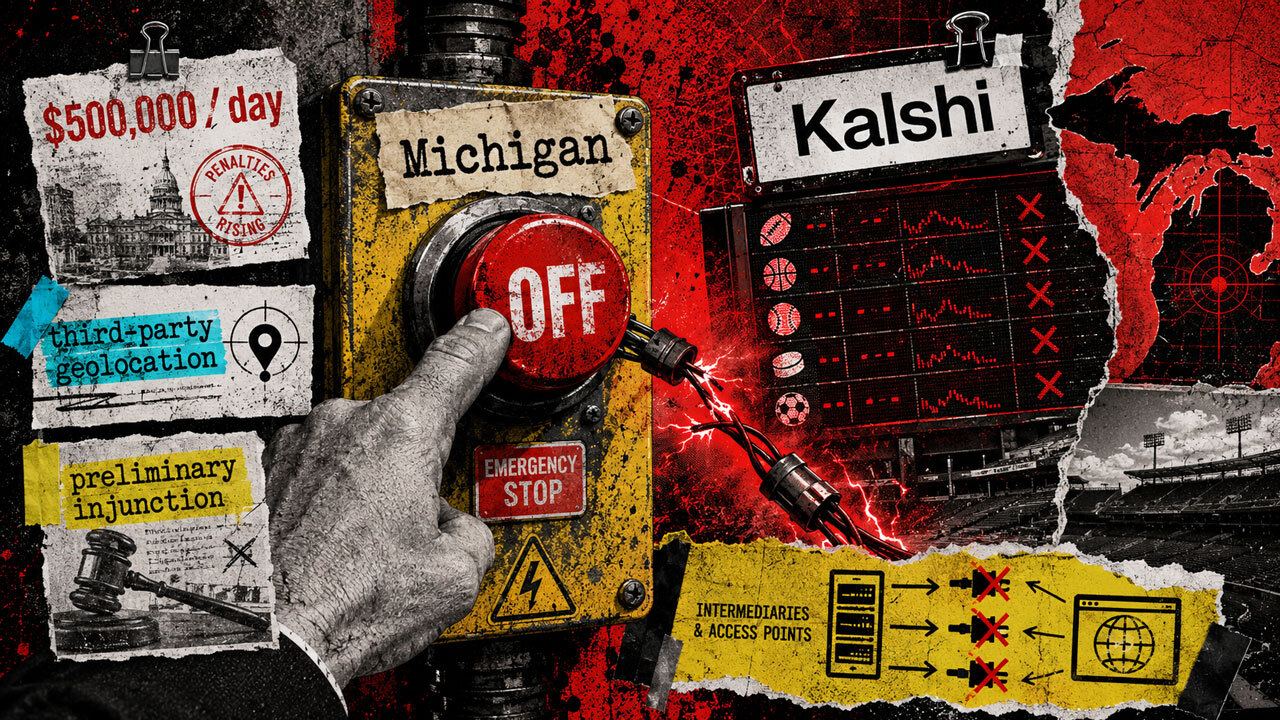
A critical component of the injunction mandates Kalshi’s use of a third-party geolocation provider. This provider must be licensed by the Michigan Gaming Control Board (MGCB) and possess the technical capabilities to enforce the regulator’s stringent geofencing specifications. The financial repercussions for failing to meet this requirement are severe: the order stipulates a daily penalty of $500,000 for each day Kalshi remains in violation. This substantial figure underscores the state’s determination to enforce its regulatory framework.
Furthermore, the injunction extends to intermediaries that grant users access to Kalshi’s platform. Within three business days of the order’s issuance, Kalshi is obligated to furnish a copy of the injunction and the contact details of Michigan’s legal counsel to every futures commission merchant (FCM) that offers Kalshi’s sports event contracts to its clients. Crucially, Kalshi will not be held liable for any subsequent actions or inactions of these FCMs once they have been duly notified.
This preliminary injunction represents a progression from an earlier temporary restraining order (TRO) that was initially issued for a 14-day period. The MGCB had previously announced that the TRO carried a daily noncompliance penalty of $120,000. The preliminary injunction not only elevates the geolocation-specific penalty to $500,000 per day but also maintains its enforceability until a final resolution of the case. While the judge found that Michigan and its residents would suffer immediate and irreparable harm without such relief, based on alleged harms stemming from unlicensed sports products, the ultimate validity of these allegations remains to be determined in subsequent legal proceedings. As of September 2, 2026, reports indicated that Kalshi had not yet issued a public statement regarding this latest ruling.
A Developing National Legal Landscape
It is important to note that Michigan’s injunction is geographically confined to its state borders. It grants Michigan regulatory authority within its jurisdiction for the time being, but it does not resolve the fundamental federal preemption question that forms the bedrock of Kalshi’s defense. Kalshi contends that its operations, as a federally registered market under the Commodity Exchange Act, fall under the exclusive regulatory purview of the Commodity Futures Trading Commission (CFTC).
This federal preemption argument has encountered differing judicial interpretations across the country, contributing to a fragmented legal landscape for prediction markets. In April 2026, the U.S. Court of Appeals for the Third Circuit ruled in favor of Kalshi, finding that the exchange had a reasonable probability of demonstrating that federal law preempts New Jersey’s regulatory efforts. This decision upheld preliminary protections for Kalshi in that jurisdiction.
However, a contrasting outcome emerged on August 28, 2026, when the U.S. Court of Appeals for the Ninth Circuit addressed a similar dispute involving Nevada. In this instance, the Ninth Circuit concluded that Kalshi had not sufficiently demonstrated federal preemption for its sports event contracts, thereby allowing Nevada’s regulatory enforcement to proceed.
The CFTC itself has asserted its exclusive jurisdiction over prediction markets operated on designated contract markets. The ongoing legal schisms between federal and state regulatory interpretations, exemplified by the differing appellate court rulings, create a complex and uncertain environment for operators, regulators, and intermediaries. This situation means that businesses like Kalshi face a patchwork of rules, with compliance requirements varying significantly depending on the specific state or jurisdiction in which they operate.
Background: The Rise of Prediction Markets and Regulatory Scrutiny
Prediction markets, also known as information markets or betting exchanges, allow participants to trade contracts whose payoffs are contingent on the outcome of future events. These events can range from political elections to economic indicators and, increasingly, sporting events. Proponents argue that these markets serve as valuable forecasting tools, aggregating collective wisdom and providing real-time insights into the probability of various outcomes.
Kalshi, established in 2015, has positioned itself as a regulated exchange for event contracts, distinguishing its offerings from traditional gambling. The exchange operates under a license from the CFTC, which oversees derivatives markets in the United States. Kalshi’s business model has focused on providing a platform for users to bet on the likelihood of specific events occurring, including economic news, political outcomes, and, notably, sports results.
The rapid growth and increasing sophistication of prediction markets, particularly those venturing into the realm of sports, have attracted significant attention from state regulators. Many state gaming commissions view these activities as a direct challenge to their established sports betting frameworks, which typically involve stringent licensing requirements, consumer protection measures, and revenue-sharing agreements with the state. The classification of these contracts as either federally regulated financial instruments or state-regulated gambling products is at the heart of the current legal battles.
Michigan’s approach, as demonstrated by the MGCB’s actions, reflects a broader trend of states asserting their authority to regulate any form of betting that occurs within their borders. The state’s argument hinges on the premise that contracts tied to sporting events, regardless of how they are framed, fall under the purview of its legalized sports betting laws. This perspective is supported by the significant revenue generated by regulated sportsbooks and the established regulatory infrastructure designed to protect consumers and ensure market integrity.

The Legal Stalemate and Its Implications
The current legal standoff between Kalshi and states like Michigan highlights a fundamental tension between federal oversight of derivatives markets and state-level authority over gambling. The Commodity Exchange Act, administered by the CFTC, provides a framework for regulating financial futures and options, which Kalshi argues its event contracts fall under. Conversely, states have historically maintained broad powers to regulate gambling activities within their borders, often through specific licensing and taxation regimes.
The differing outcomes in the Third and Ninth Circuit Courts of Appeals underscore the complexity of this jurisdictional battle. The Third Circuit’s inclination towards federal preemption suggests a recognition of the CFTC’s role in regulating novel financial instruments, even those with characteristics that might resemble traditional betting. The Ninth Circuit’s contrasting decision, however, indicates a willingness by some federal courts to defer to state regulatory authority when the economic substance of the transactions appears to align with gambling activities.
The CFTC’s stance, asserting exclusive jurisdiction, further complicates the issue. If the CFTC’s interpretation is ultimately upheld, it could significantly curtail states’ ability to regulate prediction markets that operate under its purview. Conversely, if state regulators prevail, it could lead to a highly fragmented regulatory environment where prediction markets face disparate and potentially conflicting rules across different states.
For Kalshi and other prediction market operators, this legal uncertainty translates into significant operational challenges. The prospect of substantial daily fines, as imposed by the Michigan injunction, creates a powerful incentive to comply with state-specific regulations, even while pursuing federal preemption defenses. The requirement for robust geolocation technology, while a standard practice in the online gambling industry, represents a significant technical and financial undertaking for exchanges that may have previously focused on broader, less geographically restricted markets.
The broader implications extend to consumers and investors. The differing legal interpretations raise questions about consumer protection, market access, and the overall legitimacy of prediction markets. A fragmented regulatory landscape could lead to confusion for users regarding their rights and the legality of their participation in these markets. Furthermore, the lack of a clear, national framework could stifle innovation and investment in the prediction market sector.
As the legal battles continue to unfold, the outcomes of future court cases and any potential legislative actions will be crucial in shaping the future of prediction markets in the United States. The ongoing dispute in Michigan serves as a critical juncture, highlighting the immediate consequences of this regulatory ambiguity and the substantial stakes involved for both market operators and the states seeking to regulate them. The $500,000 daily fine serves as a stark reminder of the financial penalties that can be levied when regulatory boundaries are challenged, pushing the industry towards a more defined and potentially restrictive operational environment.