Nila Kartika Wati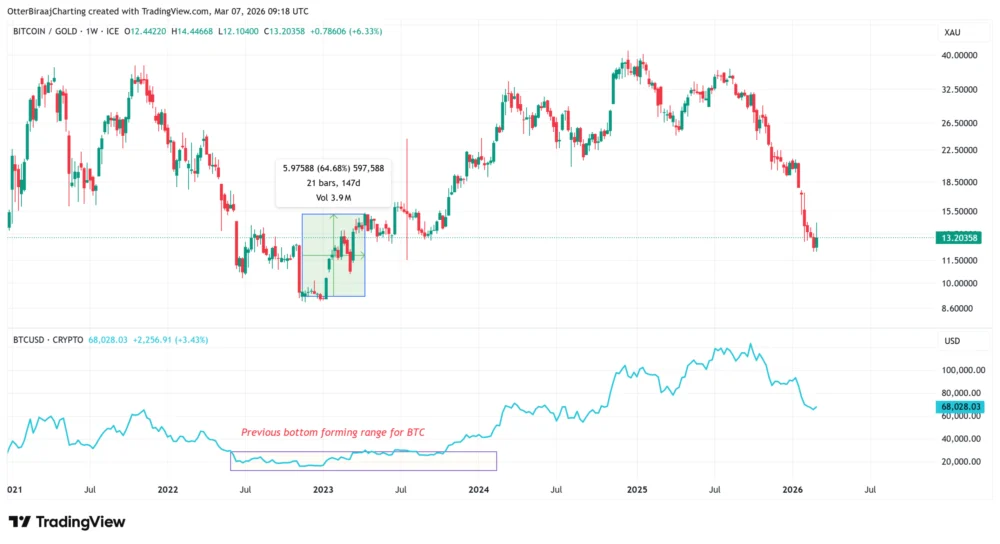
A significant divergence has emerged in the landscape of exchange-traded fund (ETF) investments, with Bitcoin (BTC) ETFs recording net positive flows over the past 30 days, while demand for gold ETFs has notably decelerated following an impressive nine-month streak of inflows. This shift is particularly striking as it occurs despite sustained elevated gold prices and a somewhat subdued sentiment surrounding Bitcoin in recent weeks. Analysts are now closely scrutinizing this contrasting trend, examining various data points that may indicate a gradual, yet profound, re-allocation of investor capital between these two prominent store-of-value assets. The implications of such a rotation could reshape investment strategies and signal evolving confidence in traditional safe havens versus emerging digital alternatives.
Gold’s Dominance Wanes After Historic Rally
For much of 2025 and the early months of 2026, gold commanded considerable investor attention, buoyed by a confluence of macroeconomic and geopolitical factors. The precious metal, long considered a quintessential safe haven, saw its prices surge amidst persistent inflation concerns, escalating global trade tensions, and widespread geopolitical uncertainties, particularly in the Middle East with the ongoing US-Israel and Iran conflict. Central banks worldwide also played a significant role, increasing their gold reserves to diversify away from traditional fiat currencies and hedge against economic volatility. This robust demand translated into a remarkable performance for gold-backed ETFs.
The year 2025 concluded with gold delivering an exceptional 65% return, marking its fourth-largest annual gain since the abandonment of the gold standard, as highlighted by Fidelity Digital Assets analyst Chris Kuiper in their "2026 Look Ahead" report released in December 2025. This momentum carried strongly into the new year, with gold ETFs attracting an impressive $18.7 billion in January 2026 and an additional $5.3 billion in February 2026. This cumulative $24 billion influx represented the strongest two-month start to a year on record for gold ETFs, extending an unbroken nine-month streak of net inflows. This sustained demand underscored a prevailing "risk-off" sentiment among investors, who sought refuge in assets perceived to offer stability during periods of market uncertainty and economic slowdown fears. The consistent accumulation indicated a broad-based conviction in gold’s ability to preserve capital and act as a hedge against inflation and geopolitical turmoil.
The Pivot: A Sudden Reversal in Gold, Bitcoin Gains Traction
The narrative, however, began to shift dramatically in early March 2026. On a pivotal Wednesday, the largest US gold-backed ETF, GLD, experienced a staggering $3 billion outflow, according to data from the Kobeissi Letter. This single-day withdrawal was the most substantial recorded for GLD in over two years, signaling an abrupt reversal in investor sentiment. The substantial outflow coincided with a sharp decline in gold prices, which saw a 4.4% drop—its steepest fall since the significant sell-off observed on January 30, 2026. This sudden retraction suggested that investors, after witnessing gold’s massive rally throughout 2025 and into early 2026, were increasingly opting to take profits, potentially re-evaluating their risk exposure amidst evolving market conditions.
In stark contrast, Bitcoin ETF flows, which had previously experienced periods of significant outflows, began to demonstrate a notable turnaround over the past month. The 30-day net flow for Bitcoin ETFs transitioned from a substantial $1.9 billion outflow recorded on February 6, 2026, to a positive $273 million inflow by March 6, 2026. This marked a critical inflection point, indicating renewed investor interest and a potential stabilization of the market after initial post-launch volatility and profit-taking phases.
The divergence becomes even clearer when examining the holdings data measured in native units rather than their dollar value. For Bitcoin ETFs, balances moved from a net decrease of 42,275 BTC on February 6, 2026, to a net increase of 4,021 BTC by March 6, 2026. This metric, which isolates the actual accumulation or distribution of the underlying asset, provides an undistorted view of investor activity, confirming a genuine increase in Bitcoin holdings within ETF structures. Concurrently, gold ETF holdings saw a sharp decline, falling from 1.4 million ounces to 621,100 ounces during the same one-month period. This stark contrast in native unit accumulation underscores a tangible shift in capital allocation, rather than merely price-driven fluctuations in dollar-denominated fund values.

Understanding the Mechanics: Gold vs. Spot Bitcoin ETFs
To fully appreciate the implications of these flow dynamics, it is crucial to understand the distinct operational mechanisms and market contexts of gold and spot Bitcoin ETFs.
Gold ETFs, such as the prominent GLD, are designed to track the price of gold. They typically hold physical gold bullion in secure vaults or invest in gold futures contracts, providing investors with exposure to the precious metal without the complexities of direct ownership. These funds have existed for decades, offering a highly liquid and regulated avenue for both institutional and retail investors to participate in the gold market. Their long-standing presence and established regulatory frameworks have historically positioned them as a go-to asset for diversification and safe-haven seeking. The recent outflows from GLD, therefore, represent a significant change in established investor behavior, moving away from a historically reliable asset class.
Spot Bitcoin ETFs, on the other hand, are a relatively recent innovation, particularly in the United States, where they gained regulatory approval in January 2024. These ETFs directly hold actual Bitcoin, offering a regulated and easily accessible investment vehicle for mainstream investors who previously faced barriers to entry in the volatile cryptocurrency market. The launch of these ETFs was met with immense anticipation, attracting billions in initial capital as institutional investors and financial advisors could finally allocate to Bitcoin within traditional brokerage accounts. However, the initial period also saw significant outflows, often attributed to profit-taking from early investors, the conversion of Grayscale’s existing trust (GBTC) into an ETF, and a natural rebalancing of portfolios after the initial surge. The recent shift to net positive inflows signals that the market for these new products may be maturing, finding a more stable demand base, and potentially attracting new capital that had been waiting for clarity and stability. This maturation phase is critical for Bitcoin’s broader acceptance as an institutional asset.
Expert Insights and the "Risk-On" Reallocation
The emerging trend has garnered sharp commentary from market strategists. Joe Consorti, Head of Growth at Horizon, succinctly summarized the evolving dynamics: "Gold is stalling out while bitcoin is soaring. BTC is set to overtake gold’s % growth over the last month as the U.S. economy accelerates and risk sentiment improves. The anticipated risk-off -> risk-on rotation could be underway." Consorti’s observation points to a broader macroeconomic shift. A "risk-off" environment typically sees investors flocking to perceived safe havens like gold, government bonds, and the U.S. dollar. Conversely, a "risk-on" environment is characterized by increased investor appetite for riskier assets such as equities, commodities, and, increasingly, cryptocurrencies like Bitcoin, driven by optimism about economic growth, corporate earnings, and innovation.
The perceived acceleration of the U.S. economy, potentially fueled by robust employment data, easing inflation pressures, or a clearer path for interest rate policies from the Federal Reserve, could be a primary catalyst for this shift. As confidence in economic stability grows, the urgency to hold traditional safe havens diminishes, making growth-oriented assets more appealing. This transition reflects a changing calculus for portfolio managers, who may now be comfortable re-allocating capital from assets that performed well during uncertainty to those poised to benefit from an economic expansion.
Chris Kuiper of Fidelity Digital Assets, in his December 2025 "2026 Look Ahead" report, provided a historical perspective that resonates with the current market activity. He noted the cyclical nature of outperformance between gold and Bitcoin, stating, "Historically, gold and bitcoin have taken turns outperforming. With gold shining in 2025, it would not be surprising if bitcoin takes the lead next." Kuiper’s analysis suggests that gold’s stellar performance in 2025 might have positioned it near the late stages of its leadership cycle, paving the way for Bitcoin to assume a dominant role.
His report further elucidated the typical timeline for such rotations. Following Bitcoin’s significant market bottom in 2022, it took approximately 147 days, or 21 weeks, for BTC to establish a sustained trend of outperforming gold. This period served as a consolidation phase before the Bitcoin-to-gold ratio began its upward trajectory. Interestingly, the current BTC-to-gold ratio is observed trading near the same consolidation zone that characterized the earlier rotation phases in 2022-2023. This historical parallel provides a potential roadmap for the unfolding dynamics, suggesting that while the shift is underway, a definitive and sustained outperformance by Bitcoin might still require a period of market adjustment and consolidation.

Broader Implications and Future Outlook
The potential rotation of investor demand from gold to Bitcoin carries significant implications for asset allocation strategies and the evolving definition of a "store of value" in the 21st century.
For Investment Strategy: Institutional and retail investors may begin to recalibrate their portfolios, reducing exposure to gold and increasing allocations to Bitcoin, particularly through the accessible ETF wrapper. This could lead to a more diversified approach to hedging against inflation and geopolitical risks, incorporating both traditional and digital assets. Fund managers who previously viewed Bitcoin with skepticism may find its increasing liquidity, regulatory clarity (via ETFs), and potential for higher growth more compelling in a "risk-on" environment.
The Future of Digital vs. Traditional Assets: This trend reinforces the ongoing debate about Bitcoin’s role as "digital gold." While gold has millennia of history as a store of value, Bitcoin’s fixed supply, decentralized nature, and technological advantages position it as a formidable challenger. The current flow data suggests that a segment of the market is increasingly accepting Bitcoin as a legitimate, perhaps even superior, alternative for capital preservation and growth in specific market conditions. This could accelerate the mainstream adoption of cryptocurrencies beyond speculative trading.
Macroeconomic Environment and Policy: The shift also implicitly reflects investor expectations regarding central bank policies and global economic growth. If investors believe that central banks, like the Federal Reserve, might maintain a more accommodative stance or that global growth prospects are improving, the appeal of yield-bearing or growth-oriented assets typically increases at the expense of non-yielding safe havens. The ongoing global fiscal deficits, trade tensions, and geopolitical uncertainties, however, remain critical background factors. As Kuiper noted, both gold and Bitcoin can ultimately benefit from these persistent macro pressures, as investors seek neutral stores of value outside traditional monetary systems. The recent geopolitical flare-ups, while initially bolstering gold’s appeal, could eventually reinforce Bitcoin’s narrative as a censorship-resistant, borderless asset, especially for those seeking alternatives to state-controlled financial systems.
Long-Term Outperformance: Macroeconomic strategist Lyn Alden further supports the long-term potential for Bitcoin, expecting it to outperform gold over the next two to three years, building on gold’s strong rally in the preceding months. Alden’s perspective often emphasizes Bitcoin’s unique supply scarcity, its global network effects, and its increasing utility in a digital-first economy as fundamental drivers for its long-term appreciation relative to gold. This suggests that while cyclical rotations are natural, the underlying structural advantages of Bitcoin could position it for sustained leadership in the coming years.
While the current data points strongly towards a potential rotation, it is essential to acknowledge that market dynamics are complex and subject to rapid change. The "risk-off" to "risk-on" shift is rarely linear, and unforeseen global events or significant policy changes could quickly alter investor sentiment. However, the clear divergence in ETF flows, particularly the granular data on native unit holdings, provides compelling evidence that a re-evaluation of the traditional gold-Bitcoin dynamic is firmly underway. This period marks a critical juncture for both asset classes, signaling an evolving landscape where digital assets are increasingly asserting their presence within mainstream investment portfolios.
This article does not contain investment advice or recommendations. Every investment and trading move involves risk, and readers should conduct their own research when making a decision. While we strive to provide accurate and timely information, Cointelegraph does not guarantee the accuracy, completeness, or reliability of any information in this article. This article may contain forward-looking statements that are subject to risks and uncertainties. Cointelegraph will not be liable for any loss or damage arising from your reliance on this information.