Nila Kartika Wati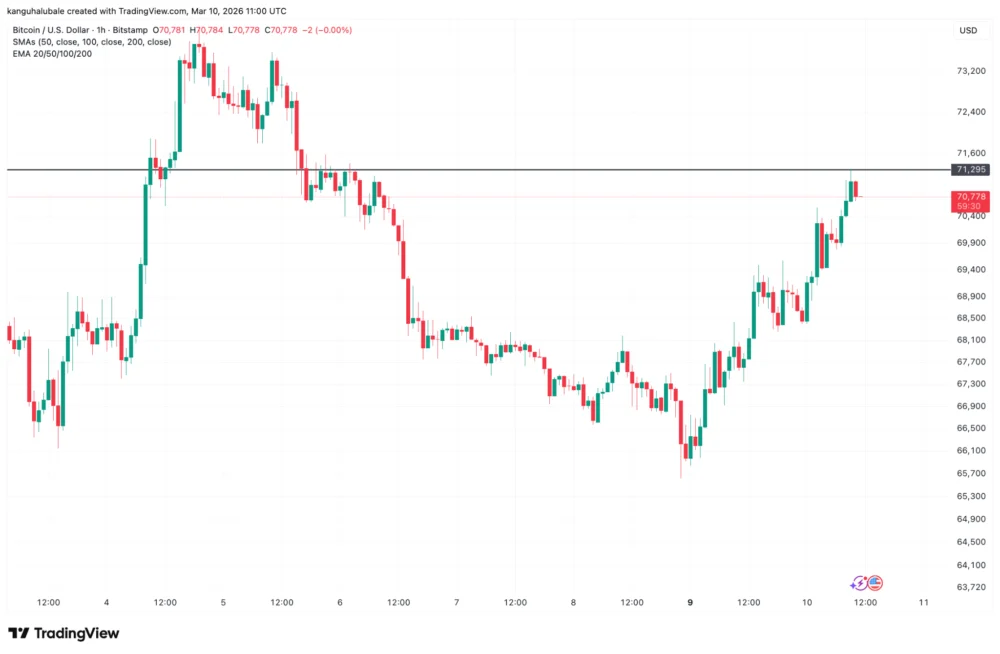
Bitcoin (BTC) experienced a significant price surge on Tuesday, liquidating substantial short positions across the market as participants reacted to evolving geopolitical narratives, specifically comments from former U.S. President Donald Trump concerning the Iran war. This upward momentum, which saw BTC’s price climb above the critical $70,000 threshold, was further bolstered by strong institutional demand flowing into spot Bitcoin Exchange-Traded Funds (ETFs) and strengthening technical indicators, signaling renewed buyer activity in the cryptocurrency market.
The immediate catalyst for Tuesday’s price action appeared to be a shift in broader market sentiment influenced by geopolitical developments. While the direct causal link between specific political statements and cryptocurrency movements can be complex and multi-faceted, market participants often interpret comments from influential figures regarding international conflicts as signals for global economic stability. In this instance, reports indicated that President Trump’s remarks on the Iran war, likely interpreted as de-escalatory or clarifying, contributed to a reduction in perceived geopolitical risk. This sentiment shift can encourage a "risk-on" environment where assets traditionally seen as more volatile, like Bitcoin, can attract capital. Simultaneously, as noted by market observers, confusion surrounding the Iran situation had previously sent oil prices tumbling, suggesting a broader re-evaluation of risk premiums across various asset classes, with crypto ultimately posting modest gains.
The Dynamics of a Short Squeeze: $186 Million Liquidated

The most immediate and dramatic effect of this upward movement was a significant "short squeeze." A short position in financial markets is a bet that an asset’s price will fall. Traders "short" an asset by borrowing it, selling it at the current price, and hoping to buy it back later at a lower price to return it to the lender, profiting from the difference. A "liquidation" occurs when the price moves against a short seller to such an extent that their collateral is insufficient to cover potential losses, forcing their brokerage or exchange to automatically close their position to prevent further losses. This forced buying can further accelerate price increases, creating a cascading effect known as a short squeeze.
On Tuesday, this dynamic played out vividly in the Bitcoin market. Data revealed that BTC’s price action liquidated a staggering $186 million in short positions within a 24-hour period. This substantial figure underscores the rapid and forceful nature of the price increase, catching many bearish traders off guard. Analysts at CryptoReviewing highlighted this event, stating in a post on X, "$BTC pumped above $70,000 yesterday, liquidating $186M shorts in the past 24 hours!" This sudden influx of buying pressure from forced liquidations contributed significantly to Bitcoin’s rally, propelling its value upwards and reinforcing the bullish sentiment that had begun to emerge. At its peak on Tuesday, BTC/USD was hovering around $70,780 on Bitstamp, marking a robust 4.5% gain over the preceding 24 hours.
Navigating the Technical Landscape: Liquidity Clusters and Price Targets
Beyond the immediate impact of short liquidations, market analysts are closely scrutinizing Bitcoin’s technical landscape, particularly the formation of "liquidity clusters." These clusters represent areas on the price chart where a high volume of buy or sell orders are concentrated, often corresponding to significant support or resistance levels. They essentially act as magnets for price action, as markets tend to move towards areas where liquidity can be efficiently "swept" or absorbed.

According to data from TradingView and analysis by platforms like CoinGlass, the current market structure presents a fascinating setup. Following the recovery and short liquidations, orders are now stacked both above and below the current spot price, setting the stage for the next major liquidity grab.
The liquidation heatmap, a visual representation of these order clusters, indicates that the supply zone between $70,000 and $72,000 currently exhibits thinner liquidity. This characteristic suggests that if bullish momentum persists, this zone could be relatively easily "swept" – meaning the price could pass through it with less resistance, potentially paving the way for a move towards the next significant cluster of liquidations situated between $74,000 and $75,000. This higher range represents a major resistance point where many short positions have been established, and a breach could trigger another wave of liquidations, further fueling an upward trend.
However, the analysis is not entirely one-sided. Analysts also pointed out the presence of "bigger clusters below" the current price, specifically in the range of $64,000 to $68,000. These lower clusters collectively hold approximately four times more liquidity than the immediate supply zone above, making them a significant target for potential downward price movements if buying pressure wanes. "Meanwhile, below at $64,000-$68,000 we have large liquidity clusters, totalling roughly 4x more liquidity, making this the ‘more likely’ zone to visit next from a liquidity perspective," CryptoReviewing analysts noted, while simultaneously acknowledging the recent bullish pressure: "Bulls just applied the pressure."
Zooming out to a weekly timeframe, CoinGlass’s liquidation heatmap further highlighted the "largest short liquidation cluster" residing higher up, precisely between $74,000 and $75,000. This weekly perspective suggests that a sustained push towards this range could unlock a significant cascade of short liquidations, potentially paving the way for a more substantial rally over the medium term. The interplay between these immediate and longer-term liquidity zones will dictate Bitcoin’s price trajectory in the coming days and weeks.

Positive Recovery Signals: RSI and Spot Volume Indicate Strengthening Momentum
Beyond the immediate price action and liquidation data, several fundamental and technical indicators are flashing "positive" recovery signals for Bitcoin. One such key indicator is the 14-day Relative Strength Index (RSI). The RSI is a momentum oscillator that measures the speed and change of price movements. It ranges from 0 to 100, with readings below 30 typically indicating an asset is oversold and readings above 70 suggesting it is overbought.
According to data from Glassnode, Bitcoin’s 14-day RSI has shown a notable improvement over the past week. It rose from a low of 30 on March 1st to 52 on Tuesday. This upward trajectory from deeply oversold territory towards the neutral 50-mark is significant. Glassnode, in its latest Weekly Market Pulse report, interpreted this rising RSI as "signaling a modest improvement in BTC momentum" and further noted that "the move higher points to high buyer activity." This shift suggests that the selling pressure that previously pushed Bitcoin into oversold conditions has receded, making way for renewed buying interest and a healthier, more balanced market.
Accompanying the strengthening RSI, spot demand for Bitcoin has also seen a robust resurgence. Trading volume, a crucial metric for gauging market activity and conviction, has soared. At the time of writing, Bitcoin’s spot trading volume had risen to $9.3 billion, a remarkable increase from just $3.38 billion recorded on Saturday. This represents a more than 140% surge in trading activity, indicating a significant return of both retail and institutional participants to the market. Higher trading volumes during a price rally generally lend more credibility to the upward movement, suggesting it is supported by genuine market interest rather than thin trading or speculative moves.

The Institutional Imperative: Spot Bitcoin ETFs Drive Demand
Perhaps the most compelling narrative driving Bitcoin’s current strength is the sustained and accelerating institutional demand, primarily channeled through spot Bitcoin Exchange-Traded Funds (ETFs). The approval of these ETFs earlier in the year marked a pivotal moment for the cryptocurrency market, providing traditional finance investors with a regulated and easily accessible vehicle to gain exposure to Bitcoin without directly holding the asset.
The impact of these ETFs continues to be a major tailwind for Bitcoin. Glassnode data highlights that net inflows into spot Bitcoin ETFs have accelerated, reaching an impressive $934 million. Concurrently, the trading volumes for these investment products have also seen a substantial increase, rising to $23.1 billion from $16 billion just last week. This consistent influx of capital and heightened trading activity underscores the growing appetite from traditional financial institutions and sophisticated investors. Glassnode further elaborated that the strength of these inflows "points to sustained institutional demand and continued traditional finance engagement," reinforcing the view that Bitcoin is increasingly being integrated into mainstream investment portfolios.
The demand for spot ETFs continued strongly at the start of the week. On Monday alone, these investment products attracted $167 million in net inflows. When considering global Bitcoin investment products, the total net inflows logged an even more significant $521 million, collectively contributing to Bitcoin’s impressive upside momentum. This consistent buying pressure from institutional channels provides a robust foundation for Bitcoin’s price stability and growth, differentiating the current rally from previous cycles that were often driven more by retail speculation. Crypto investor and analyst CW8900 further corroborated this trend, observing "net buying" across all major exchanges, which he characterized as a "positive signal of actual buying demand." This comprehensive buying across various platforms, both centralized and via ETFs, paints a picture of broad-based market confidence.

Capital Rotation: Bitcoin vs. Gold – A Shifting Paradigm?
A fascinating parallel trend emerging in the broader financial landscape is the apparent rotation of capital from traditional safe-haven assets, particularly gold, into Bitcoin. As Cointelegraph previously reported, Bitcoin ETFs have consistently recorded net positive inflows over the past 30 days, while gold ETFs simultaneously experienced record outflows during the same period. This divergence suggests a potential paradigm shift in how some investors perceive and allocate capital for inflation hedging and store-of-value purposes.
Historically, gold has been the quintessential safe-haven asset, prized for its ability to preserve wealth during economic uncertainty and inflationary periods. However, Bitcoin has increasingly been dubbed "digital gold" by proponents who argue it possesses similar, if not superior, characteristics in the digital age. Its decentralized nature, limited supply cap (21 million coins), and resistance to censorship make it an attractive alternative for a new generation of investors and institutions. The accelerating outflows from gold ETFs juxtaposed with the surging inflows into Bitcoin ETFs could signal that a portion of institutional and sophisticated capital is re-evaluating these two assets. Investors might be increasingly viewing Bitcoin as a more technologically advanced, liquid, and potentially higher-growth alternative to gold in an increasingly digital and globalized economy. This capital rotation, if it continues, could have profound long-term implications for both asset classes, solidifying Bitcoin’s role as a legitimate, albeit volatile, contender in the safe-haven and store-of-value narrative.
Market Outlook and Future Implications

The recent price surge, fueled by geopolitical reactions, substantial short liquidations, and robust institutional inflows, paints a complex but largely bullish picture for Bitcoin in the short to medium term. The market is currently at a crucial juncture, with significant liquidity clusters both above and below the current price. While the immediate path of least resistance appears to be upwards, targeting the $74,000-$75,000 range where the largest weekly short liquidation cluster resides, the presence of substantial liquidity at lower levels ($64,000-$68,000) suggests that a pullback cannot be entirely ruled out.
The strengthening technical indicators, such as the rising RSI and surging spot trading volumes, coupled with the unwavering institutional demand via spot ETFs, provide a solid foundation for continued optimism. These factors collectively indicate a healthy market with genuine buying interest, moving beyond purely speculative retail-driven pumps. The narrative of capital rotation from gold into Bitcoin further underscores a fundamental shift in investment strategies, potentially positioning Bitcoin as a more mainstream and resilient asset in diversified portfolios.
However, investors must remain vigilant. The cryptocurrency market is inherently volatile, and external factors, including further geopolitical developments or shifts in regulatory sentiment, can rapidly influence price action. While the "bulls just applied the pressure," as noted by analysts, the path forward will likely involve navigating these critical liquidity zones. A sustained breakout above the $72,000 level would strongly reinforce the bullish case, while a failure to hold current support could see a retest of lower demand zones. Regardless of the immediate price fluctuations, the underlying trend of institutional adoption and increasing market maturity appears firmly in place, signaling a potentially transformative period for Bitcoin.
This article does not contain investment advice or recommendations. Every investment and trading move involves risk, and readers should conduct their own research when making a decision. While we strive to provide accurate and timely information, Cointelegraph does not guarantee the accuracy, completeness, or reliability of any information in this article. This article may contain forward-looking statements that are subject to risks and uncertainties. Cointelegraph will not be liable for any loss or damage arising from your reliance on this information.