James Watt
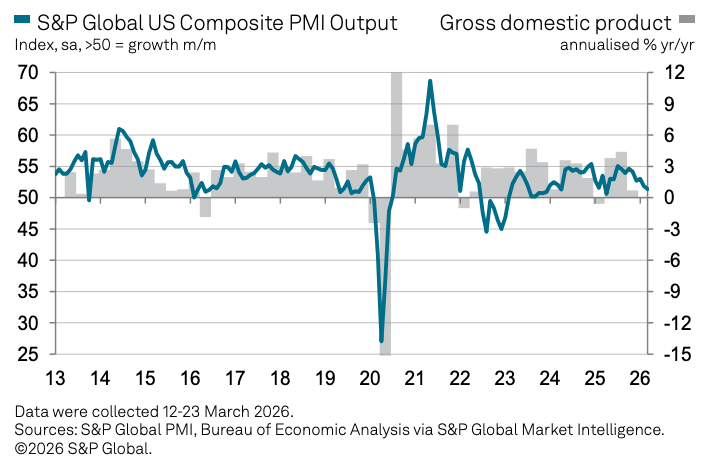
The latest data from S&P Global suggests that while the US economy remains in expansion territory—defined by any reading above 50.0—the momentum is visibly fading. The services sector, the primary engine of American economic growth, saw its activity index drop to 51.1, down from 51.7 in the previous month. Conversely, the manufacturing sector showed a surprising uptick to 52.4, but analysts warn that this growth may be driven by defensive inventory building rather than genuine consumer demand. For Bitcoin, which has thrived on the narrative of easing financial conditions and a "soft landing" for the US economy, this pivot toward a stagflationary environment presents a significant fundamental headwind.
Understanding the PMI Data and the Stagflation Signal
The Purchasing Managers’ Index (PMI) is a critical leading indicator of economic health, providing an early look at business conditions before official government statistics are released. The March report highlighted a growing divergence between different sectors of the economy. While the manufacturing sector reached a 21-month high in output, the underlying reasons for this surge are cause for concern. Companies reported lengthening supplier delivery times and a sharp increase in input costs, which reached their highest levels in ten months.
Stagflation occurs when economic growth slows, unemployment rises, and inflation remains high. The March PMI report touched on all three pillars of this phenomenon. Business activity slowed, employment in the private sector fell for the first time in over a year, and price pressures accelerated. S&P Global noted that the survey is consistent with an annualized GDP growth rate of approximately 1.0%, while the trajectory of input prices suggests that inflation could settle near the 4% mark—well above the Federal Reserve’s 2% target.

For the cryptocurrency market, this data is particularly toxic. Bitcoin is frequently traded as a proxy for global liquidity. When inflation remains "sticky" despite a slowing economy, the Federal Reserve loses the flexibility to cut interest rates. Higher interest rates increase the "opportunity cost" of holding non-yielding assets like Bitcoin and strengthen the US Dollar, creating a dual-pronged pressure on crypto valuations.
Chronology of the Economic Shift
The road to the current stagflation scare has been paved by several months of conflicting economic signals. To understand the gravity of the March PMI report, it is necessary to look at the timeline of events leading up to this shift:
- January 2026: Markets began the year with high optimism, pricing in as many as six interest rate cuts for the year. Bitcoin rallied on the expectation of a rapid return to "cheap money."
- February 2026: Consumer Price Index (CPI) and Producer Price Index (PPI) data came in hotter than expected. The Federal Reserve signaled a "wait and see" approach, and Bitcoin’s volatility increased as the "higher for longer" narrative gained traction.
- Early March 2026: Geopolitical tensions escalated significantly, specifically involving conflict in the Middle East and concerns regarding Iran. Crude oil prices surged, adding immediate pressure to global supply chains and energy costs.
- March 24, 2026: The release of the S&P Global Flash PMI confirmed the worst fears of the market. The data showed that the manufacturing "rebound" was largely a reaction to supply chain fears, while the services sector—and by extension, the consumer—was beginning to buckle under the weight of high costs.
The Divergence Between Manufacturing and Services
A deeper dive into the PMI sub-indices reveals why the market reacted so poorly to seemingly positive manufacturing numbers. The rise in manufacturing output to 52.4 was accompanied by a concerning trend: companies were increasing their purchases and stockpiling inventories not because of a surge in orders, but as a hedge against future supply disruptions and rising energy prices.
In the services sector, which accounts for more than two-thirds of the US economy, the outlook was significantly grimmer. New business growth slowed, and export orders for services declined. Service providers cited the high cost of living and elevated borrowing costs as the primary deterrents for consumer spending. Most importantly, the drop in service sector confidence reached its lowest point in several months, reflecting a growing belief among business owners that the economic environment is becoming increasingly hostile.

This "split economy" creates a dilemma for the Federal Reserve. If they cut rates to support the slowing services sector and prevent a rise in unemployment, they risk fueling the inflationary fire in the manufacturing and energy sectors. If they keep rates high to combat inflation, they risk pushing the economy into a deep recession. This uncertainty is what drove Bitcoin down from its $70,000 peak, as traders moved toward the safety of the US Dollar and Treasury yields.
Market Reactions and Institutional Perspectives
The immediate reaction to the PMI release was felt across all asset classes. The US Dollar Index (DXY) remained firm, reflecting its status as a safe-haven asset during times of economic uncertainty. Treasury yields moved higher as bond traders adjusted their expectations, now anticipating fewer rate cuts in the second half of the year.
In the cryptocurrency space, the reaction was swift. Bitcoin, which had been consolidating near all-time highs, faced a wave of liquidations as it dipped below $70,000. Institutional analysts have noted that the "macro-correlation" of Bitcoin remains high. While Bitcoin is often touted as "digital gold," it currently behaves more like a high-beta technology stock. When the "risk-free rate" (the yield on government bonds) rises, the discounted future value of Bitcoin decreases in the eyes of institutional portfolio managers.
Industry experts suggest that the "Iran war" factor mentioned in the report has introduced a new layer of complexity. Rising energy costs act as a hidden tax on both businesses and consumers. If oil prices continue to remain elevated, the inflationary component of stagflation becomes much harder to break, potentially pinning Bitcoin in a bearish or sideways range for an extended period.

Implications for Bitcoin’s Role as an Inflation Hedge
The re-emergence of stagflation fears puts the "inflation hedge" narrative for Bitcoin to the ultimate test. Historically, proponents have argued that Bitcoin’s fixed supply makes it the ideal protection against the devaluation of fiat currency. However, the current environment is not just one of inflation, but of stagflation.
In a standard inflationary environment where the economy is growing, Bitcoin tends to perform well because there is excess liquidity in the system. In a stagflationary environment, liquidity dries up because growth is stagnant, yet prices remain high. This forces the Federal Reserve to maintain a restrictive stance, which is generally negative for Bitcoin.
There is a secondary school of thought among crypto bulls: if the Federal Reserve is eventually forced to print money to save a collapsing economy despite high inflation, the resulting loss of confidence in the US Dollar could trigger a massive rally in Bitcoin. However, the March PMI data suggests we are not yet at that "breaking point." Instead, we are in a period of grinding economic slowdown where the Fed remains committed to its hawkish stance.
Future Outlook and Key Indicators to Watch
As the market digests the implications of the March PMI, attention now shifts to upcoming data releases that will confirm or refute the stagflation narrative. The following indicators will be crucial for Bitcoin’s price action in the coming weeks:
- Personal Consumption Expenditures (PCE) Index: As the Federal Reserve’s preferred inflation metric, a higher-than-expected PCE reading would solidify the "higher for longer" interest rate path, likely putting further downward pressure on Bitcoin.
- Non-Farm Payrolls (NFP): The PMI report showed the first drop in private-sector employment in over a year. If the official NFP data confirms a cooling labor market, the "stag" part of stagflation becomes a reality, increasing the risk of a broader market sell-off.
- Energy Prices and Geopolitical Developments: Given the sensitivity of the manufacturing sector to input costs, any further escalation in global conflicts that impacts oil supply will be viewed as a direct threat to the crypto market recovery.
The current macro backdrop is arguably the most complex Bitcoin has faced since its inception. While previous bull markets were fueled by quantitative easing and low interest rates, the current cycle is being tested by a Federal Reserve that is actively fighting to cool the economy. For Bitcoin to regain its momentum and break back above $70,000, it will likely need to see a cooling of inflation data that allows the market to once again dream of a return to a more accommodative monetary policy. Until then, the shadow of stagflation remains the primary hurdle for the world’s largest cryptocurrency.