
 James Watt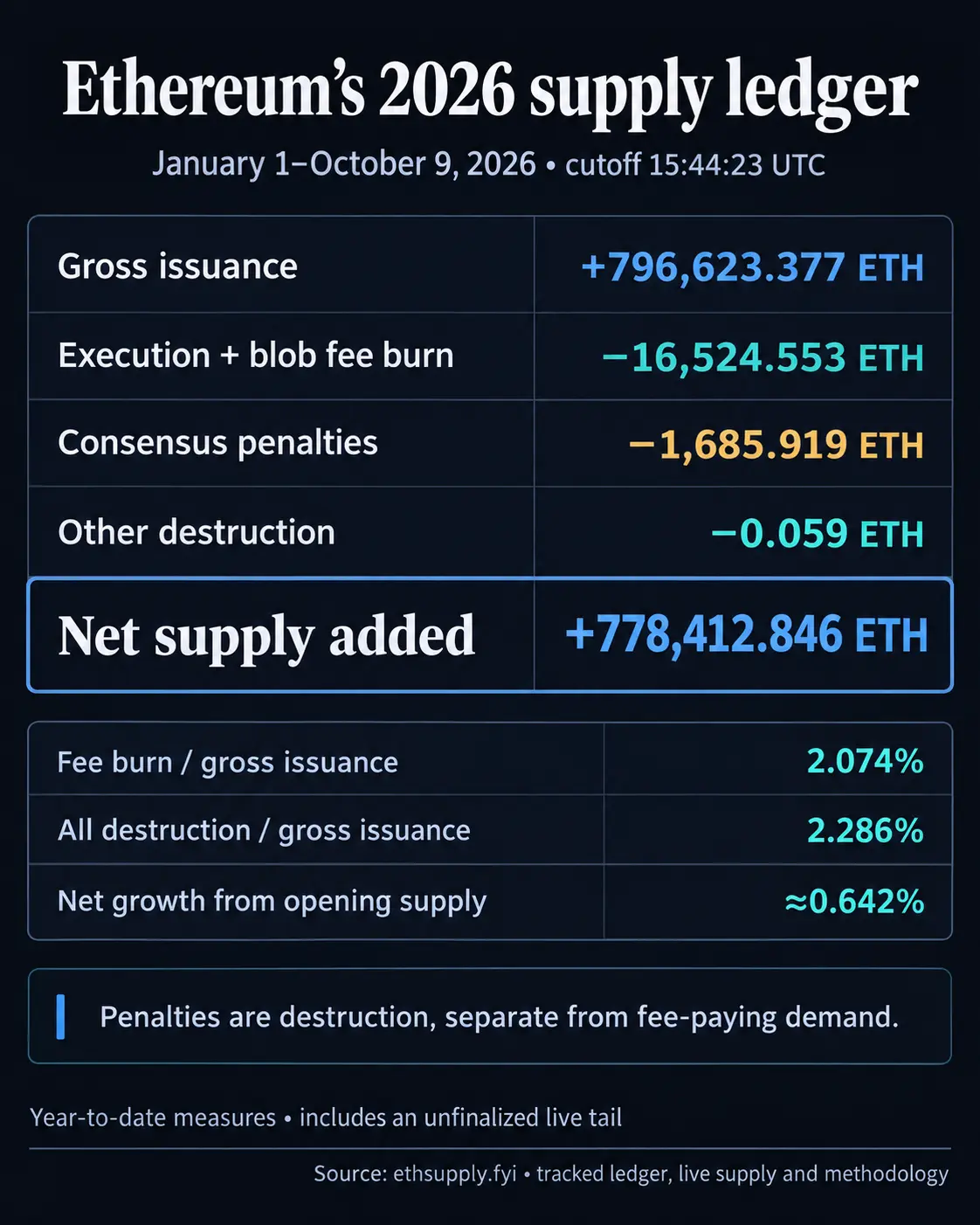
The Ethereum network has experienced a significant shift in its monetary policy and supply dynamics throughout 2026, with transaction fees burning only a small fraction of the new coins issued to validators. According to a supply ledger finalized on October 9, 2026, the burning of Ether (ETH) via transaction fees has offset just 2.07% of the total new issuance for the year. This data highlights a growing gap between the "ultrasound money" narrative—which posits that Ethereum’s supply would consistently shrink—and the practical reality of a network prioritizing scalability and lower user costs over immediate deflation.
After accounting for fee burns, validator penalties, and other forms of token destruction, the Ethereum network has added approximately 778,413 ETH to its total supply since the beginning of the year. This represents a net supply increase of approximately 0.64% from the window’s opening level on January 1. As developers move toward the "Glamsterdam" upgrade and a conditional 200 million gas limit goal, the economic hurdles for achieving a deflationary state are becoming increasingly steep.
Detailed Analysis of the 2026 Supply Ledger
The comprehensive ledger, tracked by ethsupply.fyi, covers the period from January 1, 2026, at 00:00:11 UTC through October 9, 2026, at 15:44:23 UTC. During this nearly ten-month window, the network generated 796,623.377 ETH in gross issuance. This issuance primarily comprises rewards paid to the global set of validators for securing the Proof of Stake (PoS) consensus mechanism.
In contrast, the destruction of ETH through the execution layer and "blob" transaction fees—introduced in earlier upgrades to facilitate Layer-2 scaling—totaled only 16,524.553 ETH. When additional forms of destruction are included, such as 1,685.919 ETH removed through consensus penalties (slashing and offline penalties) and a negligible 0.059 ETH from other execution-related destruction, the total amount of ETH removed from circulation reaches 18,210.531 ETH.
This discrepancy results in a net addition of 778,412.846 ETH to the circulating supply. The data reveals that while total destruction offsets approximately 2.286% of issuance, the specific "fee-burn" component—which represents actual user demand for network block space—is responsible for only 2.074% of the offset. Analysts note that treating consensus penalties as part of user-driven demand would overstate the degree to which network activity is counteracting inflation.
The Scaling Paradox: Gas Limits and the Burn Threshold
A central tension in Ethereum’s current development roadmap is the push for a higher gas limit. The gas limit dictates the maximum amount of computational work that can be included in a single block. Currently, the network operates with a 60 million gas limit, but developers are actively pursuing a conditional target of 200 million gas following the Glamsterdam upgrade.
The economic implication of a larger gas limit is profound for ETH holders. A higher limit allows the network to spread the necessary fee spending across a much larger volume of transactions. While this lowers the individual cost for users—a primary goal for mass adoption—it simultaneously lowers the "base fee" required to reach a deflationary threshold.
Based on current finalized accounting samples, the execution base fee required to offset gross issuance is approximately 13.85 gwei under the current 60 million gas limit. However, if the limit is expanded to 200 million gas, the required base fee drops to just 4.16 gwei to achieve the same total burn. In both scenarios, the network would need to burn roughly 2,992 ETH daily to reach a "net-zero" supply growth state.
The paradox lies in the fact that an unused increase in capacity does not burn ETH. For the 200 million gas target to result in a supply reduction, the network must see a massive and sustained increase in transaction volume that utilizes that new capacity. If transaction counts remain steady while the gas limit increases, the base fee will naturally drift lower, further reducing the total amount of ETH burned.
Chronology of Ethereum’s Economic Evolution
The current supply situation is the result of several years of iterative protocol changes. To understand the 2026 ledger, one must look at the sequence of upgrades that defined Ethereum’s monetary policy:
- EIP-1559 (August 2021): The "London" upgrade introduced the fee-burning mechanism. Instead of all fees going to miners (and later validators), a "base fee" was burned, making ETH potentially deflationary during periods of high demand.
- The Merge (September 2022): Ethereum transitioned from Proof of Work to Proof of Stake, reducing gross issuance by approximately 90%. This was the primary catalyst for the "ultrasound money" thesis.
- The Dencun Upgrade (March 2024): Introduced "blobs," a dedicated space for Layer-2 data that significantly reduced the cost of transacting on rollups. This move shifted a large portion of activity away from the Ethereum Mainnet (Layer 1), leading to a noticeable drop in the L1 burn rate.
- The Glamsterdam Upgrade (2026): The current focus of the Ethereum Foundation and core developers. This upgrade aims to implement Proposer-Builder Separation (PBS) and block-level access lists to support the 200 million gas limit.
The Sepolia testnet for Glamsterdam was activated on October 6, 2026, marking a critical milestone in the rollout. However, mainnet activation remains undecided as developers monitor the performance of the new gas accounting rules.
Technical Mechanics of Issuance and Destruction
The ethsupply.fyi methodology distinguishes between several layers of ETH movement. Newly created validator rewards are categorized as gross issuance. This is offset by:
- Execution Base Fees: The mandatory fee for L1 transactions.
- Blob Fees: The cost for Layer-2 networks to post data to Ethereum.
- Penalties: ETH taken from validators for malicious behavior or downtime.
- Rare Destruction: Methods such as the
SELFDESTRUCTopcode.
Crucially, "priority fees" paid by users to have their transactions processed faster do not contribute to the burn; these are paid directly to block producers (validators). Similarly, Maximal Extractable Value (MEV) payments and application-level revenues do not result in protocol-level ETH destruction.
As of October 9, 2026, there are approximately 122.116 million ETH in total supply. Given the 0.64% increase observed this year, the supply at the start of 2026 was approximately 121.338 million ETH. The current active effective stake stands at 43.754 million ETH across 853,325 active validators. Because issuance is mathematically linked to the total amount of ETH staked, the "burn threshold" is a moving target. As more ETH is staked for security, the gross issuance rises, requiring a higher base fee or more transaction volume to maintain a neutral supply.
Perspectives from the Ethereum Foundation and Stakeholders
While some investors have expressed concern over the return to an inflationary supply, the Ethereum Foundation and core research teams have consistently prioritized network utility. In communications surrounding the Glamsterdam upgrade, the Foundation has characterized the 200 million gas target as a "credible scenario" for a post-scaling world.
Developers argue that the primary value proposition of Ethereum is its role as a settlement layer for a global financial system. From this perspective, low and predictable fees are more important than a shrinking supply. If the network becomes too expensive to use, activity will migrate to competing chains, ultimately reducing the long-term demand for ETH as a reserve asset.
However, the "holders’ hurdle" remains a point of contention. For those who view ETH as a store of value, the lack of supply scarcity in 2026 represents a shift in the investment thesis. Market analysts suggest that the market is currently "pricing in" the utility of the network rather than the scarcity of the token.
Broader Impact and Future Implications
The transition of Ethereum from a deflationary asset back to a mildly inflationary one has several implications for the broader cryptocurrency ecosystem:
1. Layer-2 Dominance: The data confirms that Layer-2 solutions (like Arbitrum, Optimism, and Base) are successfully absorbing user activity. While this is a win for scalability, it hollows out the fee revenue of the Layer 1. The long-term economic sustainability of the L1 now depends on L2s paying enough in "blob fees" to compensate for the lost execution fees.
2. Staking Yields: With supply increasing, the "real yield" for stakers (nominal yield minus inflation) is lower than it was in 2023 or 2024. This may eventually lead to a plateau in the amount of ETH staked, as the opportunity cost of locking up capital increases.
3. Competitive Positioning: Ethereum’s 0.64% inflation rate remains significantly lower than that of many other Layer-1 blockchains. For example, networks with high validator incentives often see annual supply growth of 5% to 8%. Ethereum’s current state is more akin to a "low-inflation" asset than a "high-inflation" one.
4. The Glamsterdam Benchmark: The success of the 200 million gas push will be the defining metric for 2027. If the upgrade goes live and transaction volume fails to scale alongside capacity, the supply growth rate could accelerate. Conversely, if Glamsterdam triggers a new wave of on-chain applications, the network could return to a deflationary state despite the higher gas limit.
In conclusion, the October 2026 ledger serves as a reality check for the Ethereum community. While the network continues to lead in decentralization and security, its economic engine is currently optimized for growth and capacity rather than supply contraction. For the "ultrasound money" vision to return, the massive increase in capacity provided by Glamsterdam must be met with an equally massive surge in global demand for Ethereum block space.








