Nila Kartika Wati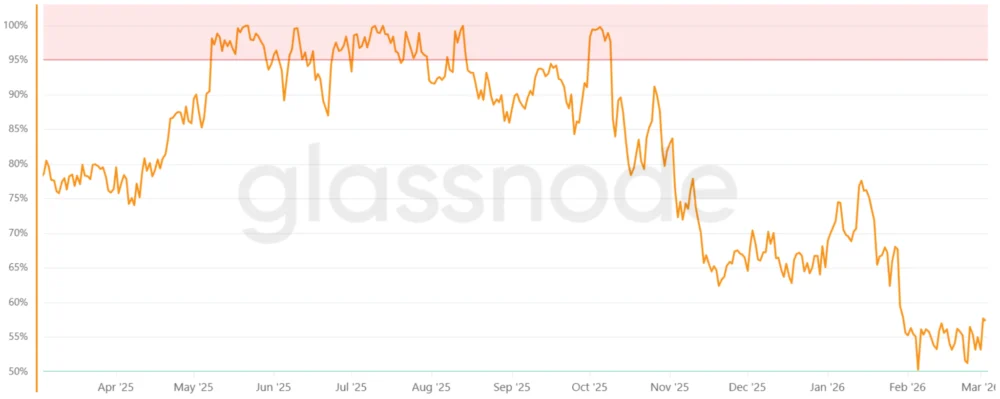
Bitcoin (BTC) has recently demonstrated a notable resurgence, climbing to a four-week high on Wednesday and potentially setting the stage for a recovery towards its January monthly close of $78,700. This upward trajectory marks a significant 22% rally from the local bottom of $60,000 recorded on February 6. However, beneath this veneer of recovery, a closer examination of various on-chain and derivatives metrics suggests a persistent comfort among bearish market participants, indicating that the path to sustained gains may be fraught with challenges. The current market environment is characterized by a complex interplay of price momentum, cautious institutional positioning, and evolving dynamics within the Bitcoin mining sector, all contributing to a nuanced and somewhat contradictory outlook.
The recent price action follows a period of intense volatility and consolidation. After reaching peaks near $95,000 in mid-January, Bitcoin experienced a sharp downturn, crashing by an estimated 32% during the first week of February. This dramatic correction saw the digital asset retest crucial support levels before finding a floor around $60,000. The subsequent rally has been interpreted by some as a healthy recovery, yet the underlying sentiment, as revealed by market indicators, paints a picture of lingering apprehension rather than unbridled optimism. This cautious mood is particularly notable given the asset’s historical propensity for rapid upward movements once significant resistance levels are overcome.
Deep Dive into Derivatives Market Skepticism
A critical indicator of market sentiment, particularly among professional traders, can be found in the derivatives market, specifically Bitcoin options. Despite the recent price surge, demand for downside protection through Bitcoin options continues to dominate the market. This is evident in the 30-day options skew (put-call ratio) at Deribit, which recently showed put (sell) options trading at a substantial 10% premium relative to equivalent call (buy) instruments. In a market considered neutral or balanced, this indicator typically fluctuates within a range of -6% to 6%. The last time such a neutral range was observed was in mid-January, a period when Bitcoin was trading significantly higher, near $95,000. The current elevated put premium suggests that a substantial portion of the market, particularly institutional and professional traders, harbors a strong fear of further downside price action, actively hedging against potential declines rather than aggressively betting on continued gains. This pronounced skew indicates a preference for capital preservation over speculative bullish positioning, a stark contrast to the exuberance often seen during previous bull runs.

Further reinforcing this cautious outlook is the stagnant demand for bullish BTC futures. The annualized premium, or basis rate, for Bitcoin futures currently sits below the neutral 5% threshold. The basis rate measures the difference between the price of futures contracts and the spot price of the underlying asset. A healthy, positive basis rate, typically above 5% annualized, signals robust demand for long positions, indicating that traders are willing to pay a premium for future exposure, often seen in strong bull markets. The current sub-5% reading suggests a lack of conviction from bulls, implying that while some short-term gains are being captured, there isn’t widespread belief in a sustained upward trend. This weakness in Bitcoin derivatives reflects the month-long consolidation that followed the sharp February crash, but the continued lack of strong bullish conviction, even as prices move above the $73,000 mark, points to a deeper, underlying hesitation that could cap further price appreciation.
On-Chain Data Reveals Supply-Side Pressures
Beyond the derivatives market, on-chain data offers valuable insights into the behavior and positioning of actual Bitcoin holders. A significant source of this market’s cautious mood likely stems from the fact that a substantial portion of the circulating supply is still held at a loss. According to data from Glassnode, an analytics firm specializing in blockchain data, approximately 43% of the Bitcoin supply is currently held at a loss based on the price at which those coins last moved. This figure represents a notable increase from the 30% observed when Bitcoin traded at $90,000 in late January.
This metric is crucial because it highlights potential overhead sell pressure. Traders and analysts fear that investors who are currently "underwater" – holding Bitcoin purchased at higher prices – will gradually exit their positions as the price recovers, aiming to break even or minimize further losses. This behavior can create a consistent supply of sell orders, effectively acting as a ceiling for price increases and making it more challenging for Bitcoin to sustain strong rallies. Each upward movement might be met with a wave of selling from these frustrated holders, thereby absorbing demand and dampening momentum. This dynamic underscores a significant supply-side challenge that bulls must overcome to establish a more robust and sustainable uptrend.
The Evolving Landscape of Bitcoin Mining: A New Source of Concern

Another critical area of concern stems from the Bitcoin mining sector, which has recently faced unprecedented pressure due to the exponential growth in demand for artificial intelligence (AI) computing power. The intense competition for energy resources, particularly electricity, driven by the insatiable demands of AI data centers, has led to a significant increase in energy costs. For Bitcoin miners, whose profitability is directly tied to the cost of electricity and the value of Bitcoin, this trend presents a substantial challenge. Simultaneously, a perceived decline in demand for the Bitcoin blockchain registry, or at least a plateau in the rate of transaction fee growth, has further squeezed miner profitability.
These combined factors have pushed miner profitability metrics towards near all-time lows. The Bitcoin Hashprice index, which measures the expected daily value of one terahash per second of hashing power, serves as a direct gauge of miner revenue. This index plummeted to $30 on Tuesday, a considerable drop from $39 just three months prior. This sharp decline in hashprice means that for every unit of computational power they deploy, miners are earning less, making their operations less lucrative.
In response to these economic pressures, several major listed mining firms have begun to pivot their business models toward high-performance computing (HPC) for AI. Companies like Marathon Digital (MARA) have announced strategies to leverage their existing infrastructure and energy connections for AI computing, which currently offers more attractive profit margins. This strategic shift often involves offloading their accumulated Bitcoin holdings to fund these new ventures or to simply manage operational costs in a less profitable mining environment. Investors fear that this trend could transform miners, traditionally net accumulators of Bitcoin, into net sellers, adding another layer of sell pressure to the market.
While some executives, such as those from Marathon Digital, have pushed back on narratives suggesting a wholesale sell-off of treasury Bitcoin, emphasizing a diversified treasury strategy, the underlying economic incentives for such a pivot remain strong. The higher profitability and growing demand in the AI/HPC sector create a compelling alternative for capital allocation, potentially diverting resources and future investments away from pure Bitcoin mining operations. This evolution in the mining sector represents a structural shift that could have long-term implications for Bitcoin’s supply dynamics.
Institutional Holdings and the $76,000 Turning Point

The influence of large institutional holders, particularly those with significant Bitcoin-centered balance sheet strategies, cannot be overstated. Strategy (MSTR US), led by Michael Saylor, remains the preeminent example in this category. Since its initial deployment of capital into Bitcoin in August 2020, the company has amassed a staggering 720,737 BTC. However, this aggressive accumulation strategy has subjected the company to intense market scrutiny, particularly as Bitcoin prices dipped below its average acquisition price, which stands at approximately $76,000. Other publicly traded entities, such as Metaplanet (3350 JP) and Twenty One Capital (XXI US), have encountered similar valuation challenges during the current volatile market conditions, experiencing periods where their Bitcoin holdings were temporarily underwater.
The $76,000 average cost basis for Strategy is more than just a psychological level; it represents a critical financial threshold with significant implications for market dynamics. While Strategy has repeatedly affirmed that it does not face imminent liquidation risks or a lack of cash for interest payments on its yield-bearing assets, the market recognizes the strategic importance of this price point. When Bitcoin trades above Strategy’s cost basis, it incentivizes the company to potentially issue new stock, leveraging its appreciated Bitcoin holdings without diluting current shareholders. This mechanism allows the company to raise additional capital to acquire more Bitcoin or fund other corporate initiatives, creating a virtuous cycle for Bitcoin price appreciation.
Conversely, market participants looking to suppress the price, or "bears," have strong incentives to keep Bitcoin pegged below $76,000. By doing so, they can limit Strategy’s ability to engage in these non-dilutive capital raises, thereby removing a potential source of sustained institutional demand. Therefore, a recovery toward the $78,700 January close may take longer than expected, as the market battles around this pivotal $76,000 level. However, if Bitcoin manages to decisively breach and hold above $76,000, and subsequently the $78,700 mark, momentum could significantly shift in favor of bulls. Such a move would not only alleviate the pressure on Strategy and similar institutional holders but could also signal a broader market acceptance of higher price levels, potentially unlocking further capital inflows and renewed bullish sentiment. This institutional cost basis acts as a crucial battleground, determining not just the short-term trajectory but potentially the mid-term strategic positioning of major market players.
Broader Implications and Future Outlook
The current state of the Bitcoin market presents a fascinating dichotomy: a strong price recovery on one hand, juxtaposed with persistent bearish signals from derivatives and on-chain data, coupled with structural shifts in the mining industry and critical institutional cost bases. This complex environment suggests that while Bitcoin’s resilience remains evident, its path to a new all-time high will likely be more challenging and protracted than previous cycles.

The confluence of factors – professional traders hedging against downside risk, a significant portion of holders waiting to break even, miners potentially transitioning into net sellers, and major institutional players battling around their cost bases – creates a formidable array of resistances. For Bitcoin to achieve a sustained upward trajectory, these underlying pressures must either dissipate or be overcome by an overwhelming wave of new demand. This demand could stem from renewed retail interest, fresh institutional capital inflows, or a significant positive macro development that boosts overall market confidence.
The interplay of these forces means that market participants should expect continued volatility and periods of consolidation. The $76,000 and $78,700 levels are not merely technical resistance points but represent crucial psychological and financial thresholds that could dictate the market’s direction for the foreseeable future. A definitive break above these levels, accompanied by a shift in derivatives sentiment and a reduction in on-chain supply-side pressures, would be a strong indicator of renewed bullish momentum. Until then, the market remains in a delicate balance, where every upward move is met with skepticism and the potential for a swift reversal. The coming weeks will be critical in determining whether Bitcoin can truly shake off its bearish undercurrents and solidify its recovery.
This article does not contain investment advice or recommendations. Every investment and trading move involves risk, and readers should conduct their own thorough research when making financial decisions. While efforts are made to provide accurate and timely information, this publication does not guarantee the accuracy, completeness, or reliability of any information presented. This article may contain forward-looking statements that are subject to inherent risks and uncertainties. No liability will be accepted for any loss or damage arising from reliance on this information.