Nila Kartika Wati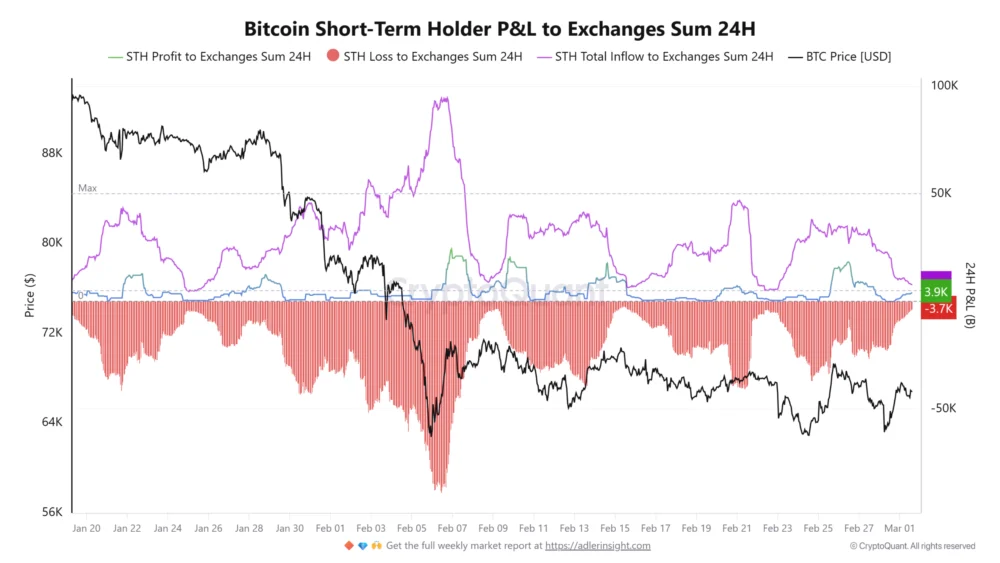
Bitcoin (BTC) experienced a significant rally on Monday, propelling its price to the $70,000 threshold, even as geopolitical tensions cast a long and unsettling shadow across the Middle East. This upward movement comes at a time when global markets are often prone to volatility, suggesting a complex interplay of factors driving investor sentiment in the cryptocurrency space. Analysis of on-chain data from CryptoQuant indicates a notable decline in short-term holder (STH) loss transfers to exchanges, reaching a two-week low over the past 24 hours. This reduction in selling pressure from recent buyers stands in stark contrast to the more aggressive liquidation phases observed earlier in the year, particularly in February. The confluence of a strengthening Bitcoin price and a reduction in panic-driven selling amidst geopolitical uncertainty paints a nuanced picture of the market’s current state.
Market Resilience Amidst Geopolitical Jitters
The Middle East has, in recent weeks, been a focal point of global concern, with escalating rhetoric and military maneuvers between key regional and international actors. Reports of increased tensions involving the United States and Iran, alongside the ongoing broader instability, typically trigger a flight to safety in traditional financial markets, often benefiting assets like gold or government bonds. However, Bitcoin’s rally in this environment suggests that a growing segment of investors may be viewing the digital asset through a similar lens, or that the internal dynamics of the crypto market are sufficiently robust to withstand external shocks. The ability of Bitcoin to not only hold its ground but also advance significantly during such periods is a testament to its evolving perception as a potential hedge against macroeconomic and geopolitical instability, a narrative often termed "digital gold."
The behavior of short-term holders is particularly crucial in assessing market sentiment during stress events. These are participants who have acquired Bitcoin relatively recently and are often more susceptible to emotional decision-making, prone to selling at a loss when market conditions turn unfavorable. The CryptoQuant metric tracking STH profit/loss (P&L) to exchanges provides a direct window into this behavior, measuring the volume of Bitcoin that recent buyers send to exchanges at either a profit or a loss. A significant increase in loss transfers typically signals capitulation, where newer investors are exiting their positions, often at the bottom of a price dip. The current data, showing a deceleration of these loss transfers, indicates that recent buyers are exhibiting remarkable composure, choosing to hold their assets rather than panic sell into the geopolitical storm.
On-Chain Insights: A Deeper Dive into Holder Behavior

On March 1, for instance, even as the broader geopolitical climate intensified and Bitcoin briefly dipped to $63,000, realized losses from short-term holders sending BTC to exchanges fell to a mere 3,700 BTC. This figure is strikingly low when compared to previous periods of market stress. For a clearer perspective, consider the events of February 5-6, which marked a distinct capitulation window for short-term holders. During that 24-hour period, a staggering 89,000 BTC were sent to exchanges at a realized loss by STHs. The dramatic difference between these two figures—3,700 BTC versus 89,000 BTC—underscores the profound shift in short-term holder behavior. Since that February peak, loss-driven inflows have consistently compressed, suggesting a strengthening resolve among newer market participants.
Crypto analyst MorenoDV, commenting on these trends, highlighted that even the most event-sensitive holders have not accelerated their distribution, exhibiting what he termed "zero panic." This observation is pivotal because it implies that the fundamental demand for Bitcoin remains strong, and the supply overhang from nervous short-term holders has significantly diminished. The reduction in loss transfers is a clear signal that the immediate sell pressure from recent buyers has largely cooled, creating a more stable foundation for potential price appreciation. The sustainability of the current rally, therefore, heavily relies on whether these realized losses remain contained or if external factors trigger a renewed wave of selling that pushes them back toward prior capitulation levels. This metric will be a key indicator for market watchers as geopolitical uncertainties persist.
Derivatives Market Deleveraging and Stability
Beyond the spot market, the derivatives landscape also offers crucial insights into the health and sustainability of Bitcoin’s rally. Data from the BTC derivatives market points towards a significant reduction in overall risk, a healthy sign for a market that has often been characterized by excessive leverage. Crypto analyst Darkfost notably pointed out that Binance’s open interest (OI), a measure of the total number of outstanding derivatives contracts that have not been settled, has declined by 25% since the beginning of the year. It fell from 130,800 BTC to 97,680 BTC, representing a substantial contraction in speculative positions.
This deleveraging trend is further corroborated by the estimated leverage ratio, which gauges open interest against the exchange’s BTC reserves. The weekly average of this ratio has dropped to 0.146. Historically, levels below 0.15 have corresponded with aggressive deleveraging phases throughout the current market cycle. Such periods, while potentially triggering short-term volatility as leveraged positions are unwound, are generally considered beneficial for the long-term health of the market. They reduce the risk of cascading liquidations, where a small price movement can trigger a domino effect of forced selling, amplifying downturns. The current low leverage environment suggests that the recent price ascent is built on a more organic foundation of spot demand rather than being solely fueled by highly leveraged speculative activity, which can often be fragile. This reduction in systemic risk within the derivatives market provides a more stable backdrop for Bitcoin’s price trajectory.
Technical Landscape: Key Levels and Potential Trajectories

From a technical analysis perspective, Bitcoin is actively working to reclaim a significant price level: its Monthly Rolling Volume-Weighted Average Price (RVWAP). This indicator, currently positioned in the high-$68,000 region, provides a volume-weighted average price anchored to the beginning of the month. When BTC trades above its Monthly RVWAP, it signifies that the average participant who entered the market during the current month is now in profit. This often leads to a positive shift in the short-term positioning bias of traders, encouraging further buying and reducing the likelihood of immediate selling. Reclaiming and consolidating above this level is a strong bullish signal.
The four-hour chart visually depicts Bitcoin’s push past the $70,000 mark, placing it in proximity to its first major external liquidity pocket, identified between $70,000 and $71,500. These liquidity pockets represent areas where a significant volume of buy or sell orders are concentrated, often acting as magnets for price action. Converting this range into a robust support zone would be a critical development, potentially paving the way for a further price expansion towards the $80,000 region. This $80,000 level is particularly significant as it previously acted as a supply zone in January, capping earlier upside attempts.
Crypto trader LP further elaborated on these technical dynamics, noting the accumulation of "low-leverage liquidation clusters" near and just above the range highs, specifically between $70,000 and $73,000 on higher timeframes (HTF). These liquidation clusters, representing areas where leveraged positions would be forced to close, often act as powerful "magnets" for price when they build in size. The price tends to gravitate towards these areas to sweep the available liquidity, which can then fuel further moves. The current setup suggests that if Bitcoin can successfully clear the $71,500 resistance, the path to $80,000 could become considerably clearer, potentially driven by the cascade of liquidations of short positions.
Spot Market Strength: The Foundation of the Rally
The strength of the current rally is further reinforced by robust spot flow data across major exchanges. During the breakout leg, Binance spot market registered approximately $7.79 million in positive delta. Coinbase, another significant player, contributed about $1.16 million in positive delta, while OKX added nearly $3.7 million. A "positive delta" in this context signifies aggressive buying pressure on the spot market, where market orders are actively consuming available sell-side liquidity. This is a crucial distinction, as it indicates genuine demand for Bitcoin rather than activity solely driven by derivatives or highly speculative leveraged trading.
The presence of strong positive delta across multiple prominent exchanges signals that the rally is underpinned by organic spot bidding, suggesting a broader participation from buyers who are acquiring actual Bitcoin rather than just taking leveraged positions. This is a healthier indicator for market sustainability. With reduced leverage use in the derivatives market and a noticeable decline in loss-driven selling from short-term holders, the market’s collective attention is now firmly fixed on how Bitcoin’s price will react as it navigates the critical $71,500 liquidity band. A decisive break and consolidation above this level, supported by continued spot buying, would reinforce the bullish outlook and potentially trigger the next leg of the rally.

The "Digital Gold" Narrative in Times of Uncertainty
Bitcoin’s performance during periods of geopolitical unrest has long been a subject of debate. Proponents argue that its decentralized nature, limited supply, and independence from traditional financial systems make it a compelling "digital gold"—a safe haven asset that can preserve value when fiat currencies or conventional markets falter. This current rally, coinciding with heightened Middle East tensions, lends some credence to this narrative. Unlike traditional assets, Bitcoin is not directly tied to the economic health or political stability of any single nation-state, making it an attractive alternative for investors seeking diversification away from sovereign risks.
However, the "digital gold" thesis is not universally accepted. Critics often point to Bitcoin’s inherent volatility and its relatively short history compared to established safe havens. Its correlation with traditional risk assets, particularly tech stocks, has also been a point of contention. Yet, the current behavior of short-term holders, exhibiting remarkable restraint despite a geopolitical backdrop that would typically induce panic, suggests a maturation in investor psychology. It indicates that a growing number of participants are perhaps internalizing Bitcoin’s long-term value proposition, viewing dips as buying opportunities rather than signals for capitulation, even when external events create uncertainty. This evolving perception is critical for Bitcoin’s journey towards broader acceptance as a legitimate store of value.
Broader Macroeconomic and Geopolitical Context
The geopolitical landscape of the Middle East has far-reaching implications for the global economy. Instability in the region often translates to spikes in oil prices, disruptions in global supply chains, and increased uncertainty in international trade. These factors can fuel inflation, impact central bank policies, and ultimately influence investor appetite for risk assets. The current rally in Bitcoin, therefore, must be viewed not in isolation but within this broader macroeconomic context. If the market perceives Bitcoin as a hedge against potential inflation or a safe harbor from economic fallout stemming from geopolitical events, its appeal naturally increases.
Furthermore, the backdrop of ongoing institutional adoption, particularly with the introduction of spot Bitcoin Exchange-Traded Funds (ETFs) in major markets, provides a significant layer of sustained demand. While not directly tied to Monday’s specific rally, the constant influx of institutional capital into Bitcoin through these regulated products acts as a powerful underlying support mechanism. This institutional validation not only brings new capital but also enhances Bitcoin’s credibility and accessibility for a wider range of investors, potentially dampening the impact of short-term volatility induced by external events. The steady accumulation by entities like MicroStrategy, for example, signals a long-term conviction that can absorb selling pressure.

Outlook and Future Considerations
The immediate outlook for Bitcoin appears cautiously optimistic, contingent on its ability to consolidate above key technical levels and maintain the current composure of its short-term holders. The combination of declining loss transfers, significant deleveraging in the derivatives market, and robust spot buying suggests a market that is not only resilient but also potentially preparing for further upside. The critical test will be the $71,500 liquidity band. A decisive breach of this resistance, potentially clearing the path to $80,000, would signify a strong continuation of the current bullish momentum.
However, the persistent geopolitical uncertainty in the Middle East remains a wildcard. While Bitcoin has shown resilience thus far, a significant escalation could still introduce unforeseen market shocks. Investors will continue to monitor global events closely, alongside on-chain metrics and technical indicators, to gauge the sustainability of Bitcoin’s impressive rally in these tumultuous times. The convergence of macro factors, evolving investor psychology, and robust technical indicators paints a compelling picture for Bitcoin as it navigates the complexities of the global financial landscape.