James Watt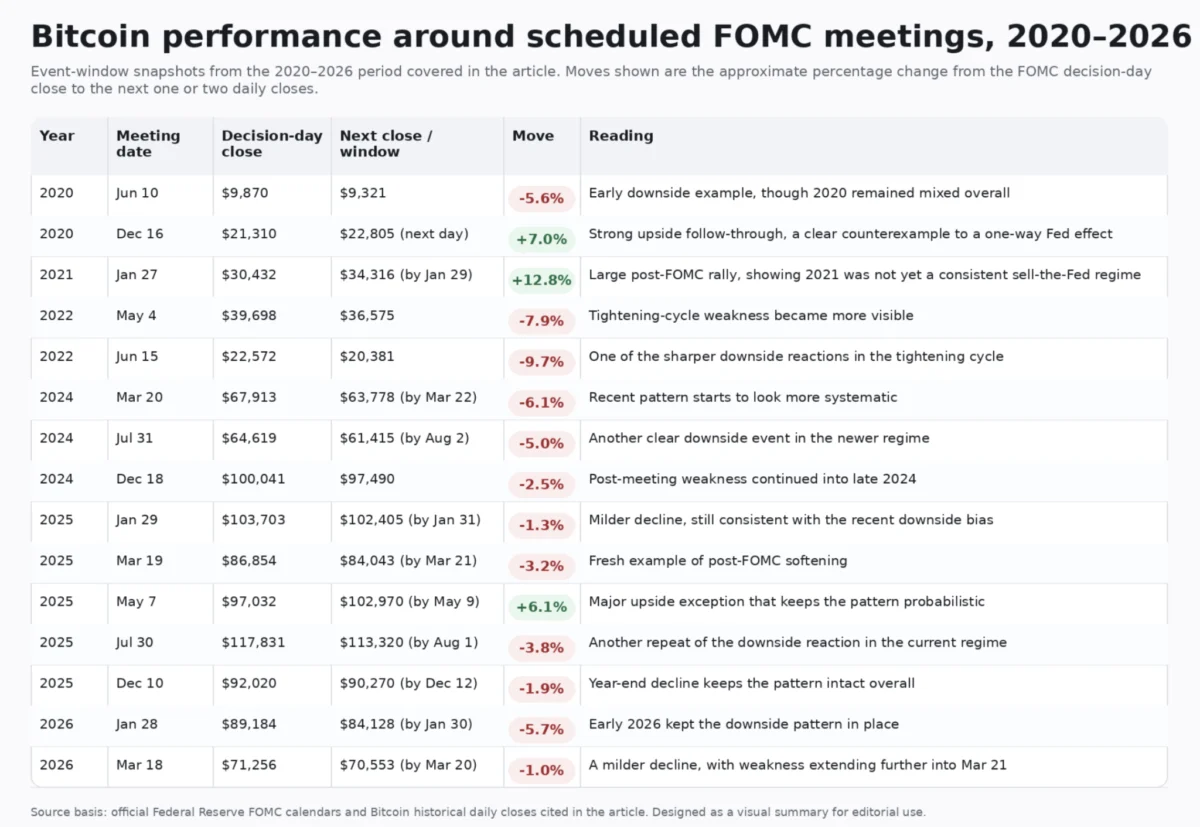
The phenomenon, often described by market participants as a "sell-the-Fed" reaction, has become particularly pronounced over the last 24 months. While Bitcoin historically exhibited varied responses to monetary policy shifts, the current market regime shows a systematic tendency for traders to reduce exposure within a 48-hour window following the conclusion of Fed meetings. This shift highlights Bitcoin’s integration into the broader risk-asset complex, where it now trades in lockstep with equities, foreign exchange, and interest rate expectations.
The Evolution of Macro Sensitivity: 2020–2022
To understand the current systematic weakness, it is essential to analyze the historical backdrop of Bitcoin’s reaction function. In the early stages of the current decade, Bitcoin’s response to the Federal Reserve was inconsistent and often overshadowed by idiosyncratic crypto-native catalysts.
During the 2020 FOMC cycle, the market was largely driven by pandemic-era liquidity and the massive expansion of the M2 money supply. On June 10, 2020, Bitcoin experienced a sharp decline in the session following the Fed meeting, sliding from $9,870 to $9,321. At the time, this was viewed as a bearish signal; however, subsequent meetings that year failed to confirm a trend. The July 29, 2020, meeting saw prices remain flat to slightly bullish, while the December 16 meeting acted as a springboard for a massive rally, with Bitcoin climbing from $21,310 to over $23,137 within 48 hours.
By 2021, the market remained in a state of flux. While some meetings, such as those in March and June, resulted in short-term softening, others triggered significant rallies. On January 27, 2021, a Fed announcement preceded a jump from $30,432 to $34,316 within two days. This era was characterized by "narrative momentum" where the Fed was just one of many factors, including corporate adoption by firms like Tesla and the rise of decentralized finance (DeFi).

The true structural shift began in 2022. As the Federal Reserve initiated one of the most aggressive interest rate hiking cycles in history to combat decades-high inflation, Bitcoin’s correlation with traditional risk assets tightened. Following the May 4, 2022, meeting, Bitcoin fell from $39,698 to $36,575. A month later, after the June 15 meeting, the asset dropped from $22,572 to $20,381. Although 2022 still saw occasional "relief rallies" post-FOMC, the direction of travel was becoming increasingly clear: Bitcoin was now a "high-beta" play on global liquidity conditions.
The Emergence of Systematic Weakness: 2024–2025
The transition from "macro-sensitive" to "systematically weak" post-FOMC became undeniable during the 2024 and 2025 trading years. Data indicates that as the market matured and institutional participation via Spot Bitcoin ETFs grew, the "pricing rhythm" of the asset became tethered to the 48-hour window surrounding Fed decisions.
In 2024, several key dates illustrated this burgeoning trend:
- March 20, 2024: Bitcoin traded at $67,913 at the close of the meeting. By March 22, it had plummeted to $63,778, representing a 6.1% decline.
- July 31, 2024: The asset stood at $64,619 post-announcement, only to slide to $61,415 by August 2, a 5.0% drop.
- December 18, 2024: Even with Bitcoin trading near the psychological $100,000 level, the post-Fed fade persisted, with prices moving from $100,041 to $97,490 the following day.
The 2025 calendar year reinforced this behavior. With the exception of a significant outlier in May 2025—where Bitcoin rose 6.1% from $97,032 to $102,970—nearly every other FOMC window resulted in a price contraction. The January 2025 meeting saw a drift from $103,703 to $102,405, while the March 19 meeting triggered a 3.2% decrease over 48 hours. Similar "softening" was recorded in the June, July, September, October, and December meetings of 2025.
Current Market Dynamics in 2026
As of the first quarter of 2026, the trend shows no signs of abating. The January 27–28, 2026, FOMC meeting provided a stark example of this entrenched market structure. On the day of the decision, Bitcoin closed at $89,184. Within the subsequent two daily closes, the price dropped to $84,128, a decline of 5.7%.

The March 17–18, 2026, meeting followed a similar, albeit more muted, trajectory. Bitcoin closed at $71,256 on March 18 and dipped to $70,553 by March 20. The drawdown eventually extended to $68,734 by March 21. These consistent reactions suggest that market participants are now pre-positioning for Fed events and using the actual announcement as a liquidity window to exit or hedge positions.
Institutional Influence and the "Calendar Risk" Factor
The systematic weakness observed in the 48 hours post-FOMC can be attributed to several structural changes in the cryptocurrency market. The most significant of these is the influx of institutional capital. Unlike the retail-driven cycles of 2017 or 2020, the current market is dominated by macro hedge funds, algorithmic trading desks, and institutional asset managers.
For these entities, Bitcoin is viewed through the lens of "calendar risk." The FOMC schedule, which includes eight regularly scheduled meetings per year, creates a predictable catalyst. Professional traders often engage in "volatility harvesting" or de-risking ahead of these events to protect portfolios from unexpected hawkish shifts in Fed tone or "dot plot" projections.
Furthermore, the integration of Bitcoin into the institutional "risk-on/risk-off" framework means that it is subject to the same margin and liquidity requirements as other assets. If a Fed meeting signals "higher for longer" interest rates, institutional desks may automatically reduce exposure across all risk-sensitive holdings, with Bitcoin often being the first to be sold due to its high liquidity and 24/7 trading availability.
Analysis of the "Sell-the-Fed" Mechanism
The 48-hour post-meeting dump is rarely about the interest rate decision itself, which is often "priced in" by the time the statement is released. Instead, the weakness stems from three primary factors:

- Profit Taking on "Relief Rallies": Often, Bitcoin rallies into the Fed meeting on hopes of a dovish pivot. When the news is delivered, even if it is positive, traders execute "sell the news" strategies.
- The Press Conference Effect: The initial 2:00 PM ET statement is often followed by a 2:30 PM ET press conference by the Fed Chair. In recent years, the nuanced rhetoric during these Q&A sessions has frequently been interpreted as more hawkish than the written statement, leading to a delayed sell-off that manifests over the following two days.
- Liquidity Rebalancing: Many institutional funds rebalance their risk weightings at the end of the month or following major macro volatility events. The FOMC meetings often serve as the trigger for these structural flows.
Broader Implications for Market Participants
The emergence of this systematic pattern has profound implications for both short-term traders and long-term investors. For traders, the 48-hour window following a Fed meeting has become a high-probability "short" or "neutral" zone. The data suggests that "buying the dip" immediately after a Fed announcement has become a losing strategy in the current regime, as the true local bottom often forms 48 to 72 hours later.
For long-term investors, this development is a double-edged sword. On one hand, it confirms that Bitcoin has achieved "legitimacy" as a global macro asset. It is no longer a fringe experiment; it is a core component of the financial system’s reaction function. On the other hand, this integration has stripped Bitcoin of its "uncorrelated" status. The dream of Bitcoin as a hedge against traditional market volatility is increasingly challenged by the reality that it is often the most volatile victim of that very same macro environment.
Conclusion: Bitcoin in "Macro Time"
The systematic weakness surrounding FOMC meetings marks the end of Bitcoin’s "adolescence." The asset has moved beyond a world where it reacts solely to halving cycles or crypto-specific news. It now lives and breathes within the economic calendar of the world’s most powerful central bank.
While the "sell-the-Fed" dynamic may eventually shift—as all market patterns do—it currently stands as a defining feature of the 2024–2026 market structure. As the Federal Reserve continues to navigate the complexities of inflation, employment, and global debt, Bitcoin traders will likely continue to treat FOMC dates as moments to de-risk, wait for the dust to settle, and reassess the landscape of global liquidity. For the foreseeable future, the 48 hours after a Fed meeting will remain one of the most critical windows for price discovery in the digital asset space.